← Every exhibit
Table 1From “What is interference? When one unit changes another unit's outcome”
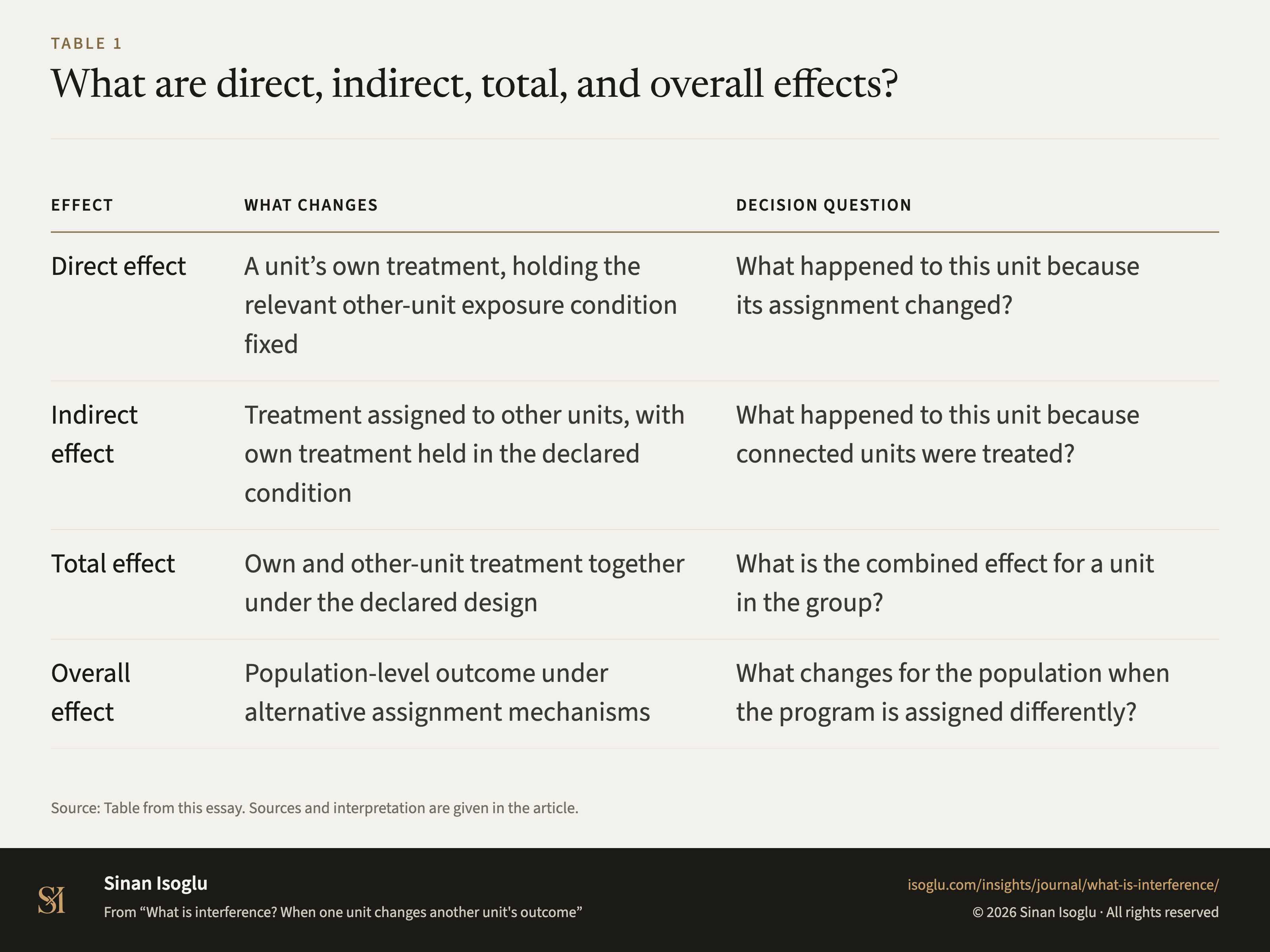
What are direct, indirect, total, and overall effects?
Table 1What are direct, indirect, total, and overall effects?
| Effect | What changes | Decision question |
|---|---|---|
| Direct effect | A unit's own treatment, holding the relevant other-unit exposure condition fixed | What happened to this unit because its assignment changed? |
| Indirect effect | Treatment assigned to other units, with own treatment held in the declared condition | What happened to this unit because connected units were treated? |
| Total effect | Own and other-unit treatment together under the declared design | What is the combined effect for a unit in the group? |
| Overall effect | Population-level outcome under alternative assignment mechanisms | What changes for the population when the program is assigned differently? |
Swipe or scroll horizontally if the table is wider than your screen.
Source: Table from this essay. Sources and interpretation are given in the article.
PNG4:3, 1600 × 1200, with the title, the source line and the attribution set in the image isoglu-2026-what-is-interference-fig01.png
From the essay
From the research bench
What is interference? When one unit changes another unit's outcome
Interference occurs when one unit’s outcome depends on another unit’s treatment. Define exposure, groups, and estimands before reading spillover.
Read the essayThis exhibit belongs to an essay: the numbers live here, the argument lives there.
Cite or embed
Related exhibits
Contact
Bring the question you're working on.
Research, a guest lecture, or a commercial question.