Figure 1From “What is customer experience management?”
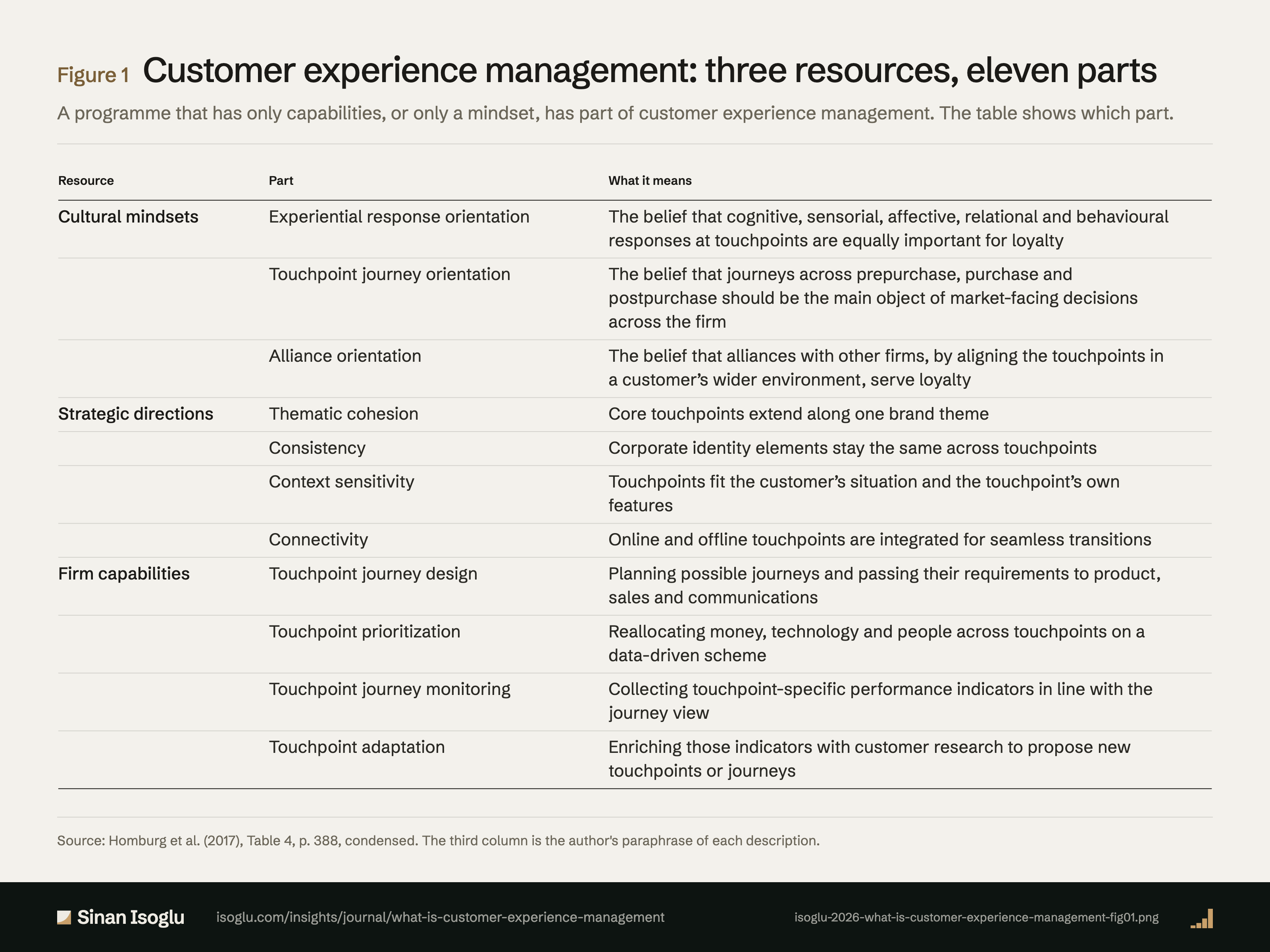
Customer experience management: three resources, eleven parts
A programme that has only capabilities, or only a mindset, has part of customer experience management. The table shows which part.
Figure 1Customer experience management: three resources, eleven parts
| Resource | Part | What it means |
|---|---|---|
| Cultural mindsets | Experiential response orientation | The belief that cognitive, sensorial, affective, relational and behavioural responses at touchpoints are equally important for loyalty |
| Touchpoint journey orientation | The belief that journeys across prepurchase, purchase and postpurchase should be the main object of market-facing decisions across the firm | |
| Alliance orientation | The belief that alliances with other firms, by aligning the touchpoints in a customer's wider environment, serve loyalty | |
| Strategic directions | Thematic cohesion | Core touchpoints extend along one brand theme |
| Consistency | Corporate identity elements stay the same across touchpoints | |
| Context sensitivity | Touchpoints fit the customer's situation and the touchpoint's own features | |
| Connectivity | Online and offline touchpoints are integrated for seamless transitions | |
| Firm capabilities | Touchpoint journey design | Planning possible journeys and passing their requirements to product, sales and communications |
| Touchpoint prioritization | Reallocating money, technology and people across touchpoints on a data-driven scheme | |
| Touchpoint journey monitoring | Collecting touchpoint-specific performance indicators in line with the journey view | |
| Touchpoint adaptation | Enriching those indicators with customer research to propose new touchpoints or journeys |
Swipe or scroll horizontally if the table is wider than your screen.
Source: Homburg et al. (2017), Table 4, p. 388, condensed. The third column is the author's paraphrase of each description.
Source and evidence
Each line names a claim related to this exhibit, its source, and how it was checked.
- A HJK17-C2 Homburg et al.'s formal definition of CEM (p. 384): "CEM refers to the cultural mindsets toward CEs, strategic directions for designing CEs, and firm capabilities for continually renewing CEs, with the goals of achieving and sustaining long-term customer loyalty."Homburg, Jozic & Kuehnl. (2017)
- A HJK17-C5 A grounded-theory study integrating interviews with 52 managers; CEM is a firm-wide approach with three main categories; firms of 97 to 164,000 employees in manufacturing and services, sampled across consumer industries (pp. 377, 382, 384); they use their own definition of the experience, with affective and relational responses: "field-based insights of 52 managers engaging in CEM with supplementary literature"; "a firm-wide management approach that entails three main categories: a firm’s (1) cultural mindsets, (2) strategic directions, and (3) capabilities"; "The size of the 52 consulted firms varied between 97 and 164,000 employees"; "diversity in size and consumer industries engaging in"; "which comprise both manufacturing (e.g., apparel, consumer electronics, health care) and services (e.g., information and communication, financial services, online retailing)"; "sensorial, affective, cognitive, relational, and behavioral responses"Homburg, Jozic & Kuehnl. (2017)
- A HJK17-C6 Table 4 describes the eleven categories: three mindsets, held as beliefs ("The mindset that ..."), four strategic directions and four capabilities, the capabilities being the process-oriented form of the other two (pp. 386, 388): "The mindset that touchpoint journeys across prepurchase, purchase, and postpurchase situations should be the main object of market-facing decision making across the firm"; "The direction to functionally integrate multiple touchpoints across online and offline environments for seamless transitions between one and another"; "The capability of planning potential touchpoint journeys as a means for business planning and modeling"; "These can be understood as the process-oriented manifestation of the other two CEM categories"Homburg, Jozic & Kuehnl. (2017)
- B CXM-OWN-C2 Figure 1 condenses Homburg et al.'s Table 4 into three resources and eleven parts, paraphrased, with the three mindsets kept as beliefs; it is the authors' coding of 52 interviews with supplementary literature, not a tested model of loyalty.Author paraphrase of HJK17-C5, HJK17-C6 and HJK17-C9
Grades: A, verified against the printed page of the primary source · B, primary source, text layer only · C, authoritative secondary · D, reported.
From the essay
Growth that compounds
What is customer experience management?
Customer experience management makes the whole journey of touchpoints, even those a firm does not own, the object of management. Its research is young.
Read the essayThis exhibit belongs to an essay: the numbers live here, the argument lives there.
Cite or embed
Related exhibits
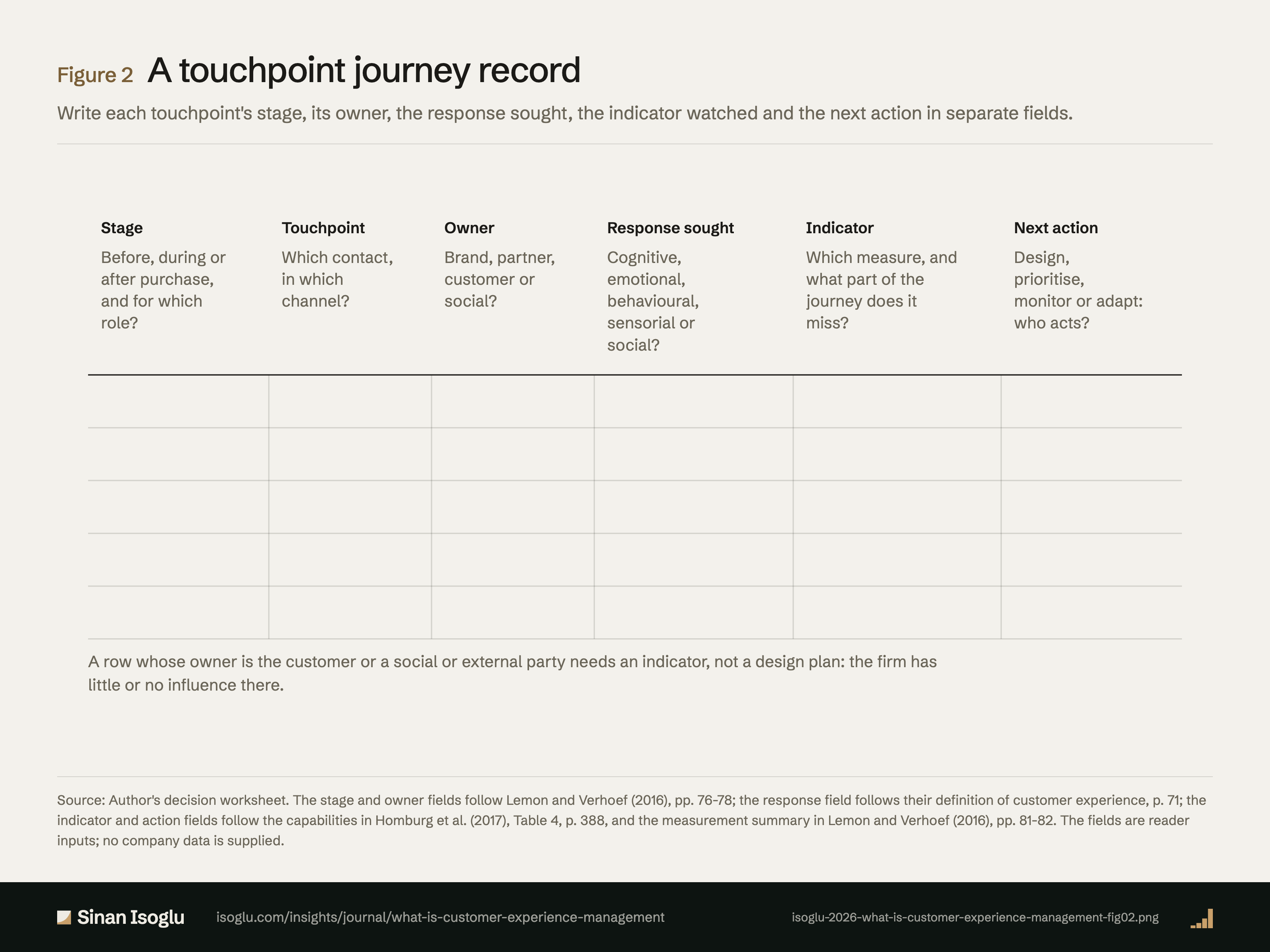
Figure 2Figure
A touchpoint journey record
What is customer experience management?
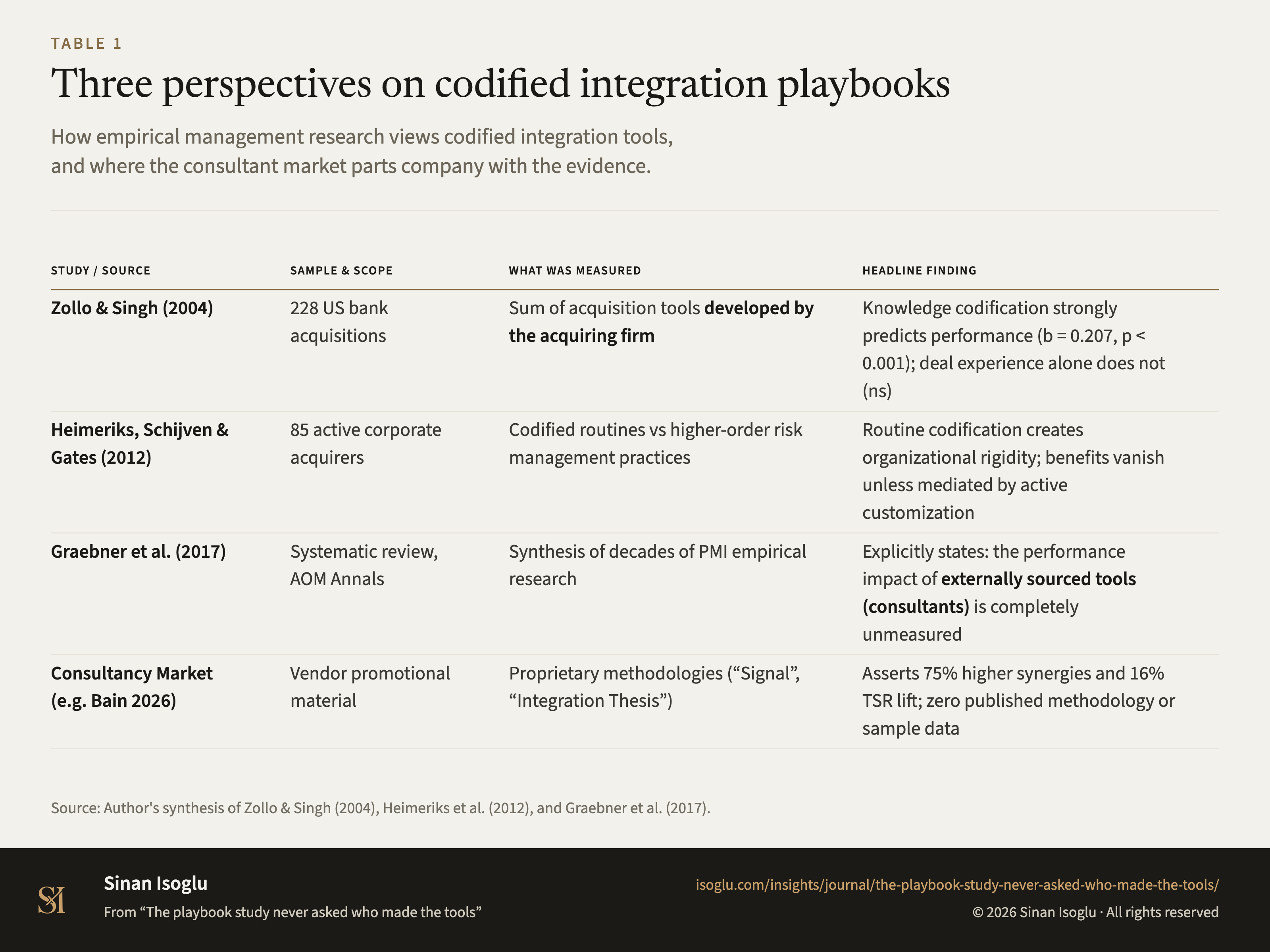
Table 1Table
Three perspectives on codified integration playbooks
The playbook study never asked who made the tools
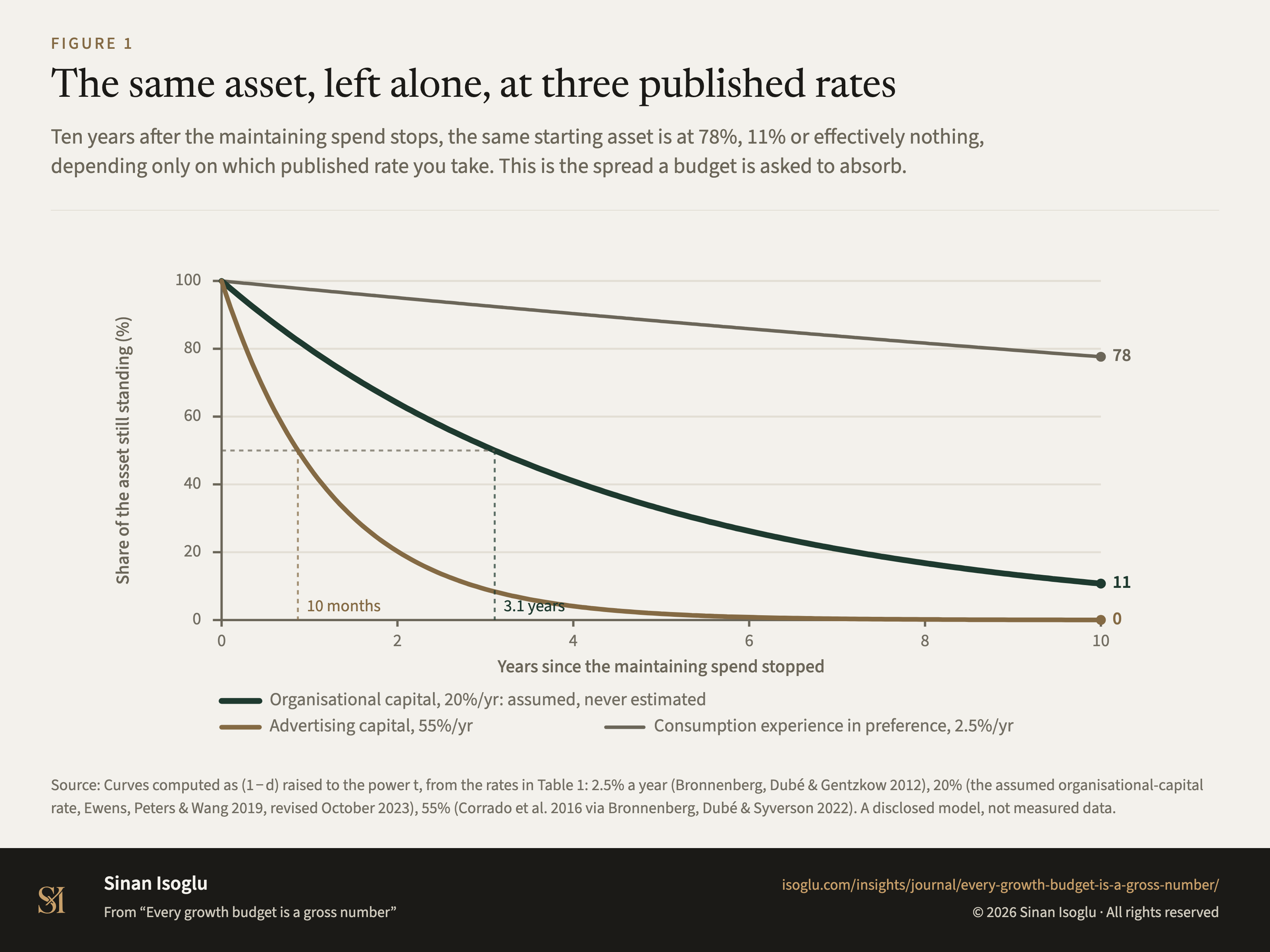
Figure 1Figure
The same asset, left alone, at three published rates
Every growth budget is a gross number
Contact
Bring the question you're working on.
Research, a guest lecture, or a commercial question.