Figure 1From “What is contribution margin?”
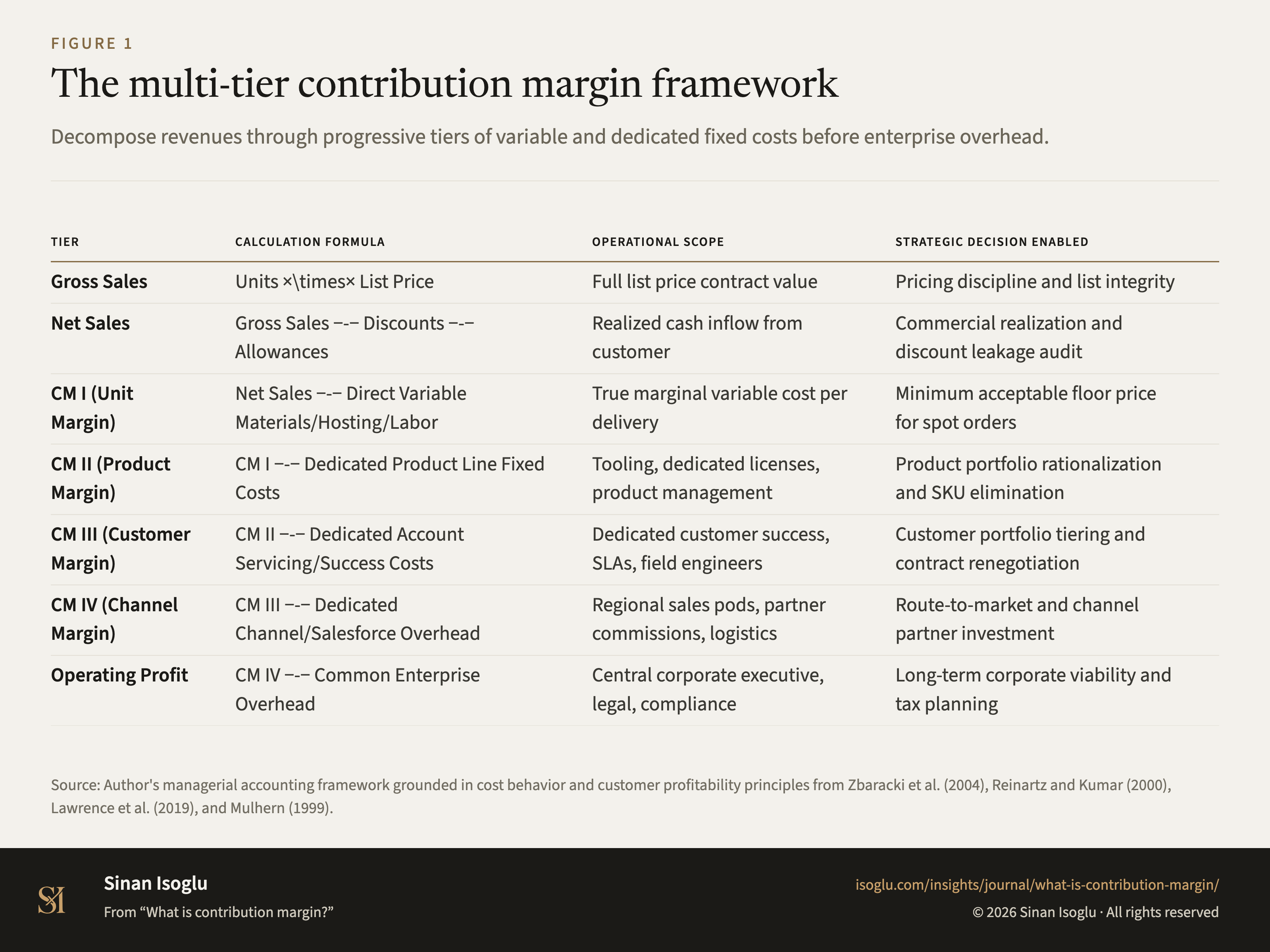
The multi-tier contribution margin framework
Decompose revenues through progressive tiers of variable and dedicated fixed costs before enterprise overhead.
Figure 1The multi-tier contribution margin framework
| Tier | Calculation formula | Operational scope | Strategic decision enabled |
|---|---|---|---|
| Gross Sales | Units $\times$ List Price | Full list price contract value | Pricing discipline and list integrity |
| Net Sales | Gross Sales $-$ Discounts $-$ Allowances | Realized cash inflow from customer | Commercial realization and discount leakage audit |
| CM I (Unit Margin) | Net Sales $-$ Direct Variable Materials/Hosting/Labor | True marginal variable cost per delivery | Minimum acceptable floor price for spot orders |
| CM II (Product Margin) | CM I $-$ Dedicated Product Line Fixed Costs | Tooling, dedicated licenses, product management | Product portfolio rationalization and SKU elimination |
| CM III (Customer Margin) | CM II $-$ Dedicated Account Servicing/Success Costs | Dedicated customer success, SLAs, field engineers | Customer portfolio tiering and contract renegotiation |
| CM IV (Channel Margin) | CM III $-$ Dedicated Channel/Salesforce Overhead | Regional sales pods, partner commissions, logistics | Route-to-market and channel partner investment |
| Operating Profit | CM IV $-$ Common Enterprise Overhead | Central corporate executive, legal, compliance | Long-term corporate viability and tax planning |
Swipe or scroll horizontally if the table is wider than your screen.
Source: Author's managerial accounting framework grounded in cost behavior and customer profitability principles from Zbaracki et al. (2004), Reinartz and Kumar (2000), Lawrence et al. (2019), and Mulhern (1999).
Source and evidence
Each line names a claim related to this exhibit, its source, and how it was checked.
- A MUL99-C1 The paper is METHOD, not an empirical finding, in its own words: "This paper provides a conceptual and methodological foundation for measuring customer profitability" by extending customer-lifetime-value approaches to broader target-marketing applications.Mulhern. (1999)
Grades: A, verified against the printed page of the primary source · B, primary source, text layer only · C, authoritative secondary · D, reported.
From the essay
Revenue operations & AI
What is contribution margin?
Contribution margin isolates revenue minus variable costs to determine how incremental volume covers fixed overhead and generates operating profit.
Read the essayThis exhibit belongs to an essay: the numbers live here, the argument lives there.
Cite or embed
Related exhibits
Contact
Bring the question you're working on.
Research, a guest lecture, or a commercial question.