Figure 1From “What is CAC payback period?”
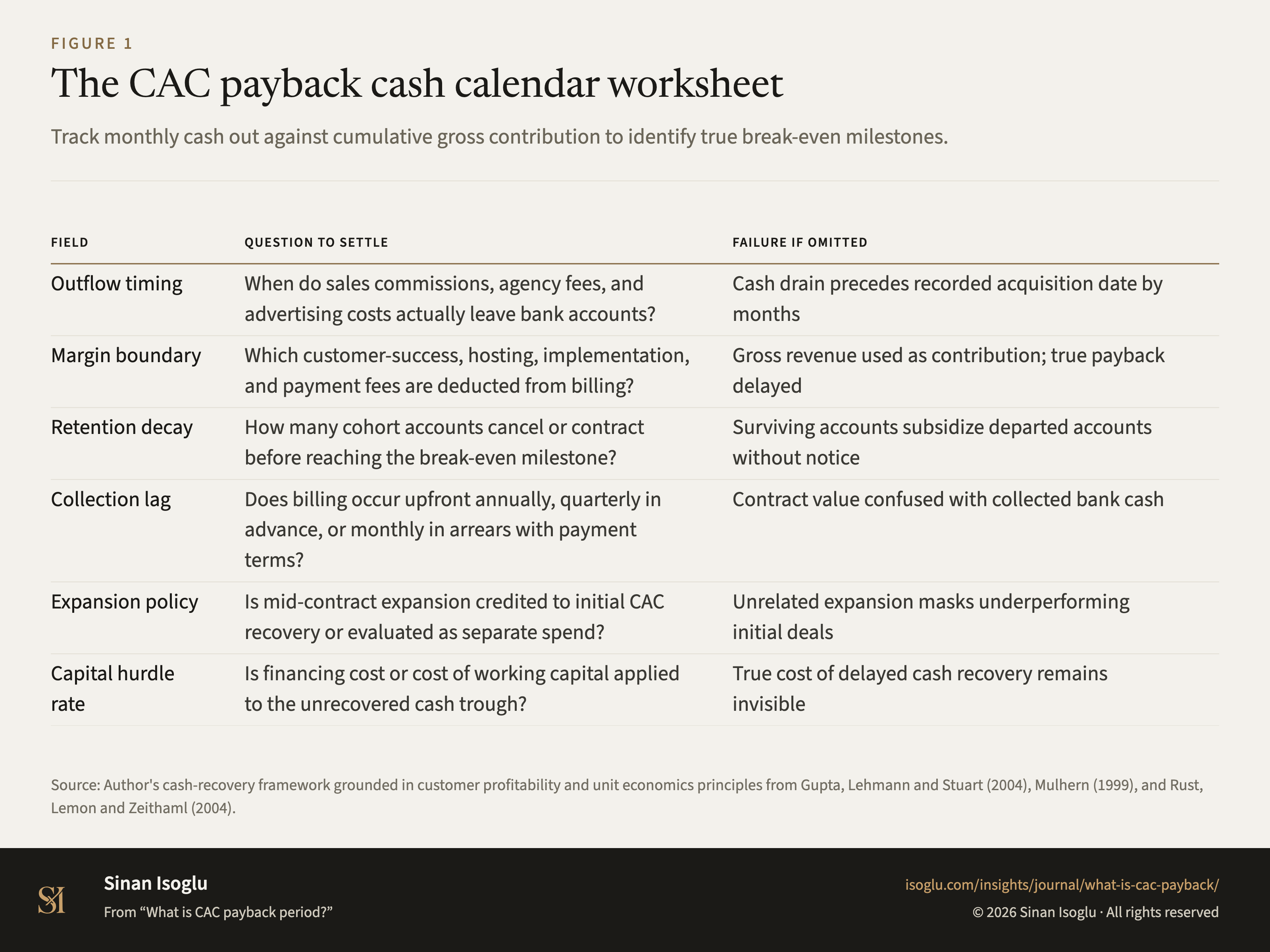
The CAC payback cash calendar worksheet
Track monthly cash out against cumulative gross contribution to identify true break-even milestones.
Figure 1The CAC payback cash calendar worksheet
| Field | Question to settle | Failure if omitted |
|---|---|---|
| Outflow timing | When do sales commissions, agency fees, and advertising costs actually leave bank accounts? | Cash drain precedes recorded acquisition date by months |
| Margin boundary | Which customer-success, hosting, implementation, and payment fees are deducted from billing? | Gross revenue used as contribution; true payback delayed |
| Retention decay | How many cohort accounts cancel or contract before reaching the break-even milestone? | Surviving accounts subsidize departed accounts without notice |
| Collection lag | Does billing occur upfront annually, quarterly in advance, or monthly in arrears with payment terms? | Contract value confused with collected bank cash |
| Expansion policy | Is mid-contract expansion credited to initial CAC recovery or evaluated as separate spend? | Unrelated expansion masks underperforming initial deals |
| Capital hurdle rate | Is financing cost or cost of working capital applied to the unrecovered cash trough? | True cost of delayed cash recovery remains invisible |
Swipe or scroll horizontally if the table is wider than your screen.
Source: Author's cash-recovery framework grounded in customer profitability and unit economics principles from Gupta, Lehmann and Stuart (2004), Mulhern (1999), and Rust, Lemon and Zeithaml (2004).
Source and evidence
Each line names a claim related to this exhibit, its source, and how it was checked.
- A GLS04-C2 The sensitivity is theirs and it is asymmetric: "a 1% improvement in retention, margin, or acqui"sition cost "improves firm value by 5%, 1%, and .1%, respectively"Gupta, Lehmann & Stuart. (2004)
- A MUL99-C1 The paper is METHOD, not an empirical finding, in its own words: "This paper provides a conceptual and methodological foundation for measuring customer profitability" by extending customer-lifetime-value approaches to broader target-marketing applications.Mulhern. (1999)
- A RLZ04-C1 The framework is a trade-off device, in the authors' words: "a unified strategic framework that enables competing marketing strategy options to be traded off on the basis of projected financial return, which is operationalized as the change in a firm's customer equity rel"ative to the incremental expenditure needed to produce itRust, Lemon & Zeithaml. (2004)
- A RLZ04-C2 The components of a lifetime value are enumerated: "each customer's lifetime value results from the frequency of category purchases, average quantity of purchase, and brand-switching patterns combined with the firm's contribution margin"Rust, Lemon & Zeithaml. (2004)
Grades: A, verified against the printed page of the primary source · B, primary source, text layer only · C, authoritative secondary · D, reported.
From the essay
Growth that compounds
What is CAC payback period?
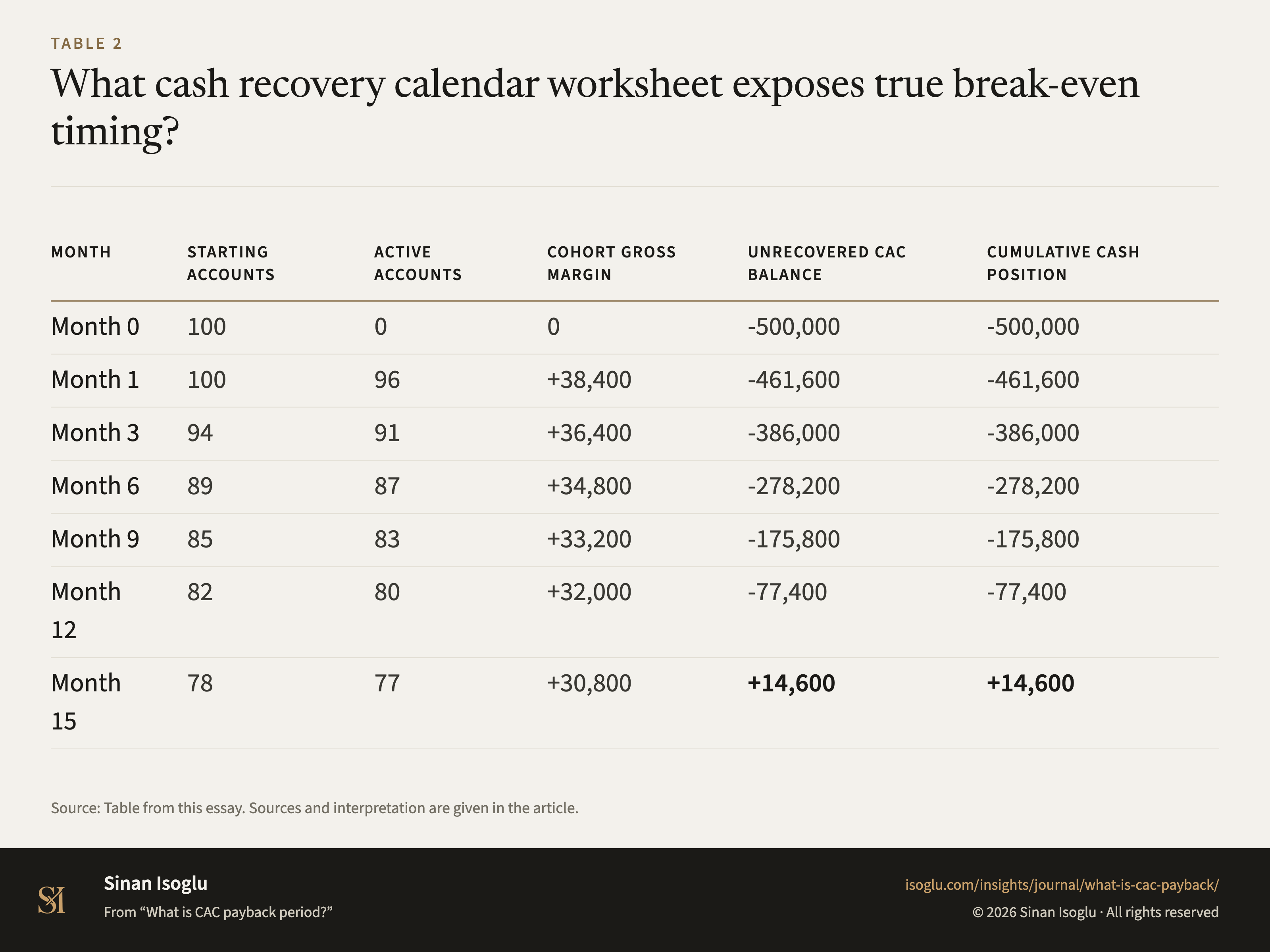
CAC payback measures when cumulative gross margin recovers acquisition costs. State the margin boundary, churn and cash calendar.
Read the essayThis exhibit belongs to an essay: the numbers live here, the argument lives there.
Cite or embed
Contact
Bring the question you're working on.
Research, a guest lecture, or a commercial question.