Figure 1From “What is a price promotion?”
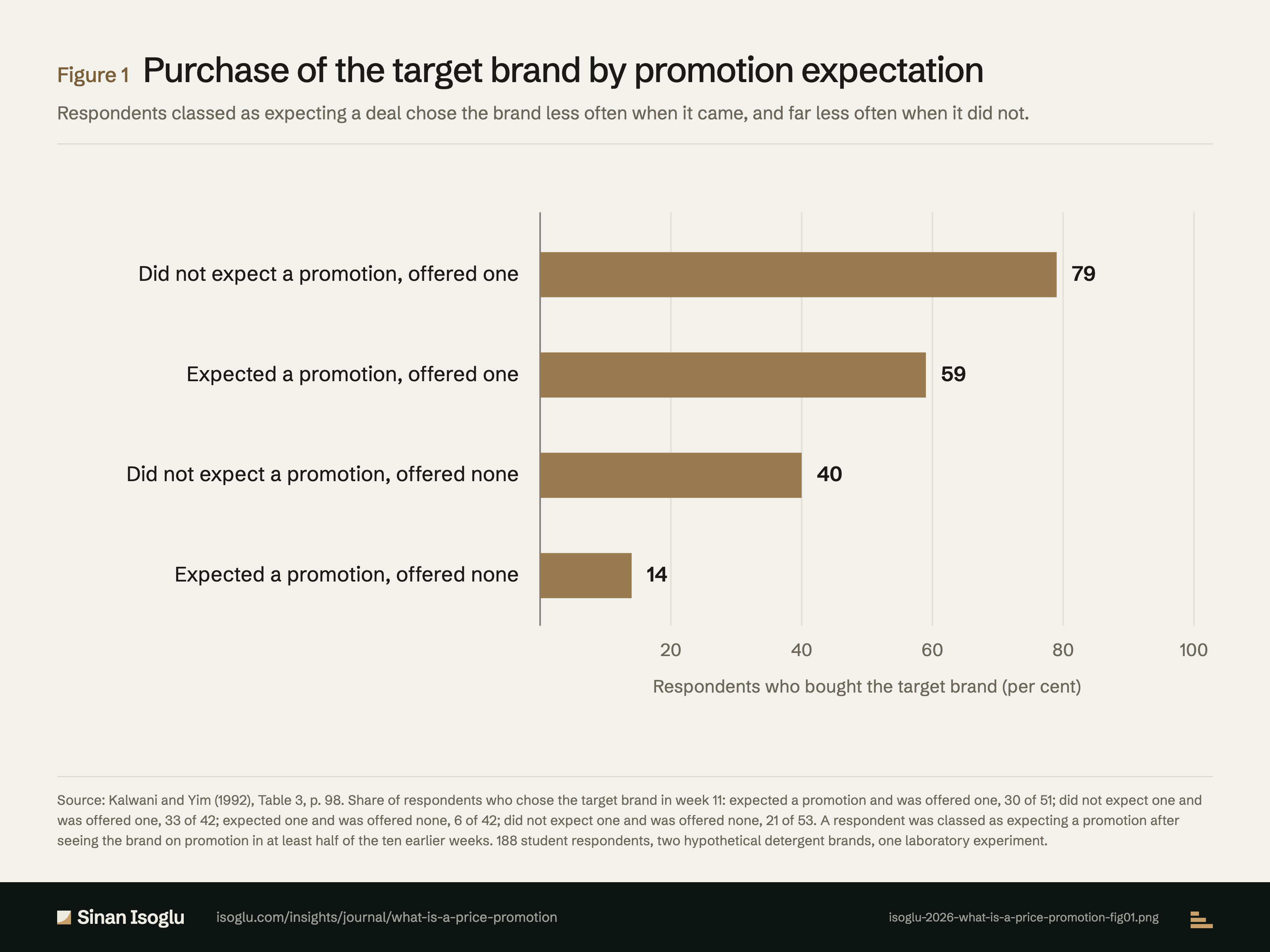
Purchase of the target brand by promotion expectation
Respondents classed as expecting a deal chose the brand less often when it came, and far less often when it did not.
Figure 1Purchase of the target brand by promotion expectation
Source: Kalwani and Yim (1992), Table 3, p. 98. Share of respondents who chose the target brand in week 11: expected a promotion and was offered one, 30 of 51; did not expect one and was offered one, 33 of 42; expected one and was offered none, 6 of 42; did not expect one and was offered none, 21 of 53. A respondent was classed as expecting a promotion after seeing the brand on promotion in at least half of the ten earlier weeks. 188 student respondents, two hypothetical detergent brands, one laboratory experiment.
Source and evidence
Each line names a claim related to this exhibit, its source, and how it was checked.
- A KY92-C4 Frequent promotions can create promotion expectations, after which consumers typically buy only on promotion; in week 11 every respondent had to choose one of the two brands, so the design measures switching, not deferral; expectation was inferred at a 50 per cent frequency threshold chosen by grid search; Table 3: purchase with promotion 59% (30 of 51) when expected and 79% (33 of 42) when not, without promotion 14% (6 of 42) when expected and 40% (21 of 53) when not; the loss of an expected promotion weighs more than a surprise one, a loss aversion phenomenon (pp. 91, 94 to 98): "they needed to purchase laundry detergent from a local supermarket"; "Brand choice was obtained by requesting the respondent to select one of the two brands for purchase."; "Though we did not set out to elicit expectations for promotional activity as we did for price"; "consumers who have been exposed to frequent price promotions in support of a given brand may come to form promotion expectations and typically will purchase the brand only when it is price promoted"; "the promotion frequency threshold of 50% or more of the time is adopted in the operationalization because it provides the highest adjusted"; "We see that 59% of the 51 respondents who were offered a price promotion on the target brand and expected a promotion on it purchased the brand in contrast to 79% of the 42 respondents"; "only 14% of the respondents who expected a promotion on the target brand purchased it without a price promotion in contrast to 40%"; "consumers' response to the loss of an expected promotion is stronger than their response to a surprise or unexpected promotion"Kalwani & Yim. (1992)
Grades: A, verified against the printed page of the primary source · B, primary source, text layer only · C, authoritative secondary · D, reported.
From the essay
Pricing & revenue architecture
What is a price promotion?
A price promotion is a temporary price cut announced to buyers. It lifts sales at once, and buyers who see it often may buy the brand less without it.
Read the essayThis exhibit belongs to an essay: the numbers live here, the argument lives there.
Cite or embed
Related exhibits
Contact
Bring the question you're working on.
Research, a guest lecture, or a commercial question.