Abbildung 1Aus „Was ist eine Preisaktion?“
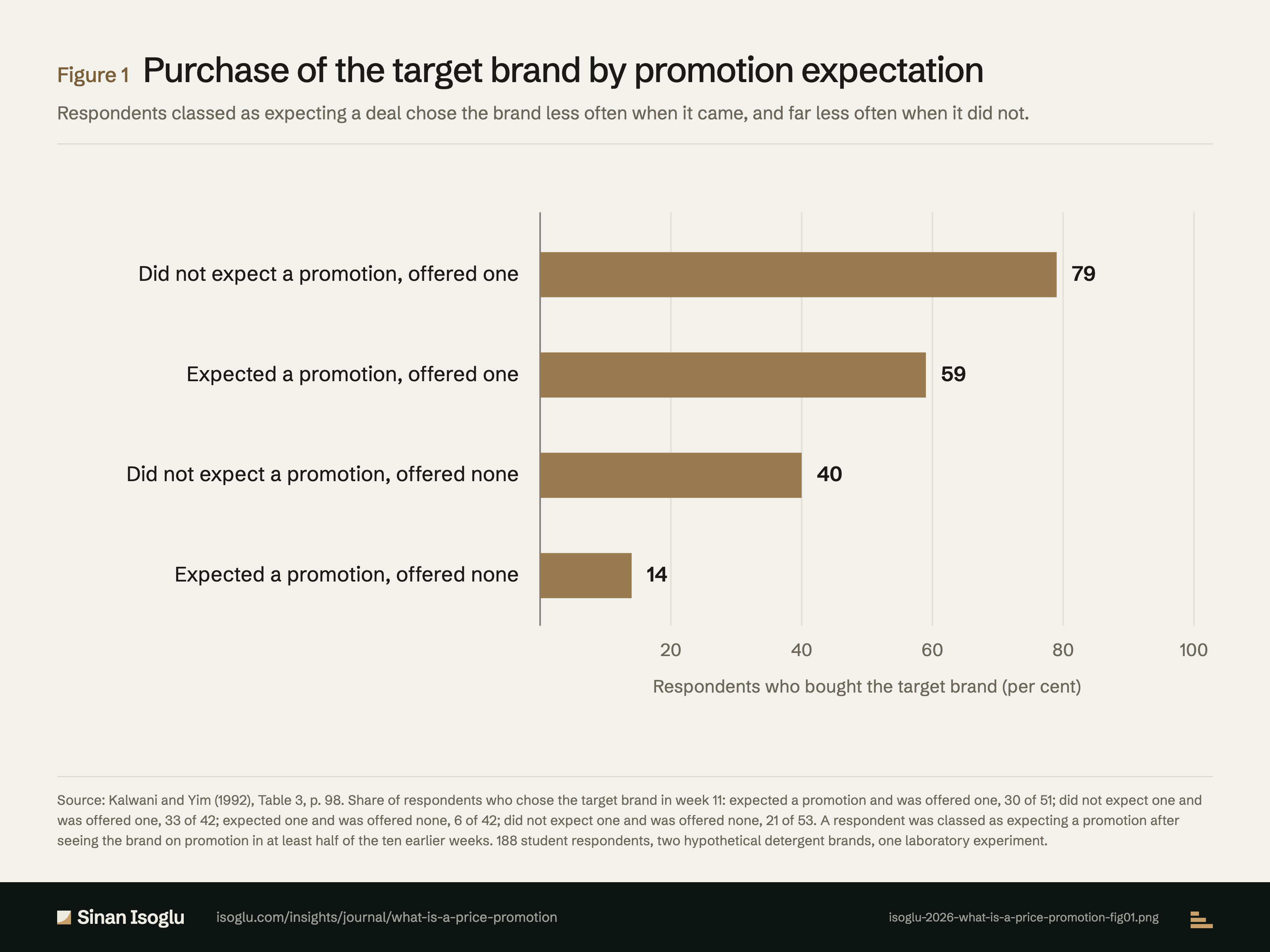
Kauf der Zielmarke nach Aktionserwartung
Befragte, denen die Autoren eine Aktionserwartung zuschrieben, wählten die Marke seltener, wenn die Aktion kam, und viel seltener, wenn sie ausblieb.
Abbildung 1Kauf der Zielmarke nach Aktionserwartung
Quelle: Kalwani und Yim (1992), Tabelle 3, S. 98. Anteil der Befragten, die in Woche 11 die Zielmarke wählten: Aktion erwartet und angeboten, 30 von 51; nicht erwartet und angeboten, 33 von 42; erwartet und nicht angeboten, 6 von 42; nicht erwartet und nicht angeboten, 21 von 53. Eine Aktionserwartung nahmen die Autoren an, wenn jemand die Marke in mindestens der Hälfte der zehn Wochen davor in der Aktion gesehen hatte. 188 studentische Befragte, zwei fiktive Waschmittelmarken, ein Laborexperiment.
Quelle und Evidenz
Jede Zeile nennt eine Aussage zu dieser Abbildung, ihre Quelle und die Art ihrer Prüfung.
- A KY92-C4 Frequent promotions can create promotion expectations, after which consumers typically buy only on promotion; in week 11 every respondent had to choose one of the two brands, so the design measures switching, not deferral; expectation was inferred at a 50 per cent frequency threshold chosen by grid search; Table 3: purchase with promotion 59% (30 of 51) when expected and 79% (33 of 42) when not, without promotion 14% (6 of 42) when expected and 40% (21 of 53) when not; the loss of an expected promotion weighs more than a surprise one, a loss aversion phenomenon (pp. 91, 94 to 98): "they needed to purchase laundry detergent from a local supermarket"; "Brand choice was obtained by requesting the respondent to select one of the two brands for purchase."; "Though we did not set out to elicit expectations for promotional activity as we did for price"; "consumers who have been exposed to frequent price promotions in support of a given brand may come to form promotion expectations and typically will purchase the brand only when it is price promoted"; "the promotion frequency threshold of 50% or more of the time is adopted in the operationalization because it provides the highest adjusted"; "We see that 59% of the 51 respondents who were offered a price promotion on the target brand and expected a promotion on it purchased the brand in contrast to 79% of the 42 respondents"; "only 14% of the respondents who expected a promotion on the target brand purchased it without a price promotion in contrast to 40%"; "consumers' response to the loss of an expected promotion is stronger than their response to a surprise or unexpected promotion"Kalwani & Yim. (1992)
Prüfgrade: A, gegen die gedruckte Seite der Primärquelle geprüft · B, Primärquelle, nur Textebene · C, belastbare Sekundärquelle · D, berichtet.
Aus dem Beitrag
Pricing & Umsatzarchitektur
Was ist eine Preisaktion?
Eine Preisaktion ist eine befristete, angekündigte Preissenkung. Sie hebt den Absatz sofort, doch wer sie oft sieht, kauft ohne sie womöglich seltener.
Den Beitrag lesenDiese Abbildung gehört zu einem Essay: Die Zahlen stehen hier, das Argument dort.
Zitieren oder einbetten
Verwandte Abbildungen
Kontakt
Schicken Sie die Frage, an der Sie arbeiten.
Forschung, ein Gastvortrag oder eine Frage aus der Praxis.