Figure 2From “What is a market entry strategy?”
The entry mode decision
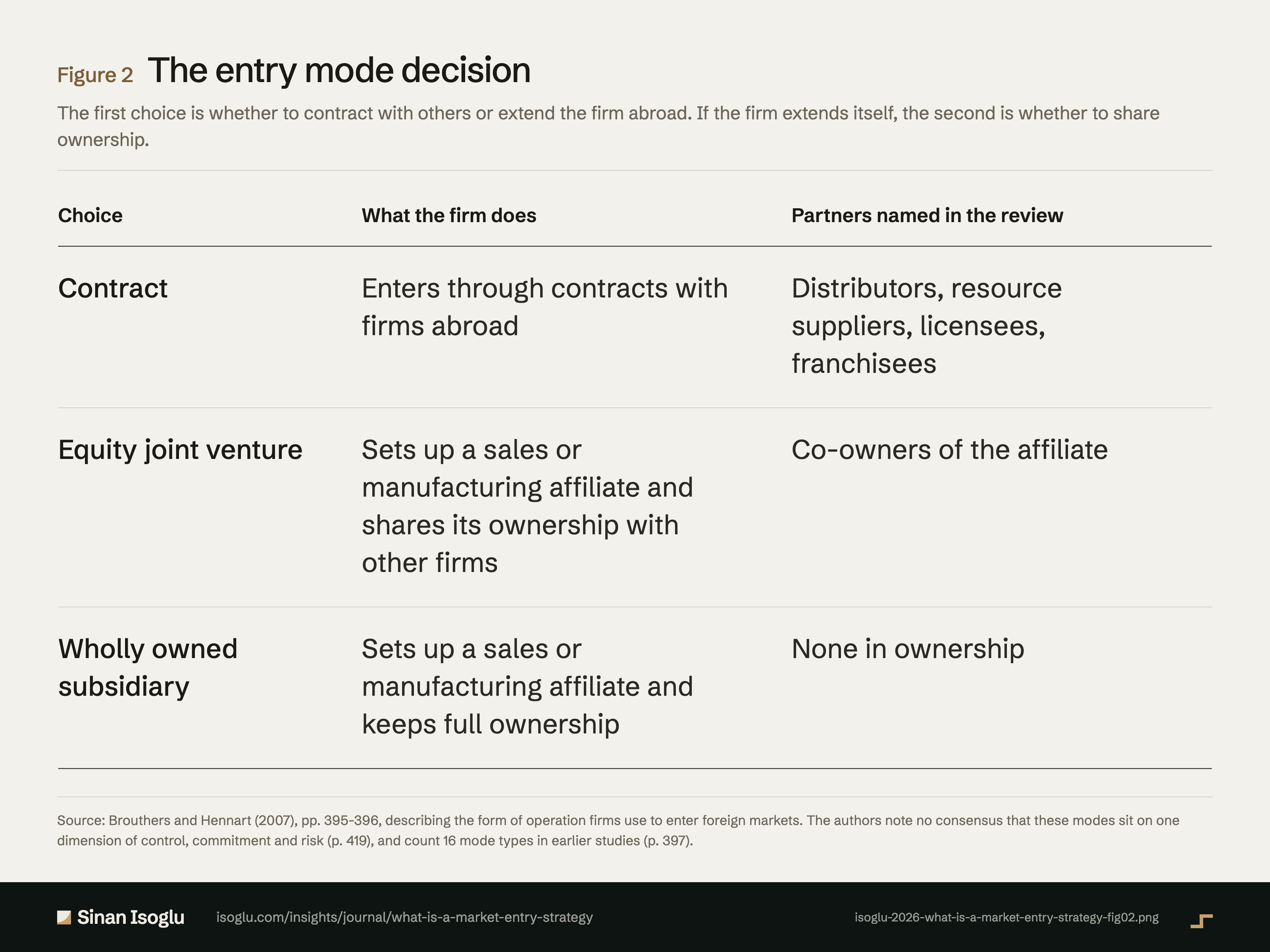
The first choice is whether to contract with others or extend the firm abroad. If the firm extends itself, the second is whether to share ownership.
Figure 2The entry mode decision
| Choice | What the firm does | Partners named in the review |
|---|---|---|
| Contract | Enters through contracts with firms abroad | Distributors, resource suppliers, licensees, franchisees |
| Equity joint venture | Sets up a sales or manufacturing affiliate and shares its ownership with other firms | Co-owners of the affiliate |
| Wholly owned subsidiary | Sets up a sales or manufacturing affiliate and keeps full ownership | None in ownership |
Swipe or scroll horizontally if the table is wider than your screen.
Source: Brouthers and Hennart (2007), pp. 395-396, describing the form of operation firms use to enter foreign markets. The authors note no consensus that these modes sit on one dimension of control, commitment and risk (p. 419), and count 16 mode types in earlier studies (p. 397).
From the essay
Go-to-market strategy
What is a market entry strategy?
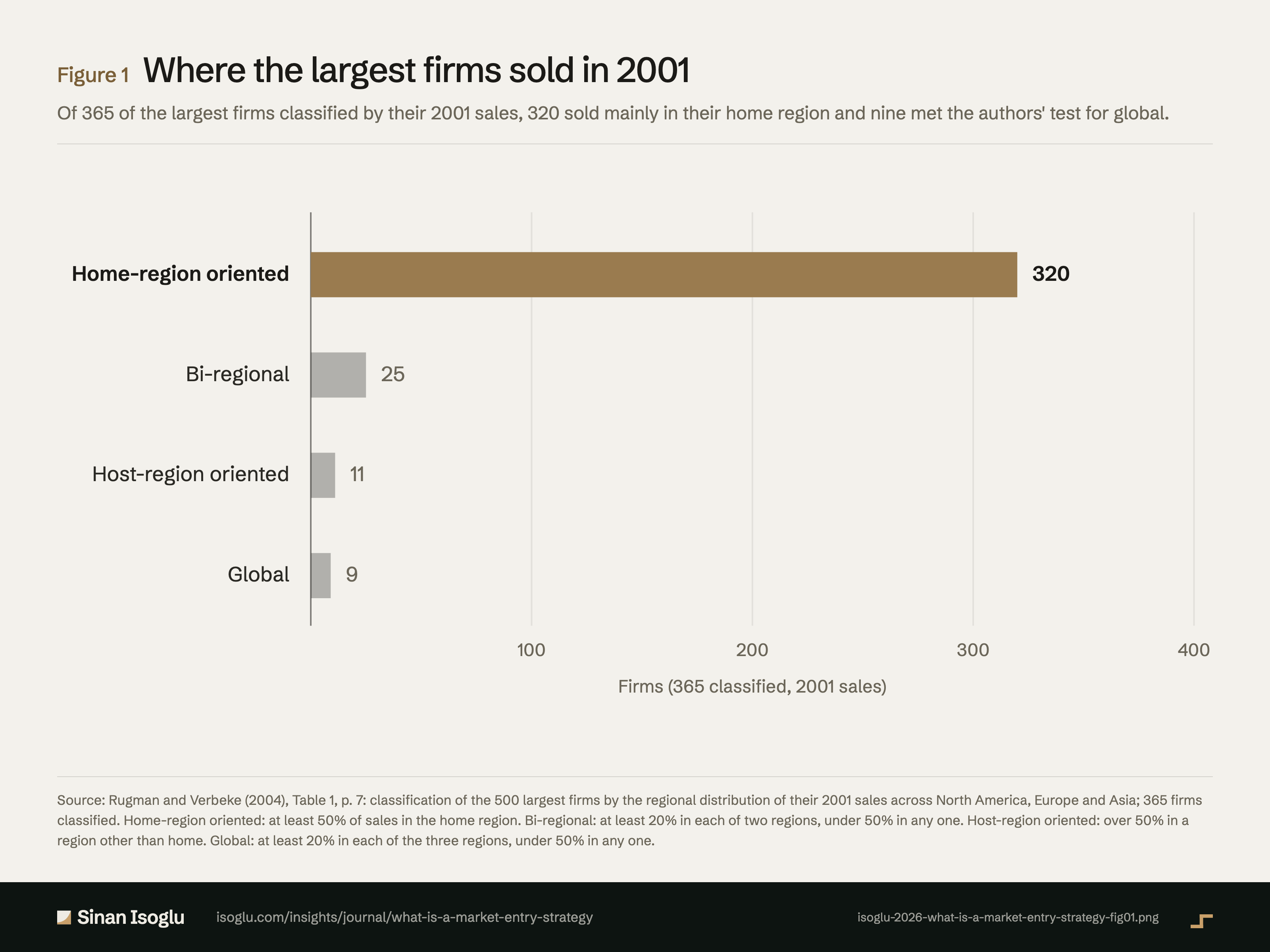
A market entry strategy decides where, how and when a firm enters. In 2001, most of the largest firms sold mainly in their home region.
Read the essayThis exhibit belongs to an essay: the numbers live here, the argument lives there.
Cite or embed
Related exhibits

Contact
Bring the question you're working on.
Research, a guest lecture, or a commercial question.