Figure 1From “What is a default option?”
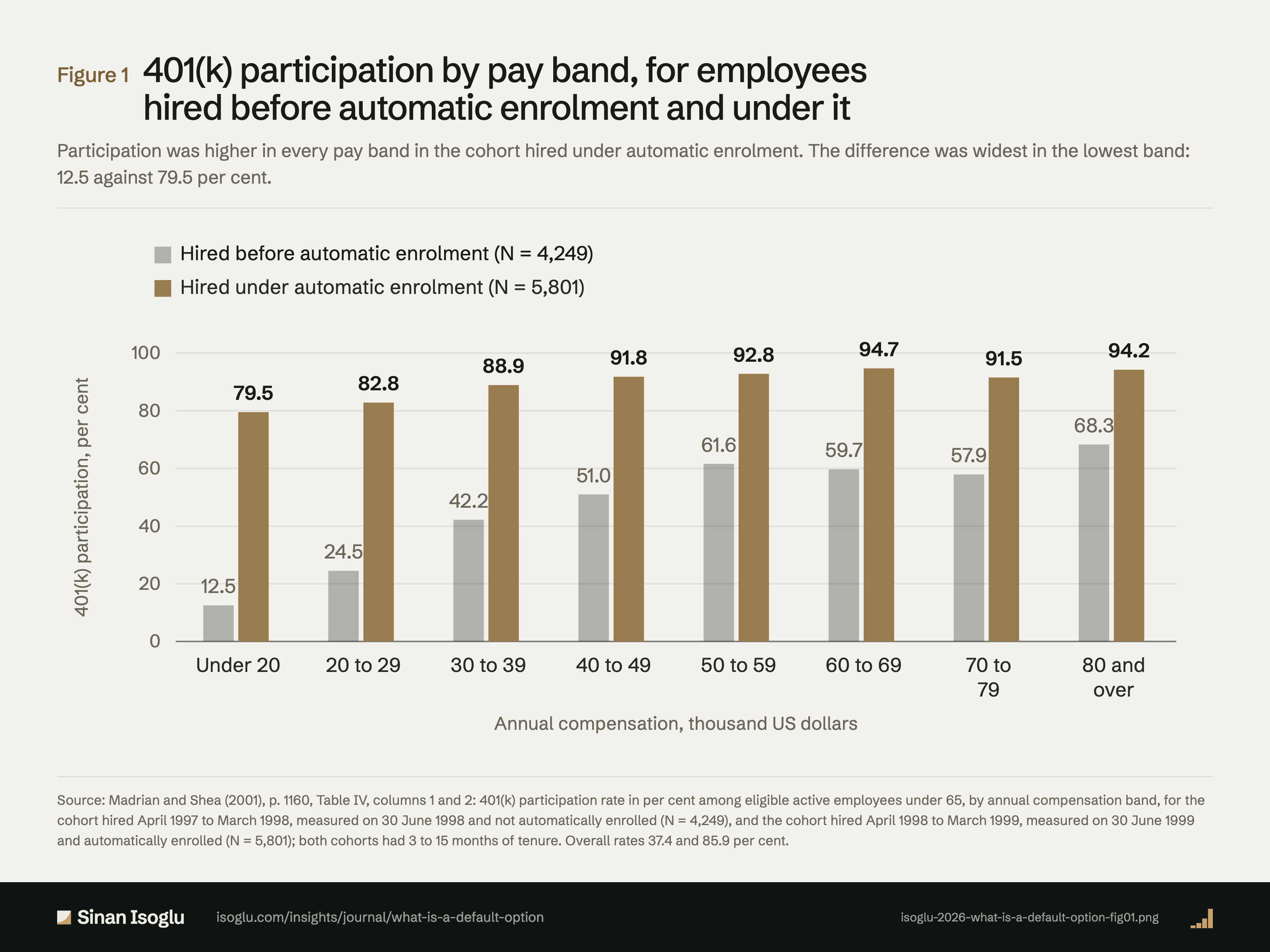
401(k) participation by pay band, for employees hired before automatic enrolment and under it
Participation was higher in every pay band in the cohort hired under automatic enrolment. The difference was widest in the lowest band: 12.5 against 79.5 per cent.
Figure 1401(k) participation by pay band, for employees hired before automatic enrolment and under it
Source: Madrian and Shea (2001), p. 1160, Table IV, columns 1 and 2: 401(k) participation rate in per cent among eligible active employees under 65, by annual compensation band, for the cohort hired April 1997 to March 1998, measured on 30 June 1998 and not automatically enrolled (N = 4,249), and the cohort hired April 1998 to March 1999, measured on 30 June 1999 and automatically enrolled (N = 5,801); both cohorts had 3 to 15 months of tenure. Overall rates 37.4 and 85.9 per cent.
Source and evidence
Each line names a claim related to this exhibit, its source, and how it was checked.
- A MSH01-C2 Participation: the WINDOW cohort (hired April 1997 to March 1998, not automatically enrolled) and the NEW cohort (hired April 1998 to March 1999, automatically enrolled) compared at 3 to 15 months of tenure on 30 June 1998 and 30 June 1999: 37.4 and 85.9 per cent (Table IV, p. 1160, page image; N = 4,249 and 5,801); raw difference 48.5 points, 50.4 regression-adjusted for gender, race, age, compensation and months of tenure, both marked significant (Table VI, p. 1167); immediate eligibility, introduced the same day, checked on the OLD cohort (30 June 1998) and the WINDOW cohort (30 June 1999) at 15 to 27 months: 48.7 and 49.4 per cent, 0.6 raw and 4.1 adjusted, the adjusted estimate also marked significant (Table VI, page image; G5 N1), small relative to the combined impact, the comparison not completely untainted; Table IV by compensation (page image), WINDOW then NEW: under 20 thousand dollars 12.5 and 79.5; 20 to 29 thousand 24.5 and 82.8; 30 to 39 thousand 42.2 and 88.9; 40 to 49 thousand 51.0 and 91.8; 50 to 59 thousand 61.6 and 92.8; 60 to 69 thousand 59.7 and 94.7; 70 to 79 thousand 57.9 and 91.5; 80 thousand and over 68.3 and 94.2; the highest and lowest pay-related rates about 55 points apart (WINDOW) and 15 (NEW); effects largest among the groups with the lowest participation before; participation equalized, in the conclusion partially (p. 1185; G5 N12); the authors attribute the difference almost completely to automatic enrollment; a comparison of hiring cohorts, not of employees assigned at random (pp. 1151, 1154 to 1162, 1167, 1185): "were made immediately eligible to participate in the 401(k) plan regardless of service"; "less than half the 86 percent participation rate of the NEW cohort with a similar amount of tenure"; "The regression-adjusted impact of automatic enrollment on the 401(k) participation rate for these two groups of employees is in fact even slightly larger, at 50 percent"; "The regression-adjusted differences are estimated from OLS regressions which include categorical controls for gender, race, age, compensation, and months of tenure."; "An asterisk indicates statistical significance."; "This is small, however, relative to the overall combined impact of automatic enrollment and immediate eligibility"; "This comparison does not provide a completely untainted assessment of the impact of immediate eligibility"; "the disparity between the highest and lowest pay-related participation rates is about 55 percentage points for the WINDOW cohort"; "15 percentage points for the NEW cohort"; "The effects are largest among the groups with the lowest participation rate under the previous regime of affirmative elections"; "it equalizes participation rates across various demographic groups"; "Thus, it seems likely that the 401(k) participation differences between the NEW and the WINDOW cohort can be attributed almost completely to the impact of automatic enrollment."; "Automatic enrollment also serves to partially equalize participation differences"Madrian & Shea (2001) · Madrian & Shea. (2001)
Grades: A, verified against the printed page of the primary source · B, primary source, text layer only · C, authoritative secondary · D, reported.
From the essay
Growth that compounds
What is a default option?
A default applies to whoever does not choose. At one US firm, new hires' 401(k) participation was 37 per cent without automatic enrolment and 86 with it.
Read the essayThis exhibit belongs to an essay: the numbers live here, the argument lives there.
Cite or embed
Contact
Bring the question you're working on.
Research, a guest lecture, or a commercial question.