Figure 1From “What is CAC?”
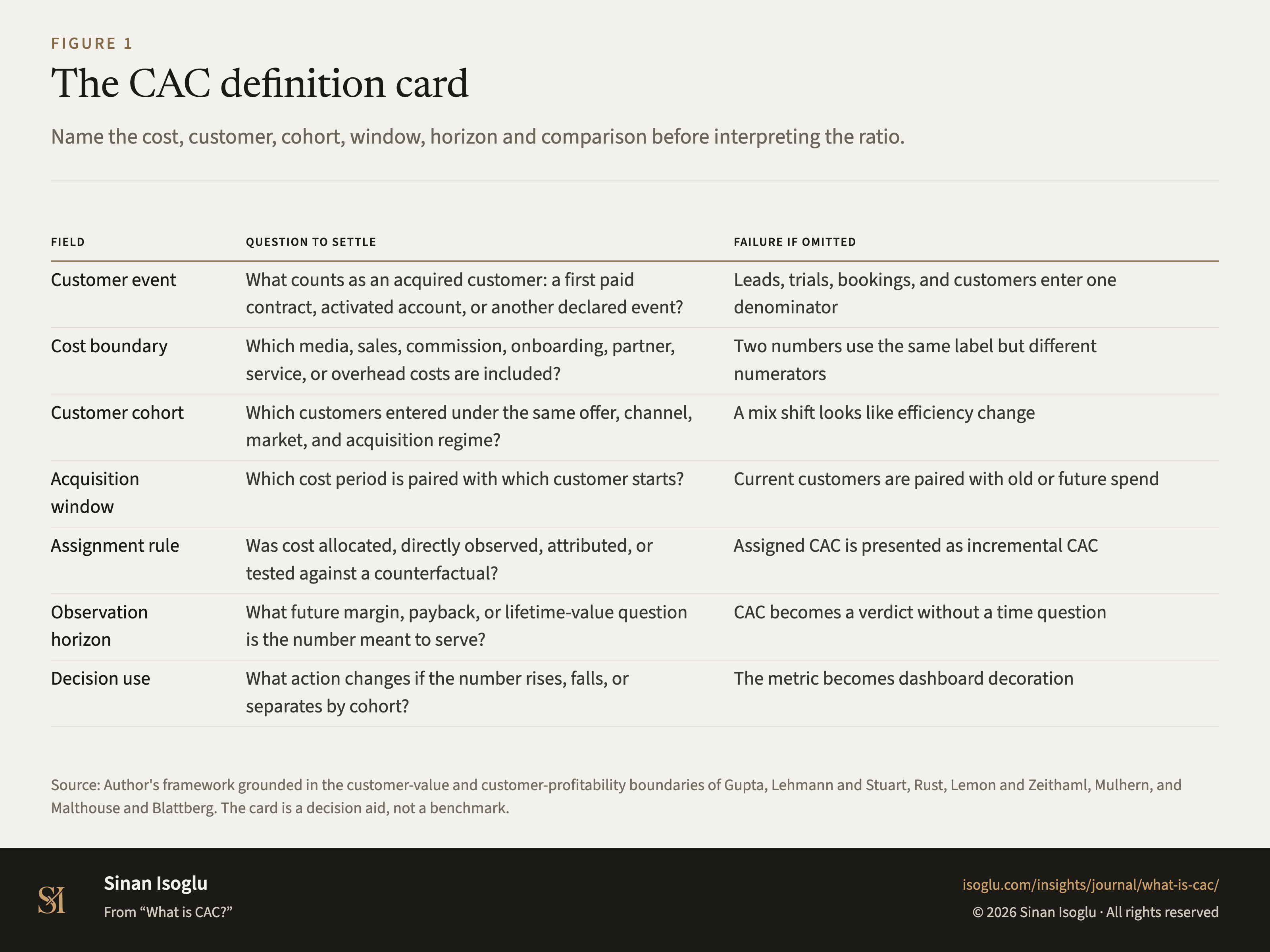
The CAC definition card
Name the cost, customer, cohort, window, horizon and comparison before interpreting the ratio.
Figure 1The CAC definition card
| Field | Question to settle | Failure if omitted |
|---|---|---|
| Customer event | What counts as an acquired customer: a first paid contract, activated account, or another declared event? | Leads, trials, bookings, and customers enter one denominator |
| Cost boundary | Which media, sales, commission, onboarding, partner, service, or overhead costs are included? | Two numbers use the same label but different numerators |
| Customer cohort | Which customers entered under the same offer, channel, market, and acquisition regime? | A mix shift looks like efficiency change |
| Acquisition window | Which cost period is paired with which customer starts? | Current customers are paired with old or future spend |
| Assignment rule | Was cost allocated, directly observed, attributed, or tested against a counterfactual? | Assigned CAC is presented as incremental CAC |
| Observation horizon | What future margin, payback, or lifetime-value question is the number meant to serve? | CAC becomes a verdict without a time question |
| Decision use | What action changes if the number rises, falls, or separates by cohort? | The metric becomes dashboard decoration |
Swipe or scroll horizontally if the table is wider than your screen.
Source: Author's framework grounded in the customer-value and customer-profitability boundaries of Gupta, Lehmann and Stuart, Rust, Lemon and Zeithaml, Mulhern, and Malthouse and Blattberg. The card is a decision aid, not a benchmark.
Source and evidence
Each line names a claim related to this exhibit, its source, and how it was checked.
- A GLS04-C2 The sensitivity is theirs and it is asymmetric: "a 1% improvement in retention, margin, or acqui"sition cost "improves firm value by 5%, 1%, and .1%, respectively"Gupta, Lehmann & Stuart. (2004)
- A RLZ04-C1 The framework is a trade-off device, in the authors' words: "a unified strategic framework that enables competing marketing strategy options to be traded off on the basis of projected financial return, which is operationalized as the change in a firm's customer equity rel"ative to the incremental expenditure needed to produce itRust, Lemon & Zeithaml. (2004)
- A RLZ04-C2 The components of a lifetime value are enumerated: "each customer's lifetime value results from the frequency of category purchases, average quantity of purchase, and brand-switching patterns combined with the firm's contribution margin"Rust, Lemon & Zeithaml. (2004)
- A MUL99-C2 Concentration is analysed as a distribution, not asserted as a ratio: "a sharply descending curve for the ordering of customer profit" corresponds to a skewed frequency distribution, and the Lorenz curve's shortcoming is that "it cannot portray percentiles of customers who represent a financial loss to a firm"Mulhern. (1999)
- A MB05-C3 "the feasibility of such strategies depends on the probabilities and costs of misclassifying customers", so it turns on prediction accuracy, forecast horizon, and the costs of misclassification.Malthouse & Blattberg. (2005)
Grades: A, verified against the printed page of the primary source · B, primary source, text layer only · C, authoritative secondary · D, reported.
From the essay
Growth that compounds
What is CAC?
CAC is a defined cost per acquired customer, not a universal ratio. State the cohort, boundary, horizon and counterfactual before comparing channels.
Read the essayThis exhibit belongs to an essay: the numbers live here, the argument lives there.
Cite or embed
Related exhibits
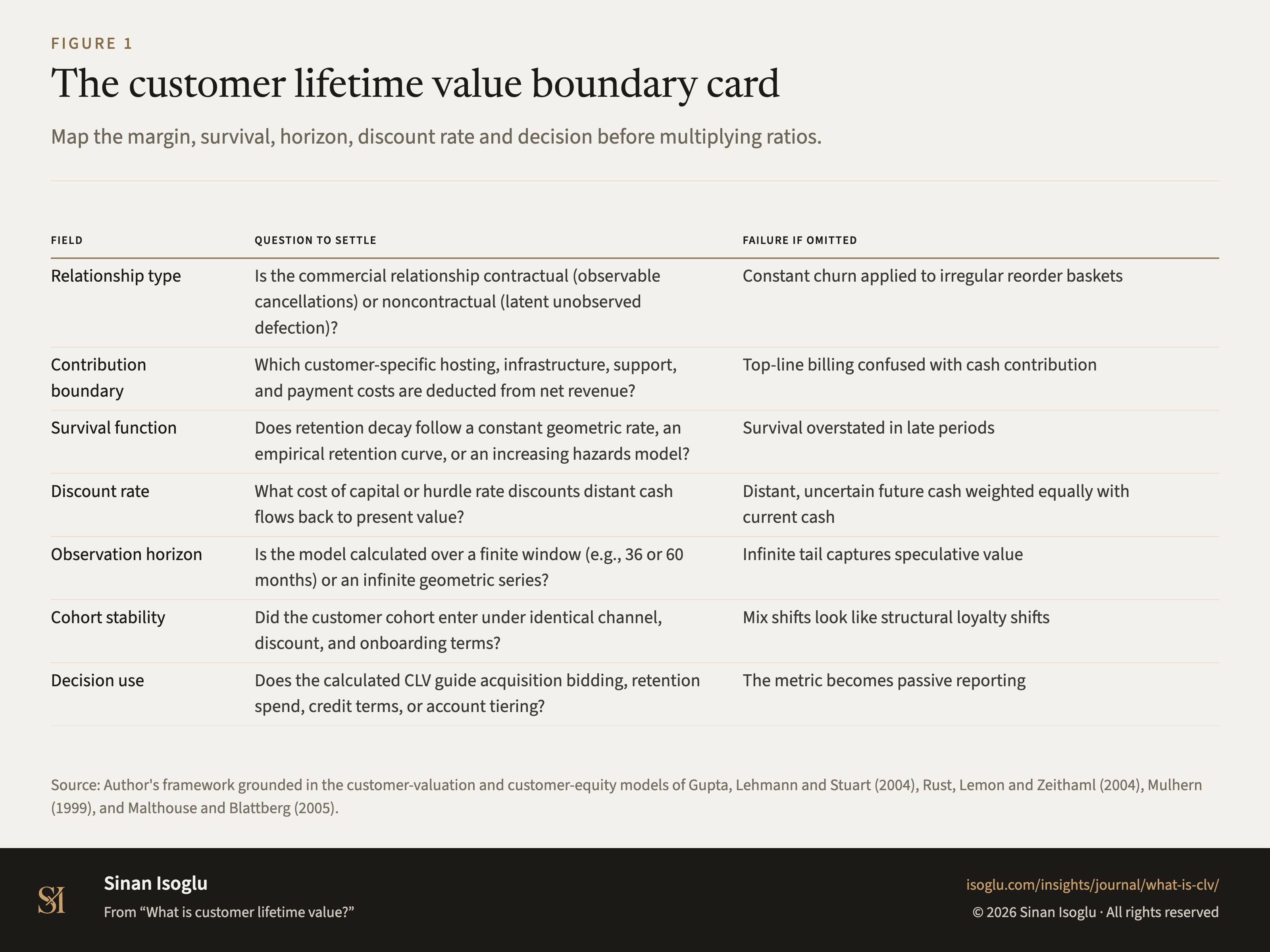
Figure 1Figure
The customer lifetime value boundary card
What is customer lifetime value?
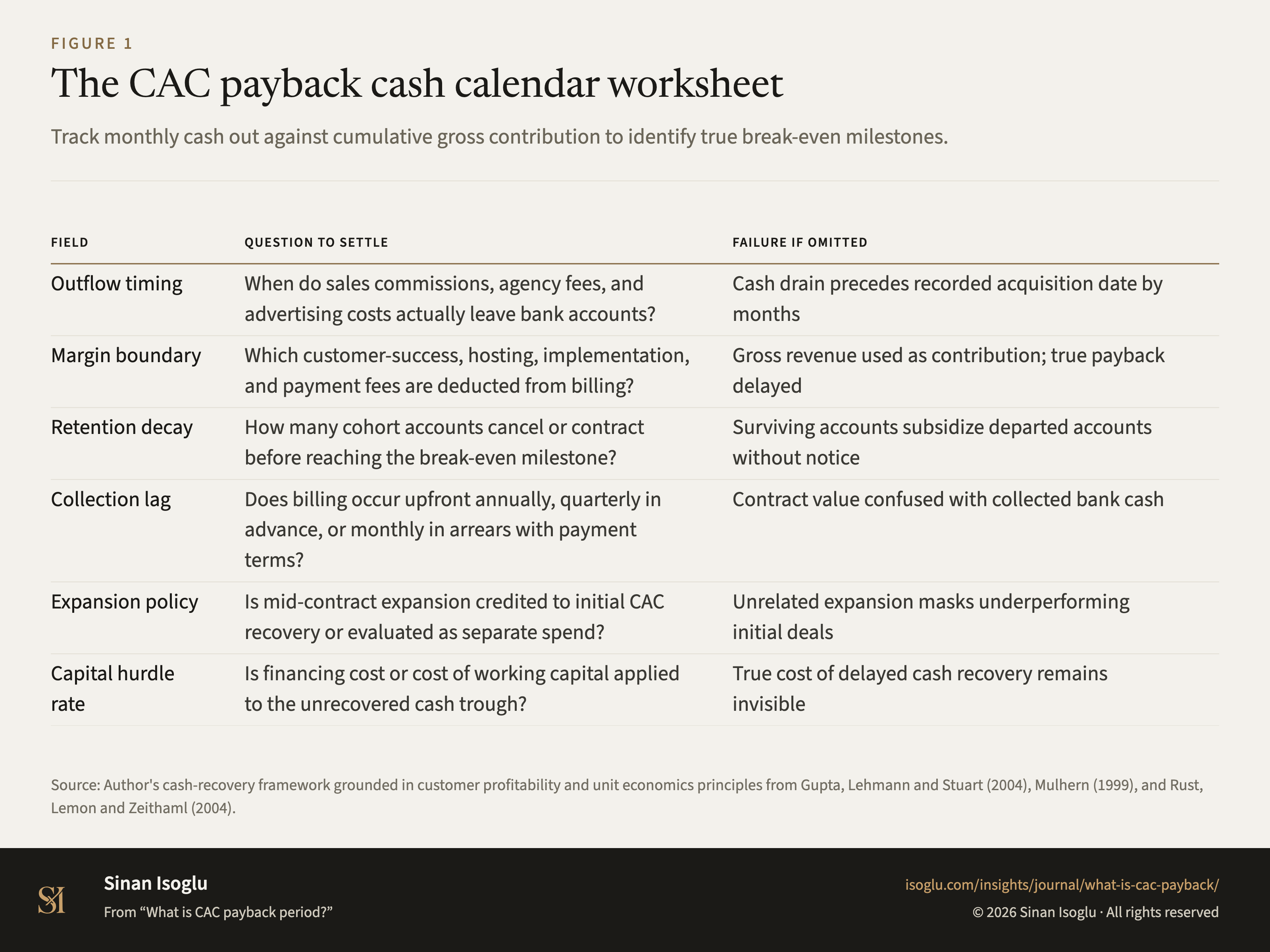
Figure 1Figure
The CAC payback cash calendar worksheet
What is CAC payback period?
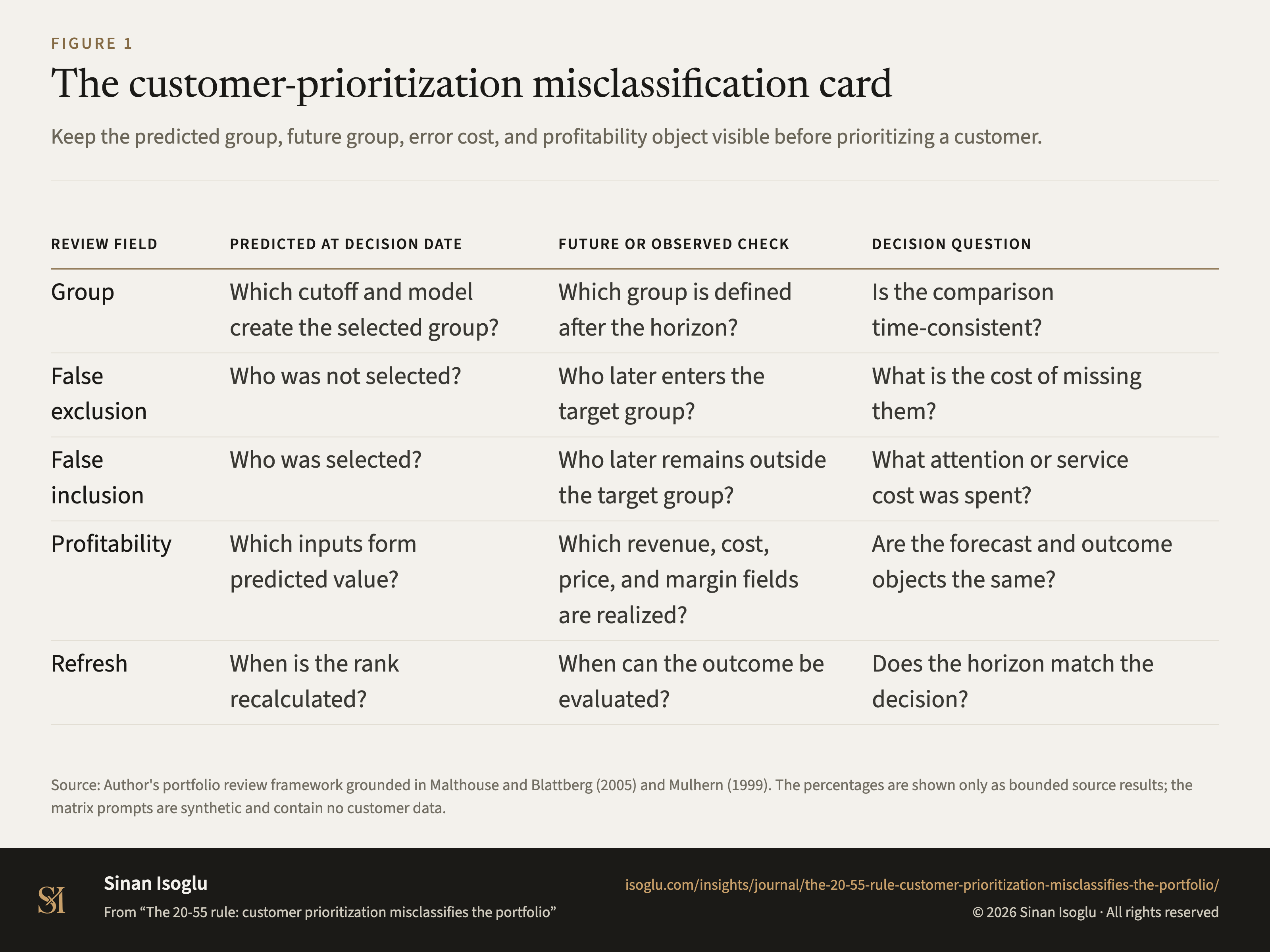
Figure 1Figure
The customer-prioritization misclassification card
The 20-55 rule: customer prioritization misclassifies the portfolio
Contact
Bring the question you're working on.
Research, a guest lecture, or a commercial question.