Figure 1From “What are unit economics?”
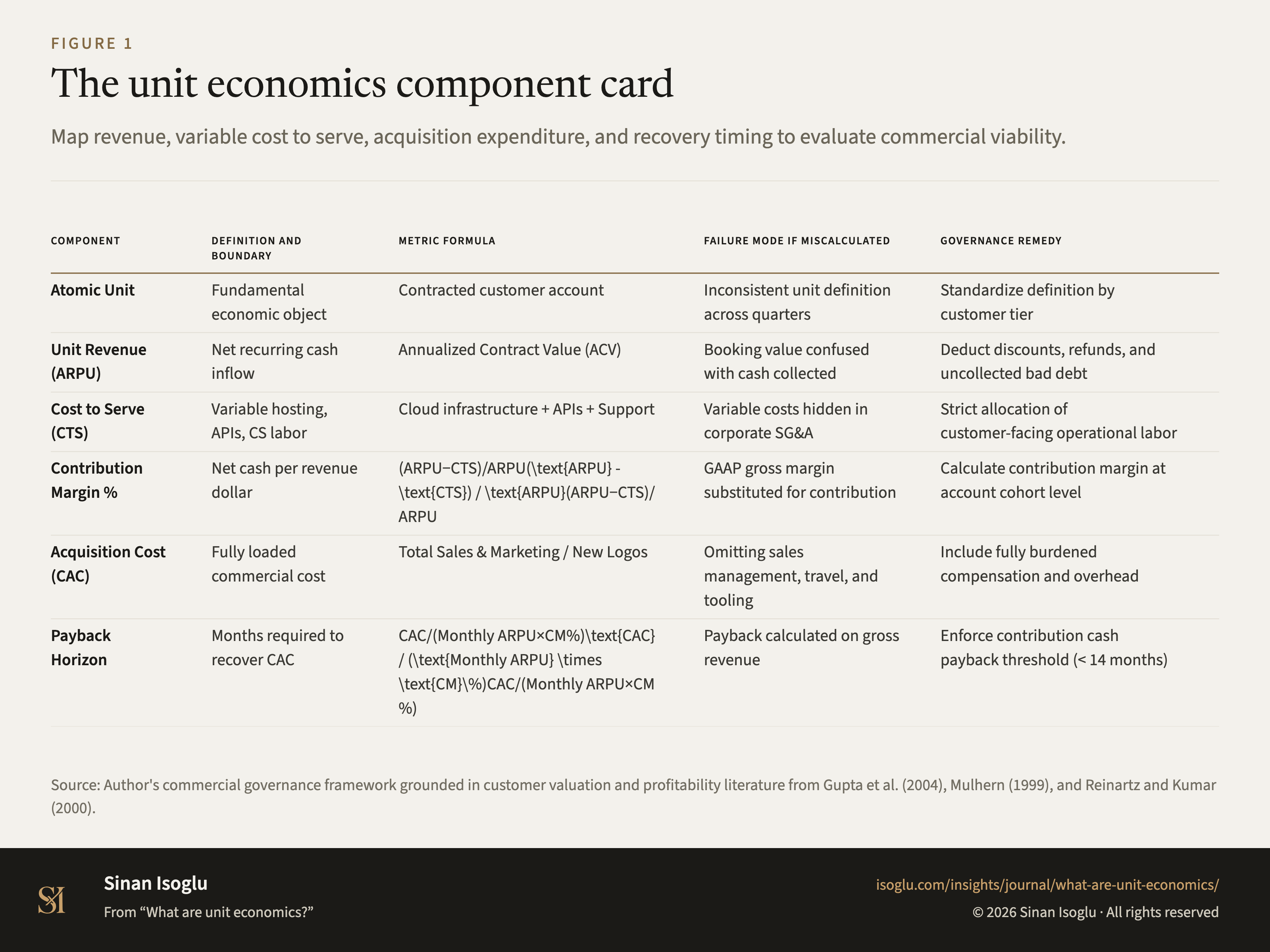
The unit economics component card
Map revenue, variable cost to serve, acquisition expenditure, and recovery timing to evaluate commercial viability.
Figure 1The unit economics component card
| Component | Definition and boundary | Metric formula | Failure mode if miscalculated | Governance remedy |
|---|---|---|---|---|
| Atomic Unit | Fundamental economic object | Contracted customer account | Inconsistent unit definition across quarters | Standardize definition by customer tier |
| Unit Revenue (ARPU) | Net recurring cash inflow | Annualized Contract Value (ACV) | Booking value confused with cash collected | Deduct discounts, refunds, and uncollected bad debt |
| Cost to Serve (CTS) | Variable hosting, APIs, CS labor | Cloud infrastructure + APIs + Support | Variable costs hidden in corporate SG&A | Strict allocation of customer-facing operational labor |
| Contribution Margin % | Net cash per revenue dollar | $(\text{ARPU} - \text{CTS}) / \text{ARPU}$ | GAAP gross margin substituted for contribution | Calculate contribution margin at account cohort level |
| Acquisition Cost (CAC) | Fully loaded commercial cost | Total Sales & Marketing / New Logos | Omitting sales management, travel, and tooling | Include fully burdened compensation and overhead |
| Payback Horizon | Months required to recover CAC | $\text{CAC} / (\text{Monthly ARPU} \times \text{CM}\%)$ | Payback calculated on gross revenue | Enforce contribution cash payback threshold (< 14 months) |
Swipe or scroll horizontally if the table is wider than your screen.
Source: Author's commercial governance framework grounded in customer valuation and profitability literature from Gupta et al. (2004), Mulhern (1999), and Reinartz and Kumar (2000).
From the essay
Growth that compounds
What are unit economics?
Unit economics evaluate direct revenue and variable costs per fundamental business unit. Define the unit, contribution margin, CAC and payback horizon.
Read the essayThis exhibit belongs to an essay: the numbers live here, the argument lives there.
Cite or embed
Contact
Bring the question you're working on.
Research, a guest lecture, or a commercial question.