Figure 2From “Transfer price and market price are different objects”
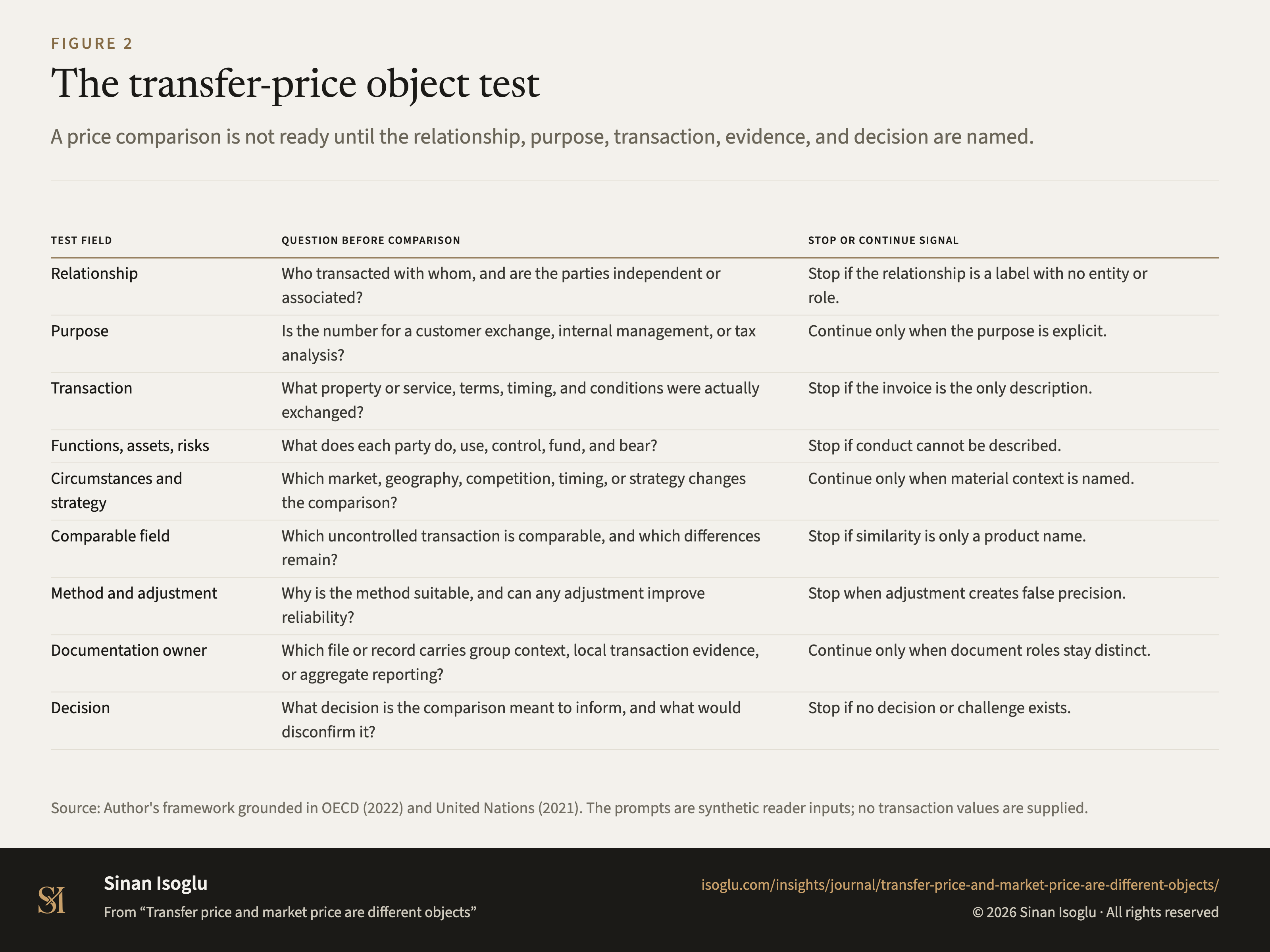
The transfer-price object test
A price comparison is not ready until the relationship, purpose, transaction, evidence, and decision are named.
Figure 2The transfer-price object test
| Test field | Question before comparison | Stop or continue signal |
|---|---|---|
| Relationship | Who transacted with whom, and are the parties independent or associated? | Stop if the relationship is a label with no entity or role. |
| Purpose | Is the number for a customer exchange, internal management, or tax analysis? | Continue only when the purpose is explicit. |
| Transaction | What property or service, terms, timing, and conditions were actually exchanged? | Stop if the invoice is the only description. |
| Functions, assets, risks | What does each party do, use, control, fund, and bear? | Stop if conduct cannot be described. |
| Circumstances and strategy | Which market, geography, competition, timing, or strategy changes the comparison? | Continue only when material context is named. |
| Comparable field | Which uncontrolled transaction is comparable, and which differences remain? | Stop if similarity is only a product name. |
| Method and adjustment | Why is the method suitable, and can any adjustment improve reliability? | Stop when adjustment creates false precision. |
| Documentation owner | Which file or record carries group context, local transaction evidence, or aggregate reporting? | Continue only when document roles stay distinct. |
| Decision | What decision is the comparison meant to inform, and what would disconfirm it? | Stop if no decision or challenge exists. |
Swipe or scroll horizontally if the table is wider than your screen.
Source: Author's framework grounded in OECD (2022) and United Nations (2021). The prompts are synthetic reader inputs; no transaction values are supplied.
Source and evidence
Each line names a claim related to this exhibit, its source, and how it was checked.
- A OECD22-C2 The comparison is with what independent parties would have done: Article 9 applies where "conditions are made or imposed between the two enterprises in their commercial or financial relations which differ from those which would be made between independent enterprises"OECD (2022), pp. 31-32 · official full text
- A OECD22-C3 Functional analysis identifies economically significant activities and responsibilities, assets used or contributed, risks assumed, and what parties actually doOECD (2022), pp. 39-40, 46-47 · official full text
- A OECD22-C4 The comparability process moves from transaction understanding and functions to methods, comparables, adjustments, and arm's-length remuneration; reliability matters more than a compulsory processOECD (2022), pp. 150-151 · official full text
- A OECD22-C5 The documentation framework separates group-level master-file information, transaction-level local-file information, and aggregate Country-by-Country reportingOECD (2022), pp. 231-233 · official full text
- A OECD22-C6 Comparable information can be incomplete or unavailable, and transfer pricing requires judgment rather than exact scienceOECD (2022), p. 32 · official full text
- A UNTP21-C2 A missing perfect comparable does not by itself establish that a controlled transaction is not at arm's length; imperfect comparables or other approaches may be considered within stated limitsUnited Nations (2021), pp. 49-50 · official full text
- A UNTP21-C3 The practical process includes transaction understanding, comparability factors, methods, comparables, adjustments, documentation, and monitoring, and is not necessarily linearUnited Nations (2021), pp. 52-53 · official full text
- A UNTP21-C5 Contract terms may need to be understood through correspondence, communications, economic relationships, and conduct when a written contract does not fully define the arrangementUnited Nations (2021), p. 57 · official full text
- A UNTP21-C6 Comparability adjustments should be made only when material differences can be assessed accurately enough to improve reliabilityUnited Nations (2021), pp. 50-51 · official full text
Grades: A, verified against the printed page of the primary source · B, primary source, text layer only · C, authoritative secondary · D, reported.
From the essay
Pricing & revenue architecture
Transfer price and market price are different objects
A market price can inform transfer pricing, but it is not automatically the answer. Start with the transaction, functions, risks and terms.
Read the essayThis exhibit belongs to an essay: the numbers live here, the argument lives there.
Cite or embed
Related exhibits
Contact
Bring the question you're working on.
Research, a guest lecture, or a commercial question.