Figure 1From “Transfer price and market price are different objects”
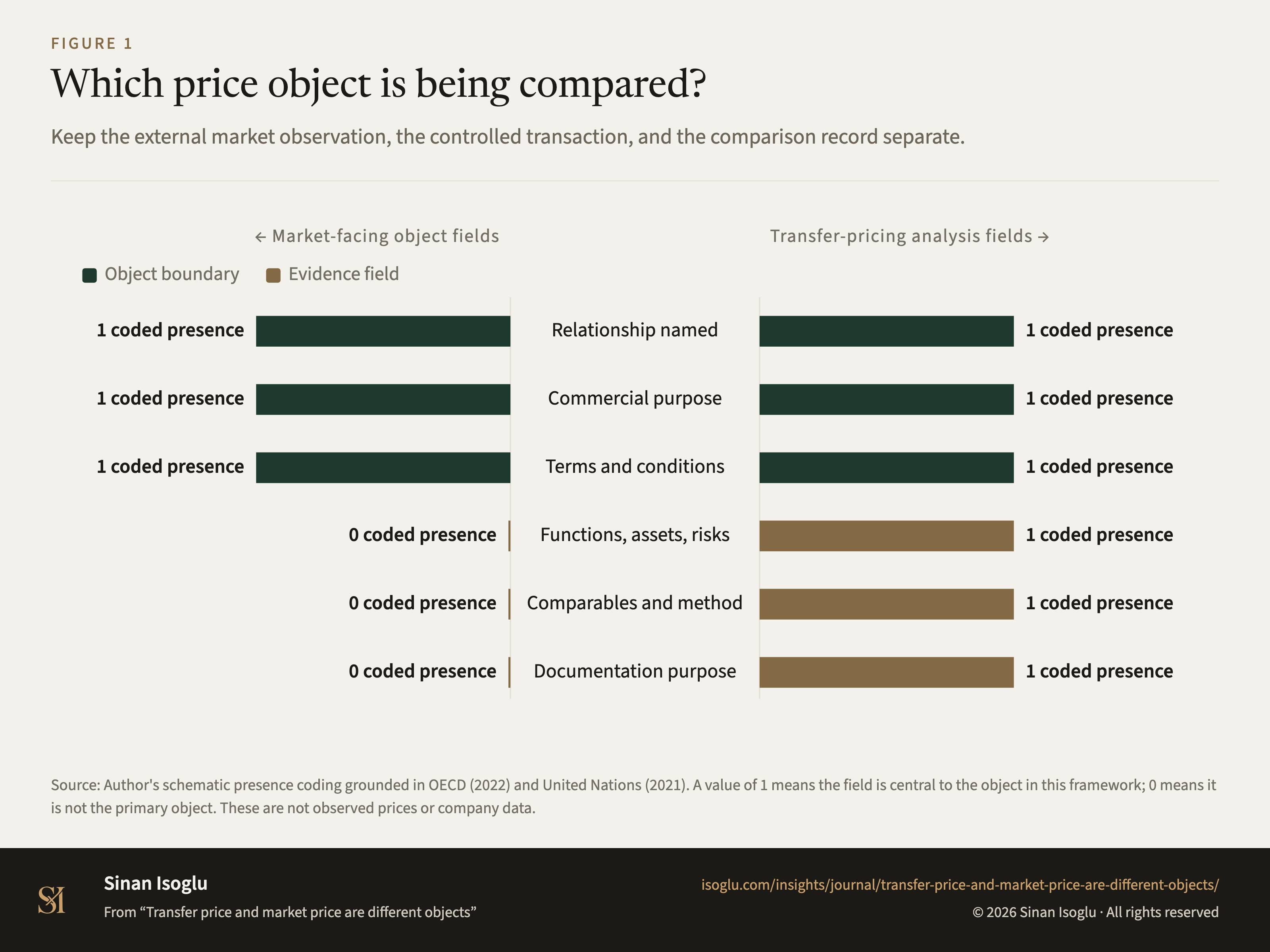
Which price object is being compared?
Keep the external market observation, the controlled transaction, and the comparison record separate.
Figure 1Which price object is being compared?
Source: Author's schematic presence coding grounded in OECD (2022) and United Nations (2021). A value of 1 means the field is central to the object in this framework; 0 means it is not the primary object. These are not observed prices or company data.
Source and evidence
Each line names a claim related to this exhibit, its source, and how it was checked.
- A OECD22-C1 The arm's-length principle is "the international transfer pricing standard that OECD member countries have agreed should be used for tax purposes by MNE groups and tax administrations"OECD (2022), p. 29 · official full text
- A OECD22-C2 The comparison is with what independent parties would have done: Article 9 applies where "conditions are made or imposed between the two enterprises in their commercial or financial relations which differ from those which would be made between independent enterprises"OECD (2022), pp. 31-32 · official full text
- A OECD22-C3 Functional analysis identifies economically significant activities and responsibilities, assets used or contributed, risks assumed, and what parties actually doOECD (2022), pp. 39-40, 46-47 · official full text
- A UNTP21-C1 Comparability analysis includes understanding the accurately delineated controlled transaction and comparing its conditions with uncontrolled transactions in comparable circumstancesUnited Nations (2021), p. 49 · official full text
- A UNTP21-C4 Comparability factors include the property or service, contractual terms, functions with assets and risks, economic circumstances, and business strategiesUnited Nations (2021), p. 56 · official full text
Grades: A, verified against the printed page of the primary source · B, primary source, text layer only · C, authoritative secondary · D, reported.
From the essay
Pricing & revenue architecture
Transfer price and market price are different objects
A market price can inform transfer pricing, but it is not automatically the answer. Start with the transaction, functions, risks and terms.
Read the essayThis exhibit belongs to an essay: the numbers live here, the argument lives there.
Cite or embed
Related exhibits
Contact
Bring the question you're working on.
Research, a guest lecture, or a commercial question.