Table 1From “The player payoff is the permission”
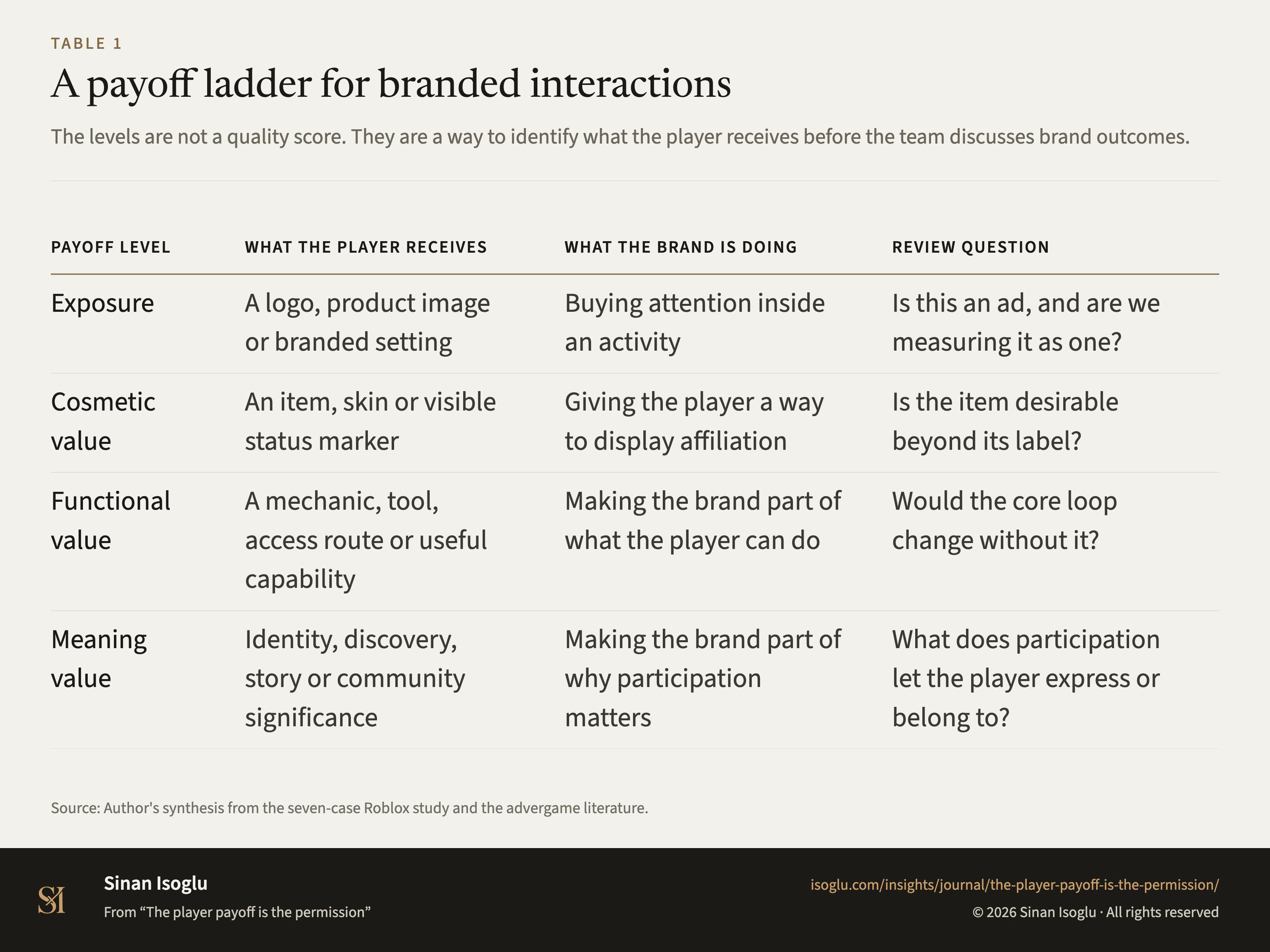
A payoff ladder for branded interactions
The levels are not a quality score. They are a way to identify what the player receives before the team discusses brand outcomes.
Table 1A payoff ladder for branded interactions
| Payoff level | What the player receives | What the brand is doing | Review question |
|---|---|---|---|
| Exposure | A logo, product image or branded setting | Buying attention inside an activity | Is this an ad, and are we measuring it as one? |
| Cosmetic value | An item, skin or visible status marker | Giving the player a way to display affiliation | Is the item desirable beyond its label? |
| Functional value | A mechanic, tool, access route or useful capability | Making the brand part of what the player can do | Would the core loop change without it? |
| Meaning value | Identity, discovery, story or community significance | Making the brand part of why participation matters | What does participation let the player express or belong to? |
Swipe or scroll horizontally if the table is wider than your screen.
Source: Author's synthesis from the seven-case Roblox study and the advergame literature.
Source and evidence
Each line names a claim related to this exhibit, its source, and how it was checked.
- B SI23-C5 Four recurring interpretive themes were integration, identity fit, interaction value and audience expectationSubmitted Isoglu (2023) bachelor thesis, findings and discussion
- A VBMA-C2 Five coefficients, each its own: ad attitude "(rc ¼ .20)", persuasion "(rc ¼ .11)", choice behavior "(rc ¼ .16)", and negative for memory "we found a negative integrated effect (rc ¼ .16)" and for persuasion knowledge at .18Berlo, Reijmersdal & Eisend (2021), abstract
- A VBMA-C3 A meta-analysis of "five advergame effects" against "other types of advertising", which is not a platform result: no Roblox and no long-term brand equity are in itBerlo, Reijmersdal & Eisend (2021), abstract
- A VBVR-C2 Both mechanisms, verbatim: "virtual product appeal strengthens the effect of brands in VR games on brand attitude", and "brands in VR games elicit emotional responses, which subsequently drive brand attitude and purchase intention"Berlo et al. (2021)
Grades: A, verified against the printed page of the primary source · B, primary source, text layer only · C, authoritative secondary · D, reported.
From the essay
From the research bench
The player payoff is the permission
A branded interaction earns attention when it gives the player something worth doing, collecting or sharing that a generic game cannot provide as well.
Read the essayThis exhibit belongs to an essay: the numbers live here, the argument lives there.
Cite or embed
Contact
Bring the question you're working on.
Research, a guest lecture, or a commercial question.