Table 1From “Brand fit is a mechanic, not a mood board”
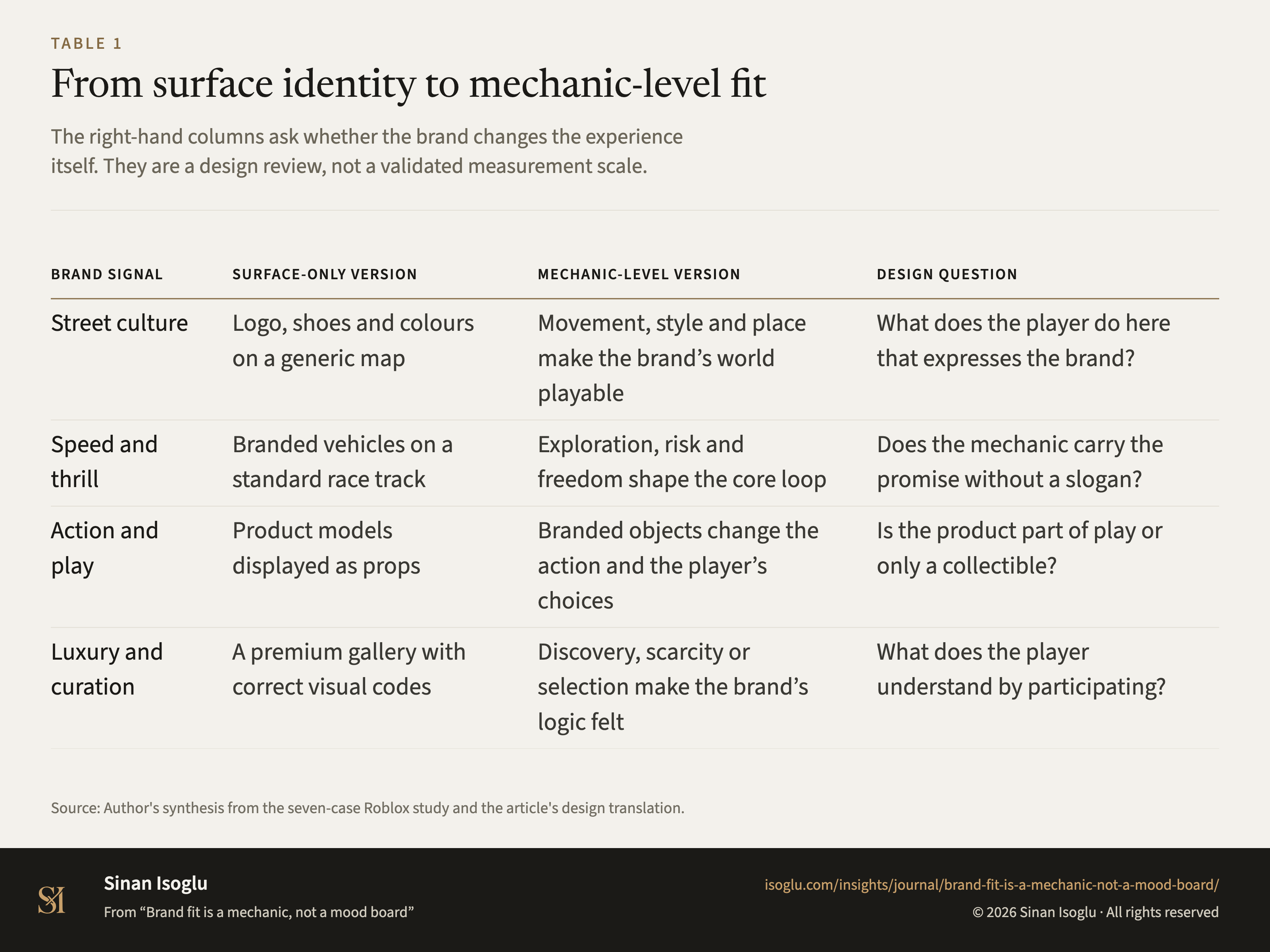
From surface identity to mechanic-level fit
The right-hand columns ask whether the brand changes the experience itself. They are a design review, not a validated measurement scale.
Table 1From surface identity to mechanic-level fit
| Brand signal | Surface-only version | Mechanic-level version | Design question |
|---|---|---|---|
| Street culture | Logo, shoes and colours on a generic map | Movement, style and place make the brand's world playable | What does the player do here that expresses the brand? |
| Speed and thrill | Branded vehicles on a standard race track | Exploration, risk and freedom shape the core loop | Does the mechanic carry the promise without a slogan? |
| Action and play | Product models displayed as props | Branded objects change the action and the player's choices | Is the product part of play or only a collectible? |
| Luxury and curation | A premium gallery with correct visual codes | Discovery, scarcity or selection make the brand's logic felt | What does the player understand by participating? |
Swipe or scroll horizontally if the table is wider than your screen.
Source: Author's synthesis from the seven-case Roblox study and the article's design translation.
Source and evidence
Each line names a claim related to this exhibit, its source, and how it was checked.
- B SI23-C5 Four recurring interpretive themes were integration, identity fit, interaction value and audience expectationSubmitted Isoglu (2023) bachelor thesis, findings and discussion
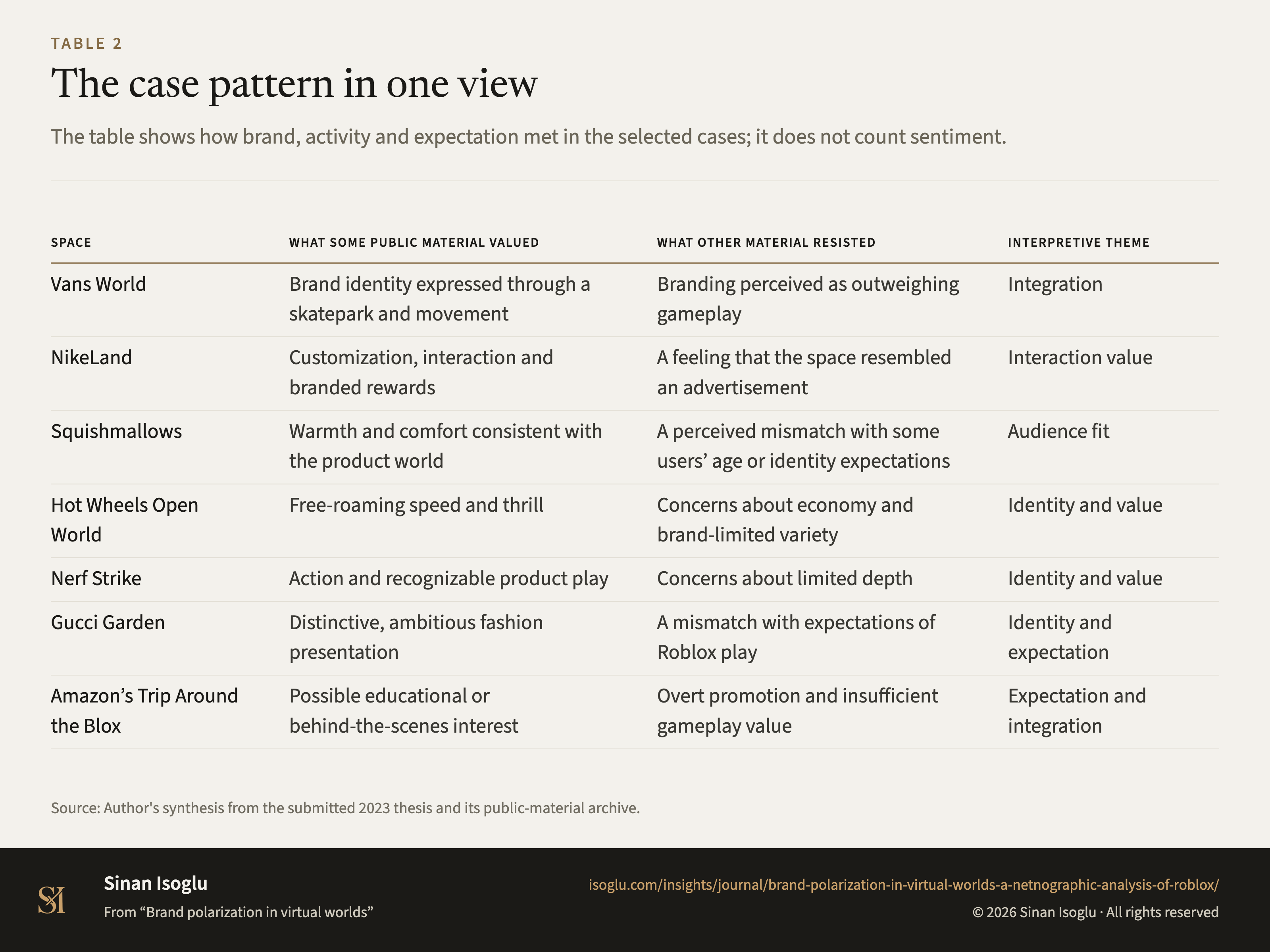
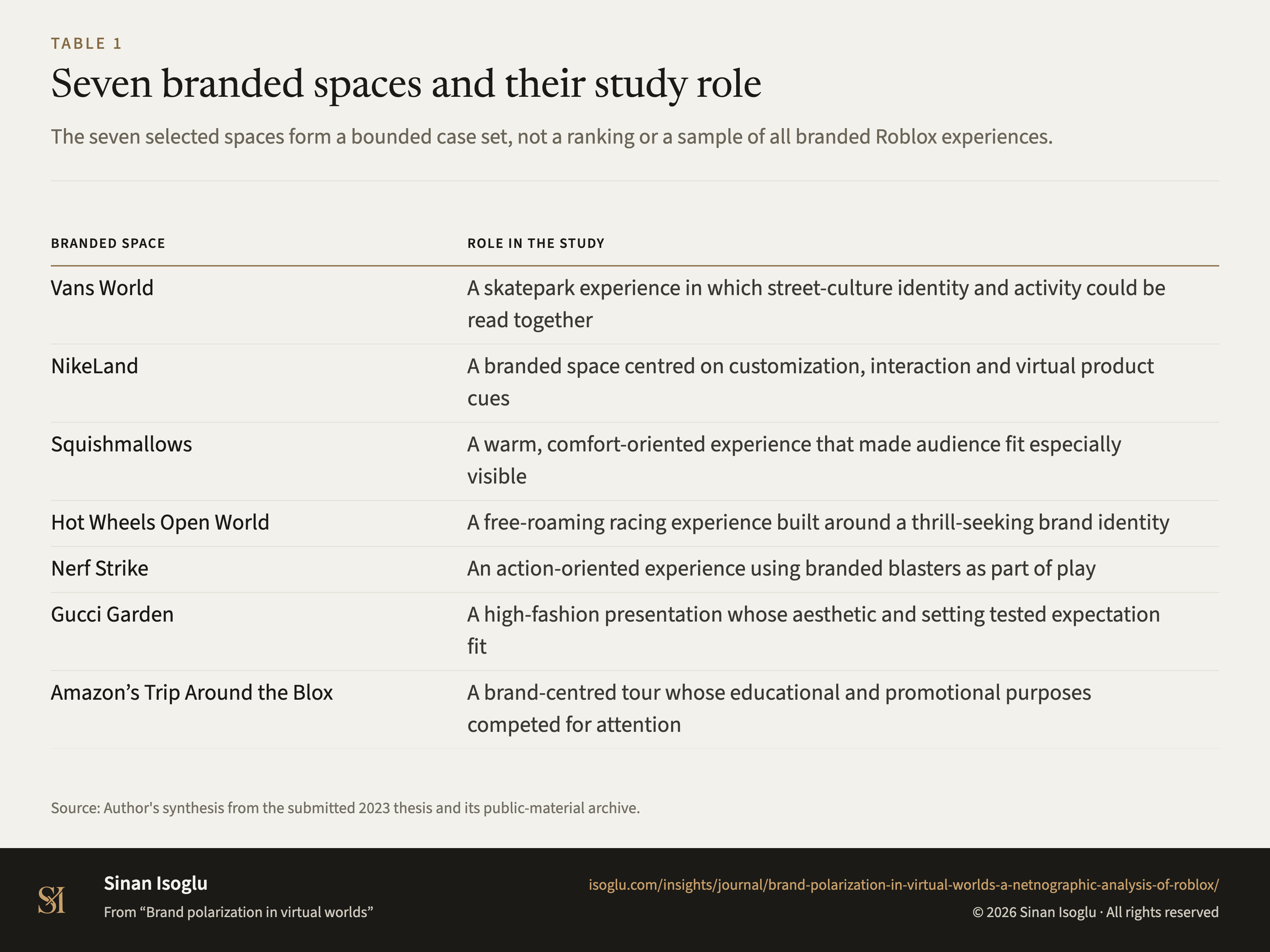
- B SI23-C6 Vans World and NikeLand show brand-fit or interaction-value readings alongside branding-over-gameplay or advertisement-like readingsSubmitted Isoglu (2023) bachelor thesis, findings
- B SI23-C8 Hot Wheels Open World and Nerf Strike connect brand identity to activity while showing value or depth frictionSubmitted Isoglu (2023) bachelor thesis, findings
- B SI23-C9 Gucci Garden and Amazon's Trip Around the Blox expose expectation and promotional-fit tensionsSubmitted Isoglu (2023) bachelor thesis, findings
- A VBVR-C2 Both mechanisms, verbatim: "virtual product appeal strengthens the effect of brands in VR games on brand attitude", and "brands in VR games elicit emotional responses, which subsequently drive brand attitude and purchase intention"Berlo et al. (2021)
Grades: A, verified against the printed page of the primary source · B, primary source, text layer only · C, authoritative secondary · D, reported.
From the essay
From the research bench
Brand fit is a mechanic, not a mood board
A brand can look right in a virtual world and still feel absent from the play. The Roblox cases show why fit belongs in rules, rewards and movement.
Read the essayThis exhibit belongs to an essay: the numbers live here, the argument lives there.
Cite or embed
Contact
Bring the question you're working on.
Research, a guest lecture, or a commercial question.