Table 1From “The branded game has to earn its place.”
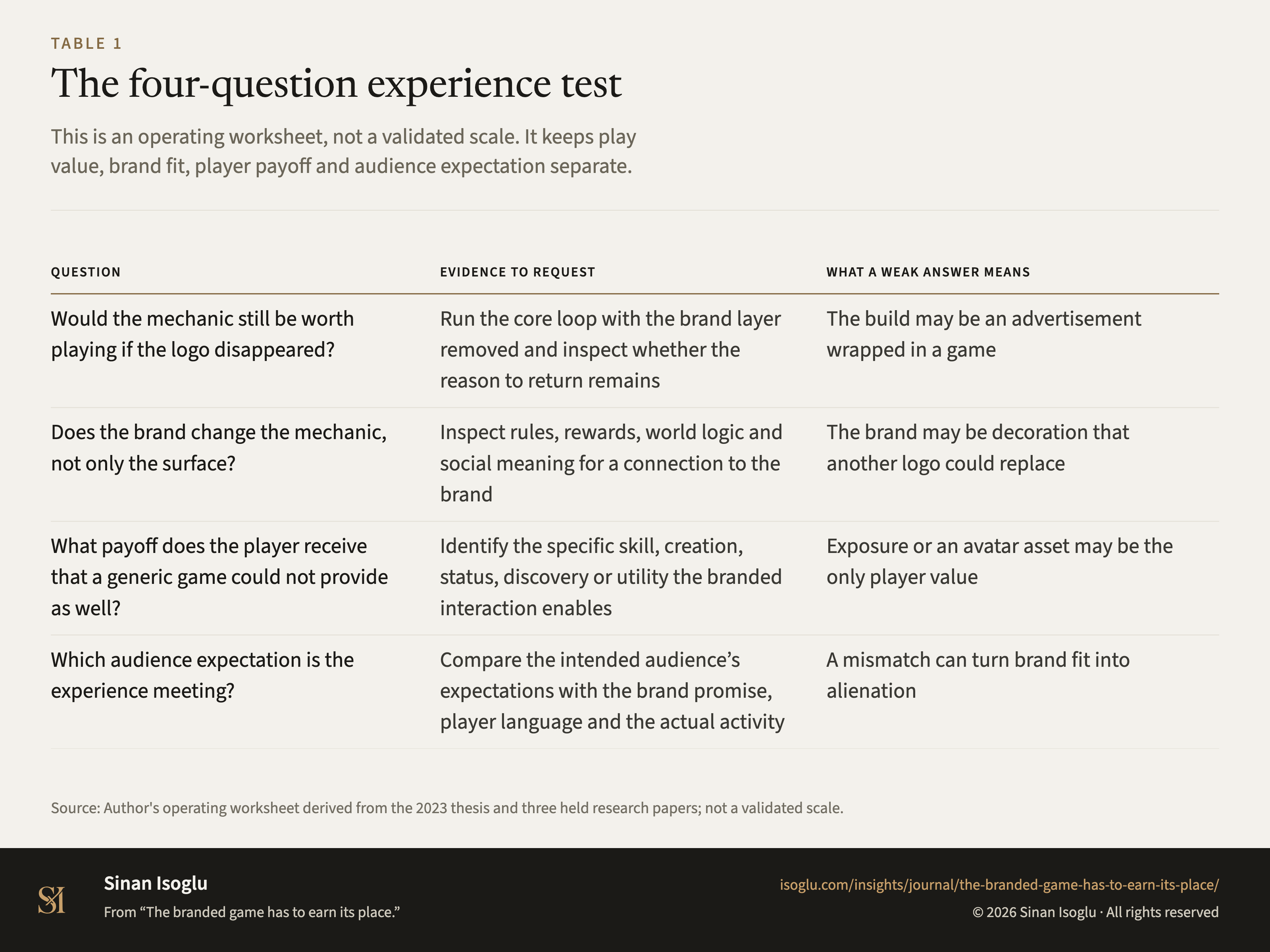
The four-question experience test
This is an operating worksheet, not a validated scale. It keeps play value, brand fit, player payoff and audience expectation separate.
Table 1The four-question experience test
| Question | Evidence to request | What a weak answer means |
|---|---|---|
| Would the mechanic still be worth playing if the logo disappeared? | Run the core loop with the brand layer removed and inspect whether the reason to return remains | The build may be an advertisement wrapped in a game |
| Does the brand change the mechanic, not only the surface? | Inspect rules, rewards, world logic and social meaning for a connection to the brand | The brand may be decoration that another logo could replace |
| What payoff does the player receive that a generic game could not provide as well? | Identify the specific skill, creation, status, discovery or utility the branded interaction enables | Exposure or an avatar asset may be the only player value |
| Which audience expectation is the experience meeting? | Compare the intended audience's expectations with the brand promise, player language and the actual activity | A mismatch can turn brand fit into alienation |
Swipe or scroll horizontally if the table is wider than your screen.
Source: Author's operating worksheet derived from the 2023 thesis and three held research papers; not a validated scale.
Source and evidence
Each line names a claim related to this exhibit, its source, and how it was checked.
- B SI23-C5 Four recurring interpretive themes were integration, identity fit, interaction value and audience expectationSubmitted Isoglu (2023) bachelor thesis, findings and discussion
- A OR24-C1 Brand polarization is defined by strong feeling at both ends rather than by mixed opinion: "polarization maintains strong emotions at both ends of the spectrum, concurrently attending to the antipodes of brand love and brand hate", and as an outcome it is a brand property: "As an outcome, polarization is a property of a brand, where a polarizing brand causes sharp division into opposing groups of individuals"Osuna et al. (2024)
- A OR24-C2 The measure is a scale with named dimensions, not a label: "four dimensions and twenty-three items: brand passion (eight items), self-brand benchmarking (five items), intra-group identification (five items) and inter-group dissociation (five items)"Osuna et al. (2024)
- A VBMA-C2 Five coefficients, each its own: ad attitude "(rc ¼ .20)", persuasion "(rc ¼ .11)", choice behavior "(rc ¼ .16)", and negative for memory "we found a negative integrated effect (rc ¼ .16)" and for persuasion knowledge at .18Berlo, Reijmersdal & Eisend (2021), abstract
- A VBVR-C2 Both mechanisms, verbatim: "virtual product appeal strengthens the effect of brands in VR games on brand attitude", and "brands in VR games elicit emotional responses, which subsequently drive brand attitude and purchase intention"Berlo et al. (2021)
Grades: A, verified against the printed page of the primary source · B, primary source, text layer only · C, authoritative secondary · D, reported.
From the essay
From the research bench
The branded game has to earn its place.
A fresh reading of a 2023 Roblox netnography turns mixed reactions into four questions for deciding whether a branded game deserves to exist.
Read the essayThis exhibit belongs to an essay: the numbers live here, the argument lives there.
Cite or embed
Related exhibits
Contact
Bring the question you're working on.
Research, a guest lecture, or a commercial question.