Figure 1From “An uplift claim needs a specification before it needs a number”
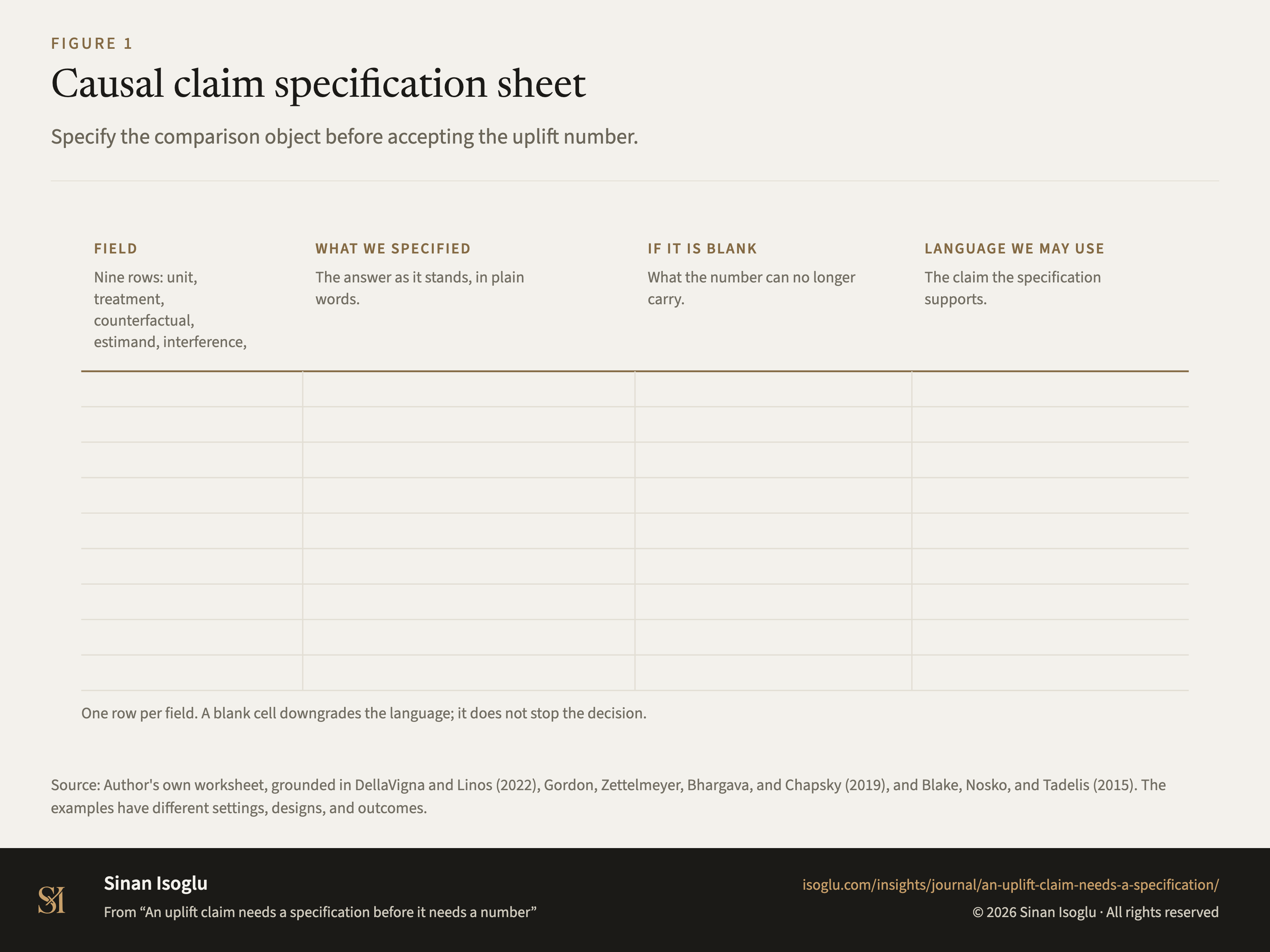
Causal claim specification sheet
Specify the comparison object before accepting the uplift number.
Figure 1Causal claim specification sheet
Source: Author's own worksheet, grounded in DellaVigna and Linos (2022), Gordon, Zettelmeyer, Bhargava, and Chapsky (2019), and Blake, Nosko, and Tadelis (2015). The examples have different settings, designs, and outcomes.
Source and evidence
Each line names a claim related to this exhibit, its source, and how it was checked.
- A DELLAVIGNA22-C1 The published-sample figure, verbatim: "an 8.7 percentage point take-up effect, which is a 33.4% increase over the average control", where "the average impact of a nudge is very large"DellaVigna & Linos (2022), Econometrica 90(1), 81–116, abstract
- A DELLAVIGNA22-C2 The decomposition, verbatim: "selective publication in the Academic Journals sample, exacerbated by low statistical power, explains about 70 percent of the difference in effect sizes between the two samples. Different nudge characteristics account for most of the residual difference." A model result, never a raw measurementDellaVigna & Linos (2022), Econometrica 90(1), 81–116, abstract
- A DELLAVIGNA22-C3 The at-scale average, verbatim: "still sizable and highly statistically significant, but smaller at 1.4 percentage points, an 8.0% increase"DellaVigna & Linos (2022), Econometrica 90(1), 81–116, abstract
- A DELLAVIGNA22-C4 The census, verbatim: "We assemble a unique data set of 126 RCTs covering 23 million individuals, including all trials run by two of the largest Nudge Units in the United States"DellaVigna & Linos (2022), Econometrica 90(1), 81–116, abstract
- B GORDON19-C6 The randomized benchmark, with its interval: "this implies the ATT lift was 73%", and "the 95% bootstrapped confidence interval for this lift is [49%, 103%]"Gordon et al. (2019), section 7.1
- B GORDON19-C7 The naive comparison, and the authors' own reading of it: exposed and unexposed conversion of 0.061% against 0.019%, "implying an ATT lift of 316%. This estimate represents the combined lift due to treatment and selection and is more than four times the lift due to treatment of 73%"Gordon et al. (2019), section 7.2
- B GORDON19-C8 Matching on demographics is not enough: "exact matching on age and gender alone performs poorly, yielding a lift of 222%"Gordon et al. (2019), section 7.2.1
- B GORDON19-C9 The count, and the qualification the authors attach to it: "the point estimates in 7 of the 14 studies with a checkout-conversion outcome are consistently off by more than a factor of three", while "observational methods do a better job of approximating RCT outcomes for registration and page"-view outcomesGordon et al. (2019), section 7.3
- B BNT15-C2 The strongest result is stated as an extreme case, not a rule: "as an extreme case, we show that brand keyword ads have no measurable short-term bene"fitsBlake, Nosko & Tadelis (2015), abstract
- B BNT15-C4 And the half usually dropped: "for non-brand keywords, we find that new and infrequent users are positively influenced by ads"Blake, Nosko & Tadelis (2015), abstract
- B BNT15-C5 The experimental non-brand ROI, and the contrast that makes it worth quoting: OLS "which result in a ROI of over 4,100% without time and geographic controls", while "We then used our experimental methods to control for endogeneity and found a ROI of" -63%, "rejecting the hypothesis that the channel yields any short-run positive returns"Blake, Nosko & Tadelis (2015), section 3.1
- B B11-C1 An uplift claim is incomplete until treatment, counterfactual, estimand, interference boundary, outcome window, and measurement object are specifiedAuthor framework grounded in DellaVigna and Linos, Gordon et al., and Blake et al.
- B B11-C2 A large exposed-versus-unexposed difference can be a selection or measurement contrast rather than a treatment effectAuthor framework grounded in the observational-versus-RCT comparisons above
Grades: A, verified against the printed page of the primary source · B, primary source, text layer only · C, authoritative secondary · D, reported.
From the essay
From the research bench
An uplift claim needs a specification before it needs a number
An uplift claim is incomplete until treatment, counterfactual, estimand, interference, time window, and outcome measure are specified before the number.
Read the essayThis exhibit belongs to an essay: the numbers live here, the argument lives there.
Cite or embed
Related exhibits
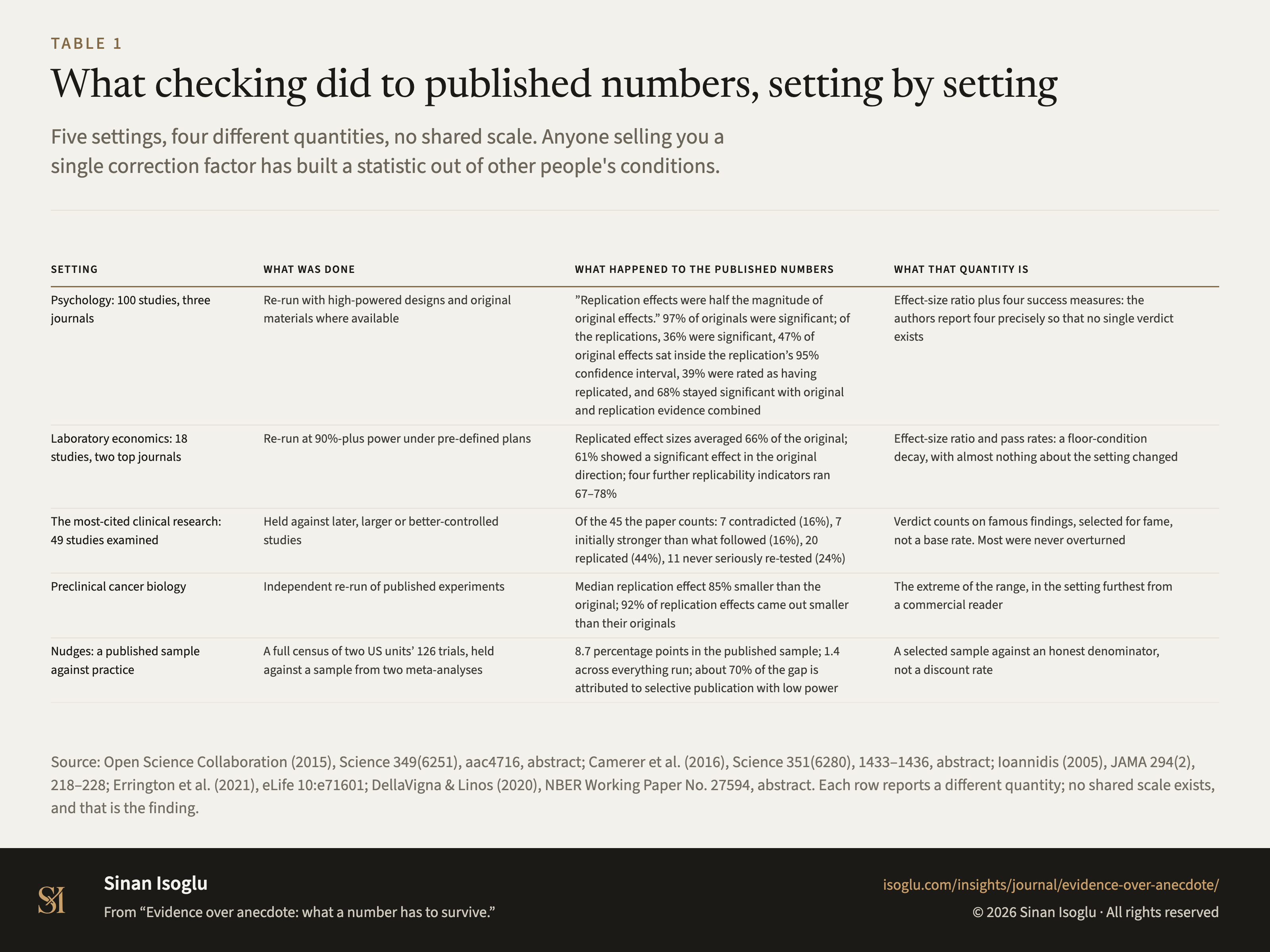
Table 1Table
What checking did to published numbers, setting by setting
Evidence over anecdote: what a number has to survive.
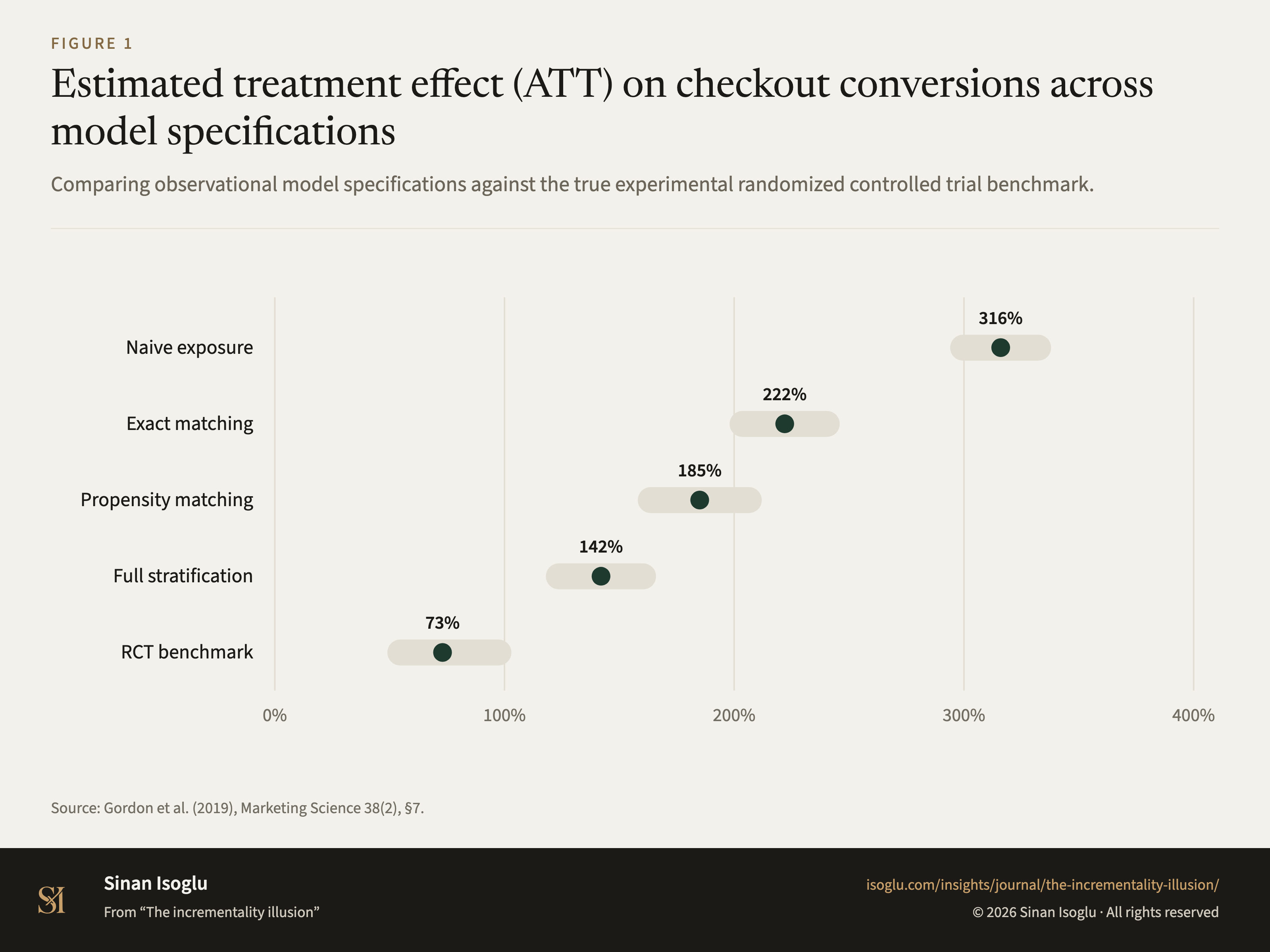
Figure 1Figure
Estimated treatment effect (ATT) on checkout conversions in study 4, by method
The incrementality illusion
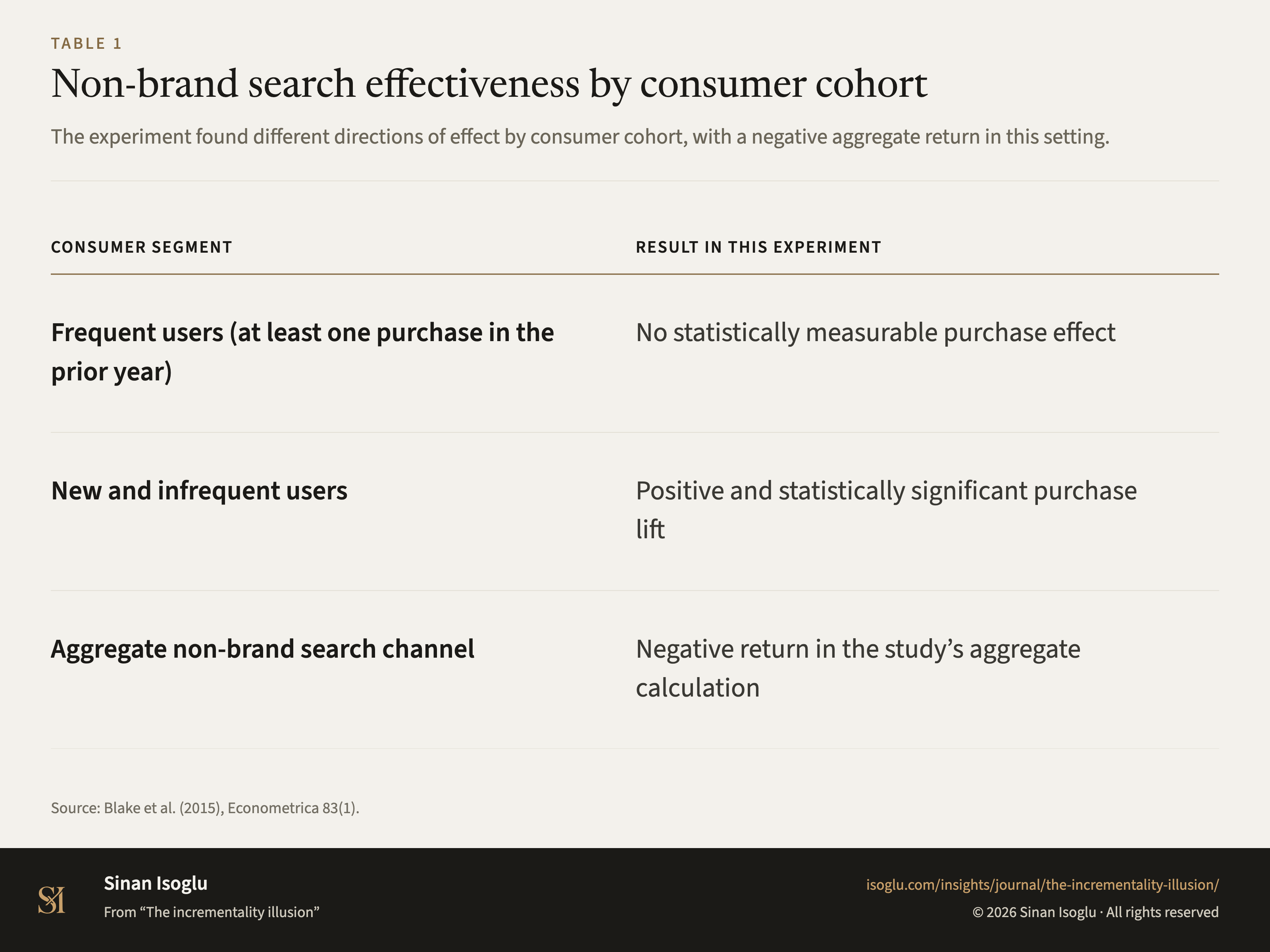
Table 1Table
Non-brand search effectiveness by consumer cohort
The incrementality illusion
Contact
Bring the question you're working on.
Research, a guest lecture, or a commercial question.