Tabelle 1Aus „Die Inkrementalitäts-Illusion“
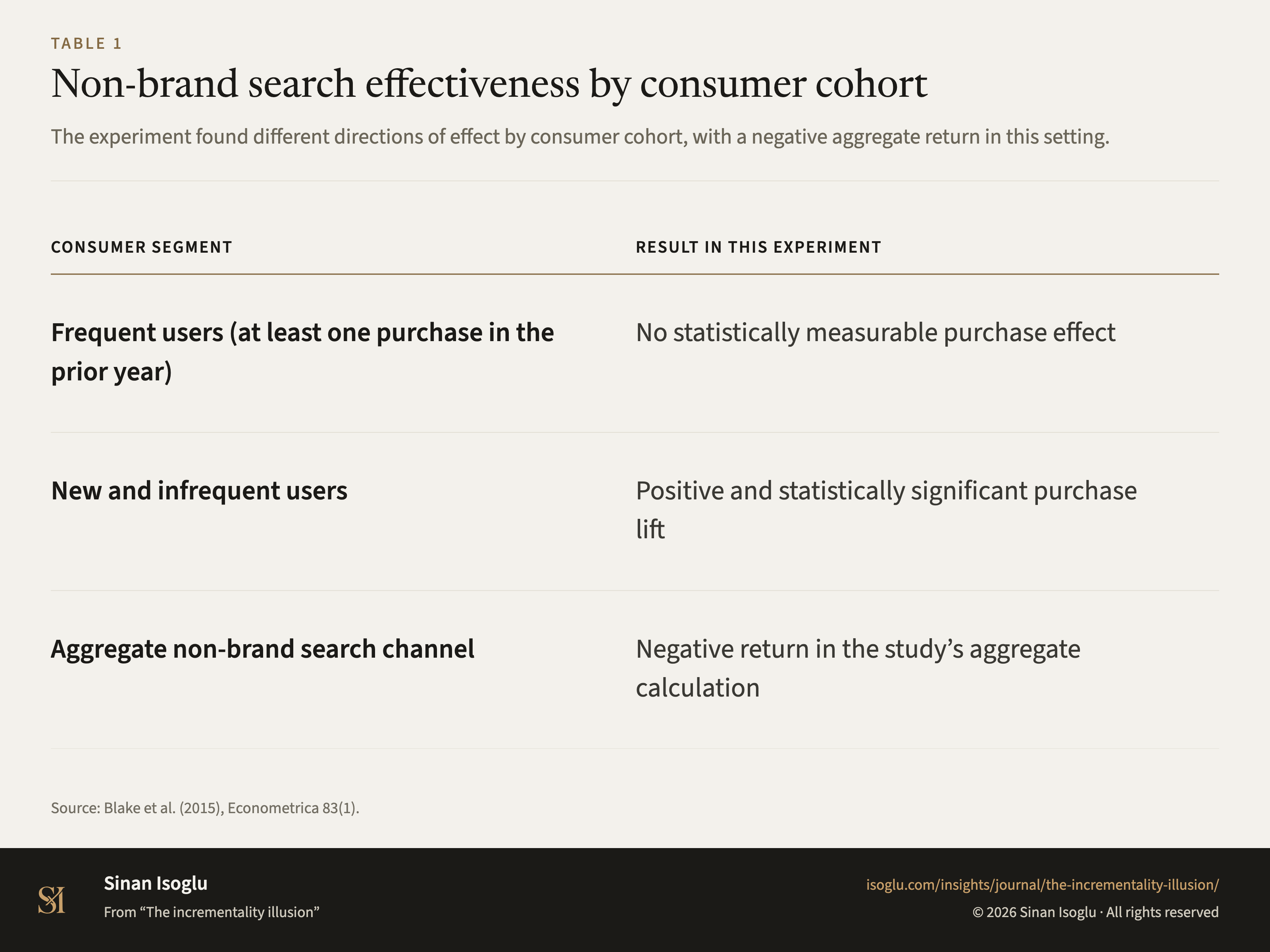
Effektivität von Non-Brand-Search nach Nutzerkohorten
Qualitative Einordnung des Experiments: Effekte und Budgetanteile werden nur soweit beschrieben, wie die Studie sie ausweist.
Tabelle 1Effektivität von Non-Brand-Search nach Nutzerkohorten
| Konsumenten-Segment | Ergebnis in diesem Experiment |
|---|---|
| Häufige Nutzer (mindestens ein Kauf im Vorjahr) | Kein statistisch messbarer Kaufeffekt |
| Neue und seltene Nutzer | Positiver und statistisch signifikanter Kauf-Uplift |
| Nicht-Marken-Suchkanal insgesamt | Negative Rendite in der aggregierten Berechnung der Studie |
Bei breiten Tabellen horizontal wischen oder scrollen.
Quelle: Blake et al. (2015), Econometrica 83(1).
Quelle und Evidenz
Jede Zeile nennt eine Aussage zu dieser Abbildung, ihre Quelle und die Art ihrer Prüfung.
- B BNT15-C2 The strongest result is stated as an extreme case, not a rule: "as an extreme case, we show that brand keyword ads have no measurable short-term bene"fitsBlake, Nosko & Tadelis (2015), abstract
- B BNT15-C3 Who the spend goes to: "more frequent users whose purchasing behavior is not influenced by ads account for most of the advertising expenses, resulting in average returns that are negative"Blake, Nosko & Tadelis (2015), abstract
- B BNT15-C4 And the half usually dropped: "for non-brand keywords, we find that new and infrequent users are positively influenced by ads"Blake, Nosko & Tadelis (2015), abstract
- B BNT15-C5 The experimental non-brand ROI, and the contrast that makes it worth quoting: OLS "which result in a ROI of over 4,100% without time and geographic controls", while "We then used our experimental methods to control for endogeneity and found a ROI of" -63%, "rejecting the hypothesis that the channel yields any short-run positive returns"Blake, Nosko & Tadelis (2015), section 3.1
Prüfgrade: A, gegen die gedruckte Seite der Primärquelle geprüft · B, Primärquelle, nur Textebene · C, belastbare Sekundärquelle · D, berichtet.
Aus dem Beitrag
Wachstum, das sich potenziert
Die Inkrementalitäts-Illusion
Warum Attributions-Dashboards Phantom-Renditen melden, während Holdout-Tests wenig oder keinen Uplift finden und wie kausale Messung planbar wird.
Den Beitrag lesenDiese Abbildung gehört zu einem Essay: Die Zahlen stehen hier, das Argument dort.
Zitieren oder einbetten
Verwandte Abbildungen
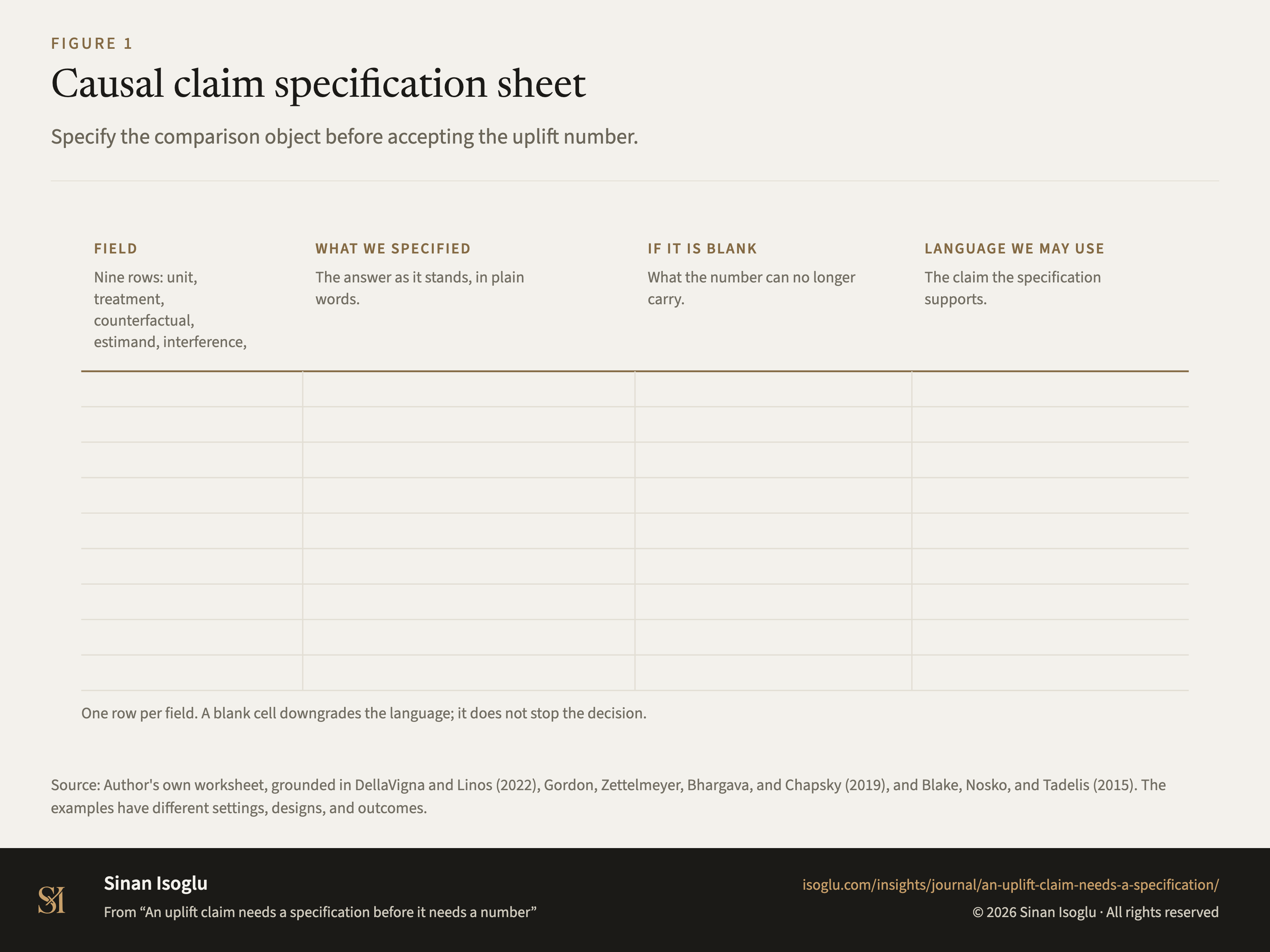
Abbildung 1Grafik
Spezifikationsblatt für kausale Aussagen
Ein Uplift braucht zuerst eine Spezifikation
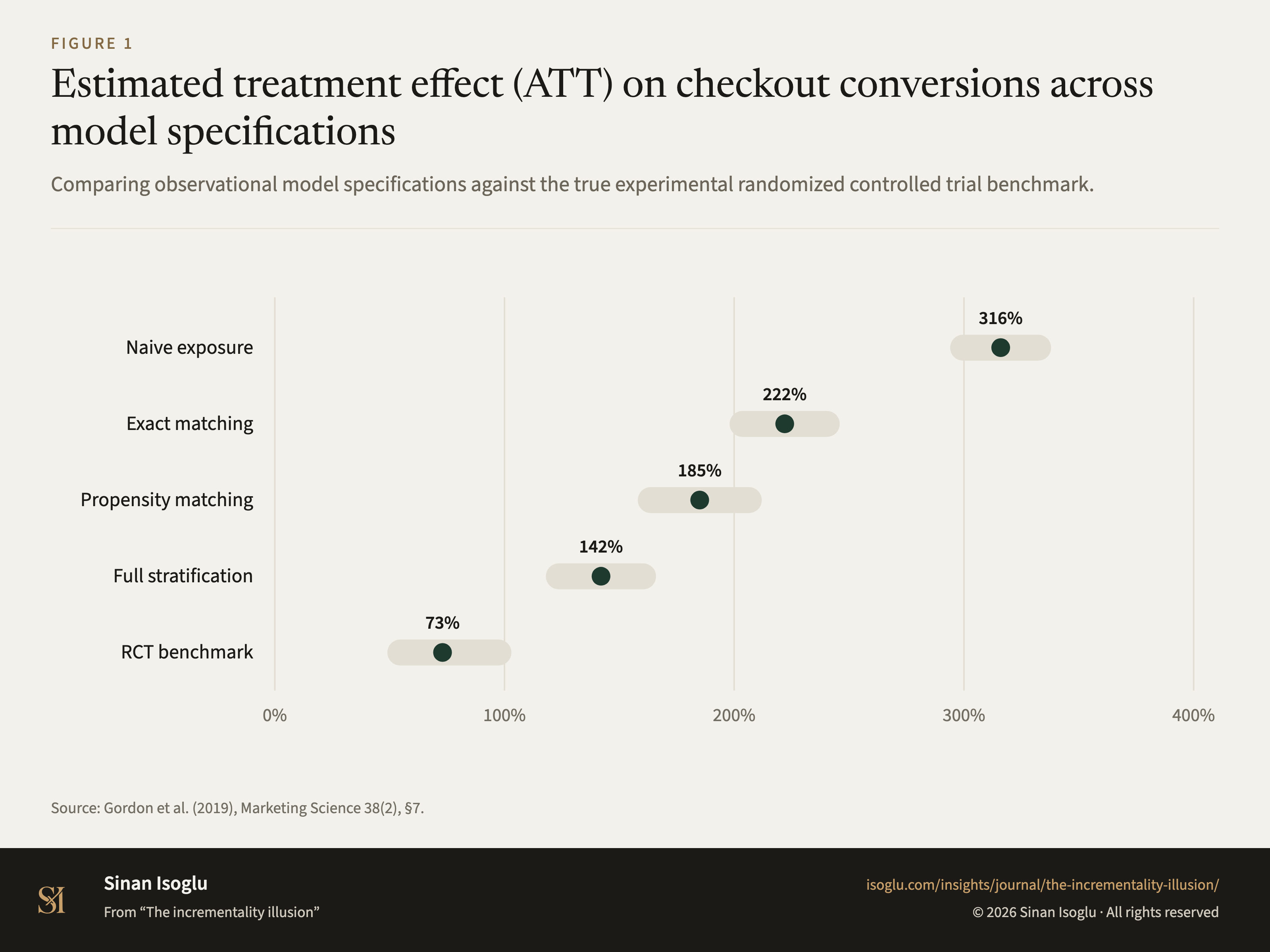
Abbildung 1Grafik
Geschätzter Behandlungseffekt (ATT) auf Checkout-Konversionen in Studie 4, nach Verfahren
Die Inkrementalitäts-Illusion
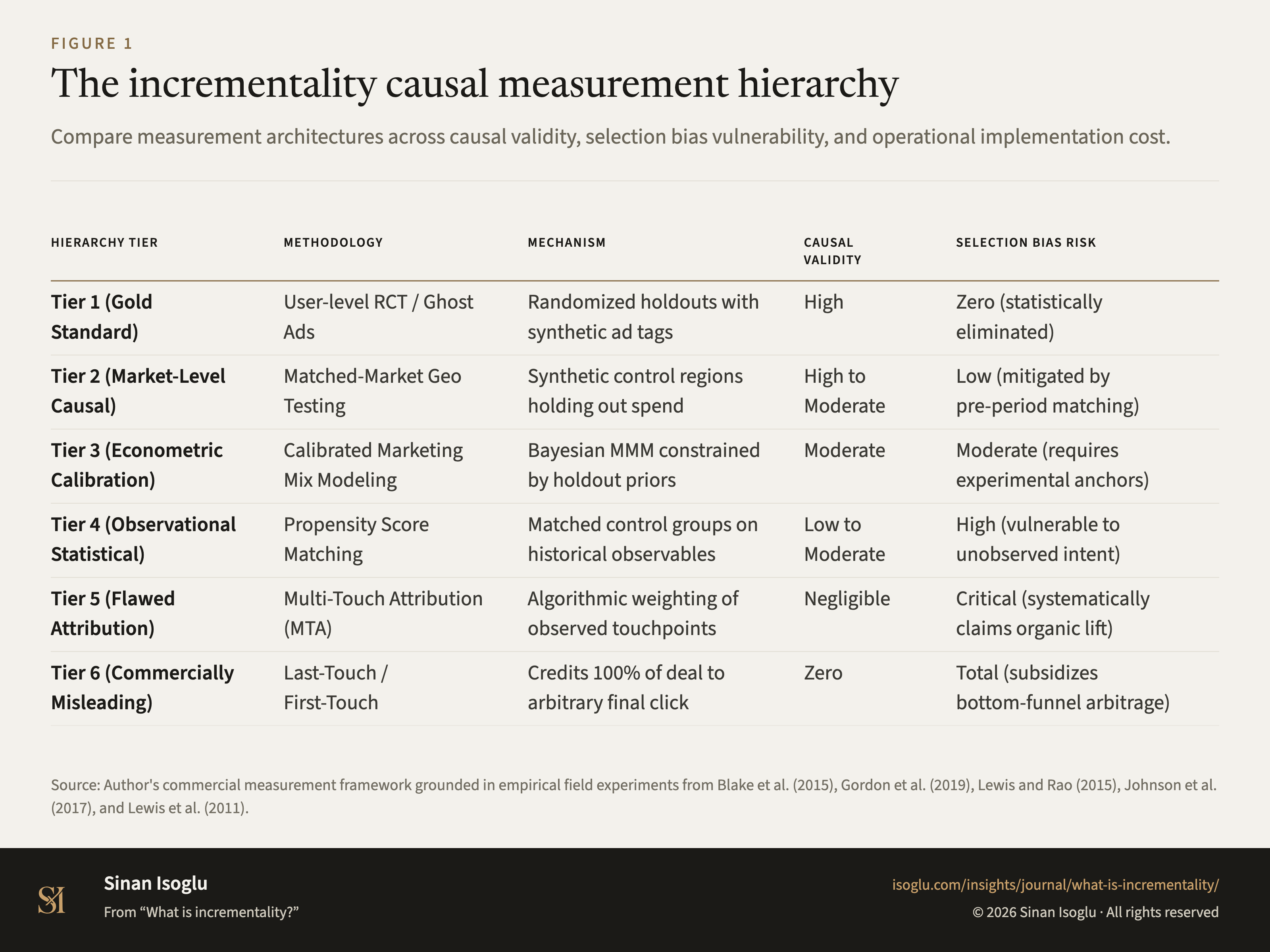
Abbildung 1Grafik
Die kausale Messhierarchie der Inkrementalität
Was ist Inkrementalität?
Kontakt
Schicken Sie die Frage, an der Sie arbeiten.
Forschung, ein Gastvortrag oder eine Frage aus der Praxis.