Table 1From “The European failure number nobody quotes”
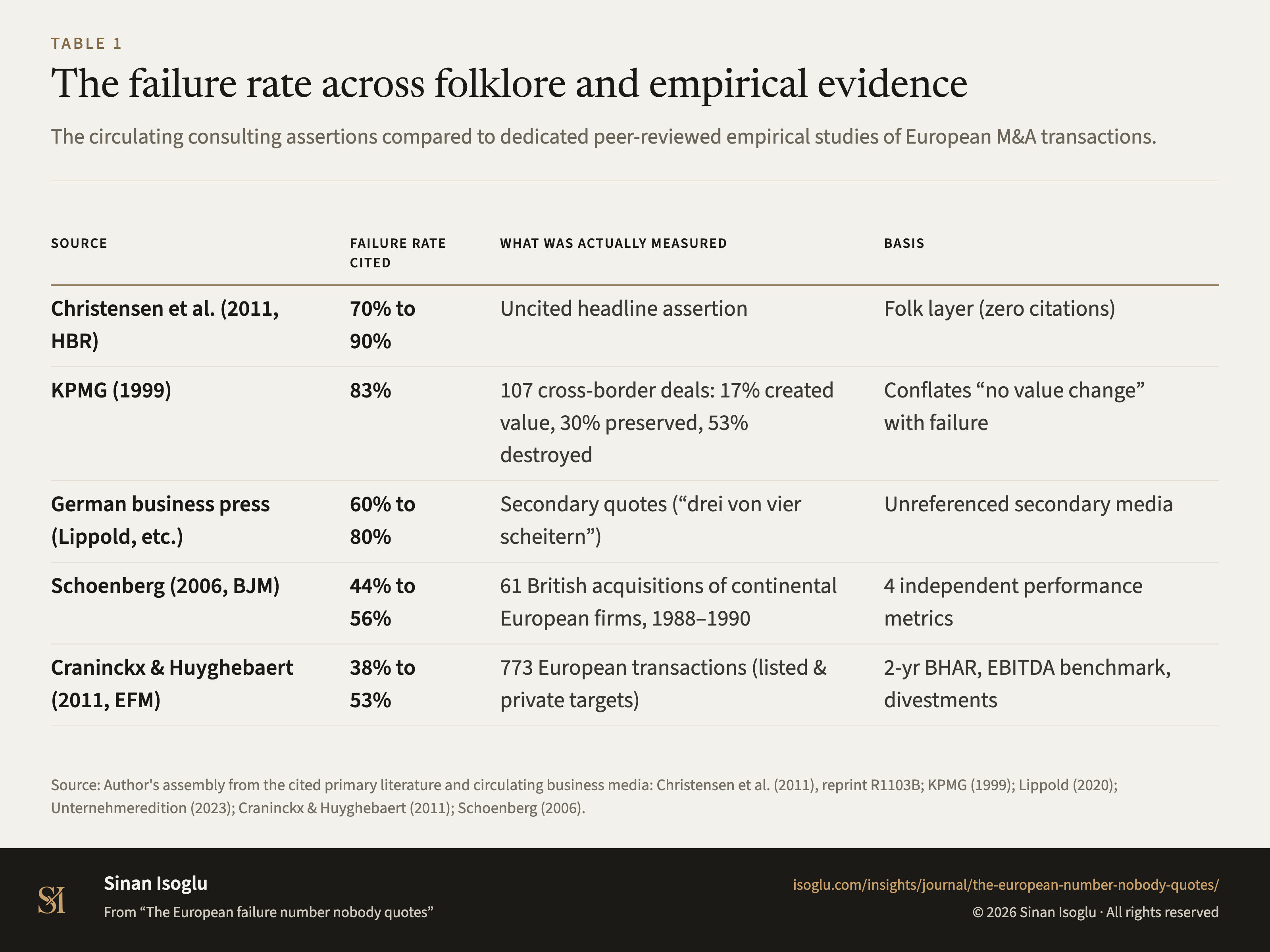
The failure rate across folklore and empirical evidence
The circulating consulting assertions compared to dedicated peer-reviewed empirical studies of European M&A transactions.
Table 1The failure rate across folklore and empirical evidence
| Source | Failure rate cited | What was actually measured | Basis |
|---|---|---|---|
| Christensen et al. (2011, HBR) | 70% to 90% | Uncited headline assertion | Folk layer (zero citations) |
| KPMG (1999) | 83% | 107 cross-border deals: 17% created value, 30% preserved, 53% destroyed | Conflates "no value change" with failure |
| German business press (Lippold, etc.) | 60% to 80% | Secondary quotes ("drei von vier scheitern") | Unreferenced secondary media |
| Schoenberg (2006, BJM) | 44% to 56% | 61 British acquisitions of continental European firms, 1988–1990 | 4 independent performance metrics |
| Craninckx & Huyghebaert (2011, EFM) | 38% to 53% | 773 European transactions (listed & private targets) | 2-yr BHAR, EBITDA benchmark, divestments |
Swipe or scroll horizontally if the table is wider than your screen.
Source: Author's assembly from the cited primary literature and circulating business media: Christensen et al. (2011), reprint R1103B; KPMG (1999); Lippold (2020); Unternehmeredition (2023); Craninckx & Huyghebaert (2011); Schoenberg (2006).
From the essay
Growth that compounds
The European failure number nobody quotes
Every European boardroom repeats that 70% to 90% of mergers fail. The peer-reviewed European record measures value destruction at roughly half.
Read the essayThis exhibit belongs to an essay: the numbers live here, the argument lives there.
Cite or embed
Related exhibits
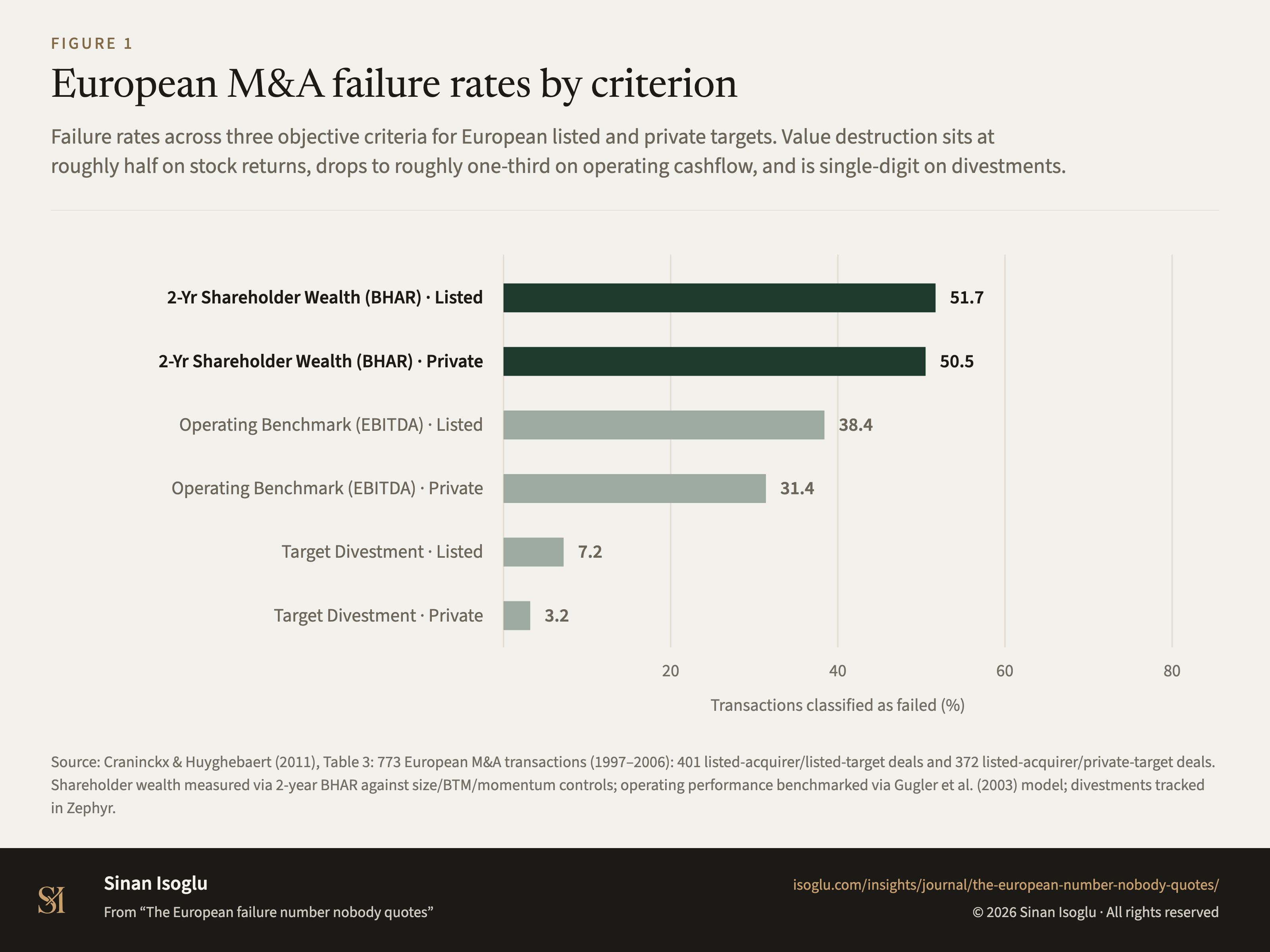
Figure 1Figure
European M&A failure rates by criterion
The European failure number nobody quotes
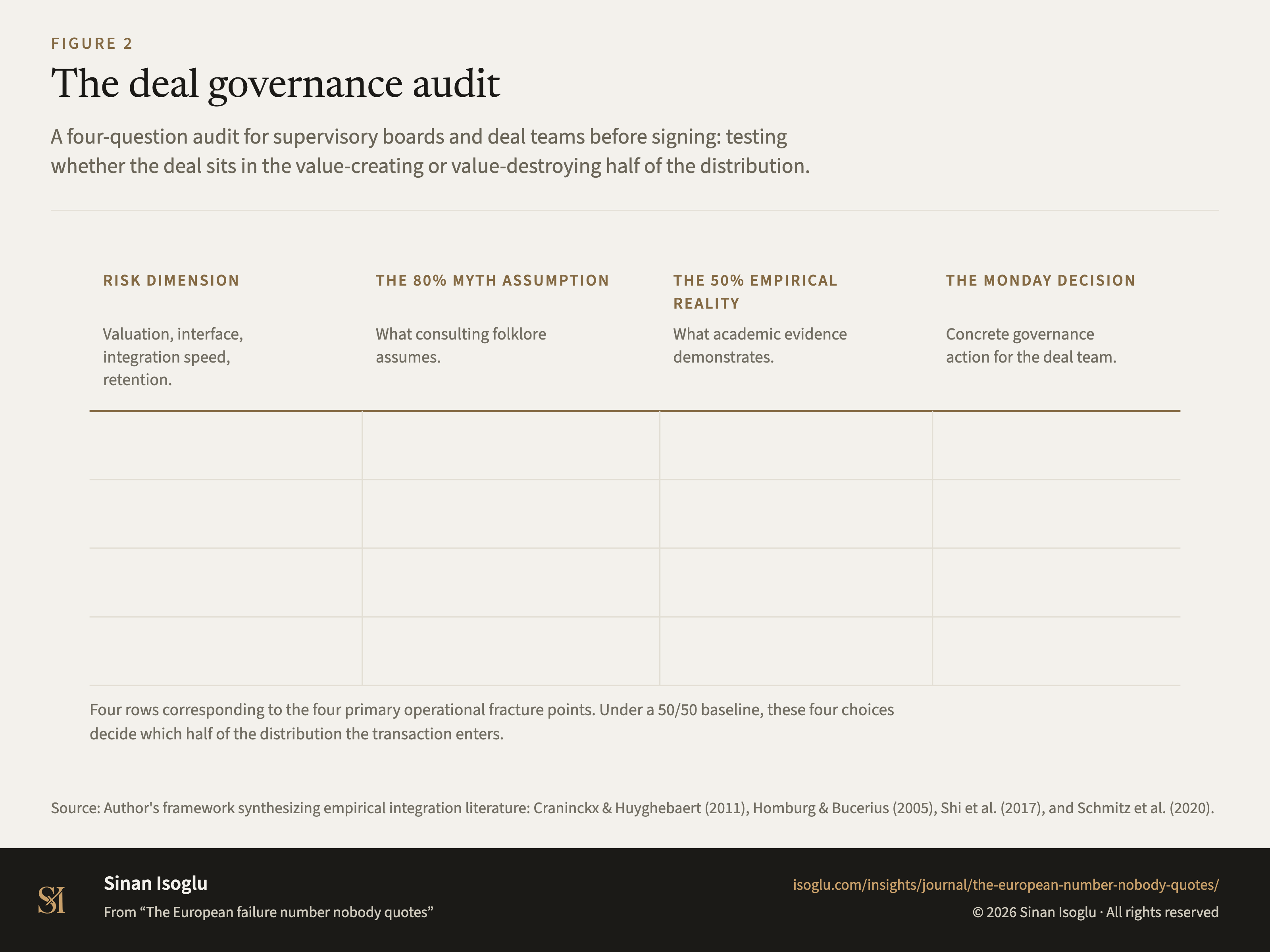
Figure 2Figure
The deal governance audit
The European failure number nobody quotes
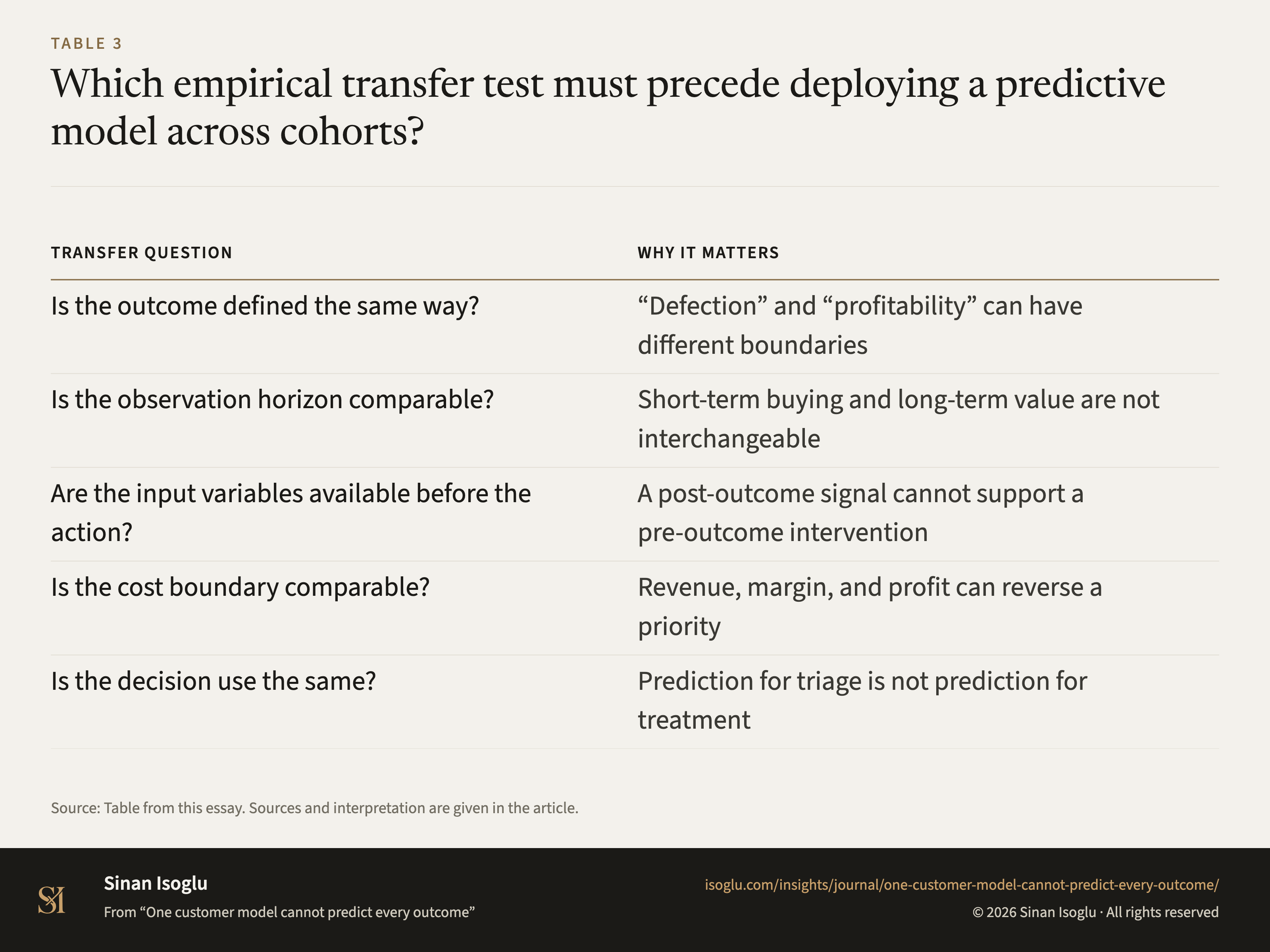
Table 3Table
Which empirical transfer test must precede deploying a predictive model across cohorts?
One customer model cannot predict every outcome
Contact
Bring the question you're working on.
Research, a guest lecture, or a commercial question.