Table 3From “One customer model cannot predict every outcome”
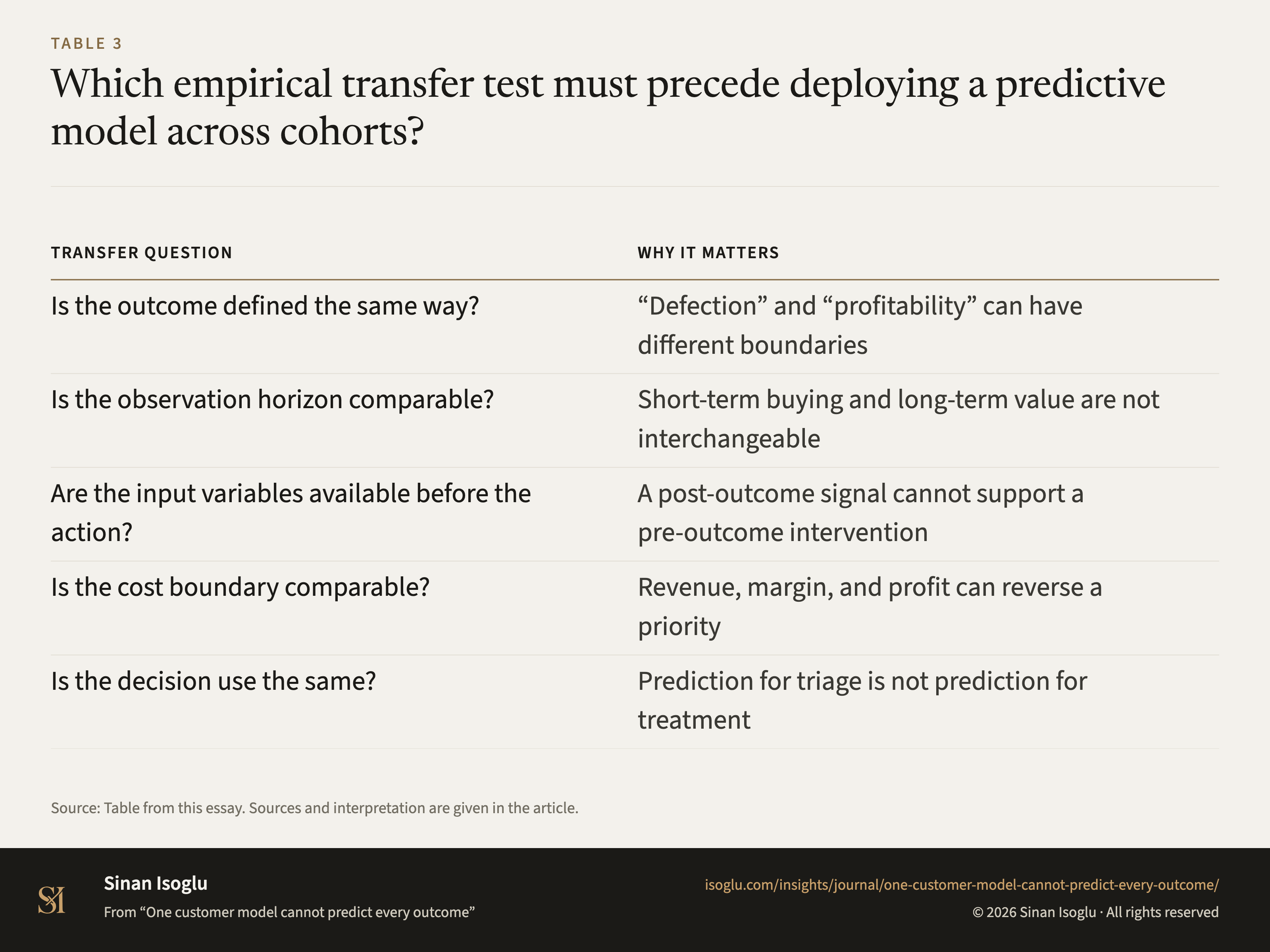
Which empirical transfer test must precede deploying a predictive model across cohorts?
Table 3Which empirical transfer test must precede deploying a predictive model across cohorts?
| Transfer question | Why it matters |
|---|---|
| Is the outcome defined the same way? | “Defection” and “profitability” can have different boundaries |
| Is the observation horizon comparable? | Short-term buying and long-term value are not interchangeable |
| Are the input variables available before the action? | A post-outcome signal cannot support a pre-outcome intervention |
| Is the cost boundary comparable? | Revenue, margin, and profit can reverse a priority |
| Is the decision use the same? | Prediction for triage is not prediction for treatment |
Swipe or scroll horizontally if the table is wider than your screen.
Source: Table from this essay. Sources and interpretation are given in the article.
From the essay
Growth that compounds
One customer model cannot predict every outcome
Next purchase, partial defection, and profitability are different outcomes: choose the model and validation question before trusting one customer score.
Read the essayThis exhibit belongs to an essay: the numbers live here, the argument lives there.
Cite or embed
Related exhibits
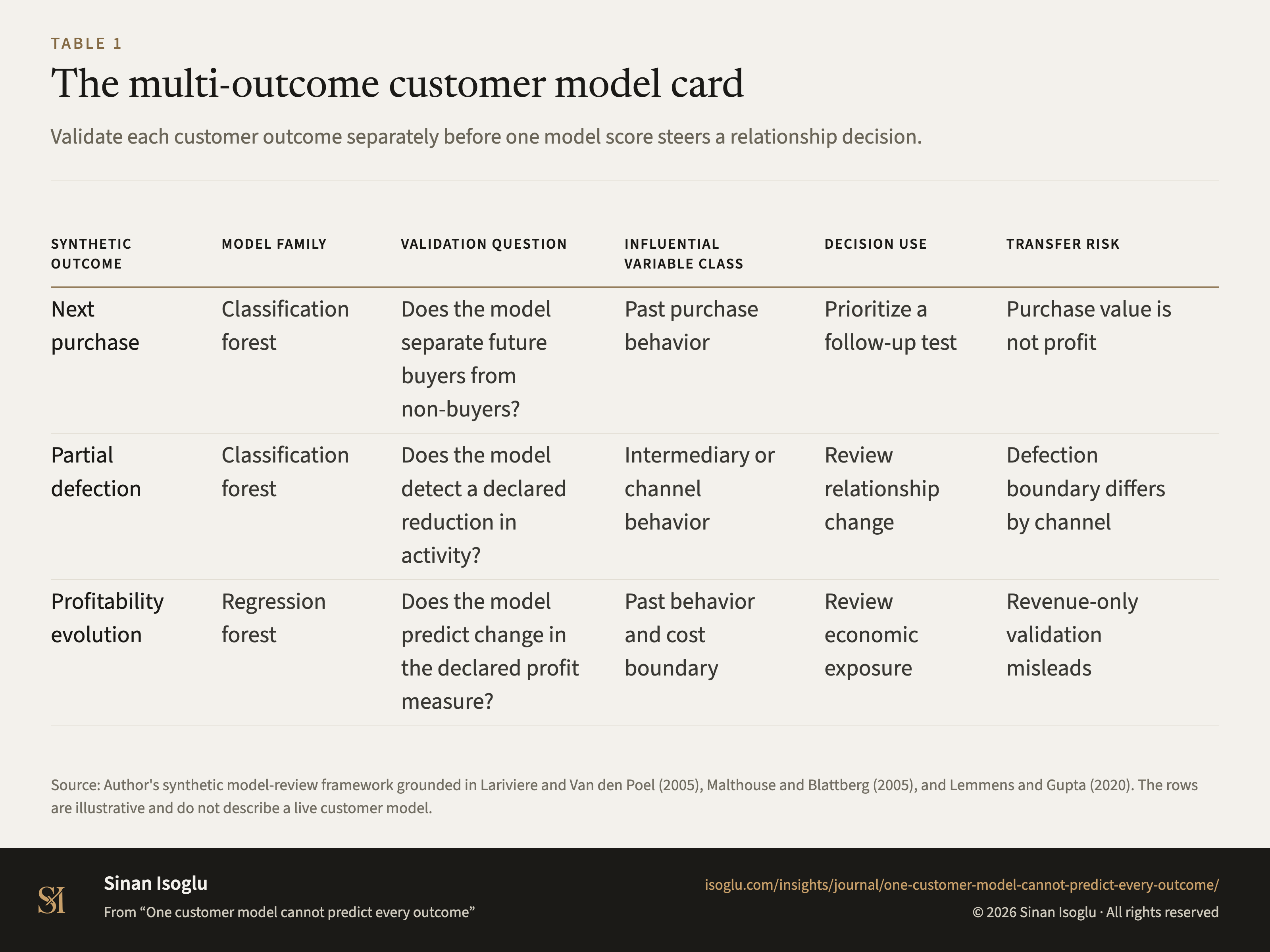
Table 1Table
The multi-outcome customer model card
One customer model cannot predict every outcome
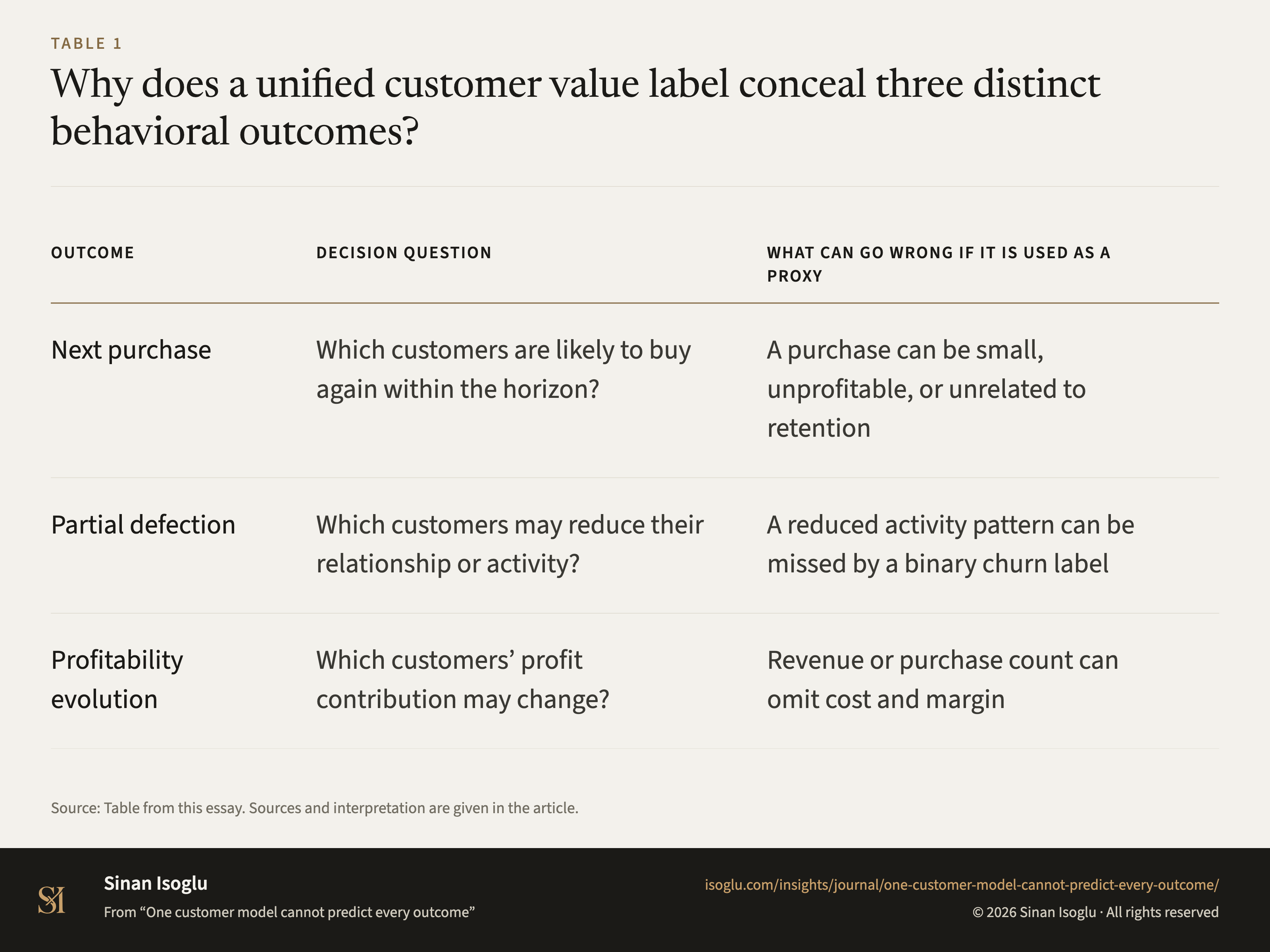
Table 1Table
Why does a unified customer value label conceal three distinct behavioral outcomes?
One customer model cannot predict every outcome
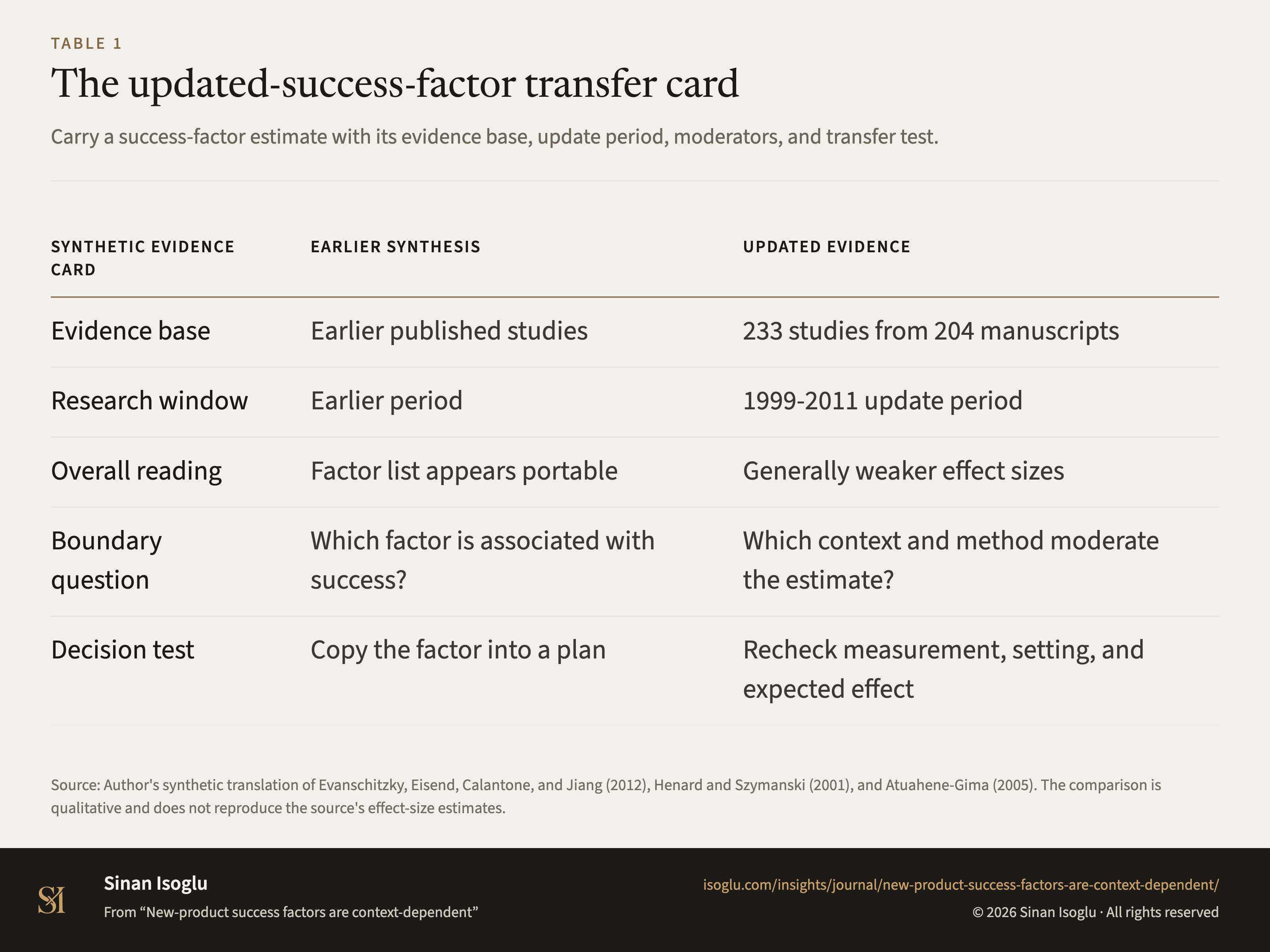
Table 1Table
The updated-success-factor transfer card
New-product success factors are context-dependent
Contact
Bring the question you're working on.
Research, a guest lecture, or a commercial question.