Table 1From “Mixed reactions are not brand polarization”
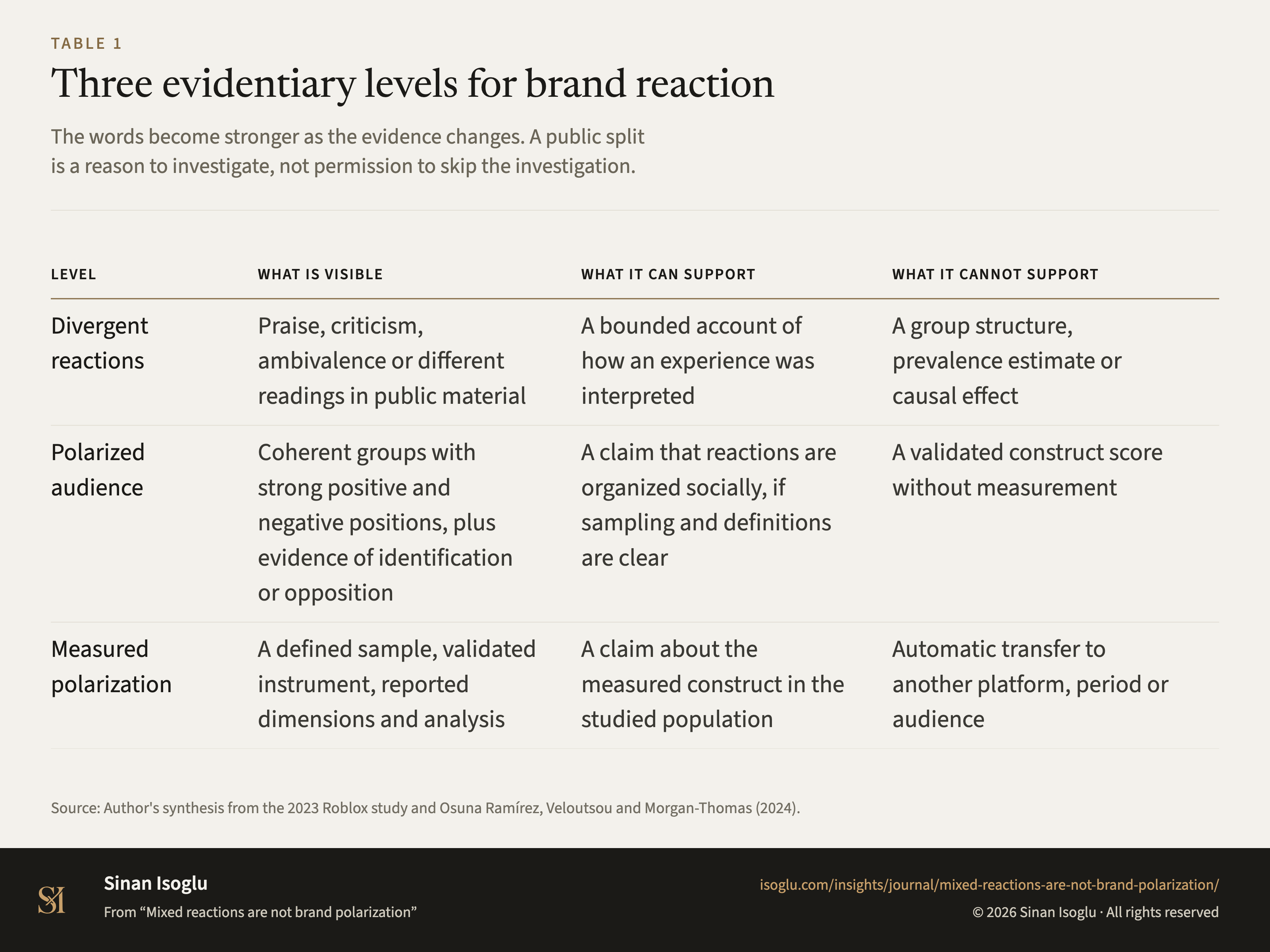
Three evidentiary levels for brand reaction
The words become stronger as the evidence changes. A public split is a reason to investigate, not permission to skip the investigation.
Table 1Three evidentiary levels for brand reaction
| Level | What is visible | What it can support | What it cannot support |
|---|---|---|---|
| Divergent reactions | Praise, criticism, ambivalence or different readings in public material | A bounded account of how an experience was interpreted | A group structure, prevalence estimate or causal effect |
| Polarized audience | Coherent groups with strong positive and negative positions, plus evidence of identification or opposition | A claim that reactions are organized socially, if sampling and definitions are clear | A validated construct score without measurement |
| Measured polarization | A defined sample, validated instrument, reported dimensions and analysis | A claim about the measured construct in the studied population | Automatic transfer to another platform, period or audience |
Swipe or scroll horizontally if the table is wider than your screen.
Source: Author's synthesis from the 2023 Roblox study and Osuna Ramírez, Veloutsou and Morgan-Thomas (2024).
Source and evidence
Each line names a claim related to this exhibit, its source, and how it was checked.
- B SI23-C10 The study is a purposive qualitative case account and not a representative or causal estimateSubmitted Isoglu (2023) bachelor thesis, method and limitations
- B SI23-C11 The case synthesis describes divergent readings and does not count sentiment or measure a populationSubmitted Isoglu (2023) bachelor thesis, method audit and article design
- A OR24-C1 Brand polarization is defined by strong feeling at both ends rather than by mixed opinion: "polarization maintains strong emotions at both ends of the spectrum, concurrently attending to the antipodes of brand love and brand hate", and as an outcome it is a brand property: "As an outcome, polarization is a property of a brand, where a polarizing brand causes sharp division into opposing groups of individuals"Osuna et al. (2024)
- A OR24-C2 The measure is a scale with named dimensions, not a label: "four dimensions and twenty-three items: brand passion (eight items), self-brand benchmarking (five items), intra-group identification (five items) and inter-group dissociation (five items)"Osuna et al. (2024)
Grades: A, verified against the printed page of the primary source · B, primary source, text layer only · C, authoritative secondary · D, reported.
From the essay
From the research bench
Mixed reactions are not brand polarization
A split in Roblox reactions can be worth studying without becoming proof of brand polarization, and the distinction changes what evidence comes next.
Read the essayThis exhibit belongs to an essay: the numbers live here, the argument lives there.
Cite or embed
Contact
Bring the question you're working on.
Research, a guest lecture, or a commercial question.