Table 1From “The asset that can leave, and what keeping it costs”
The standard cures, and what each one costs
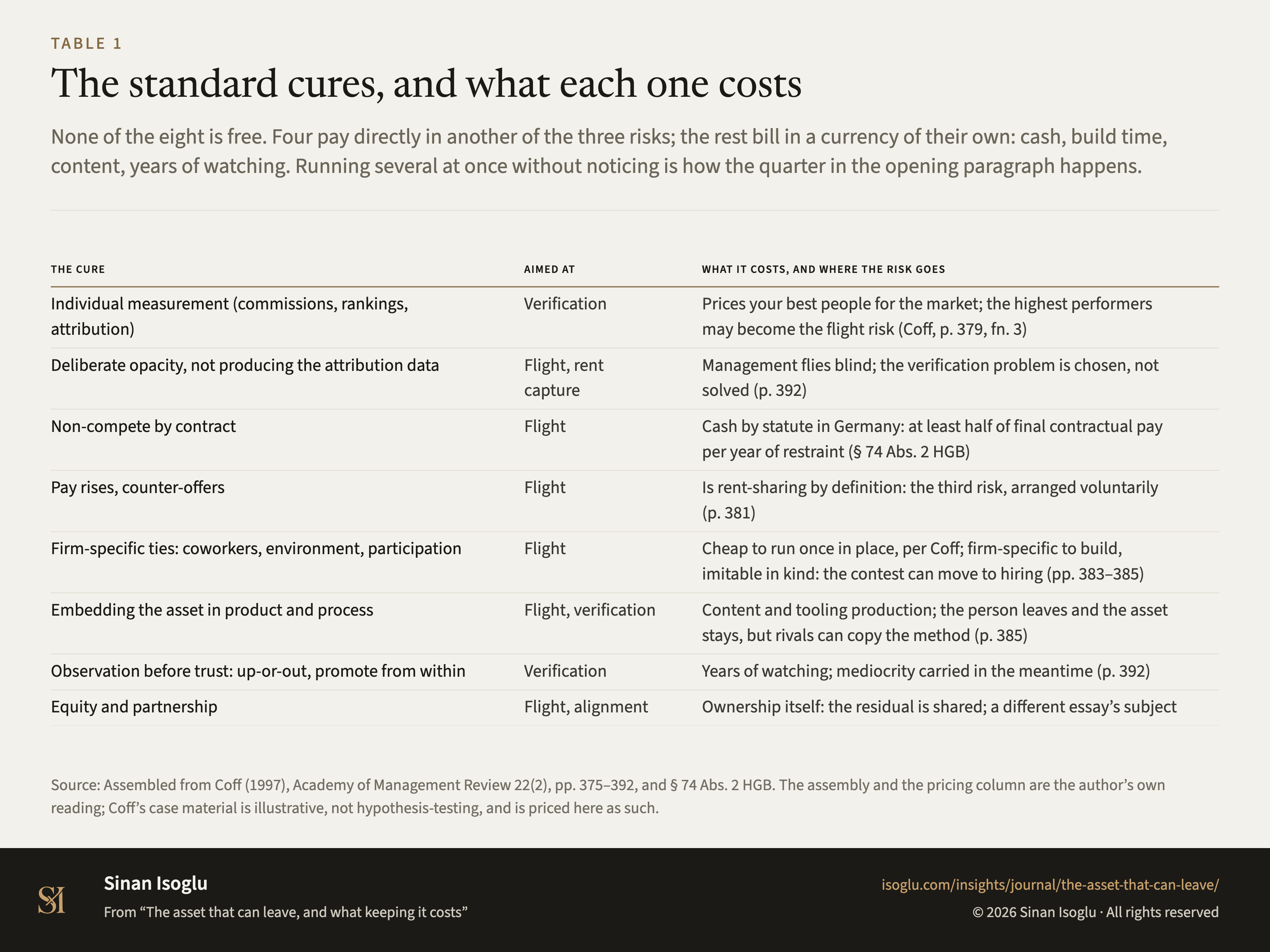
None of the eight is free. Four pay directly in another of the three risks; the rest bill in a currency of their own: cash, build time, content, years of watching. Running several at once without noticing is how the quarter in the opening paragraph happens.
Table 1The standard cures, and what each one costs
| The cure | Aimed at | What it costs, and where the risk goes |
|---|---|---|
| Individual measurement (commissions, rankings, attribution) | Verification | Prices your best people for the market; the highest performers may become the flight risk (Coff, p. 379, fn. 3) |
| Deliberate opacity, not producing the attribution data | Flight, rent capture | Management flies blind; the verification problem is chosen, not solved (p. 392) |
| Non-compete by contract | Flight | Cash by statute in Germany: at least half of final contractual pay per year of restraint (§ 74 Abs. 2 HGB) |
| Pay rises, counter-offers | Flight | Is rent-sharing by definition: the third risk, arranged voluntarily (p. 381) |
| Firm-specific ties: coworkers, environment, participation | Flight | Cheap to run once in place, per Coff; firm-specific to build, imitable in kind: the contest can move to hiring (pp. 383–385) |
| Embedding the asset in product and process | Flight, verification | Content and tooling production; the person leaves and the asset stays, but rivals can copy the method (p. 385) |
| Observation before trust: up-or-out, promote from within | Verification | Years of watching; mediocrity carried in the meantime (p. 392) |
| Equity and partnership | Flight, alignment | Ownership itself: the residual is shared; a different essay's subject |
Swipe or scroll horizontally if the table is wider than your screen.
Source: Assembled from Coff (1997), Academy of Management Review 22(2), pp. 375–392, and § 74 Abs. 2 HGB. The assembly and the pricing column are the author’s own reading; Coff’s case material is illustrative, not hypothesis-testing, and is priced here as such.
Source and evidence
Each line names a claim related to this exhibit, its source, and how it was checked.
- A COFF97-C6 If productivity is observable the risk reverses, which the paper states in a footnote rather than the body: "Note that if individual productivity is observable (i.e., no information problems), the" problem may be reversed and the highest performers may be at risk for turnovercoff-1997-human-assets
- A COFF97-C8 Retention is not rent-sharing by definition, and paying to prevent a quit is the second thing rather than the first: one simple "solution is to pay people enough so they will not quit", and although that promotes retention, it also allocates rent and is therefore "considered a rent-sharing strategy"coff-1997-human-assets
- A COFF97-C12 Training company embedded content in proprietary materials; exiting presenters stop presentingcoff-1997-human-assets
- A COFF97-C15 Magazine: up to three years to know if a replacement editor was bettercoff-1997-human-assets
- A COFF97-C17 Firms underinvest in attribution data to keep causal ambiguitycoff-1997-human-assets
- A COFF97-C19 Firm-specific compensation limits mobility: competitors cannot duplicate itcoff-1997-human-assets
- A COFF97-C20 Signing bonuses read as reimbursement for lost firm-specific compensationcoff-1997-human-assets
Grades: A, verified against the printed page of the primary source · B, primary source, text layer only · C, authoritative secondary · D, reported.
From the essay
Growth that compounds
The asset that can leave, and what keeping it costs
Part of what compounds in a commercial team sits in people. None of the standard ways to keep it is free: many are paid in another risk's currency.
Read the essayThis exhibit belongs to an essay: the numbers live here, the argument lives there.
Cite or embed
Related exhibits
Contact
Bring the question you're working on.
Research, a guest lecture, or a commercial question.