Figure 2From “Subsidizing one platform side can be a network design decision”
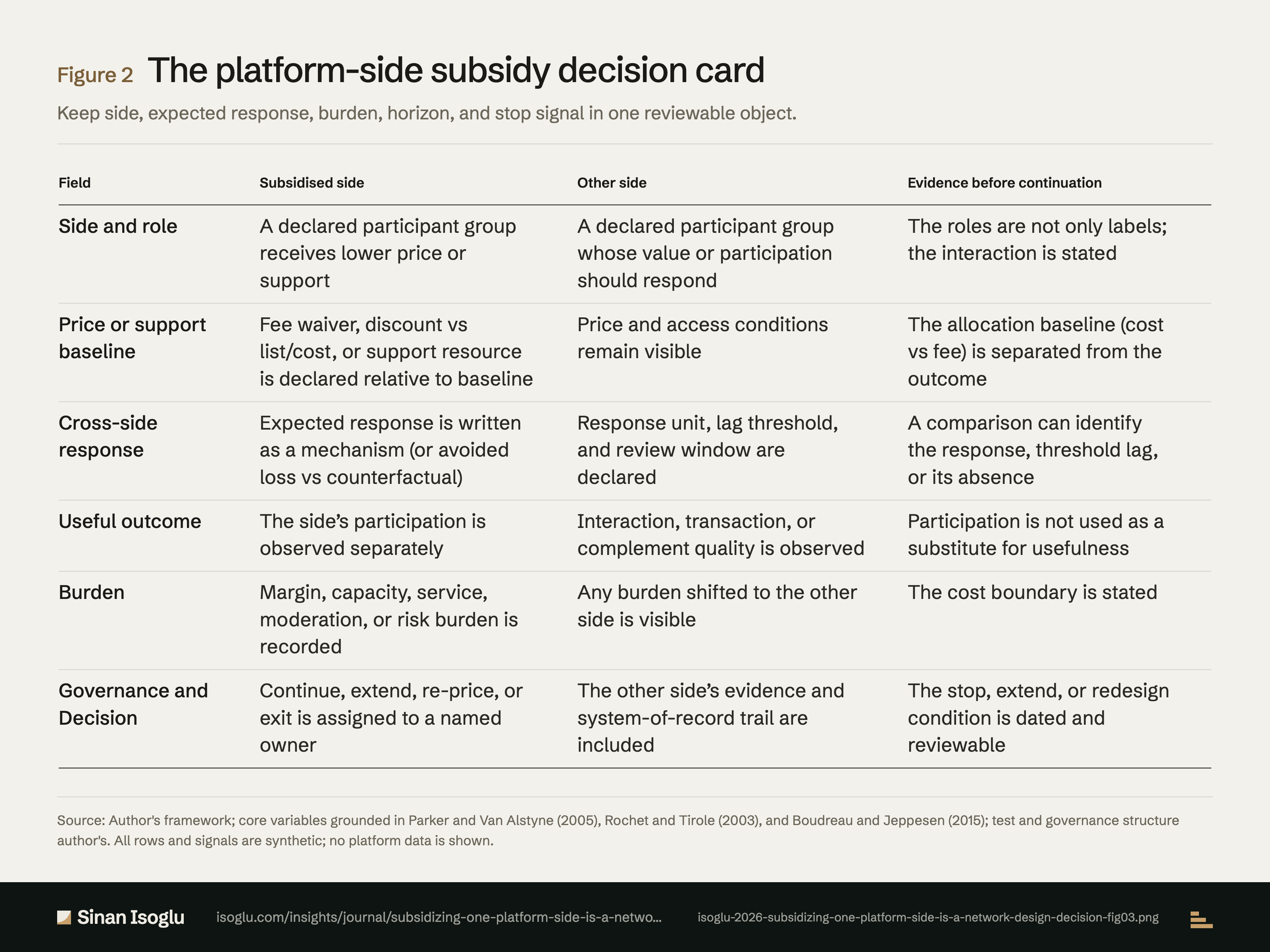
The platform-side subsidy decision card
Keep side, expected response, burden, horizon, and stop signal in one reviewable object.
Figure 2The platform-side subsidy decision card
| Field | Subsidised side | Other side | Evidence before continuation |
|---|---|---|---|
| Side and role | A declared participant group receives lower price or support | A declared participant group whose value or participation should respond | The roles are not only labels; the interaction is stated |
| Price or support baseline | Fee waiver, discount vs list/cost, or support resource is declared relative to baseline | Price and access conditions remain visible | The allocation baseline (cost vs fee) is separated from the outcome |
| Cross-side response | Expected response is written as a mechanism (or avoided loss vs counterfactual) | Response unit, lag threshold, and review window are declared | A comparison can identify the response, threshold lag, or its absence |
| Useful outcome | The side's participation is observed separately | Interaction, transaction, or complement quality is observed | Participation is not used as a substitute for usefulness |
| Burden | Margin, capacity, service, moderation, or risk burden is recorded | Any burden shifted to the other side is visible | The cost boundary is stated |
| Governance and Decision | Continue, extend, re-price, or exit is assigned to a named owner | The other side's evidence and system-of-record trail are included | The stop, extend, or redesign condition is dated and reviewable |
Swipe or scroll horizontally if the table is wider than your screen.
Source: Author's framework; core variables grounded in Parker and Van Alstyne (2005), Rochet and Tirole (2003), and Boudreau and Jeppesen (2015); test and governance structure author's. All rows and signals are synthetic; no platform data is shown.
Source and evidence
Each line names a claim related to this exhibit, its source, and how it was checked.
- A PVA05-C1 The formal model explains how firms can profitably give away information products by using two-sided network externalities: "a firm can rationally invest in a product it intends to give away into perpetuity"Parker & Van Alstyne. (2005)
- A PVA05-C2 Platform pricing and product design must account for cross-side network effects, price discrimination, and product differentiation, showing "which half of a two-sided network market to discount"Parker & Van Alstyne. (2005)
- A RT03-C1 The model describes platform competition in markets with network externalities where platforms "must choose a price structure and not only a price level"Rochet & Tirole. (2003)
- A BJ15-C2 In the reported setting, "complementor development responds to platform growth", but attracting complementors has a net-zero effect on ongoing developmentBoudreau & Jeppesen. (2015)
- B P01-OWN-C1 A side-allocation decision card should record each side, price or subsidy, expected cross-side response, burden, horizon, comparison, and decision owner.Author synthesis based on Parker and Van Alstyne (2005) and Rochet and Tirole (2003).
- B P01-OWN-C3 A subsidy review should separate participation, useful cross-side transactions, complement quality, cost burden, and continuation or exit evidence.Author synthesis based on Parker and Van Alstyne (2005), Rochet and Tirole (2003), and Boudreau and Jeppesen (2015).
- B P01-OWN-C4 The author card distinguishes continuation, bounded extension, re-pricing, exit, and pause or redesign: a defensive response needs an avoided-loss counterfactual; extension needs a predeclared lag or threshold, a dated second horizon and burden within bounds; a confounded comparison prompts pause or redesign before further commitment.Author decision rule; the cited studies do not set this threshold.
Grades: A, verified against the printed page of the primary source · B, primary source, text layer only · C, authoritative secondary · D, reported.
From the essay
Pricing & revenue architecture
Subsidizing one platform side can be a network design decision
A lower price can attract participation without creating useful network value. Name the side, response, burden, horizon, and stop rule before continuing.
Read the essayThis exhibit belongs to an essay: the numbers live here, the argument lives there.
Cite or embed
Related exhibits
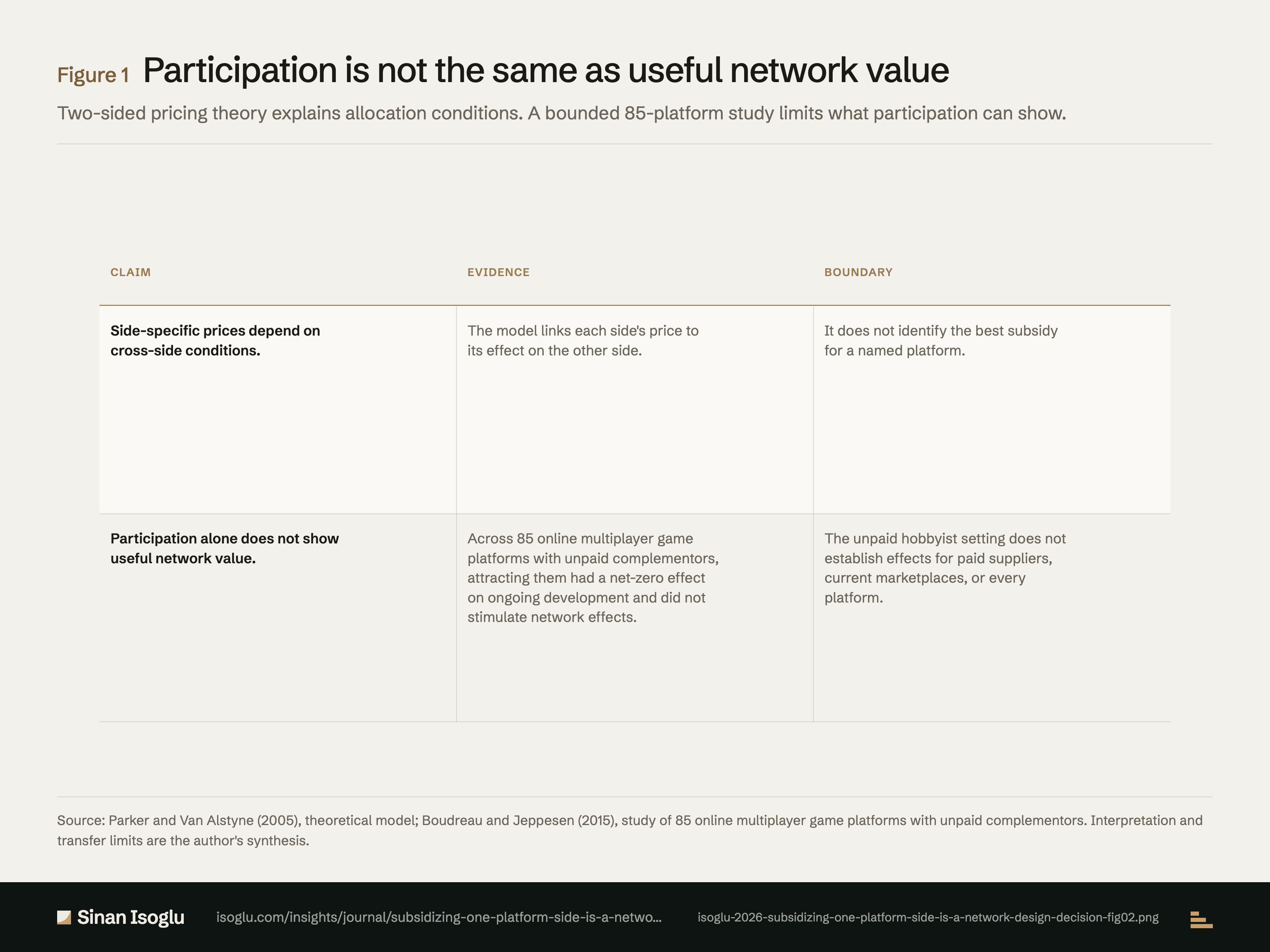
Figure 1Figure
Participation is not the same as useful network value
Subsidizing one platform side can be a network design decision
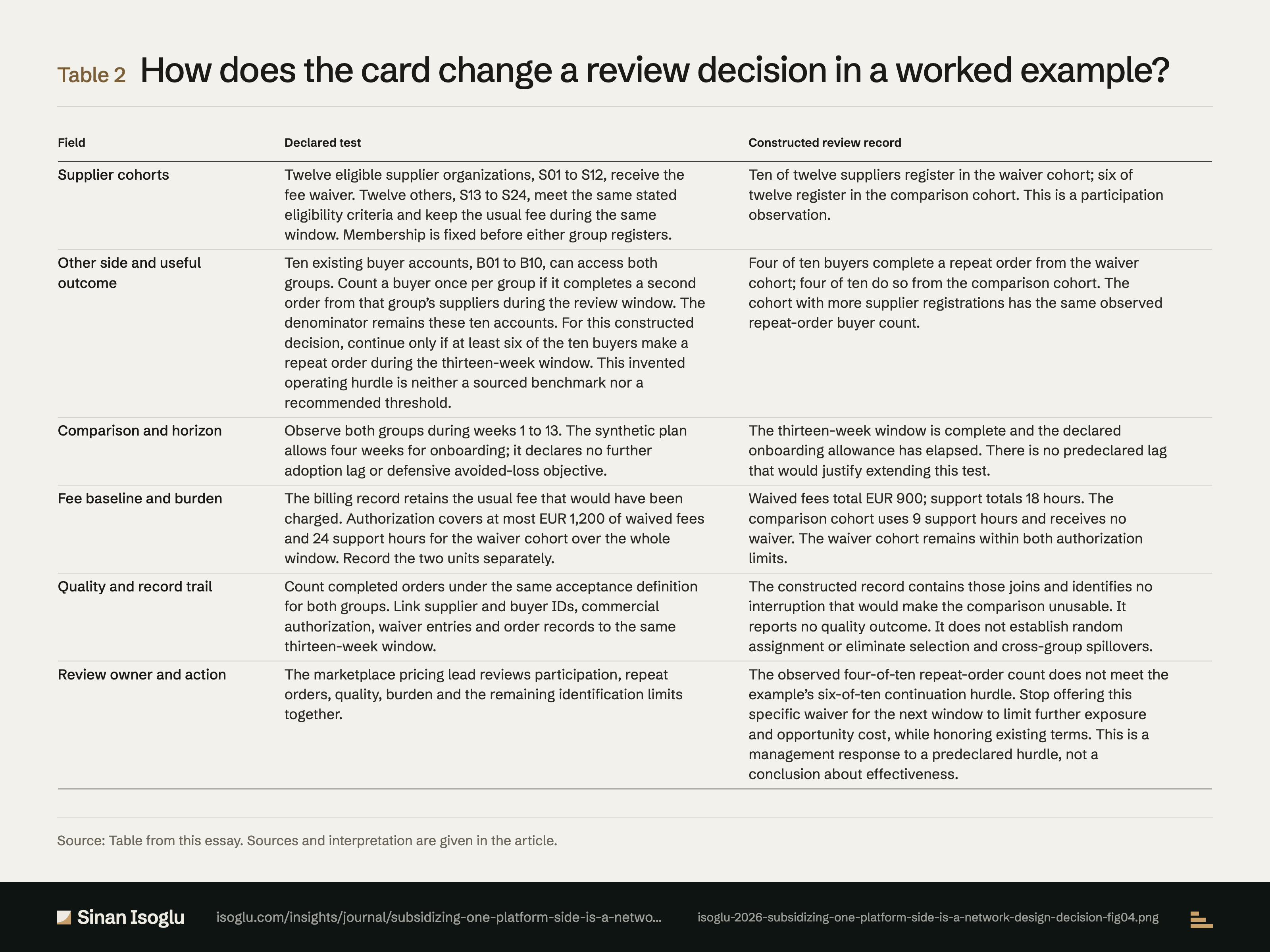
Table 2Table
How does the card change a review decision in a worked example?
Subsidizing one platform side can be a network design decision
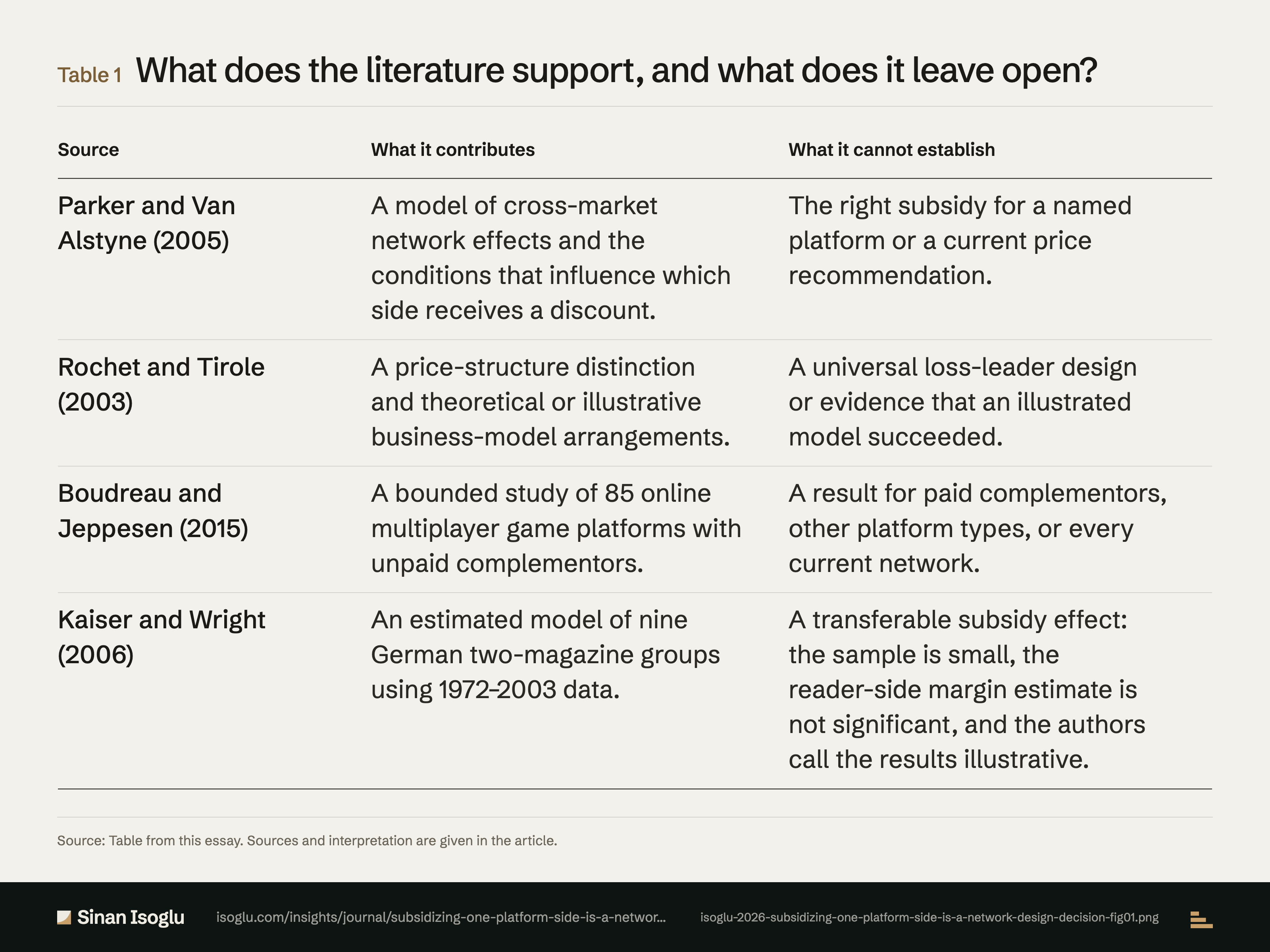
Table 1Table
What does the literature support, and what does it leave open?
Subsidizing one platform side can be a network design decision
Contact
Bring the question you're working on.
Research, a guest lecture, or a commercial question.