← Every exhibit
Table 1From “Staggered difference-in-differences needs a cohort-time estimand”
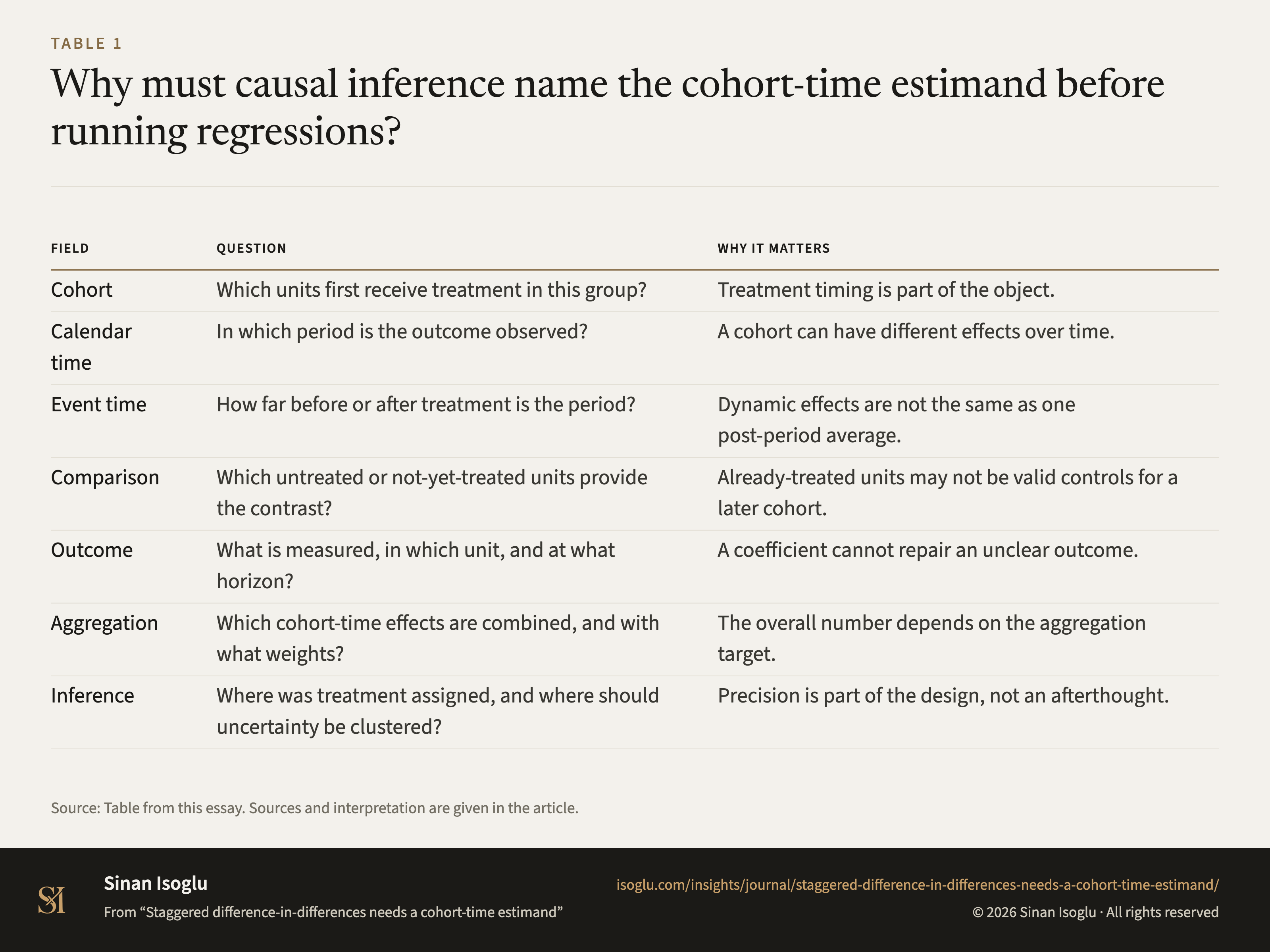
Why must causal inference name the cohort-time estimand before running regressions?
Table 1Why must causal inference name the cohort-time estimand before running regressions?
| Field | Question | Why it matters |
|---|---|---|
| Cohort | Which units first receive treatment in this group? | Treatment timing is part of the object. |
| Calendar time | In which period is the outcome observed? | A cohort can have different effects over time. |
| Event time | How far before or after treatment is the period? | Dynamic effects are not the same as one post-period average. |
| Comparison | Which untreated or not-yet-treated units provide the contrast? | Already-treated units may not be valid controls for a later cohort. |
| Outcome | What is measured, in which unit, and at what horizon? | A coefficient cannot repair an unclear outcome. |
| Aggregation | Which cohort-time effects are combined, and with what weights? | The overall number depends on the aggregation target. |
| Inference | Where was treatment assigned, and where should uncertainty be clustered? | Precision is part of the design, not an afterthought. |
Swipe or scroll horizontally if the table is wider than your screen.
Source: Table from this essay. Sources and interpretation are given in the article.
PNG4:3, 1600 × 1200, with the title, the source line and the attribution set in the image isoglu-2026-staggered-difference-in-differences-needs-a-cohort-time-estimand-fig01.png
From the essay
From the research bench
Staggered difference-in-differences needs a cohort-time estimand
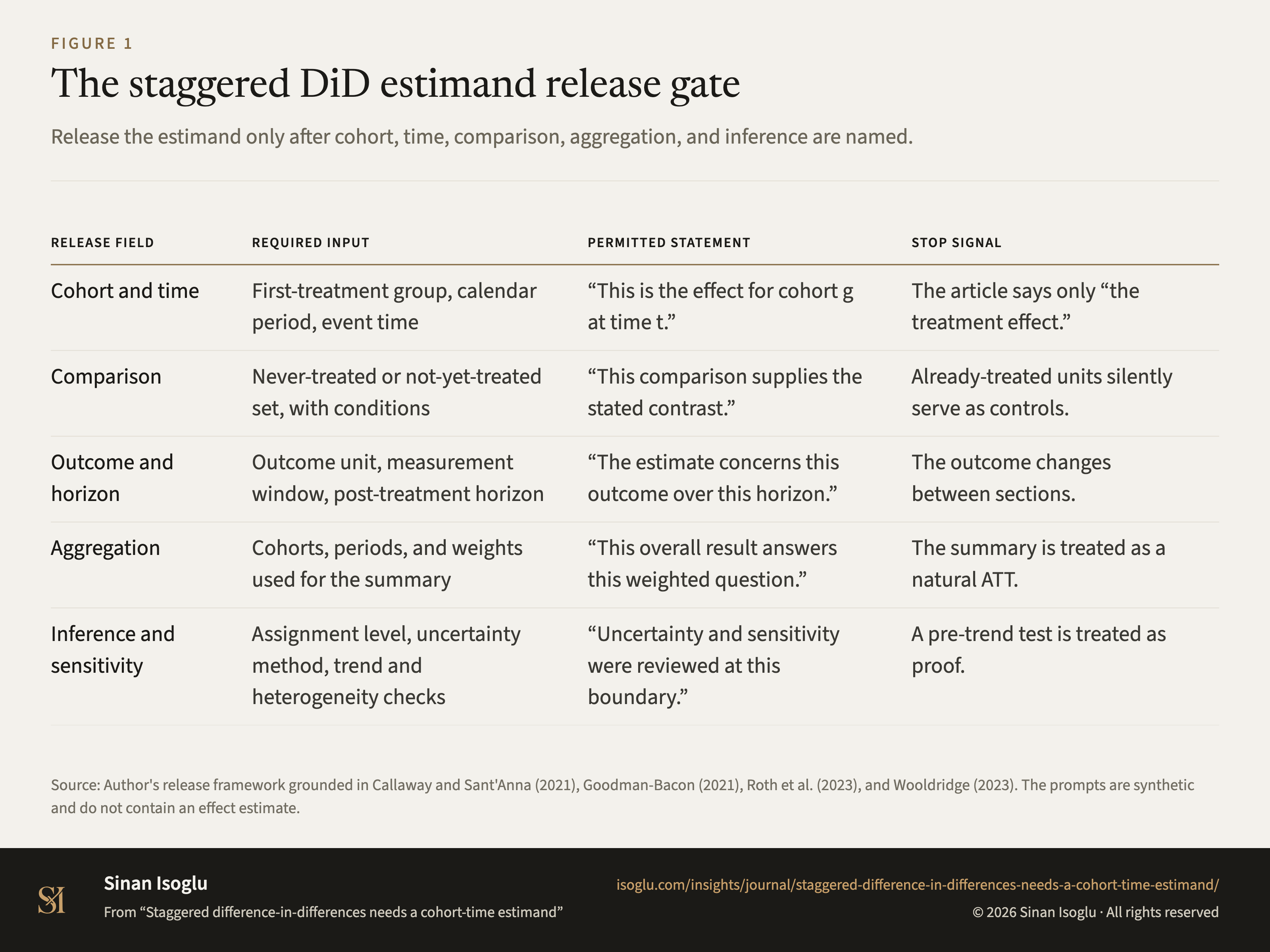
When treatment starts at different times, name the cohort-time effect and aggregation target before interpreting a familiar fixed-effects coefficient.
Read the essayThis exhibit belongs to an essay: the numbers live here, the argument lives there.
Cite or embed
Related exhibits
Contact
Bring the question you're working on.
Research, a guest lecture, or a commercial question.