Figure 1From “What is causal inference?”
Five routes to a causal estimate, and what each must assume
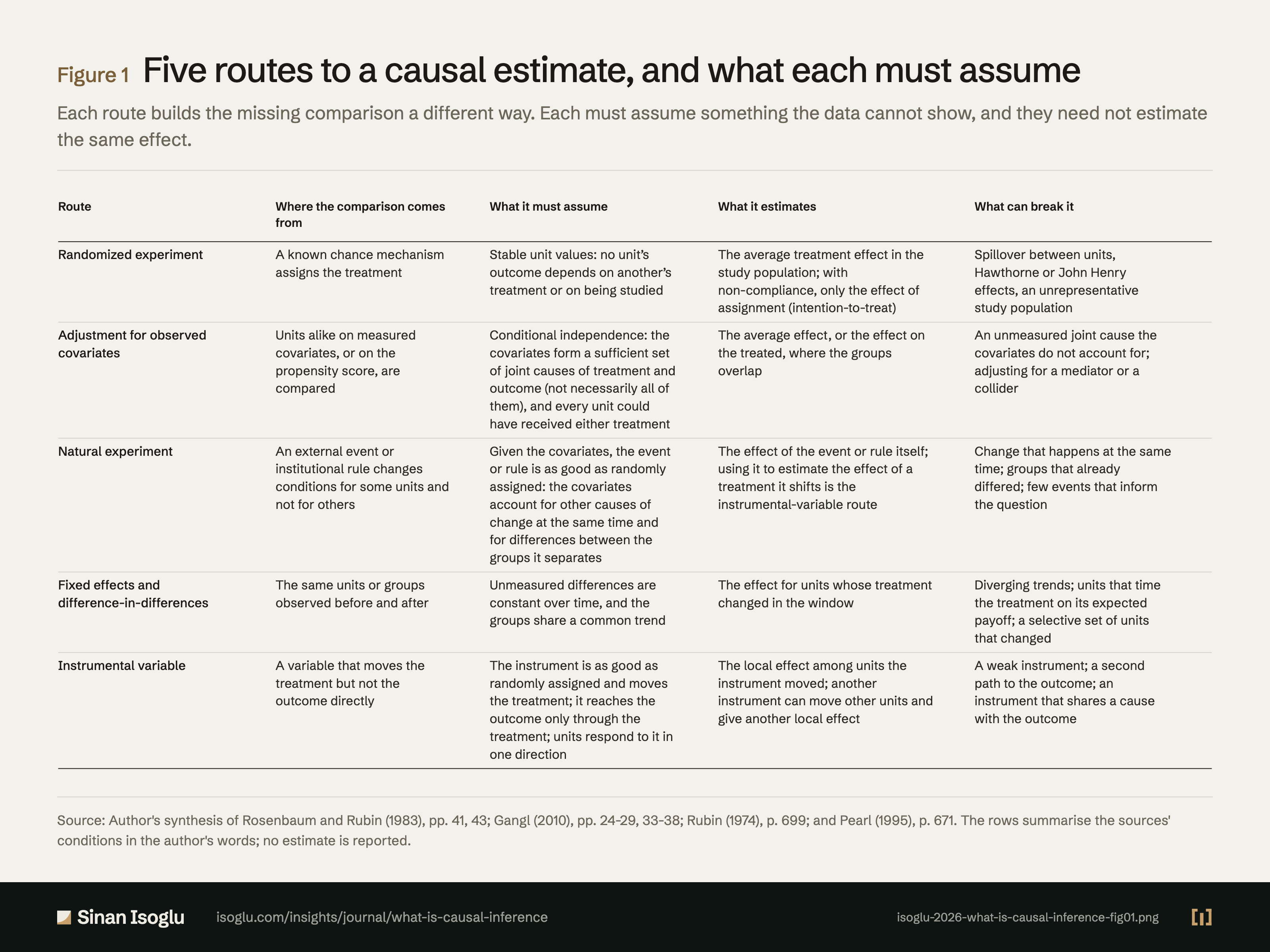
Each route builds the missing comparison a different way. Each must assume something the data cannot show, and they need not estimate the same effect.
Figure 1Five routes to a causal estimate, and what each must assume
| Route | Where the comparison comes from | What it must assume | What it estimates | What can break it |
|---|---|---|---|---|
| Randomized experiment | A known chance mechanism assigns the treatment | Stable unit values: no unit's outcome depends on another's treatment or on being studied | The average treatment effect in the study population; with non-compliance, only the effect of assignment (intention-to-treat) | Spillover between units, Hawthorne or John Henry effects, an unrepresentative study population |
| Adjustment for observed covariates | Units alike on measured covariates, or on the propensity score, are compared | Conditional independence: the covariates form a sufficient set of joint causes of treatment and outcome (not necessarily all of them), and every unit could have received either treatment | The average effect, or the effect on the treated, where the groups overlap | An unmeasured joint cause the covariates do not account for; adjusting for a mediator or a collider |
| Natural experiment | An external event or institutional rule changes conditions for some units and not for others | Given the covariates, the event or rule is as good as randomly assigned: the covariates account for other causes of change at the same time and for differences between the groups it separates | The effect of the event or rule itself; using it to estimate the effect of a treatment it shifts is the instrumental-variable route | Change that happens at the same time; groups that already differed; few events that inform the question |
| Fixed effects and difference-in-differences | The same units or groups observed before and after | Unmeasured differences are constant over time, and the groups share a common trend | The effect for units whose treatment changed in the window | Diverging trends; units that time the treatment on its expected payoff; a selective set of units that changed |
| Instrumental variable | A variable that moves the treatment but not the outcome directly | The instrument is as good as randomly assigned and moves the treatment; it reaches the outcome only through the treatment; units respond to it in one direction | The local effect among units the instrument moved; another instrument can move other units and give another local effect | A weak instrument; a second path to the outcome; an instrument that shares a cause with the outcome |
Swipe or scroll horizontally if the table is wider than your screen.
Source: Author's synthesis of Rosenbaum and Rubin (1983), pp. 41, 43; Gangl (2010), pp. 24-29, 33-38; Rubin (1974), p. 699; and Pearl (1995), p. 671. The rows summarise the sources' conditions in the author's words; no estimate is reported.
Source and evidence
Each line names a claim related to this exhibit, its source, and how it was checked.
- B CINF-OWN-C2 Five routes to a causal estimate (randomized experiment, adjustment for observed covariates, natural experiment, fixed effects and difference-in-differences, instrumental variable) differ in where the comparison comes from, what each must assume, what each estimates and what breaks it; adjustment needs a sufficient set of joint causes, not all of them; a natural experiment needs the event to be as good as random given covariates, and only its use as an instrument adds the exclusion restriction (revised at G5 2026-10-14).Author synthesis of RR83-C3, RR83-C4, GNG10-C5, GNG10-C6, GNG10-C7, GNG10-C8, GNG10-C9, GNG10-C12 and GNG10-C13
- A GNG10-C5 Randomized experiments eliminate bias, but still need the stable unit treatment value assumption, which rules out Hawthorne and John Henry effects and social interactions (p. 26): "Randomized experiments in particular eliminate bias"; "thus ruling out Hawthorne or John Henry effects"; "social interactions, information diffusion, norm formation"Gangl. (2010)
- A GNG10-C6 Experimental estimates may be hard to generalize when the study population or treatment is not representative (p. 26): "may be difficult to generalize if either the study population or the administered treatments cannot be considered representative of some larger context"Gangl. (2010)
- A GNG10-C7 The conditional independence assumption: given covariates, treatment is as good as random; it is a theoretical statement about joint causes, and a minimally sufficient set of covariates is enough (p. 27): "so that, conditional on covariates, variation in D is as good as randomly assigned"; "is not a primarily statistical, but rather a fundamentally theoretical statement about the joint causes X of D and Y"; "a minimally sufficient set of covariates"Gangl. (2010)
- A GNG10-C8 Conditioning on a mediator or a collider can damage the causal reading; only the total effect has straightforward causal content (p. 28): "put the causal interpretation in jeopardy"; "is an intervening mechanism that transmits the effect of D on Y"; "it is only the total effect of D on Y that has straightforward causal content"; "conditioning on collider variables"; "may inadvertently induce rather than alleviate dependency between treatment status and outcomes"; "that are typically intended to proxy some unobserved factor U"Gangl. (2010)
- A GNG10-C9 Natural experiments exploit an external event or institutional rule; regression discontinuity uses a known assignment rule; fixed-effects and difference-in-differences estimators condition on time-invariant unobservables (pp. 28, 29): "all share the idea of exploiting some external event or institutional condition that creates exogenous variation in the social process of interest"; "institutional rule to assign or withhold treatment that creates the relevant variation"; "difference-in-differences estimators may again be employed to condition on time-invariant unobservables"; "properly condition for both concomitant causes of change in Y and population heterogeneity"Gangl. (2010)
- A GNG10-C12 An instrument predicts treatment but not outcomes; IV does not reliably identify the average effect unless it is constant; under monotonicity it gives the local effect for compliers, which depends on the instrument; weak instruments undermine the estimator; in experiments the local effect is the complier average causal effect and the effect of the manipulation is the intention-to-treat effect (pp. 33, 36, 37): "that predicts treatment status D, but not outcomes"; "IV does not reliably identify the average treatment effect of D unless the"; "those units i that complied with treatment D because of the instrument Z"; "LATE is defined by the specific instrument Z available to the researcher"; "reliance on weak instruments undermines the statistical consistency and efficiency of the estimator"; "identifies the complier average causal effect (CACE), whereas the net effect of the manipulation Z corresponds to the intention-to-treat (ITT) effect"; "Z needs to be relevant for treatment assignment"; "potential outcomes need to be independent of Z given D"; "is untestable in principle and needs to be justified theoretically"; "the population of compliers cannot actually be identified in the sample data"; "variation in LATE estimates based on alternative instruments Z is indeed a desirable property of the analysis"Gangl. (2010)
- A GNG10-C13 The fixed-effects estimator assumes common (parallel) time trends, keeps a conditional independence assumption that is still a strong one, ruling out selection on predicted treatment impact, and with heterogeneous effects may have little external validity (p. 35): "rests on the assumption of common (parallel) time trends across groups"; "FE estimates may have little external validity"; "is still a strong one"; "ruling out endogenous selection into treatment based on agents’ reasonably accurate predictions about treatment impact"Gangl. (2010)
- A RR83-C3 The propensity score is the conditional probability of assignment given observed covariates, and adjusting for it removes bias from all observed covariates (p. 41): "The propensity score is the conditional probability of assignment to a particular treatment given a vector of observed covariates."; "adjustment for the scalar propensity score is sufficient to remove bias due to all observed covariates"Rosenbaum & Rubin. (1983)
- A RR83-C4 Strong ignorability: conditional independence of outcomes and assignment given covariates, known in a randomized trial and usually not in a nonrandomized one, plus a chance of each treatment for every unit (p. 43): "This condition is usually not known to hold in a nonrandomized experiment."; "every unit in the population has a chance of receiving each treatment"; "Generally, we shall say treatment assignment is strongly ignorable given a"; "with properly collected data in a randomized trial"Rosenbaum & Rubin. (1983)
Grades: A, verified against the printed page of the primary source · B, primary source, text layer only · C, authoritative secondary · D, reported.
From the essay
From the research bench
What is causal inference?
Causal inference estimates what a change did by comparing outcomes that are never all observed. The design and its assumptions carry the answer.
Read the essayThis exhibit belongs to an essay: the numbers live here, the argument lives there.
Cite or embed

Contact
Bring the question you're working on.
Research, a guest lecture, or a commercial question.