Table 1From “Scenario planning starts when a trigger moves a resource”
The evidence boundary around scenario planning
The table separates what the exploratory studies report from the operating mechanism a reader may still need to record.
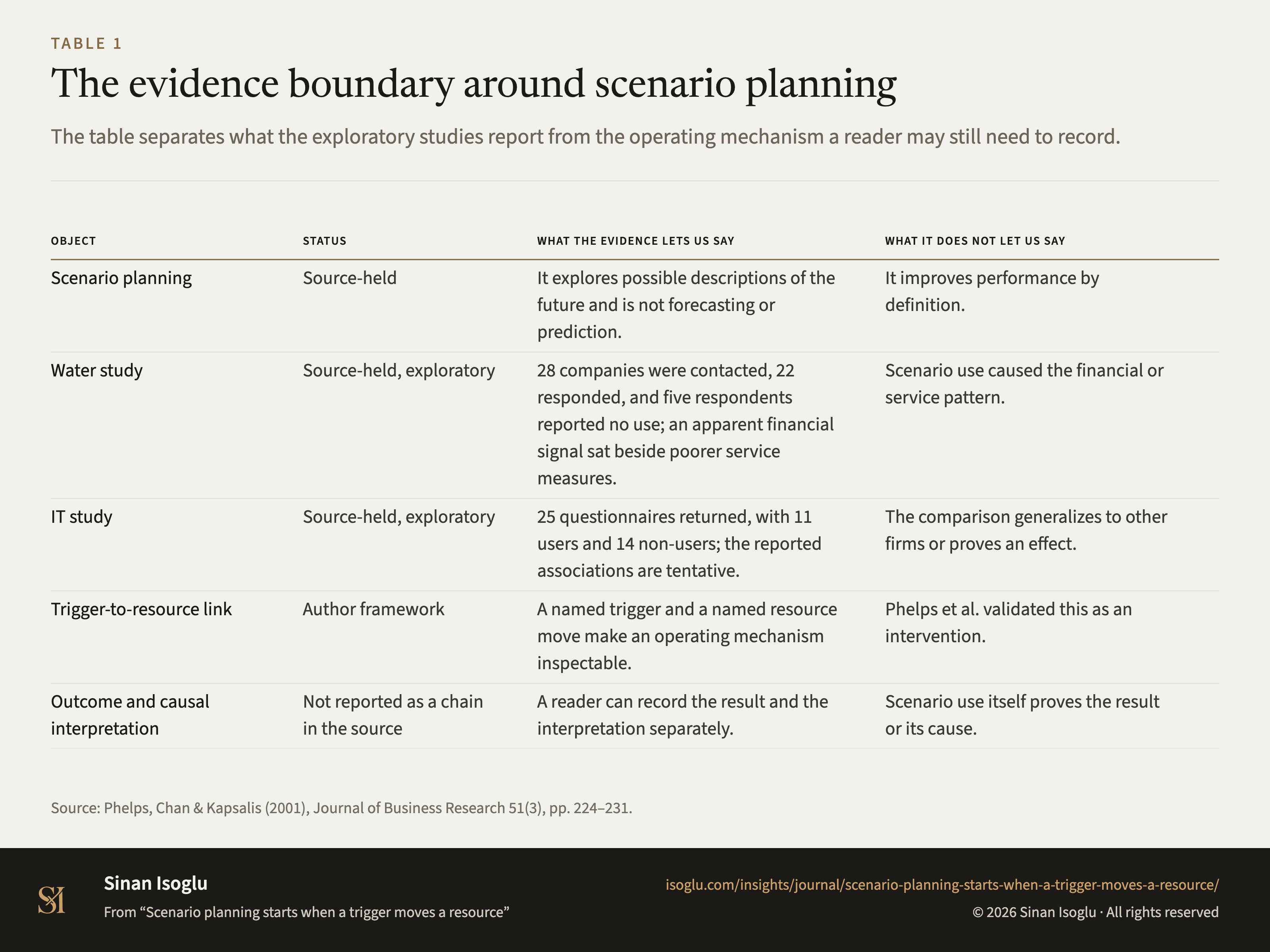
Table 1The evidence boundary around scenario planning
| Object | Status | What the evidence lets us say | What it does not let us say |
|---|---|---|---|
| Scenario planning | Source-held | It explores possible descriptions of the future and is not forecasting or prediction. | It improves performance by definition. |
| Water study | Source-held, exploratory | 28 companies were contacted, 22 responded, and five respondents reported no use; an apparent financial signal sat beside poorer service measures. | Scenario use caused the financial or service pattern. |
| IT study | Source-held, exploratory | 25 questionnaires returned, with 11 users and 14 non-users; the reported associations are tentative. | The comparison generalizes to other firms or proves an effect. |
| Trigger-to-resource link | Author framework | A named trigger and a named resource move make an operating mechanism inspectable. | Phelps et al. validated this as an intervention. |
| Outcome and causal interpretation | Not reported as a chain in the source | A reader can record the result and the interpretation separately. | Scenario use itself proves the result or its cause. |
Swipe or scroll horizontally if the table is wider than your screen.
Source: Phelps, Chan & Kapsalis (2001), Journal of Business Research 51(3), pp. 224–231.
Source and evidence
Each line names a claim related to this exhibit, its source, and how it was checked.
- A PCK01-C1 The paper opens by naming the gap it works in: "little evidence is available about the effects of scenario planning on company performance"Phelps, Chan & Kapsalis (2001), pp. 224-225
- A PCK01-C2 The water study is small and the paper counts it: "All 28 were asked to participate in this study. Twenty-two agreed", and "Of the 22 respondents, only five (23%) reported no use of scenario planning"Phelps, Chan & Kapsalis (2001), pp. 226-227
- A PCK01-C3 The water study combines a financial measure with "three measures of performance specific to the water industry: water quality, inadequate pressure of supplies, and supply interruptions", so an apparent financial signal sits beside poorer service measuresPhelps, Chan & Kapsalis (2001), pp. 226-227
- A PCK01-C4 The IT study is smaller still: twenty-"five questionnaires were returned. Eleven of these compa""nies (44%) were using scenario planning and 14 were not"Phelps, Chan & Kapsalis (2001), pp. 228-231
- A PCK01-C5 And it grades its own conclusions: "Comparison of these studies allows some tentative conclusions regarding the effects of scenario planning to be drawn"Phelps, Chan & Kapsalis (2001), p. 231
Grades: A, verified against the printed page of the primary source · B, primary source, text layer only · C, authoritative secondary · D, reported.
From the essay
From the research bench
Scenario planning starts when a trigger moves a resource
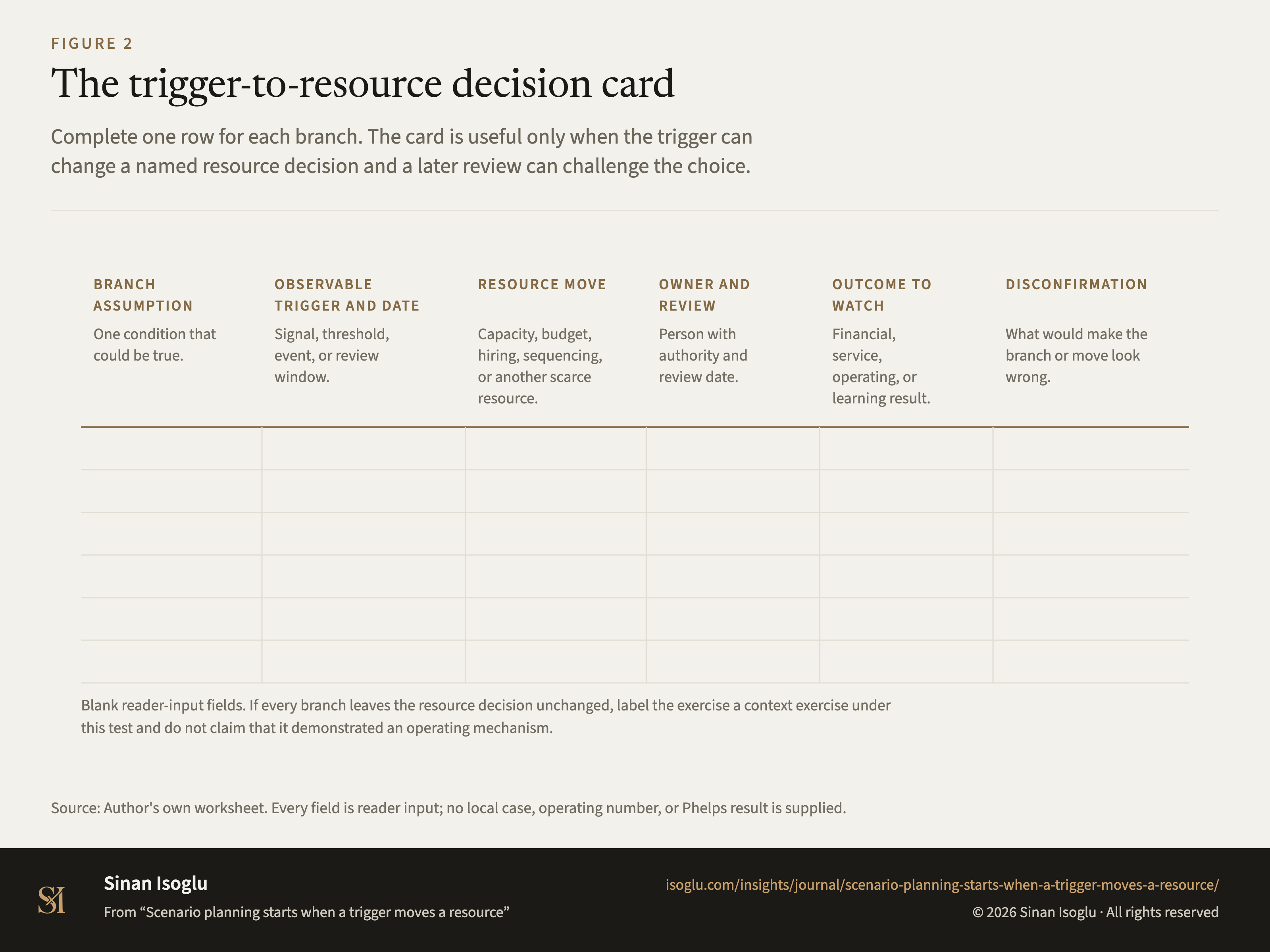
Three scenarios are not a decision. A trigger-to-resource test shows when scenario planning changes an operating choice and when it remains exploration.
Read the essayThis exhibit belongs to an essay: the numbers live here, the argument lives there.
Cite or embed
Contact
Bring the question you're working on.
Research, a guest lecture, or a commercial question.