Figure 1From “What is measurement validity?”
Three answers to what validity is
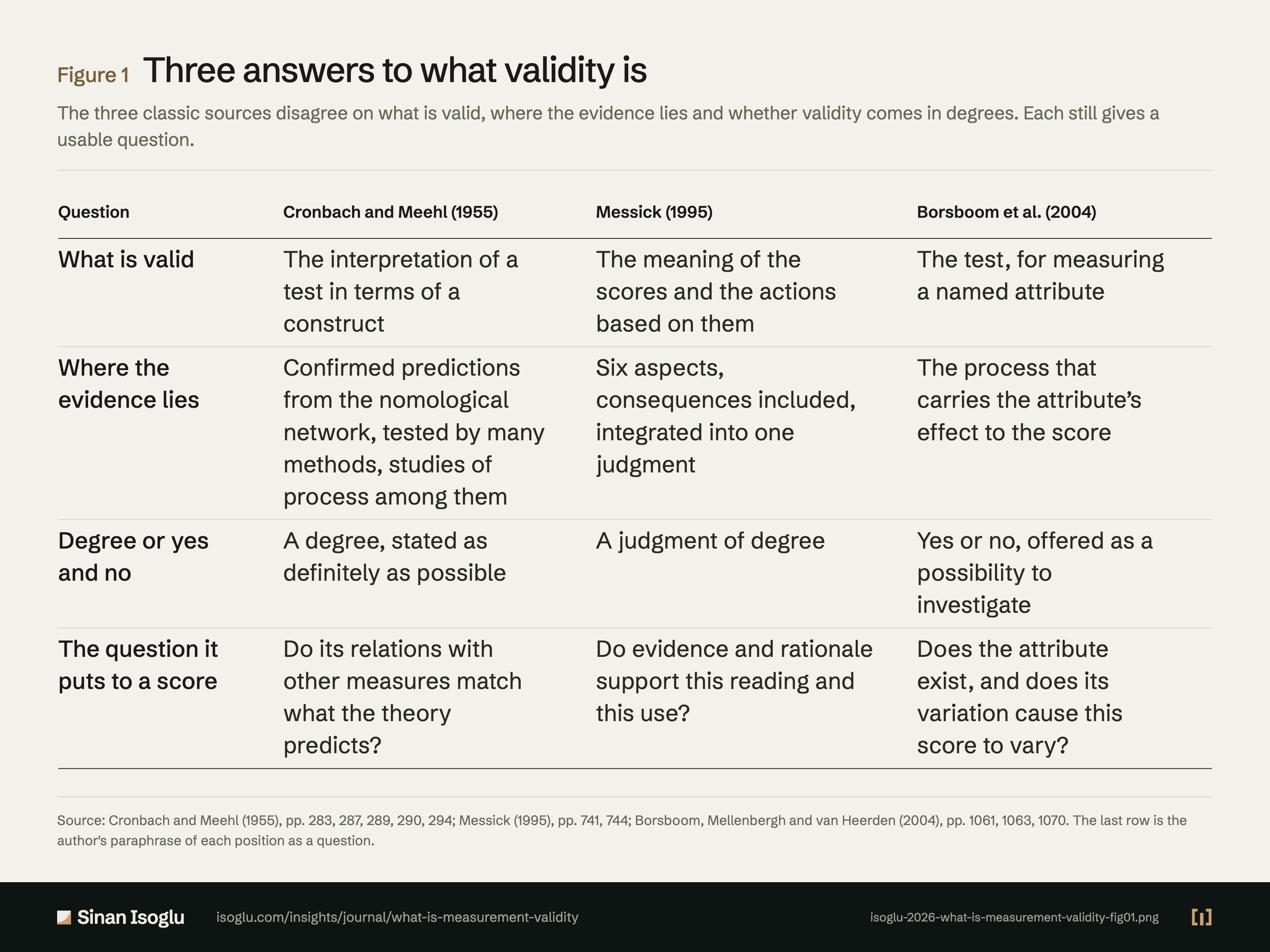
The three classic sources disagree on what is valid, where the evidence lies and whether validity comes in degrees. Each still gives a usable question.
Figure 1Three answers to what validity is
| Question | Cronbach and Meehl (1955) | Messick (1995) | Borsboom et al. (2004) |
|---|---|---|---|
| What is valid | The interpretation of a test in terms of a construct | The meaning of the scores and the actions based on them | The test, for measuring a named attribute |
| Where the evidence lies | Confirmed predictions from the nomological network, tested by many methods, studies of process among them | Six aspects, consequences included, integrated into one judgment | The process that carries the attribute's effect to the score |
| Degree or yes and no | A degree, stated as definitely as possible | A judgment of degree | Yes or no, offered as a possibility to investigate |
| The question it puts to a score | Do its relations with other measures match what the theory predicts? | Do evidence and rationale support this reading and this use? | Does the attribute exist, and does its variation cause this score to vary? |
Swipe or scroll horizontally if the table is wider than your screen.
Source: Cronbach and Meehl (1955), pp. 283, 287, 289, 290, 294; Messick (1995), pp. 741, 744; Borsboom, Mellenbergh and van Heerden (2004), pp. 1061, 1063, 1070. The last row is the author's paraphrase of each position as a question.
From the essay
From the research bench
What is measurement validity?
Measurement validity is whether a score measures what a decision treats it as measuring. The classics disagree on what is valid: the test or its reading.
Read the essayThis exhibit belongs to an essay: the numbers live here, the argument lives there.
Cite or embed
Contact
Bring the question you're working on.
Research, a guest lecture, or a commercial question.