Table 1From “Saturation is a decision rule, not a number”
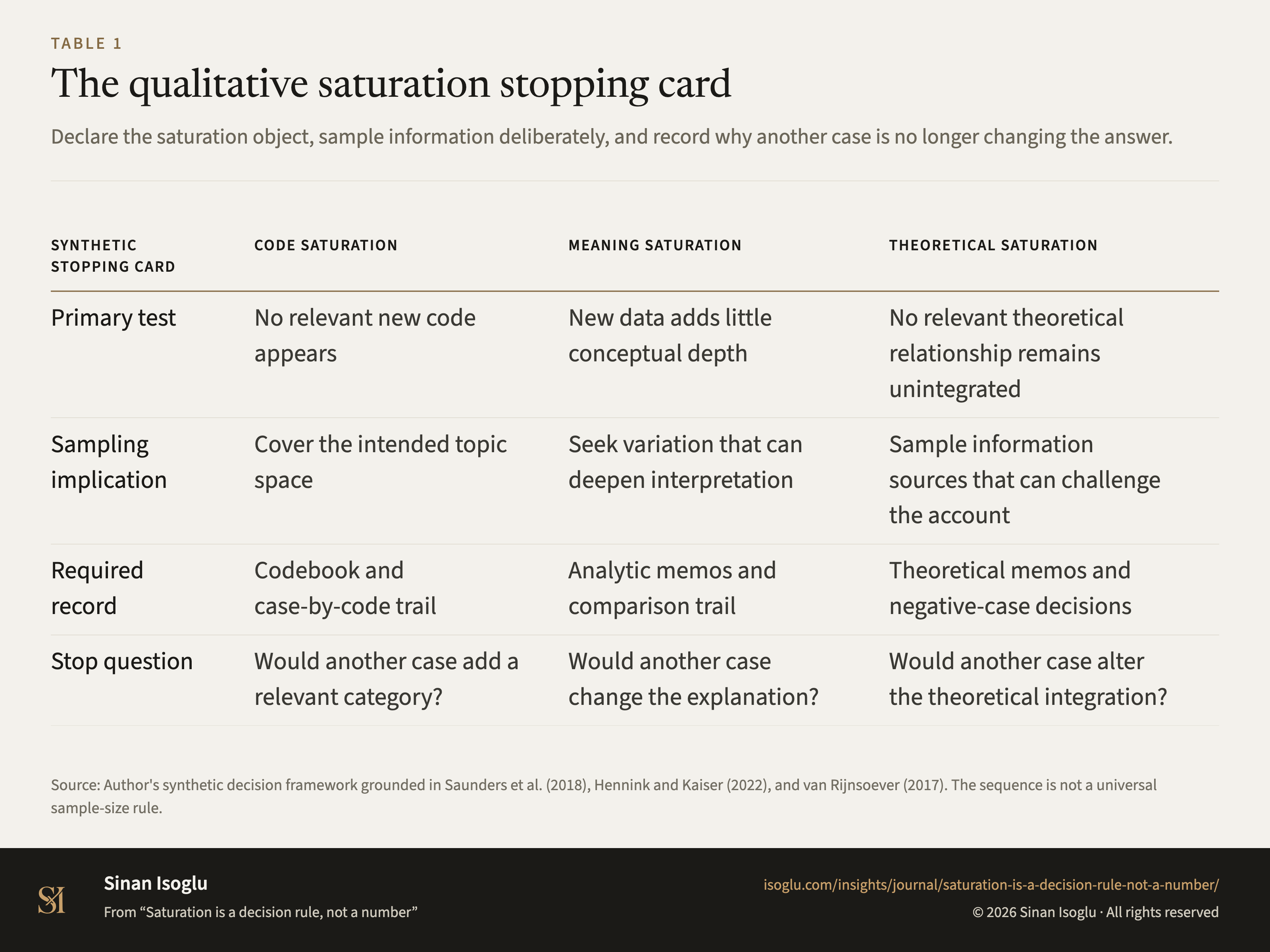
The qualitative saturation stopping card
Declare the saturation object, sample information deliberately, and record why another case is no longer changing the answer.
Table 1The qualitative saturation stopping card
| Synthetic stopping card | Code saturation | Meaning saturation | Theoretical saturation |
|---|---|---|---|
| Primary test | No relevant new code appears | New data adds little conceptual depth | No relevant theoretical relationship remains unintegrated |
| Sampling implication | Cover the intended topic space | Seek variation that can deepen interpretation | Sample information sources that can challenge the account |
| Required record | Codebook and case-by-code trail | Analytic memos and comparison trail | Theoretical memos and negative-case decisions |
| Stop question | Would another case add a relevant category? | Would another case change the explanation? | Would another case alter the theoretical integration? |
Swipe or scroll horizontally if the table is wider than your screen.
Source: Author's synthetic decision framework grounded in Saunders et al. (2018), Hennink and Kaiser (2022), and van Rijnsoever (2017). The sequence is not a universal sample-size rule.
Source and evidence
Each line names a claim related to this exhibit, its source, and how it was checked.
- A SAU18-C1 Saturation is widely used to indicate that more data are unnecessary, and the authors say the concept is used inconsistently: "It is commonly taken to indicate that, on the basis of the data that have been collected or analysed hitherto, further data collection and/or analysis are unnecessary", yet "there appears to be uncertainty as to how saturation should be conceptualized, and inconsistencies in its use"Saunders et al. (2018)
- A SAU18-C2 The article distinguishes different conceptualisations rather than treating saturation as one universal event: "We identify four distinct approaches to saturation, which differ in terms of the extent to which an inductive or a deductive logic is adopted"Saunders et al. (2018)
- A SAU18-C3 The recommendation is to make the form and rationale explicit: "We conclude that saturation should be operationalized in a way that is consistent with the research question(s), and the theoretical position and analytic framework adopted"Saunders et al. (2018)
- A HK22-C1 The design is a systematic review, in the authors' words: "We conducted a systematic review of four databases to identify studies empirically assessing sample sizes for saturation in qualitative research", and "We identified 23 articles that used empirical data (n = 17) or statistical modeling (n = 6) to assess" saturationHennink & Kaiser. (2022)
- A HK22-C2 The reviewed range, verbatim: "Studies using empirical data reached saturation within a narrow range of interviews (9-17) or focus" group discussions (4-8), particularly in relatively homogeneous populationsHennink & Kaiser. (2022)
- A HK22-C3 The caution is the authors' own and travels with the range: "these findings apply to certain types of studies (e.g., those with homogenous study populations)"Hennink & Kaiser. (2022)
- A VR17-C1 The simulation's object, in the author's words: "I conceptualize a population as consisting of sub-populations that contain different types of information sources that hold a number of codes"van Rijnsoever. (2017)
- A VR17-C2 The three sampling scenarios differ in what they require: "the minimal and maximal information scenarios are significantly more efficient than random chance", though they yield fewer repetitions per codevan Rijnsoever. (2017)
- A VR17-C3 The result that decides the guidance: "I show that theoretical saturation is more dependent on the mean probability of observing codes than on the number of codes in a population"van Rijnsoever. (2017)
Grades: A, verified against the printed page of the primary source · B, primary source, text layer only · C, authoritative secondary · D, reported.
From the essay
From the research bench
Saturation is a decision rule, not a number
Qualitative saturation is a stopping decision, not a universal interview count: match code or meaning to the question and sampling design.
Read the essayThis exhibit belongs to an essay: the numbers live here, the argument lives there.
Cite or embed
Related exhibits
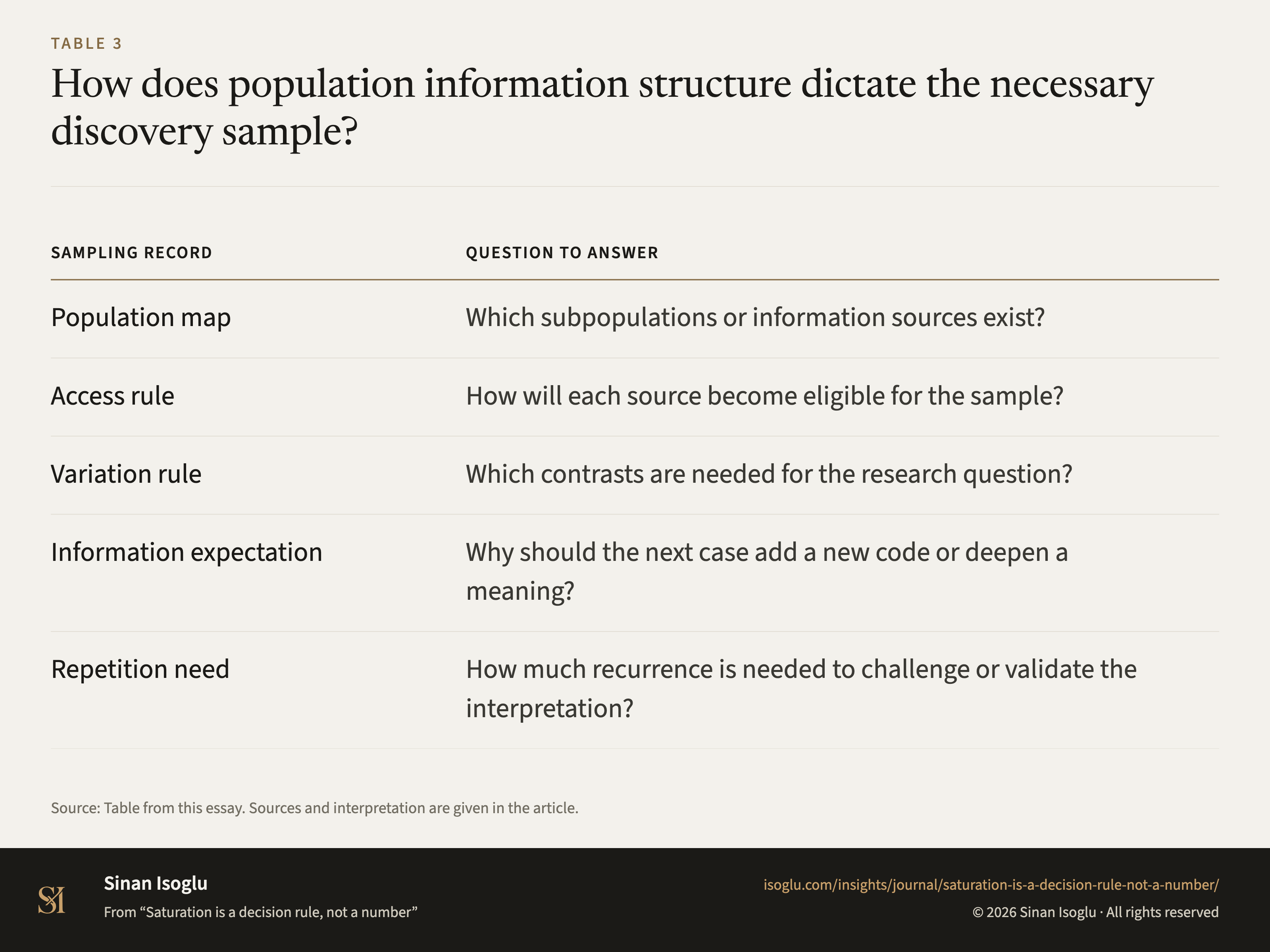
Table 3Table
How does population information structure dictate the necessary discovery sample?
Saturation is a decision rule, not a number
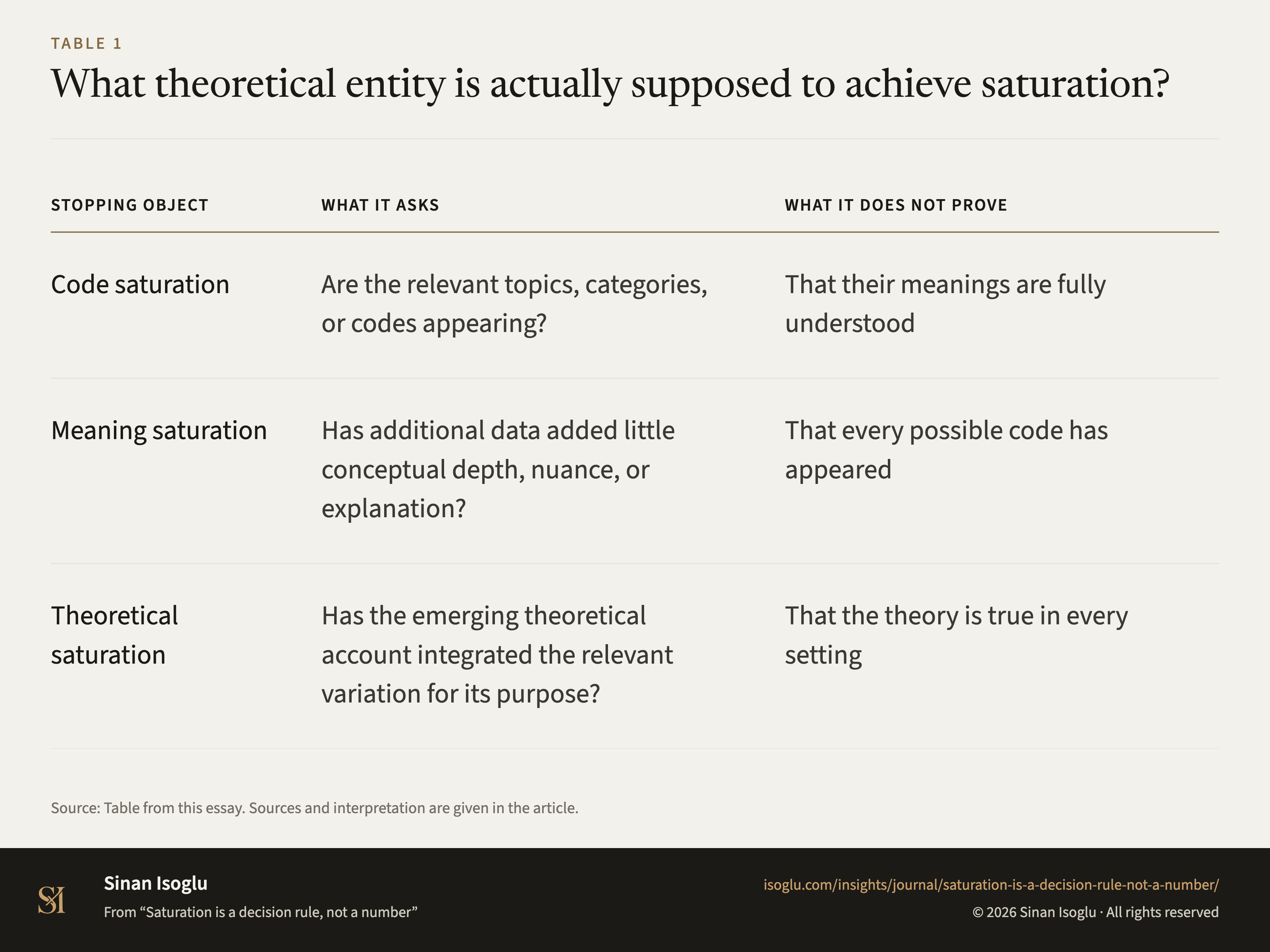
Table 1Table
What theoretical entity is actually supposed to achieve saturation?
Saturation is a decision rule, not a number
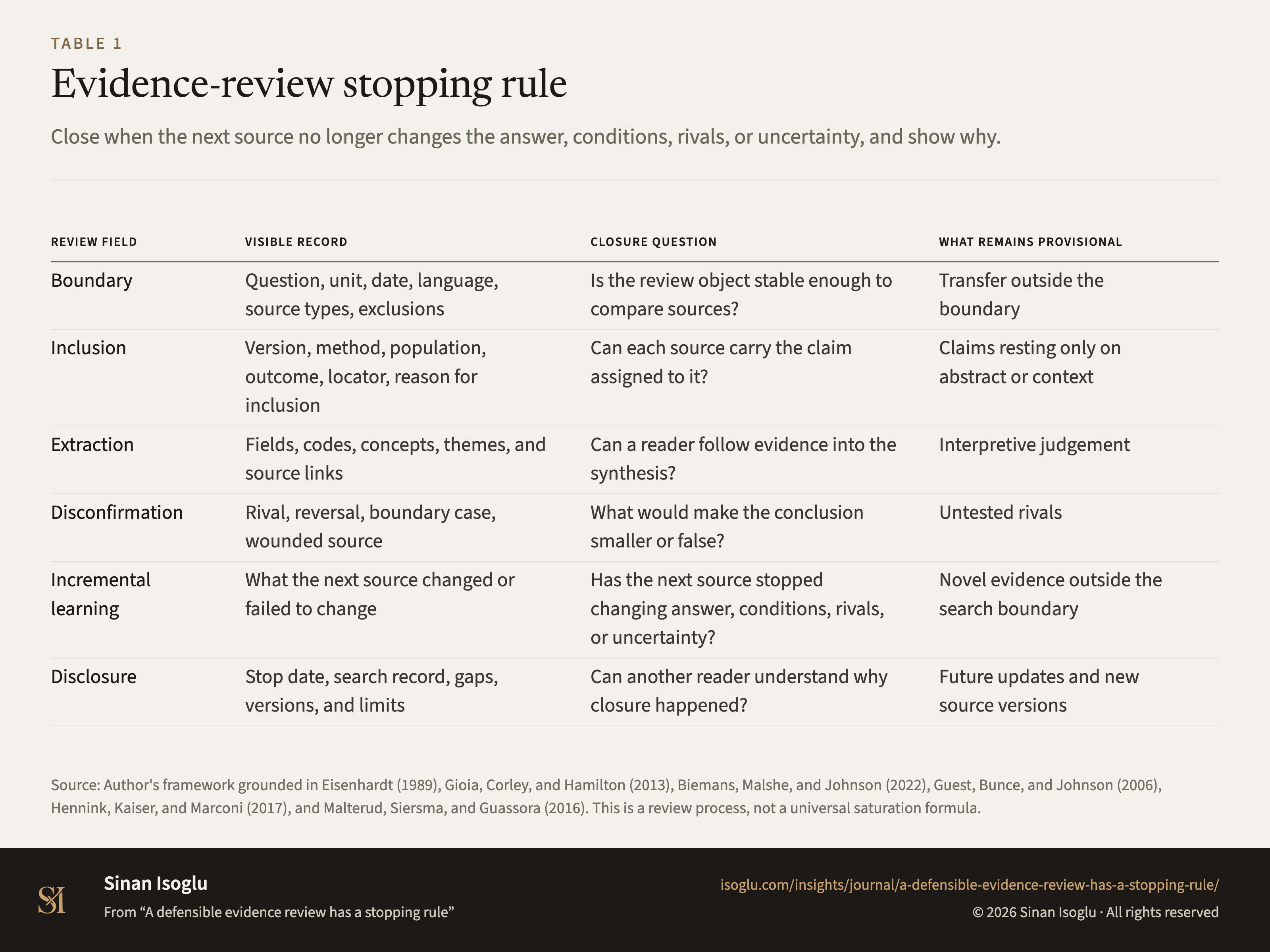
Table 1Table
Evidence-review stopping rule
A defensible evidence review has a stopping rule
Contact
Bring the question you're working on.
Research, a guest lecture, or a commercial question.