Table 1From “A defensible evidence review has a stopping rule”
Evidence-review stopping rule
Close when the next source no longer changes the answer, conditions, rivals, or uncertainty, and show why.
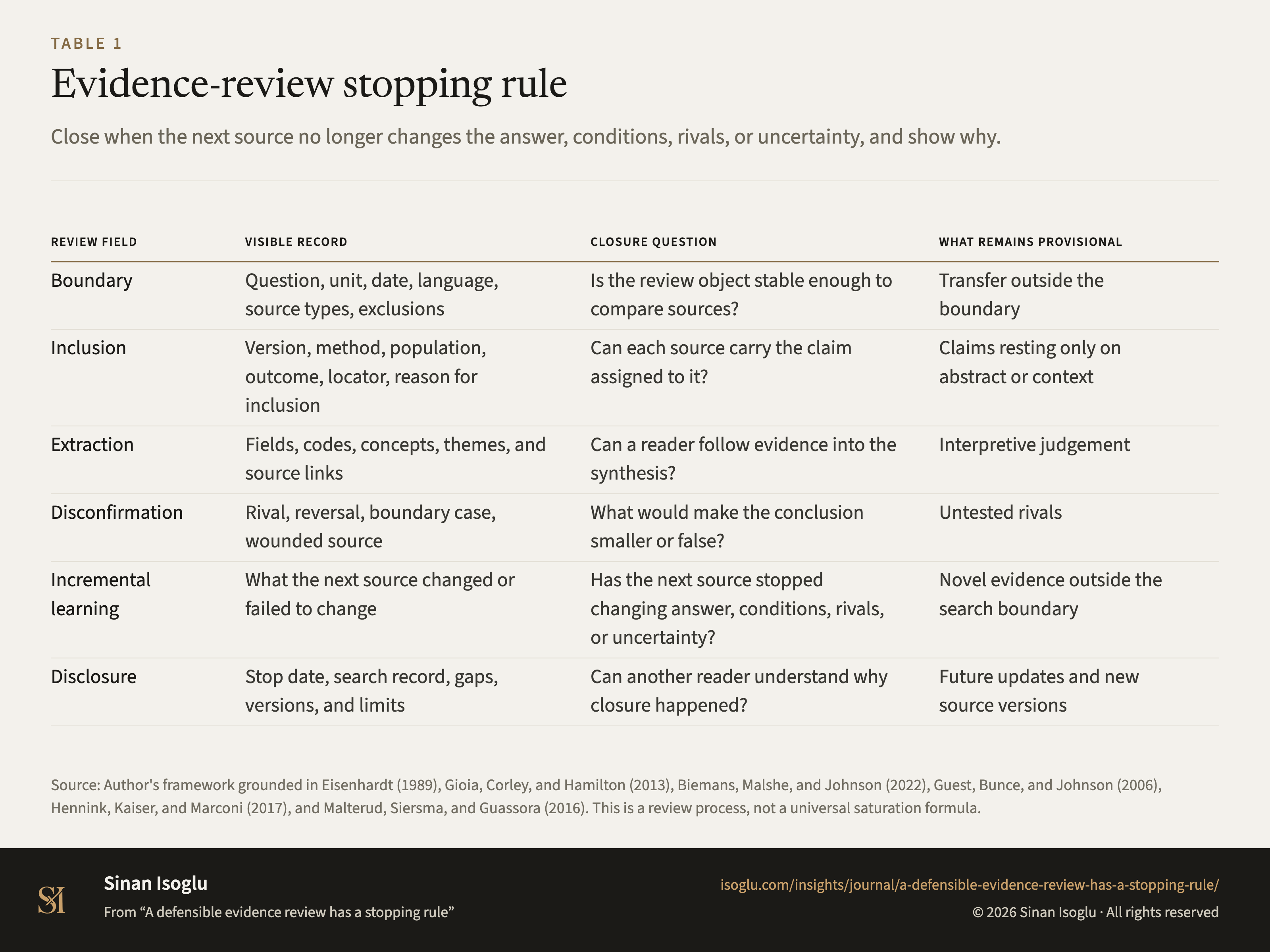
Table 1Evidence-review stopping rule
| Review field | Visible record | Closure question | What remains provisional |
|---|---|---|---|
| Boundary | Question, unit, date, language, source types, exclusions | Is the review object stable enough to compare sources? | Transfer outside the boundary |
| Inclusion | Version, method, population, outcome, locator, reason for inclusion | Can each source carry the claim assigned to it? | Claims resting only on abstract or context |
| Extraction | Fields, codes, concepts, themes, and source links | Can a reader follow evidence into the synthesis? | Interpretive judgement |
| Disconfirmation | Rival, reversal, boundary case, wounded source | What would make the conclusion smaller or false? | Untested rivals |
| Incremental learning | What the next source changed or failed to change | Has the next source stopped changing answer, conditions, rivals, or uncertainty? | Novel evidence outside the search boundary |
| Disclosure | Stop date, search record, gaps, versions, and limits | Can another reader understand why closure happened? | Future updates and new source versions |
Swipe or scroll horizontally if the table is wider than your screen.
Source: Author's framework grounded in Eisenhardt (1989), Gioia, Corley, and Hamilton (2013), Biemans, Malshe, and Johnson (2022), Guest, Bunce, and Johnson (2006), Hennink, Kaiser, and Marconi (2017), and Malterud, Siersma, and Guassora (2016). This is a review process, not a universal saturation formula.
Source and evidence
Each line names a claim related to this exhibit, its source, and how it was checked.
- B EISEN89-C1 The paper describes a process, not a result: "This paper describes the process of inducting theory using case stud"ies, from specifying the research questions to reaching closureEisenhardt. (1989). Building theories from case study research
- B EISEN89-C2 Sampling is theoretical rather than statistical: "Such research relies on theo""retical sampling (i.e., cases are chosen for theo"retical reasons, including polar typesEisenhardt. (1989). Building theories from case study research
- B EISEN89-C4 Within-case first, then across: the framework names "case and cross-case analyses, and the role of" existing literature as separate stepsEisenhardt. (1989). Building theories from case study research
- B EISEN89-C5 Closure is a judgement, and the table says so: "Theoretical saturation when possible Ends process when marginal improvement becomes small"Eisenhardt. (1989). Building theories from case study research
- B EISEN89-C6 Case-based theory should be evaluated for evidence fit, testability, logical coherence, rival explanations, and bounded noveltyEisenhardt. (1989). Building theories from case study research
- B GIOIA13-C1 The two orders are the paper's own device: "a systematic presentation of both a" first-"order analysis (i.e., an analysis using informant-centric terms and codes)" and a second-order one, distilled into "aggregate dimensions"Gioia, Corley & Hamilton. (2013)
- B GIOIA13-C2 And the authors refuse the template reading: "we see it as a flexible orientation toward qualitative, inductive research that is open to innovation", rather than a cookbookGioia, Corley & Hamilton. (2013)
- A BMJ22-C1 The review's own count: "we identify 73 articles" about the sales-marketing interface, published 1990 through 2021Biemans, Malshe & Johnson. (2022)
- A BMJ22-C2 The coding scheme, in the review's words: "structural linkages refer to the horizontal platforms or interaction" channels established for interdepartmental activity, alongside role linkages, interactions and perceptionsBiemans, Malshe & Johnson. (2022)
- B GUEST06-C2 The 12-interview result is conditional and not a universal rule, and the authors bound it themselves: saturation occurred within the first twelve interviews, "at least based on the codebook we devel"oped, in a study of relatively homogeneous respondentsGuest, Bunce & Johnson. (2006)
- B HENN17-C2 Code saturation and meaning saturation answer different questions, and the paper reports different sample sizes for each: more interviews "were needed to reach meaning saturation where we developed a richly textured understanding of issues", and the authors present the finding as conditions rather than a number, since "We used our results to develop parameters that influence saturation"Hennink, Kaiser & Marconi. (2017)
- B MAL16-C2 Higher information power can support a smaller sample, but the concept is an appraisal and not a formula: "Information power indicates that the more information the sample holds, relevant" for the study, the lower the number of participants neededMalterud, Siersma & Guassora. (2016)
- B B12-C1 An evidence review can close when its search boundary, inclusion logic, extraction structure, rival check, and incremental-learning judgement are visibleAuthor framework grounded in Eisenhardt, Gioia, Hennink, and Biemans et al.
- B B12-C2 Saturation is a purpose- and design-dependent judgement, not a universal number of sources or interviewsAuthor framework grounded in Guest, Hennink, Hagaman, and Malterud
Grades: A, verified against the printed page of the primary source · B, primary source, text layer only · C, authoritative secondary · D, reported.
From the essay
From the research bench
A defensible evidence review has a stopping rule
An evidence review is defensible when its search boundary, inclusion, extraction, rival check, and stopping judgement are visible to readers.
Read the essayThis exhibit belongs to an essay: the numbers live here, the argument lives there.
Cite or embed
Related exhibits
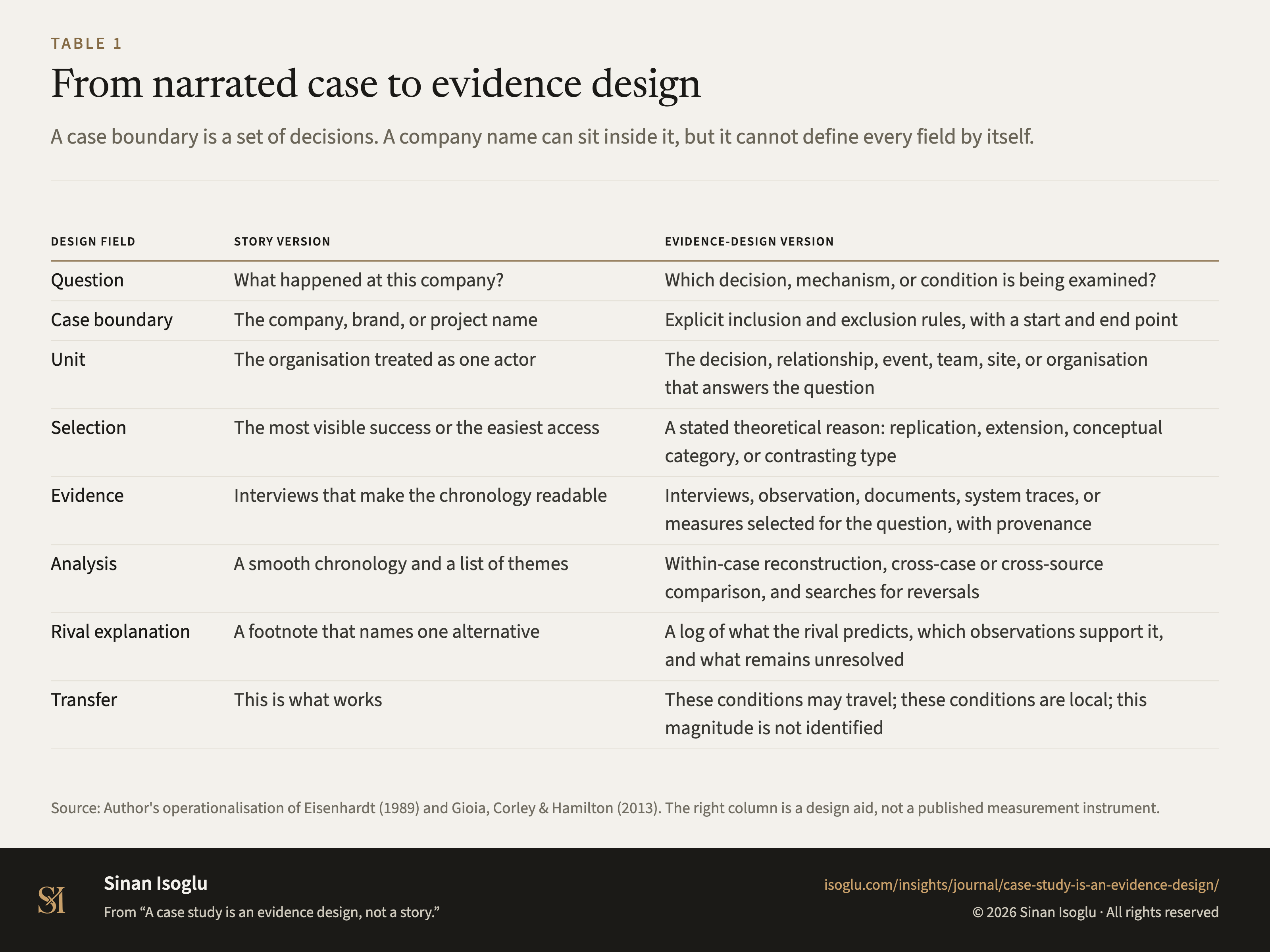
Table 1Table
From narrated case to evidence design
A case study is an evidence design, not a story.
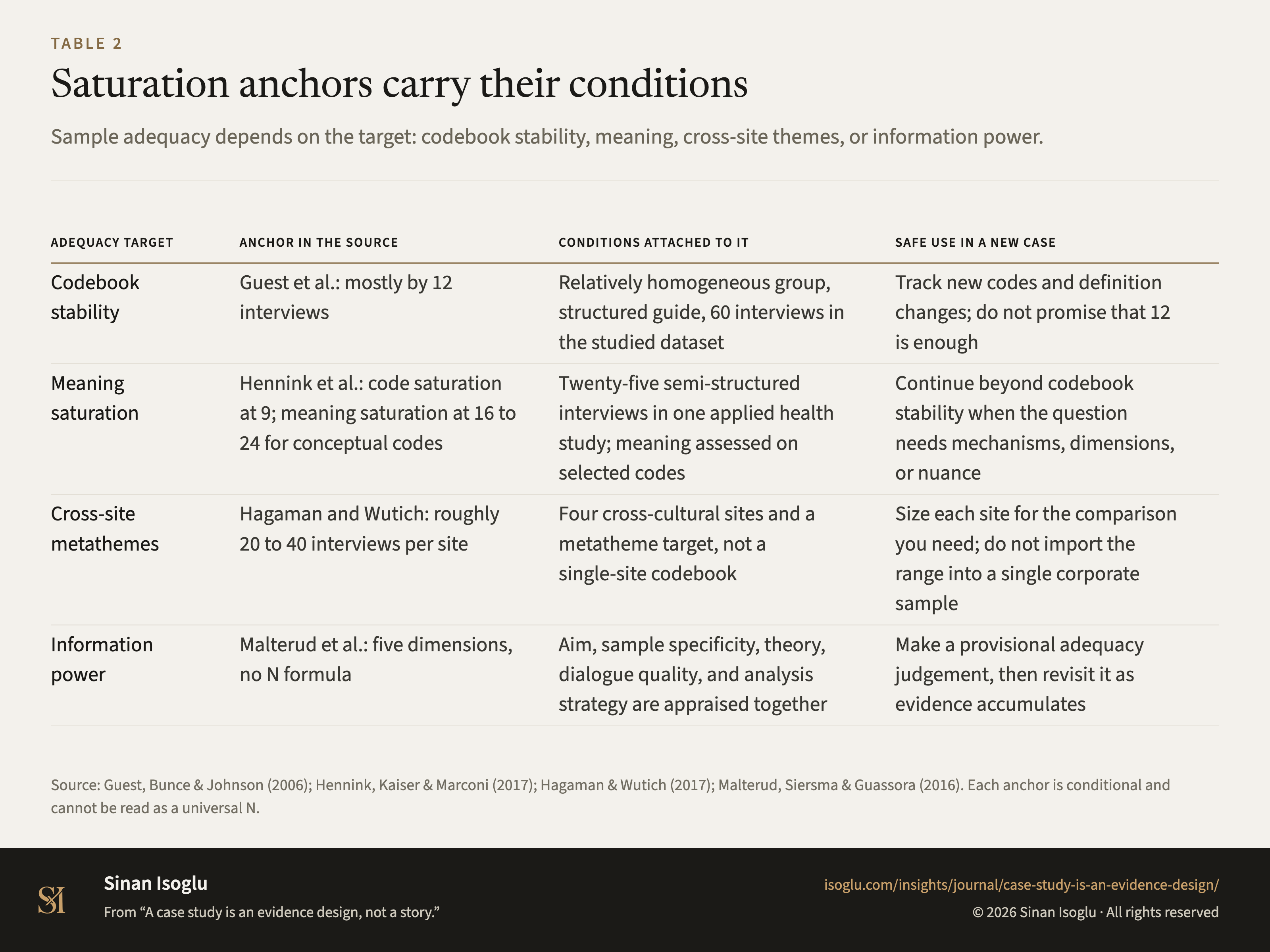
Table 2Table
Saturation anchors carry their conditions
A case study is an evidence design, not a story.
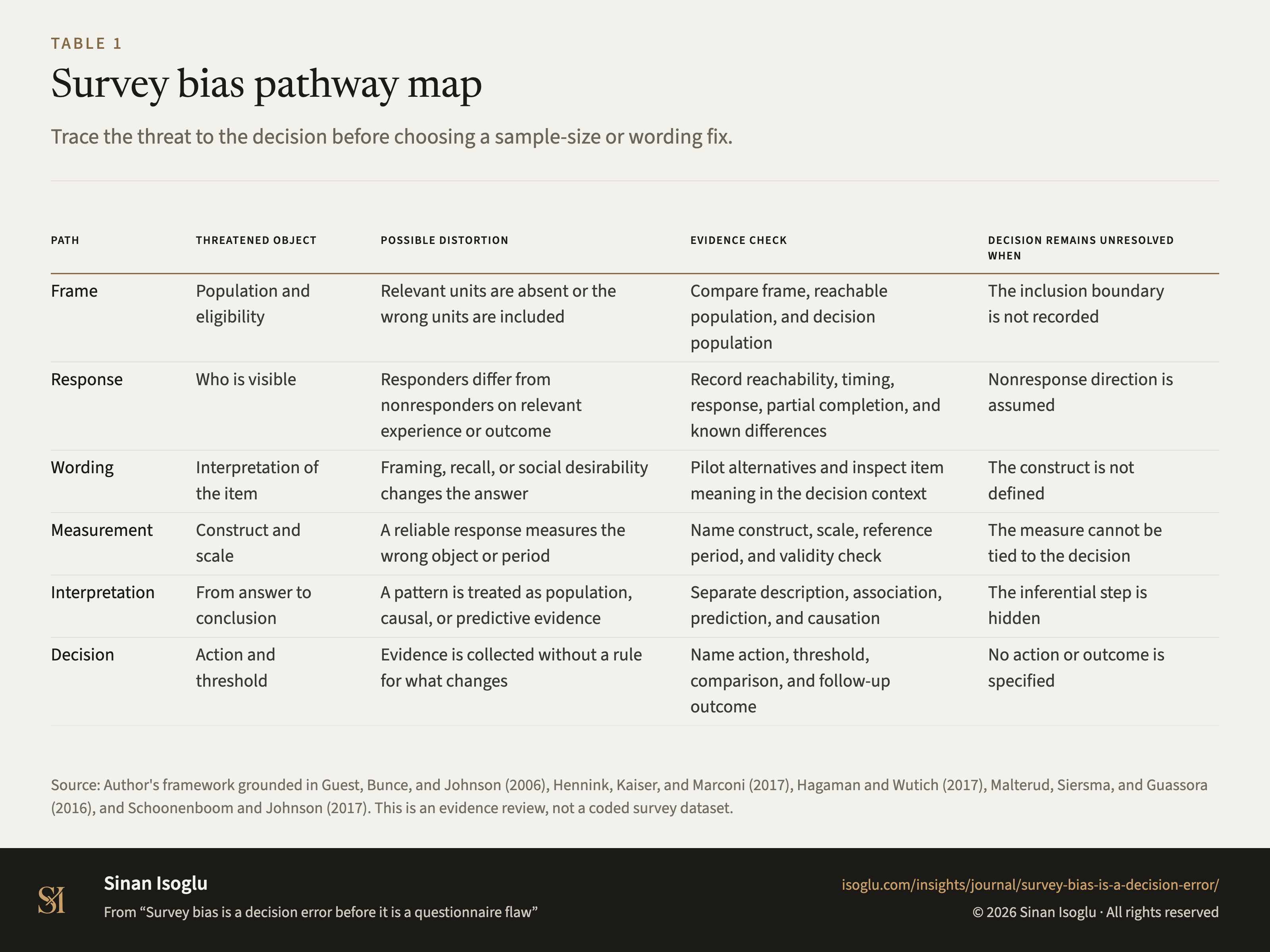
Table 1Table
Survey bias pathway map
Survey bias is a decision error before it is a questionnaire flaw
Contact
Bring the question you're working on.
Research, a guest lecture, or a commercial question.