Tabelle 1Aus „Sättigung ist eine Entscheidungsregel, keine Zahl“
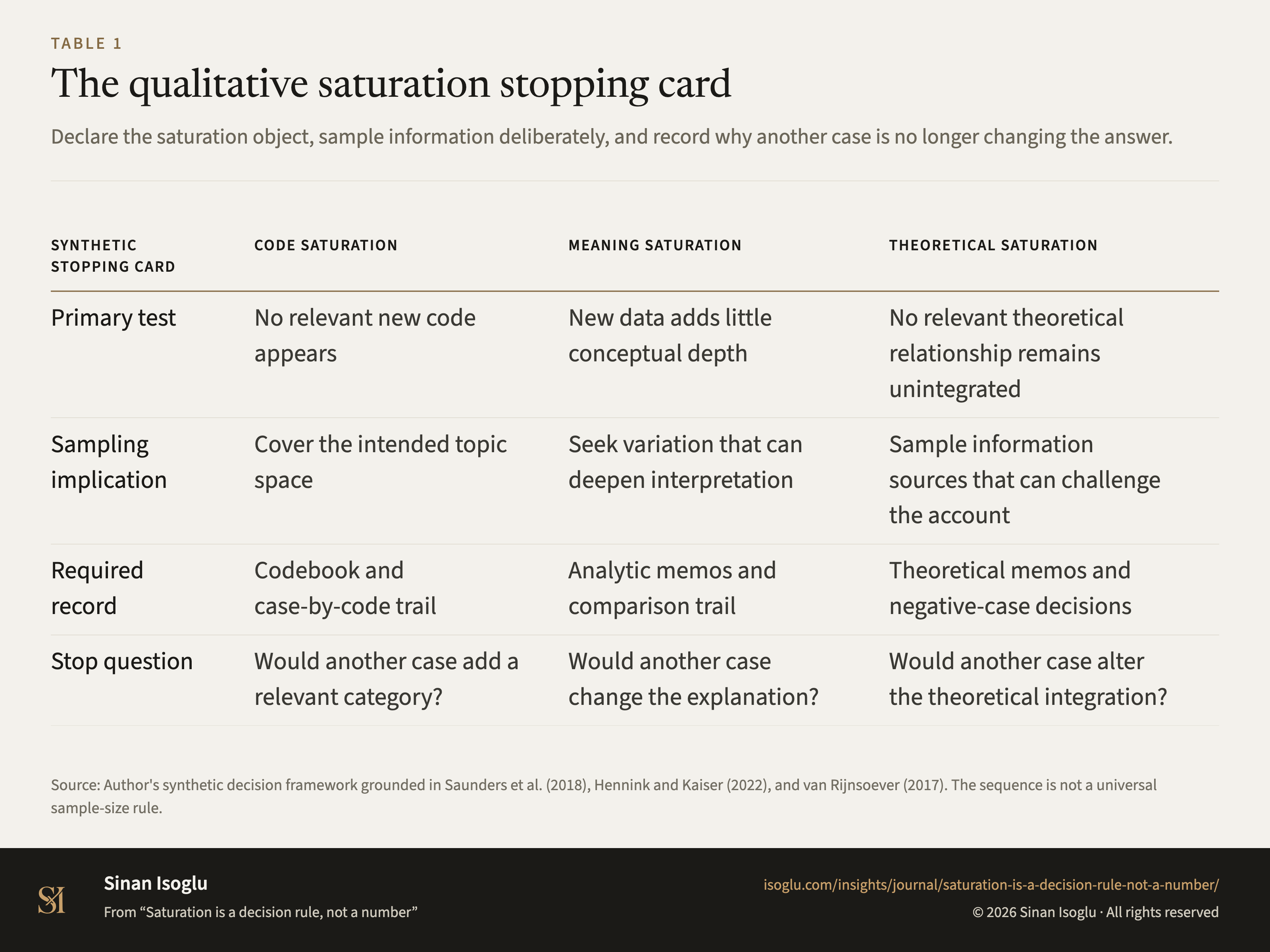
Die Stoppkarte für qualitative Sättigung
Sättigungsgegenstand erklären, Informationen bewusst sampeln und festhalten, warum ein weiterer Fall die Antwort nicht mehr verändert.
Tabelle 1Die Stoppkarte für qualitative Sättigung
| Synthetische Stoppkarte | Codesättigung | Bedeutungssättigung | Theoretische Sättigung |
|---|---|---|---|
| Primärtest | Kein relevanter neuer Code erscheint | Neues Material fügt wenig konzeptionelle Tiefe hinzu | Keine relevante theoretische Beziehung bleibt unintegriert |
| Samplingfolge | Den vorgesehenen Themenraum abdecken | Variation für tiefere Interpretation suchen | Informationsquellen auswählen, die die Erklärung herausfordern können |
| Erforderlicher Nachweis | Codebuch und Fall-Code-Spur | Analytische Memos und Vergleichsspur | Theoretische Memos und Entscheidungen zu Gegenbeispielen |
| Stoppfrage | Würde ein weiterer Fall eine relevante Kategorie ergänzen? | Würde ein weiterer Fall die Erklärung verändern? | Würde ein weiterer Fall die theoretische Integration verändern? |
Bei breiten Tabellen horizontal wischen oder scrollen.
Quelle: Synthetischer Entscheidungsrahmen des Autors, begründet in Saunders et al. (2018), Hennink und Kaiser (2022) sowie van Rijnsoever (2017). Die Abfolge ist keine universelle Stichprobengrößenregel.
Quelle und Evidenz
Jede Zeile nennt eine Aussage zu dieser Abbildung, ihre Quelle und die Art ihrer Prüfung.
- A SAU18-C1 Saturation is widely used to indicate that more data are unnecessary, and the authors say the concept is used inconsistently: "It is commonly taken to indicate that, on the basis of the data that have been collected or analysed hitherto, further data collection and/or analysis are unnecessary", yet "there appears to be uncertainty as to how saturation should be conceptualized, and inconsistencies in its use"Saunders et al. (2018)
- A SAU18-C2 The article distinguishes different conceptualisations rather than treating saturation as one universal event: "We identify four distinct approaches to saturation, which differ in terms of the extent to which an inductive or a deductive logic is adopted"Saunders et al. (2018)
- A SAU18-C3 The recommendation is to make the form and rationale explicit: "We conclude that saturation should be operationalized in a way that is consistent with the research question(s), and the theoretical position and analytic framework adopted"Saunders et al. (2018)
- A HK22-C1 The design is a systematic review, in the authors' words: "We conducted a systematic review of four databases to identify studies empirically assessing sample sizes for saturation in qualitative research", and "We identified 23 articles that used empirical data (n = 17) or statistical modeling (n = 6) to assess" saturationHennink & Kaiser. (2022)
- A HK22-C2 The reviewed range, verbatim: "Studies using empirical data reached saturation within a narrow range of interviews (9-17) or focus" group discussions (4-8), particularly in relatively homogeneous populationsHennink & Kaiser. (2022)
- A HK22-C3 The caution is the authors' own and travels with the range: "these findings apply to certain types of studies (e.g., those with homogenous study populations)"Hennink & Kaiser. (2022)
- A VR17-C1 The simulation's object, in the author's words: "I conceptualize a population as consisting of sub-populations that contain different types of information sources that hold a number of codes"van Rijnsoever. (2017)
- A VR17-C2 The three sampling scenarios differ in what they require: "the minimal and maximal information scenarios are significantly more efficient than random chance", though they yield fewer repetitions per codevan Rijnsoever. (2017)
- A VR17-C3 The result that decides the guidance: "I show that theoretical saturation is more dependent on the mean probability of observing codes than on the number of codes in a population"van Rijnsoever. (2017)
Prüfgrade: A, gegen die gedruckte Seite der Primärquelle geprüft · B, Primärquelle, nur Textebene · C, belastbare Sekundärquelle · D, berichtet.
Aus dem Beitrag
Aus der Forschung
Sättigung ist eine Entscheidungsregel, keine Zahl
Qualitative Sättigung ist eine Stoppentscheidung, keine universelle Interviewzahl: Verbinde Code oder Bedeutung mit Frage und Samplingdesign.
Den Beitrag lesenDiese Abbildung gehört zu einem Essay: Die Zahlen stehen hier, das Argument dort.
Zitieren oder einbetten
Verwandte Abbildungen
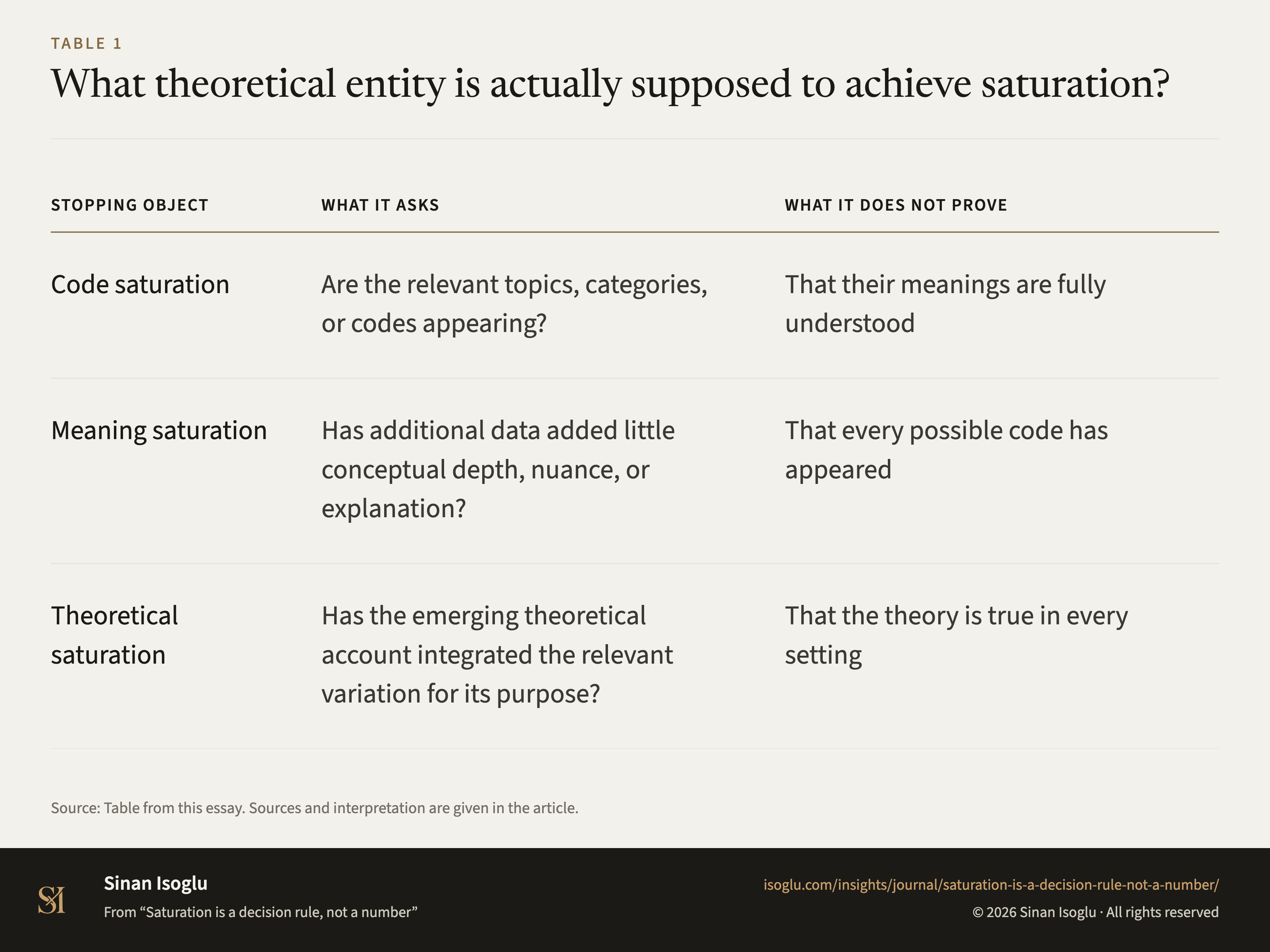
Tabelle 1Tabelle
Welches theoretische Phänomen soll in der Untersuchung tatsächlich gesättigt sein?
Sättigung ist eine Entscheidungsregel, keine Zahl
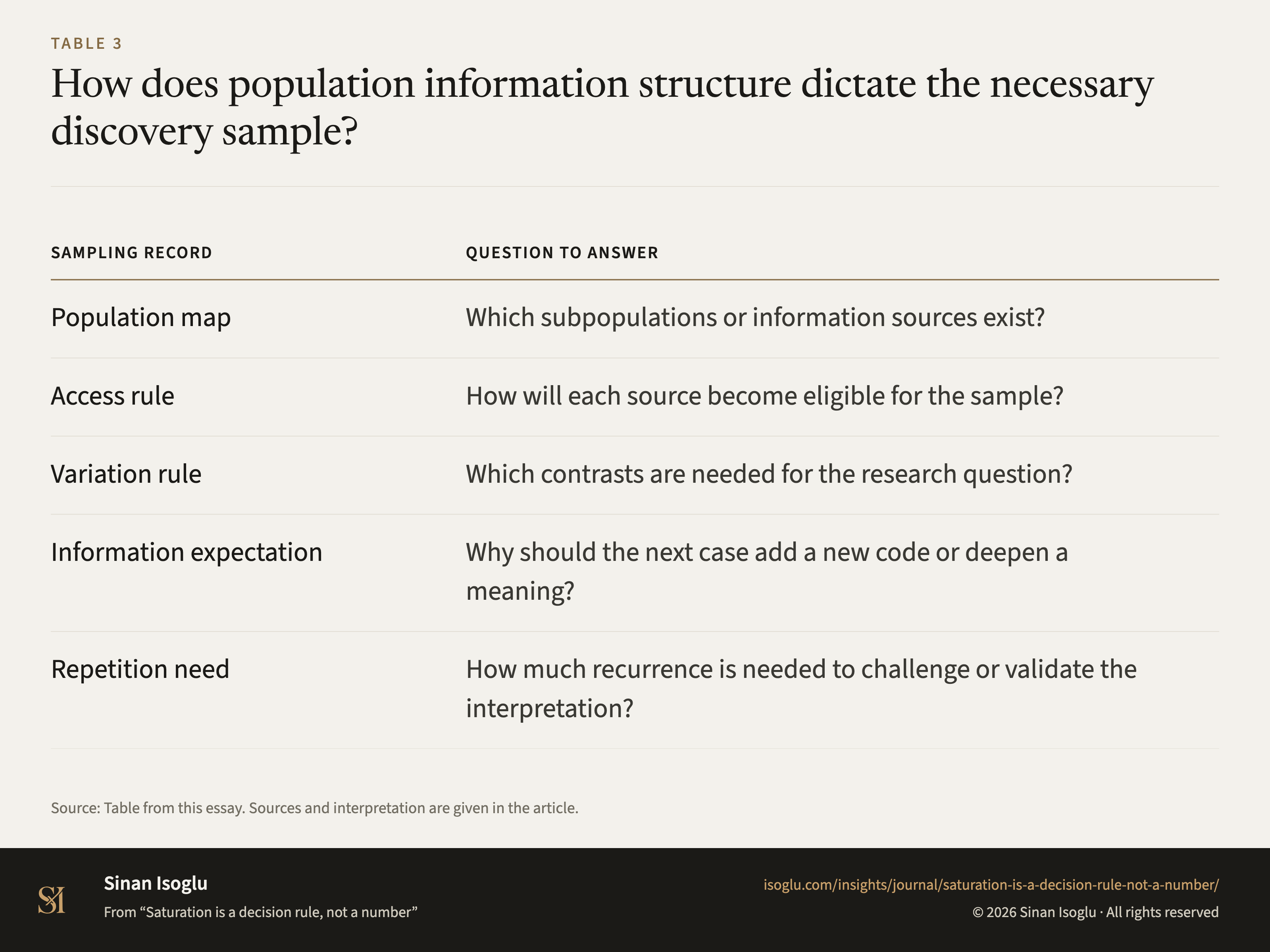
Tabelle 3Tabelle
Wie bestimmt die Informationsstruktur des Feldes den Erhebungsaufwand?
Sättigung ist eine Entscheidungsregel, keine Zahl
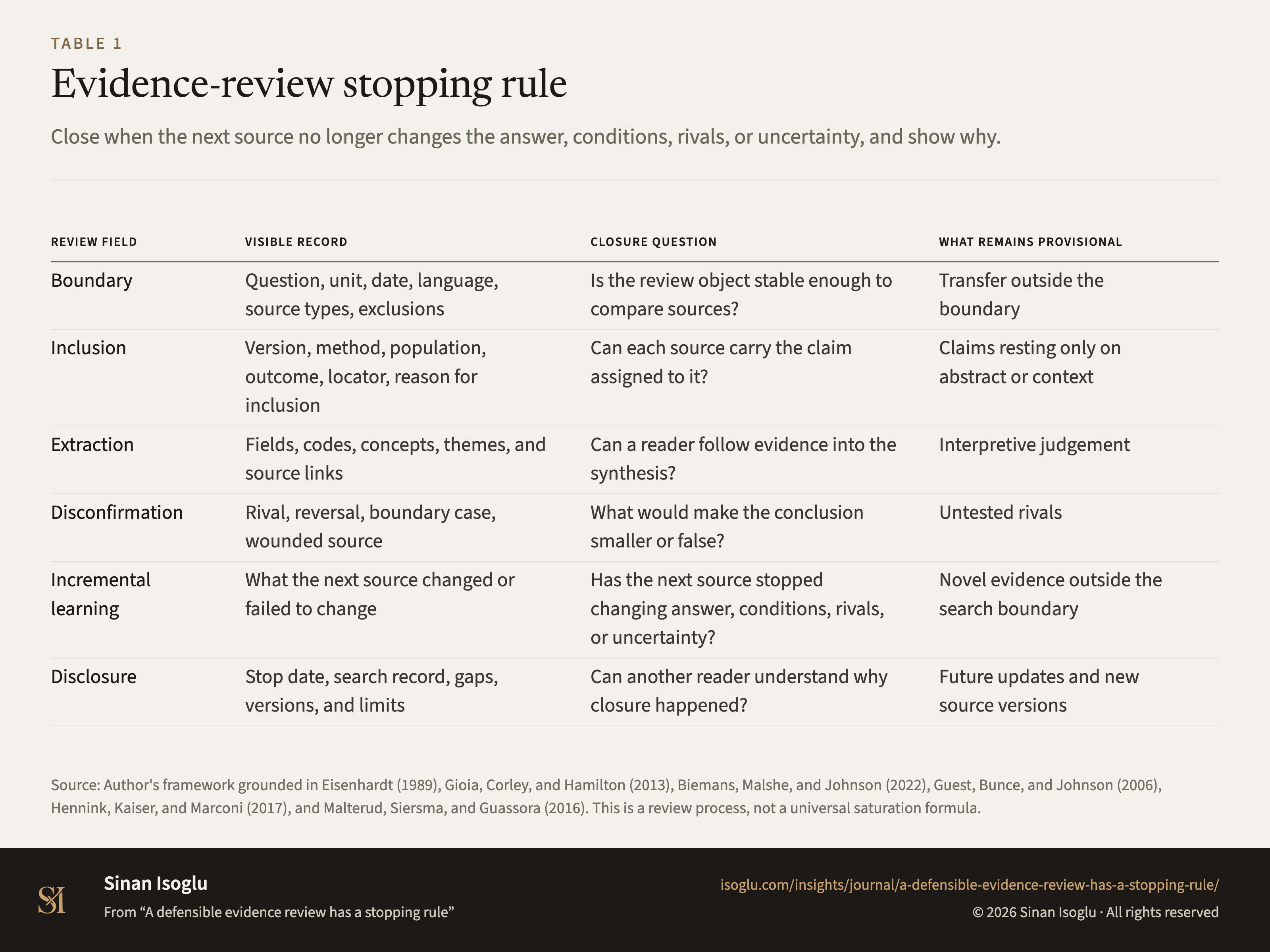
Tabelle 1Tabelle
Abbruchregel für Evidenzreviews
Ein belastbares Evidenzreview braucht eine Abbruchregel
Kontakt
Schicken Sie die Frage, an der Sie arbeiten.
Forschung, ein Gastvortrag oder eine Frage aus der Praxis.