Figure 2From “Revenue management versus dynamic pricing”
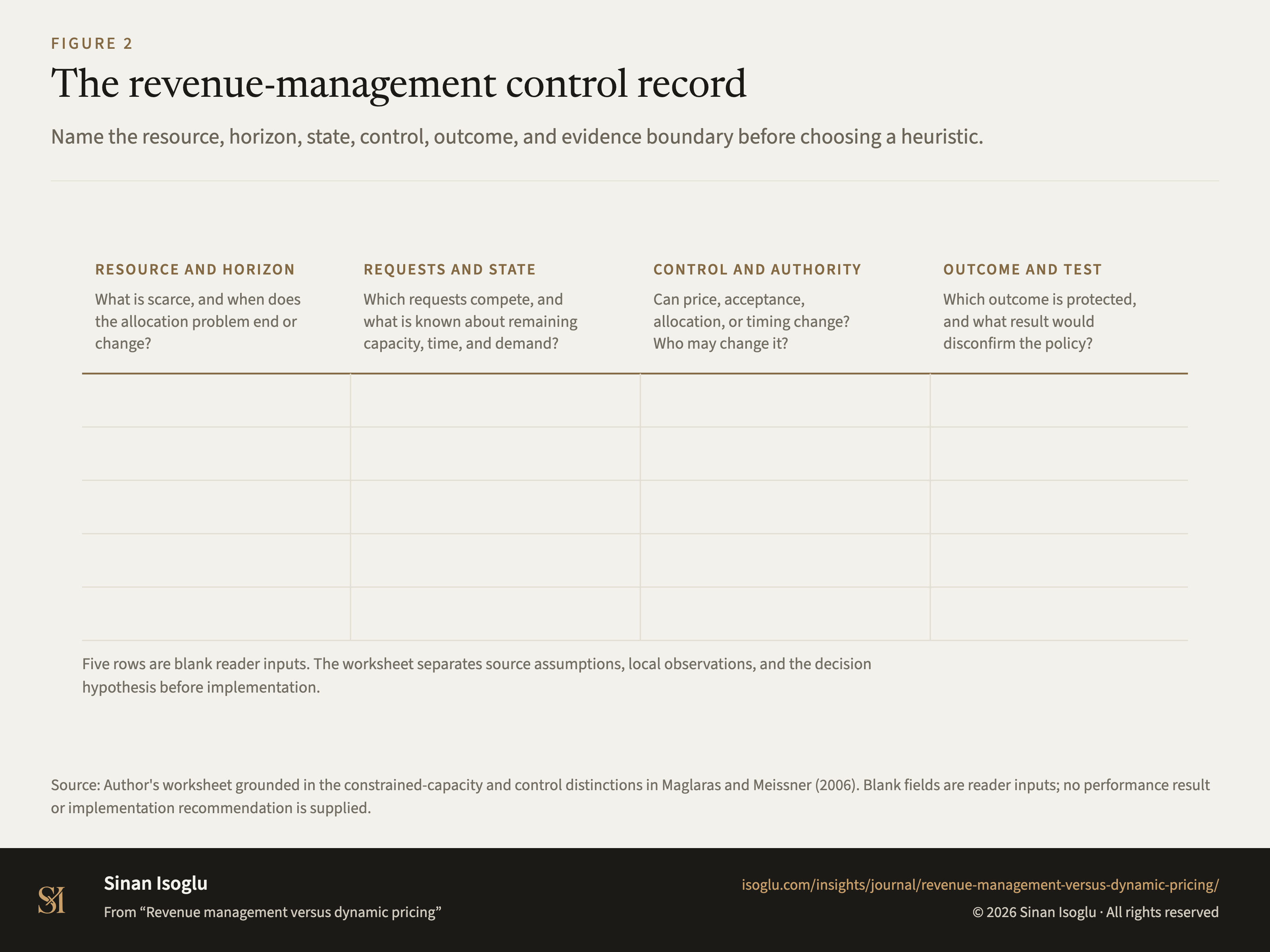
The revenue-management control record
Name the resource, horizon, state, control, outcome, and evidence boundary before choosing a heuristic.
Figure 2The revenue-management control record
Source: Author's worksheet grounded in the constrained-capacity and control distinctions in Maglaras and Meissner (2006). Blank fields are reader inputs; no performance result or implementation recommendation is supplied.
Source and evidence
Each line names a claim related to this exhibit, its source, and how it was checked.
- A MM06-C1 The model, verbatim: "a firm that owns a fixed capacity of a resource that is consumed in the production or delivery of multiple products"maglaras-meissner-2006-dynamic-pricing-revenue-management
- A MM06-C2 Two variants, not one: "We consider two well-studied variants of this problem." Price-setting under market power and capacity control at fixed prices are distinct variantsmaglaras-meissner-2006-dynamic-pricing-revenue-management
- A MM06-C3 The reduction is the contribution: both problems reduce to a formulation "in which the firm controls the aggregate rate at which all products jointly consume resource capacity"maglaras-meissner-2006-dynamic-pricing-revenue-management
- A MM06-C4 The three policies are the paper's own, and so is the limit on the strongest one: it proposes "a static pricing heuristic, (ii) a static pricing heuris"tic applied with a capacity allocation policy, and a resolving heuristic that reevaluates the fluid policy, of which "we show that “resolving” the fluid heuristic achieves asymptotically optimal performance" under fluid scaling, which is an asymptotic result and not a claim about any single marketmaglaras-meissner-2006-dynamic-pricing-revenue-management
- A MM06-C5 The heuristics are fluid-scale asymptotically optimal only where potential demand and capacity grow proportionally largemaglaras-meissner-2006-dynamic-pricing-revenue-management
- A MM06-C6 The numerical section compares policies on specified model instances, and its results do not establish a portable commercial effectmaglaras-meissner-2006-dynamic-pricing-revenue-management
Grades: A, verified against the printed page of the primary source · B, primary source, text layer only · C, authoritative secondary · D, reported.
From the essay
Pricing & revenue architecture
Revenue management versus dynamic pricing
Revenue management allocates scarce capacity over time; dynamic pricing is one control alongside acceptance and allocation when demand competes.
Read the essayThis exhibit belongs to an essay: the numbers live here, the argument lives there.
Cite or embed
Related exhibits
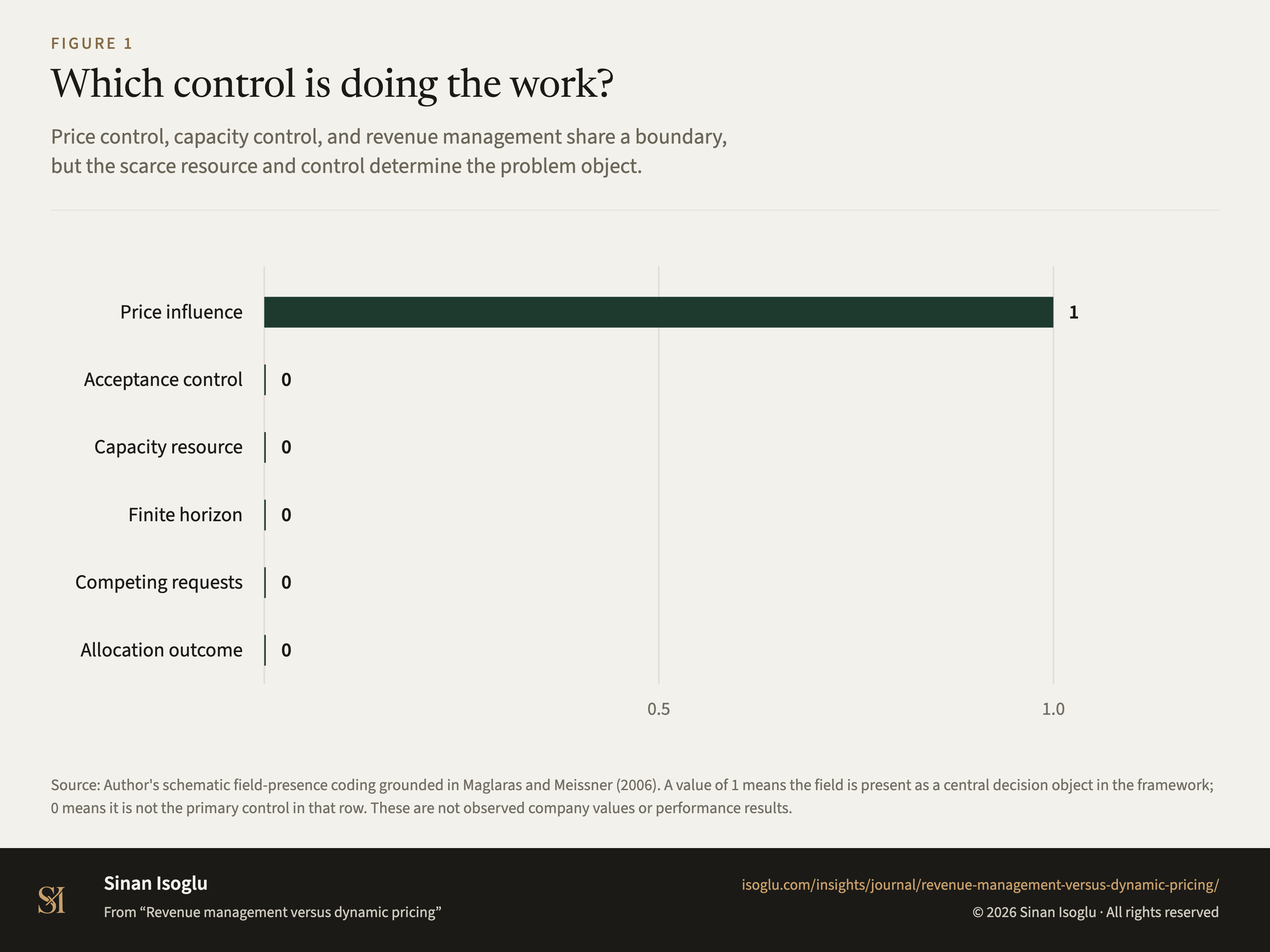
Figure 1Figure
Which control is doing the work?
Revenue management versus dynamic pricing
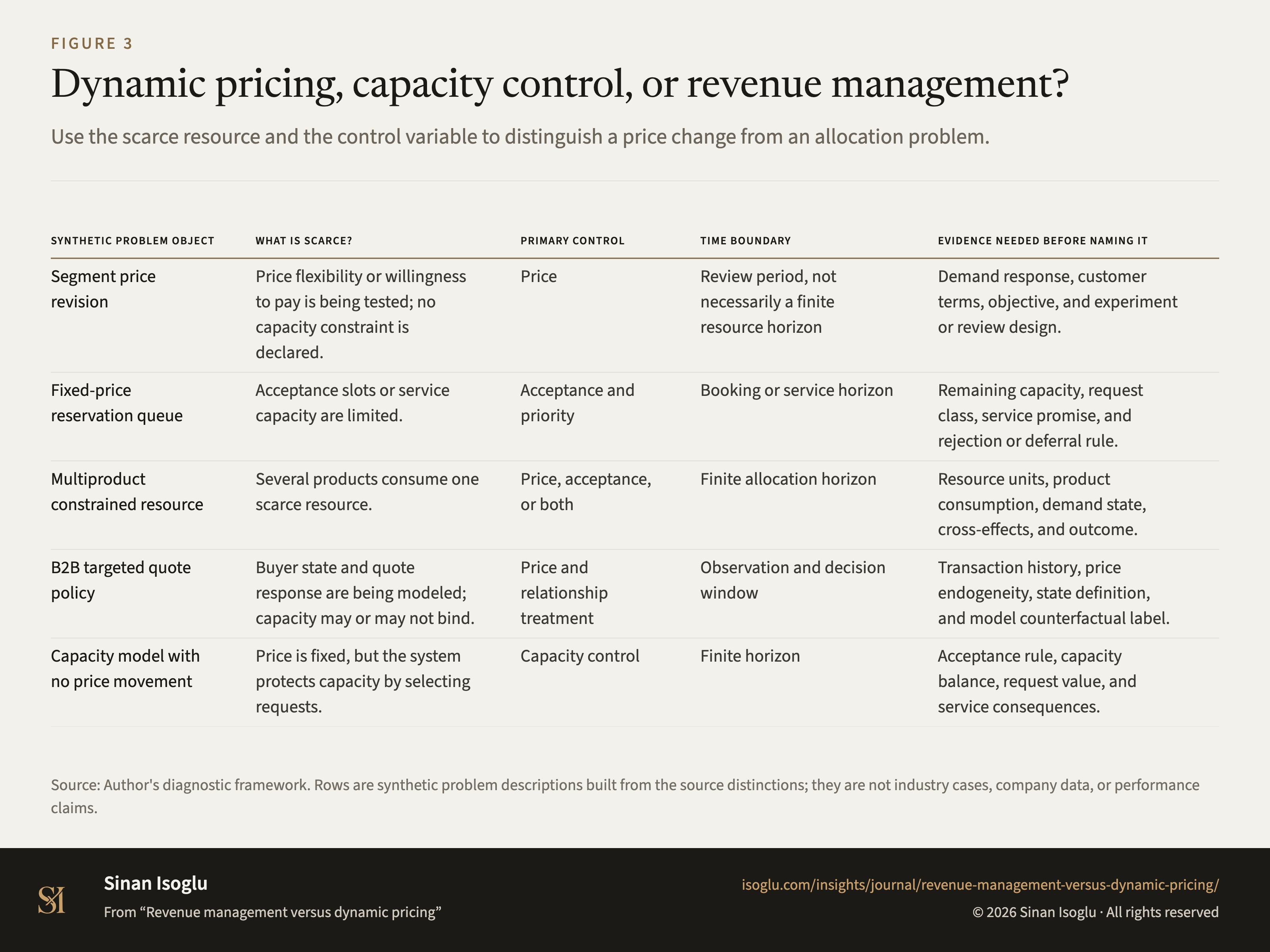
Figure 3Figure
Dynamic pricing, capacity control, or revenue management?
Revenue management versus dynamic pricing
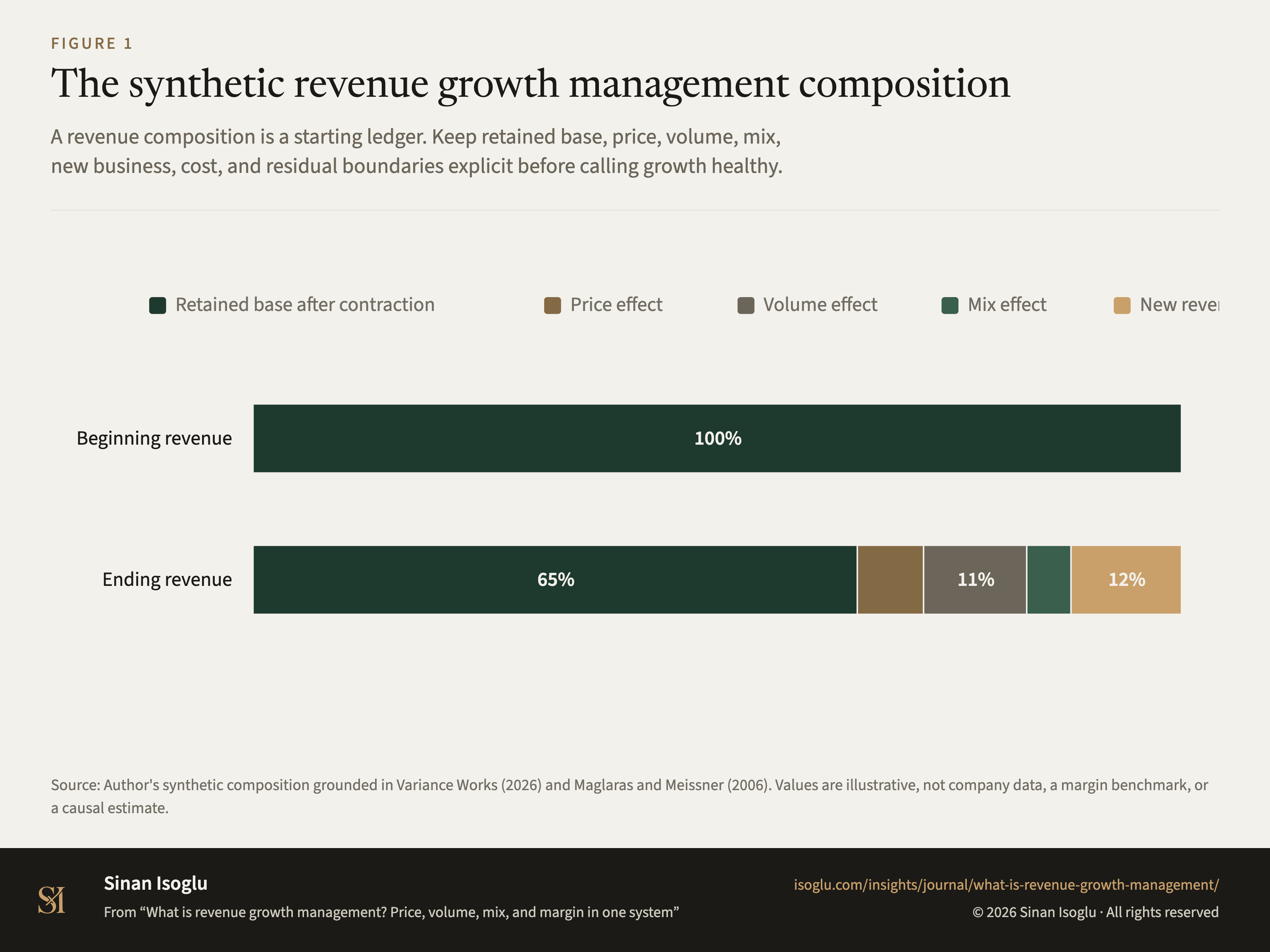
Figure 1Figure
The synthetic revenue growth management composition
What is revenue growth management? Price, volume, mix, and margin in one system
Contact
Bring the question you're working on.
Research, a guest lecture, or a commercial question.