Abbildung 2Aus „Revenue Management versus dynamische Preisgestaltung“
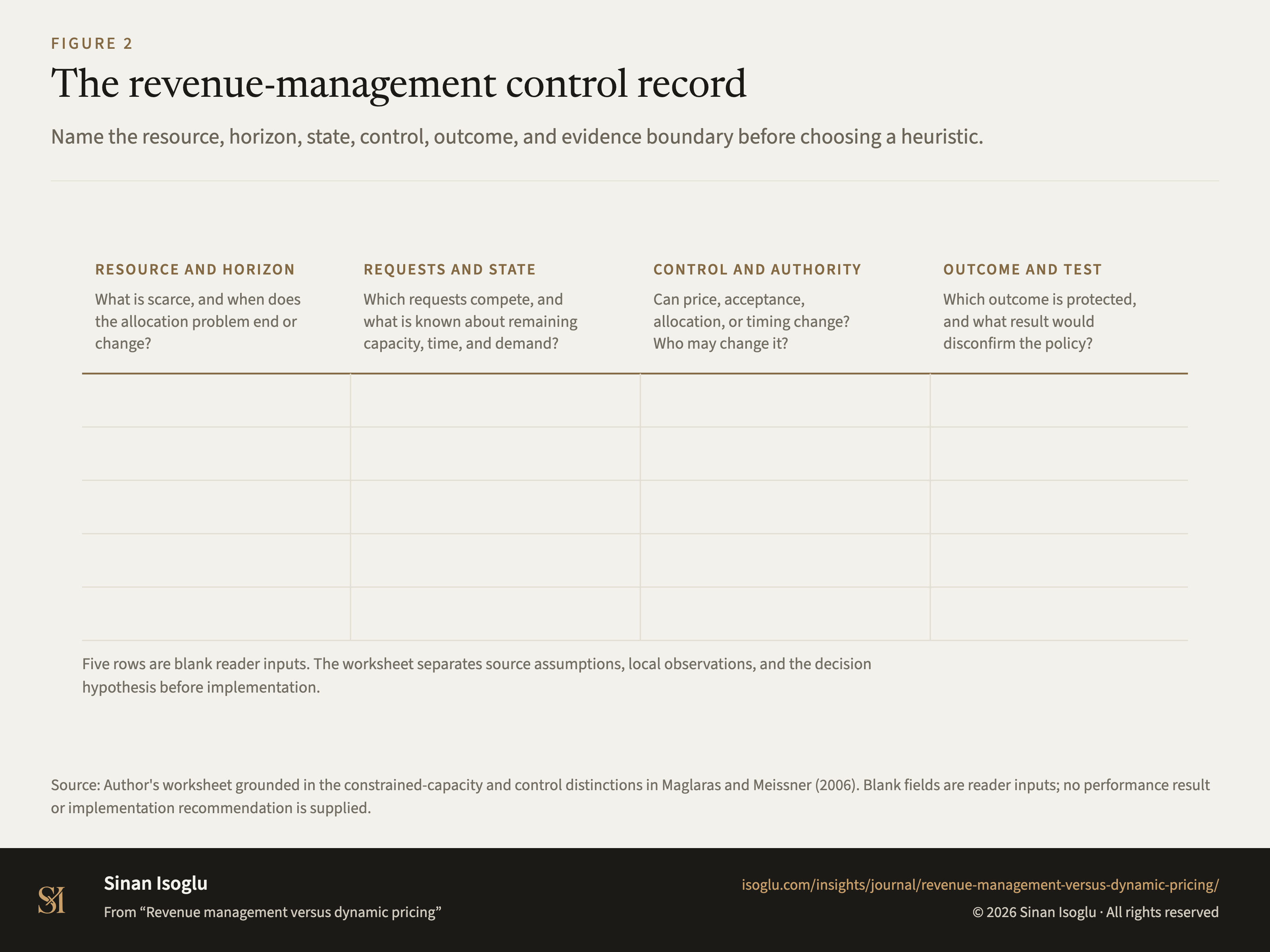
Das Steuerungsprotokoll für Revenue Management
Benennen Sie Ressource, Zeithorizont, Zustand, Steuerung, Ergebnis und Evidenzgrenze vor der Auswahl einer Heuristik.
Abbildung 2Das Steuerungsprotokoll für Revenue Management
Quelle: Arbeitsblatt des Autors, begründet mit den Unterscheidungen zu knapper Kapazität und Steuerung bei Maglaras und Meissner (2006). Leere Felder sind Eingaben der Lesenden; es wird kein Leistungsergebnis und keine Implementierungsempfehlung geliefert.
Quelle und Evidenz
Jede Zeile nennt eine Aussage zu dieser Abbildung, ihre Quelle und die Art ihrer Prüfung.
- A MM06-C1 The model, verbatim: "a firm that owns a fixed capacity of a resource that is consumed in the production or delivery of multiple products"maglaras-meissner-2006-dynamic-pricing-revenue-management
- A MM06-C2 Two variants, not one: "We consider two well-studied variants of this problem." Price-setting under market power and capacity control at fixed prices are distinct variantsmaglaras-meissner-2006-dynamic-pricing-revenue-management
- A MM06-C3 The reduction is the contribution: both problems reduce to a formulation "in which the firm controls the aggregate rate at which all products jointly consume resource capacity"maglaras-meissner-2006-dynamic-pricing-revenue-management
- A MM06-C4 The three policies are the paper's own, and so is the limit on the strongest one: it proposes "a static pricing heuristic, (ii) a static pricing heuris"tic applied with a capacity allocation policy, and a resolving heuristic that reevaluates the fluid policy, of which "we show that “resolving” the fluid heuristic achieves asymptotically optimal performance" under fluid scaling, which is an asymptotic result and not a claim about any single marketmaglaras-meissner-2006-dynamic-pricing-revenue-management
- A MM06-C5 The heuristics are fluid-scale asymptotically optimal only where potential demand and capacity grow proportionally largemaglaras-meissner-2006-dynamic-pricing-revenue-management
- A MM06-C6 The numerical section compares policies on specified model instances, and its results do not establish a portable commercial effectmaglaras-meissner-2006-dynamic-pricing-revenue-management
Prüfgrade: A, gegen die gedruckte Seite der Primärquelle geprüft · B, Primärquelle, nur Textebene · C, belastbare Sekundärquelle · D, berichtet.
Aus dem Beitrag
Pricing & Umsatzarchitektur
Revenue Management versus dynamische Preisgestaltung
Revenue Management verteilt knappe Kapazität über die Zeit; dynamische Preisgestaltung ist ein Steuerungsinstrument neben Annahme und Allokation.
Den Beitrag lesenDiese Abbildung gehört zu einem Essay: Die Zahlen stehen hier, das Argument dort.
Zitieren oder einbetten
Verwandte Abbildungen
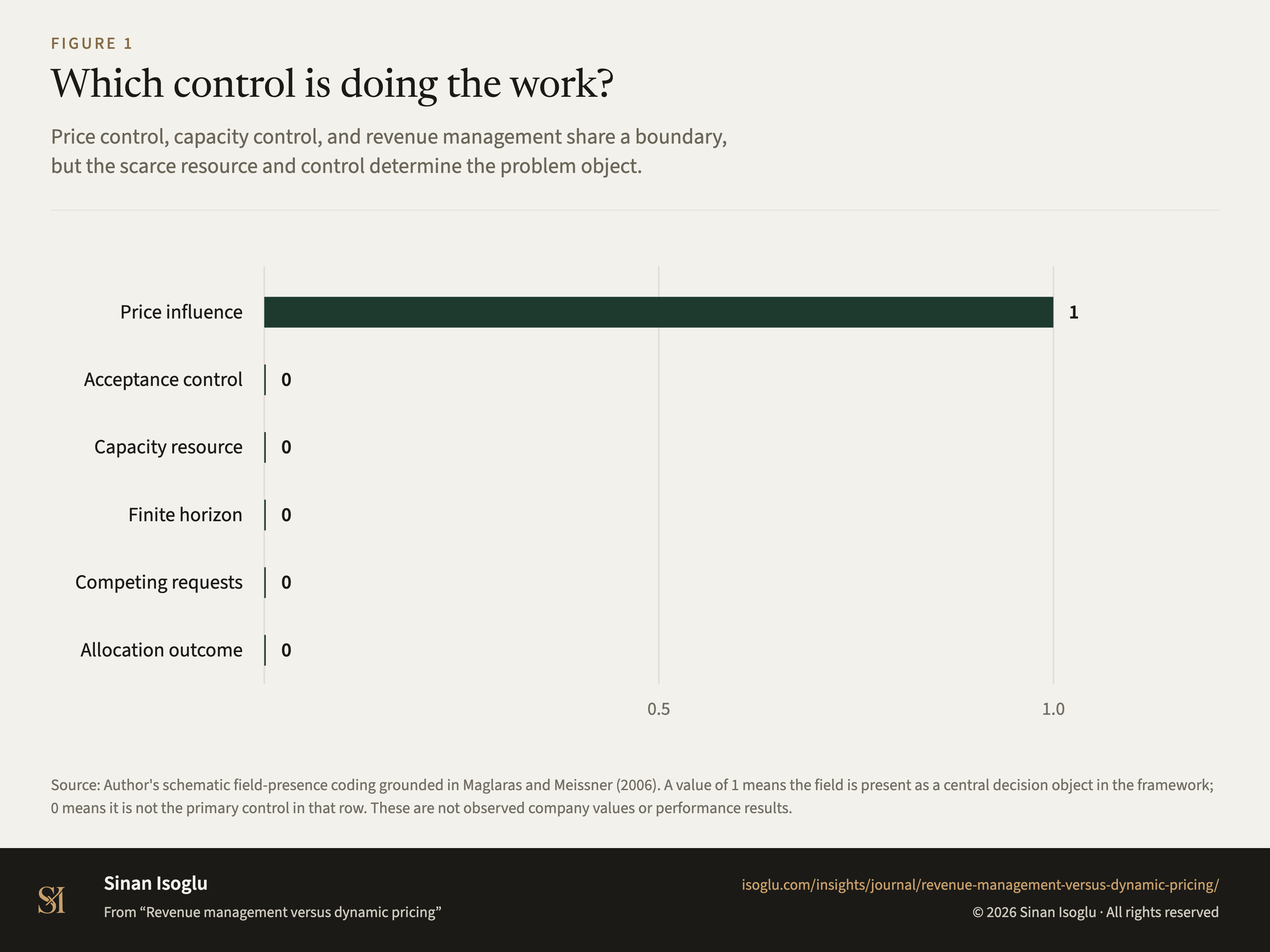
Abbildung 1Grafik
Welche Steuerung arbeitet hier?
Revenue Management versus dynamische Preisgestaltung
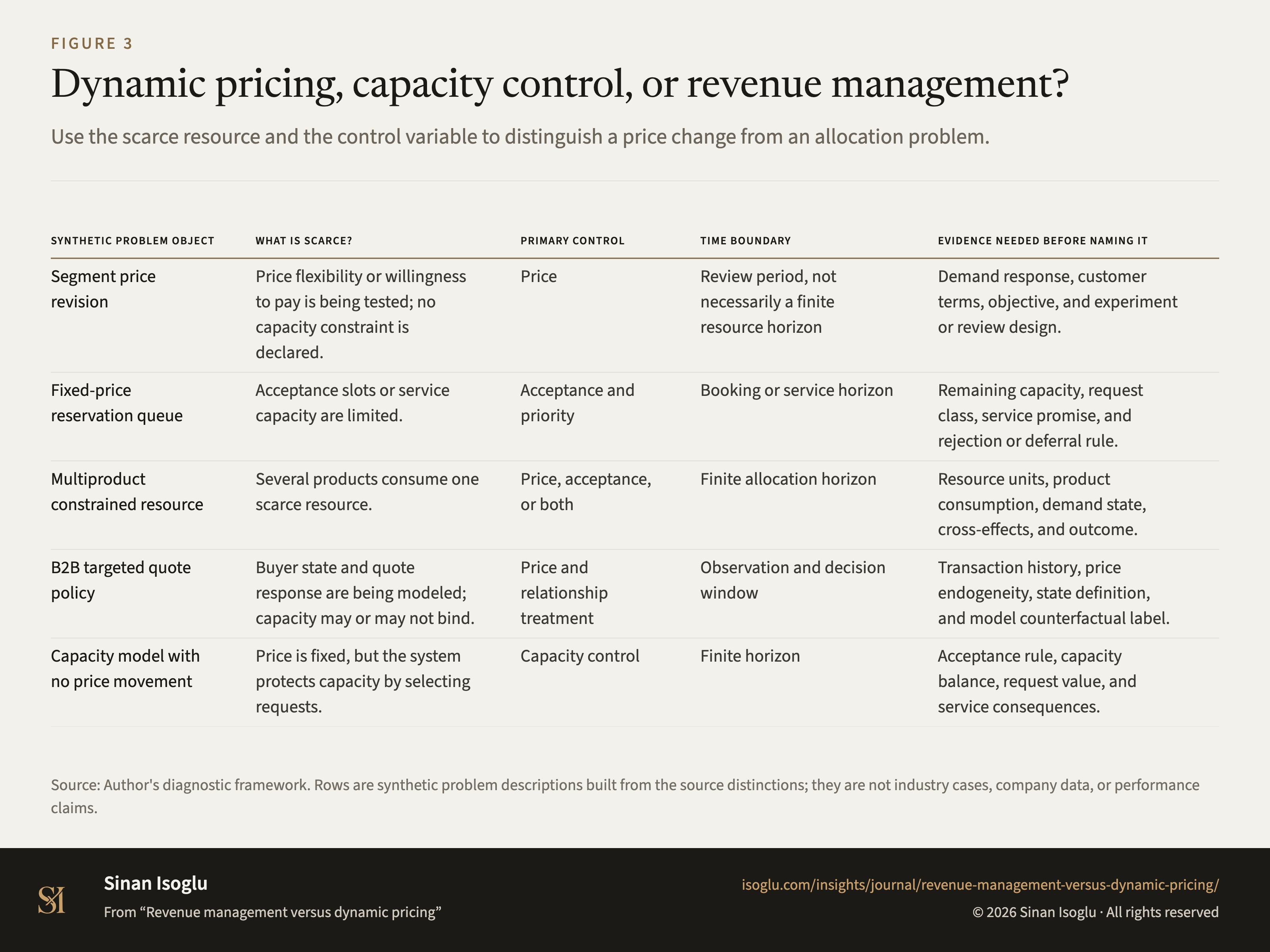
Abbildung 3Grafik
Dynamische Preisgestaltung, Kapazitätssteuerung oder Revenue Management?
Revenue Management versus dynamische Preisgestaltung
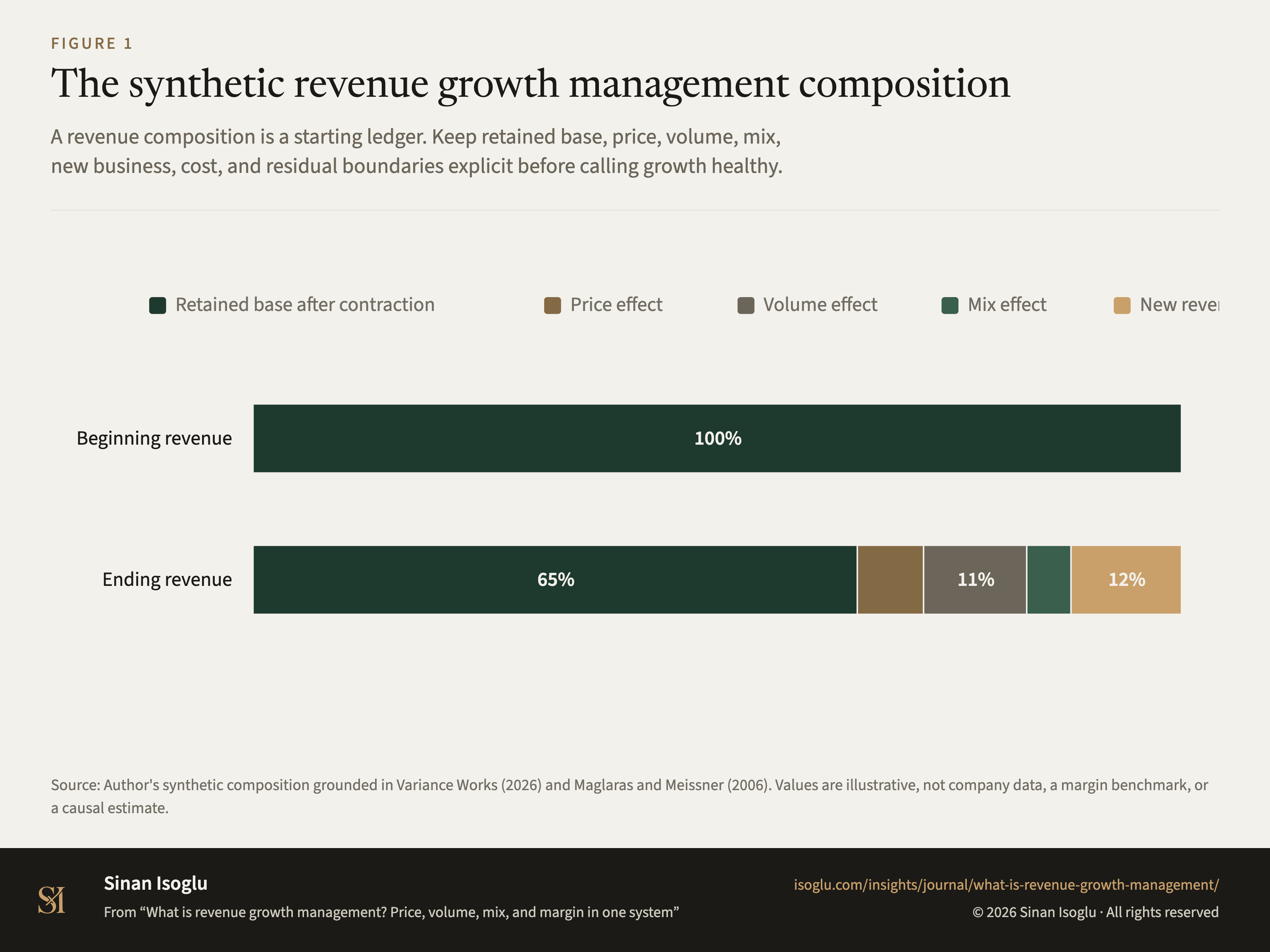
Abbildung 1Grafik
Die synthetische Revenue-Growth-Management-Zusammensetzung
Was ist Revenue Growth Management? Preis, Volumen, Mix und Marge in einem System
Kontakt
Schicken Sie die Frage, an der Sie arbeiten.
Forschung, ein Gastvortrag oder eine Frage aus der Praxis.