Figure 3From “Revenue management versus dynamic pricing”
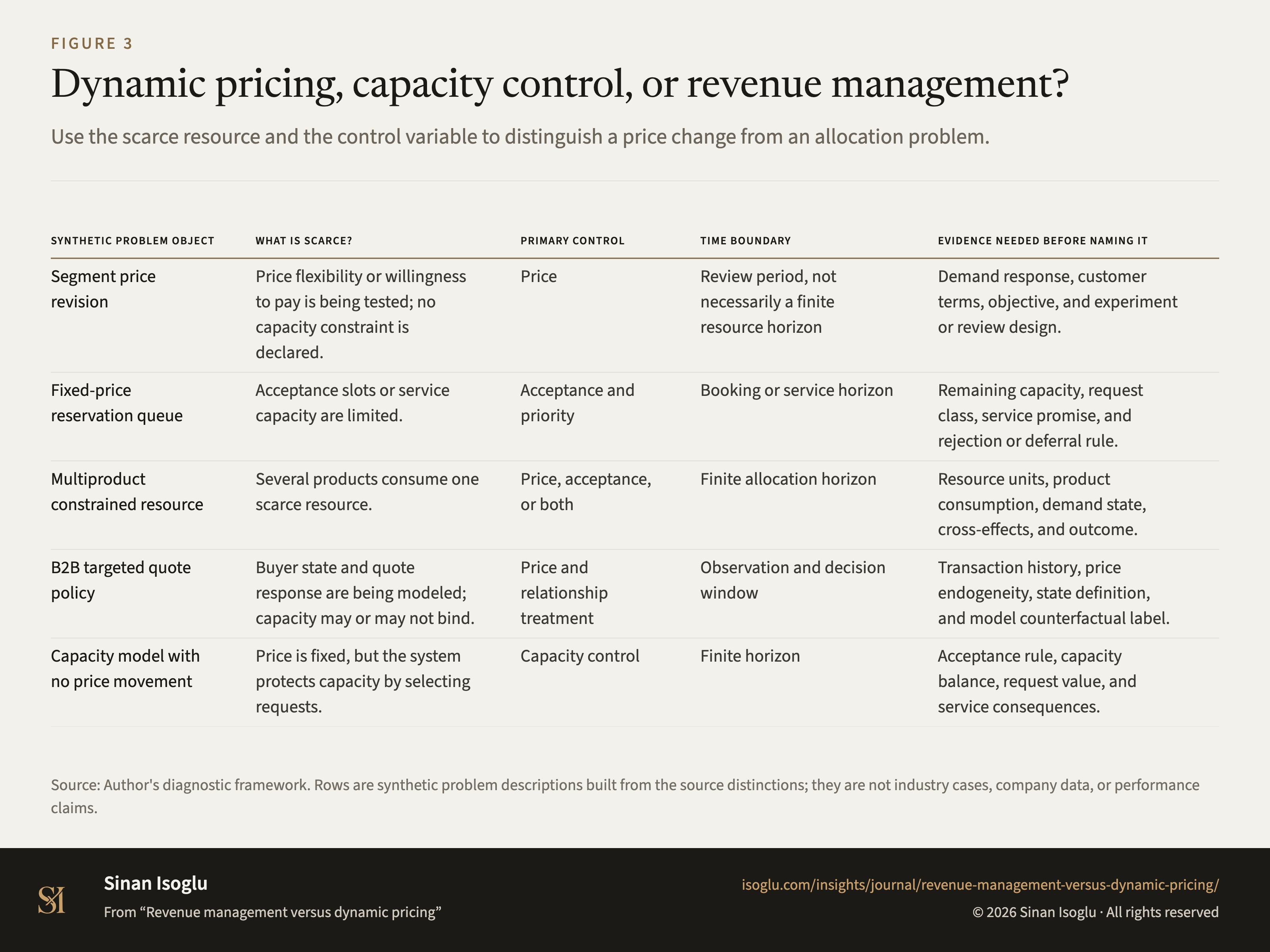
Dynamic pricing, capacity control, or revenue management?
Use the scarce resource and the control variable to distinguish a price change from an allocation problem.
Figure 3Dynamic pricing, capacity control, or revenue management?
| Synthetic problem object | What is scarce? | Primary control | Time boundary | Evidence needed before naming it |
|---|---|---|---|---|
| Segment price revision | Price flexibility or willingness to pay is being tested; no capacity constraint is declared. | Price | Review period, not necessarily a finite resource horizon | Demand response, customer terms, objective, and experiment or review design. |
| Fixed-price reservation queue | Acceptance slots or service capacity are limited. | Acceptance and priority | Booking or service horizon | Remaining capacity, request class, service promise, and rejection or deferral rule. |
| Multiproduct constrained resource | Several products consume one scarce resource. | Price, acceptance, or both | Finite allocation horizon | Resource units, product consumption, demand state, cross-effects, and outcome. |
| B2B targeted quote policy | Buyer state and quote response are being modeled; capacity may or may not bind. | Price and relationship treatment | Observation and decision window | Transaction history, price endogeneity, state definition, and model counterfactual label. |
| Capacity model with no price movement | Price is fixed, but the system protects capacity by selecting requests. | Capacity control | Finite horizon | Acceptance rule, capacity balance, request value, and service consequences. |
Swipe or scroll horizontally if the table is wider than your screen.
Source: Author's diagnostic framework. Rows are synthetic problem descriptions built from the source distinctions; they are not industry cases, company data, or performance claims.
Source and evidence
Each line names a claim related to this exhibit, its source, and how it was checked.
- A MM06-C1 The model, verbatim: "a firm that owns a fixed capacity of a resource that is consumed in the production or delivery of multiple products"maglaras-meissner-2006-dynamic-pricing-revenue-management
- A MM06-C2 Two variants, not one: "We consider two well-studied variants of this problem." Price-setting under market power and capacity control at fixed prices are distinct variantsmaglaras-meissner-2006-dynamic-pricing-revenue-management
- A MM06-C3 The reduction is the contribution: both problems reduce to a formulation "in which the firm controls the aggregate rate at which all products jointly consume resource capacity"maglaras-meissner-2006-dynamic-pricing-revenue-management
- A ZNA14-C1 Two latent states, named in the paper: "a “vigilant” state that is characterized by heightened price sensitivity and a cautious approach to ordering and a “relaxed” state with purchase behaviors that are consistent with high relational trust", and "the seller's pricing decisions can transition buyers between these two states". One industrial-consumables retailer, longitudinal transactionszhang-netzer-ansari-2014-dynamic-targeted-pricing
Grades: A, verified against the printed page of the primary source · B, primary source, text layer only · C, authoritative secondary · D, reported.
From the essay
Pricing & revenue architecture
Revenue management versus dynamic pricing
Revenue management allocates scarce capacity over time; dynamic pricing is one control alongside acceptance and allocation when demand competes.
Read the essayThis exhibit belongs to an essay: the numbers live here, the argument lives there.
Cite or embed
Related exhibits
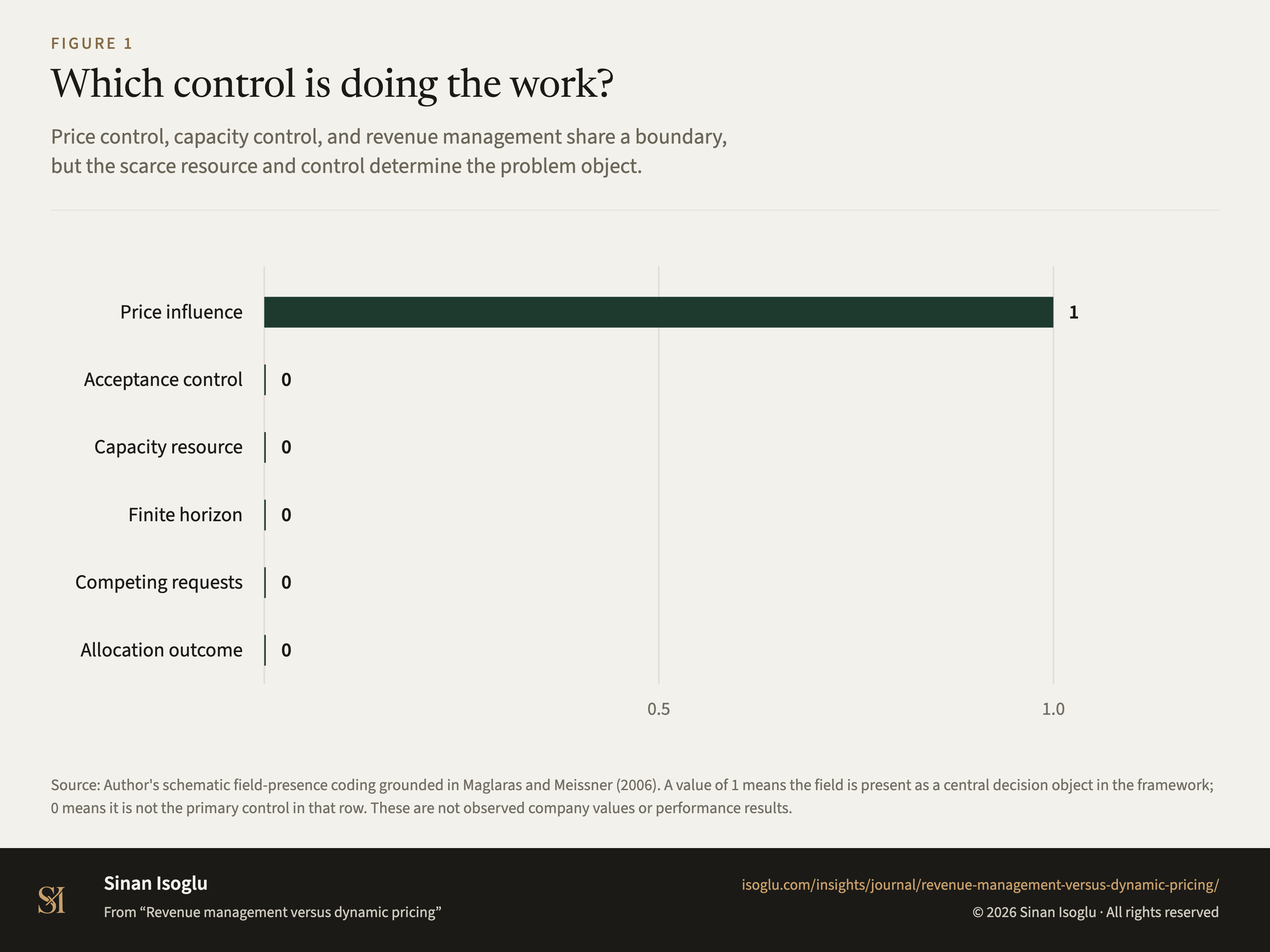
Figure 1Figure
Which control is doing the work?
Revenue management versus dynamic pricing
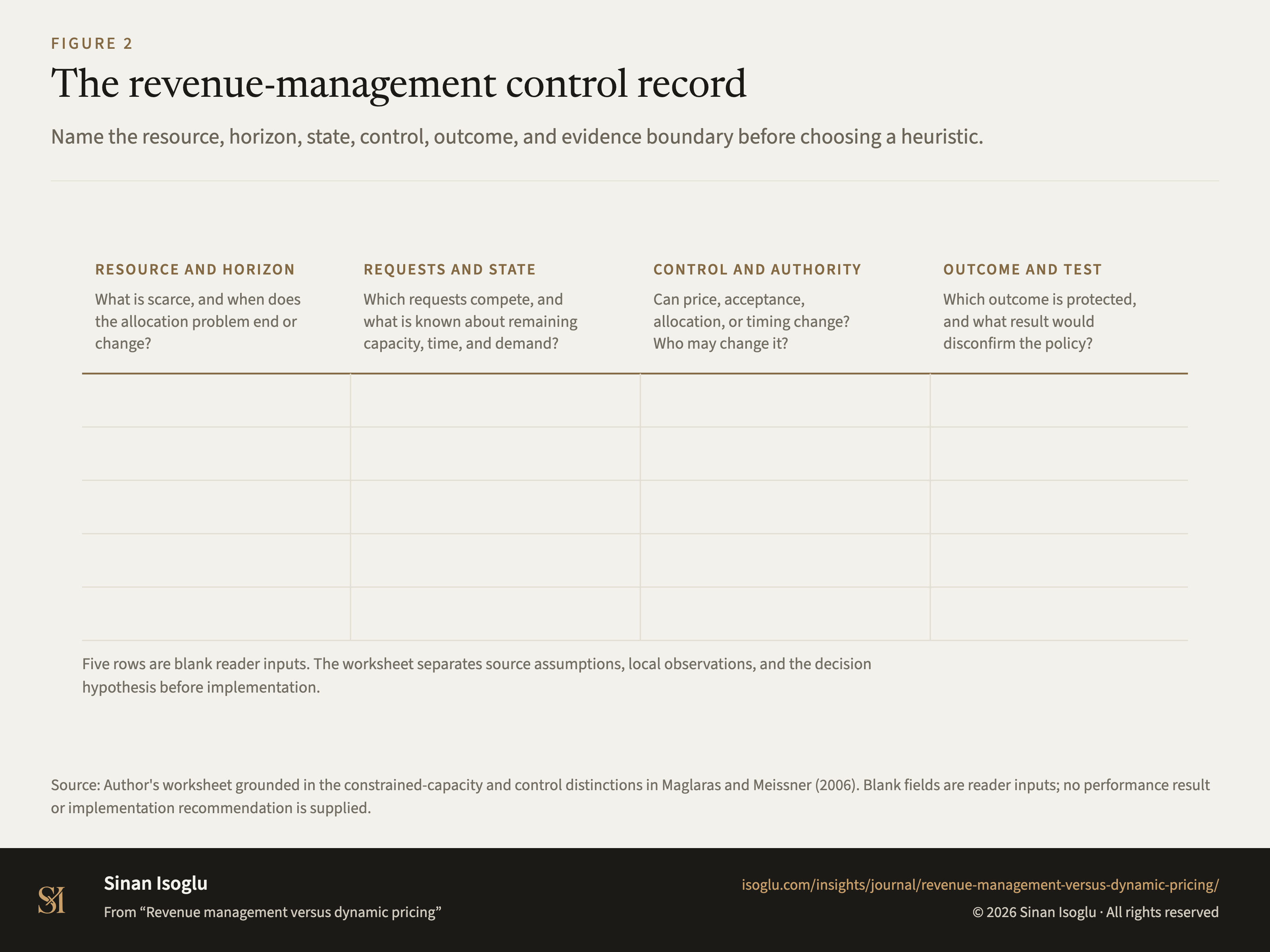
Figure 2Figure
The revenue-management control record
Revenue management versus dynamic pricing
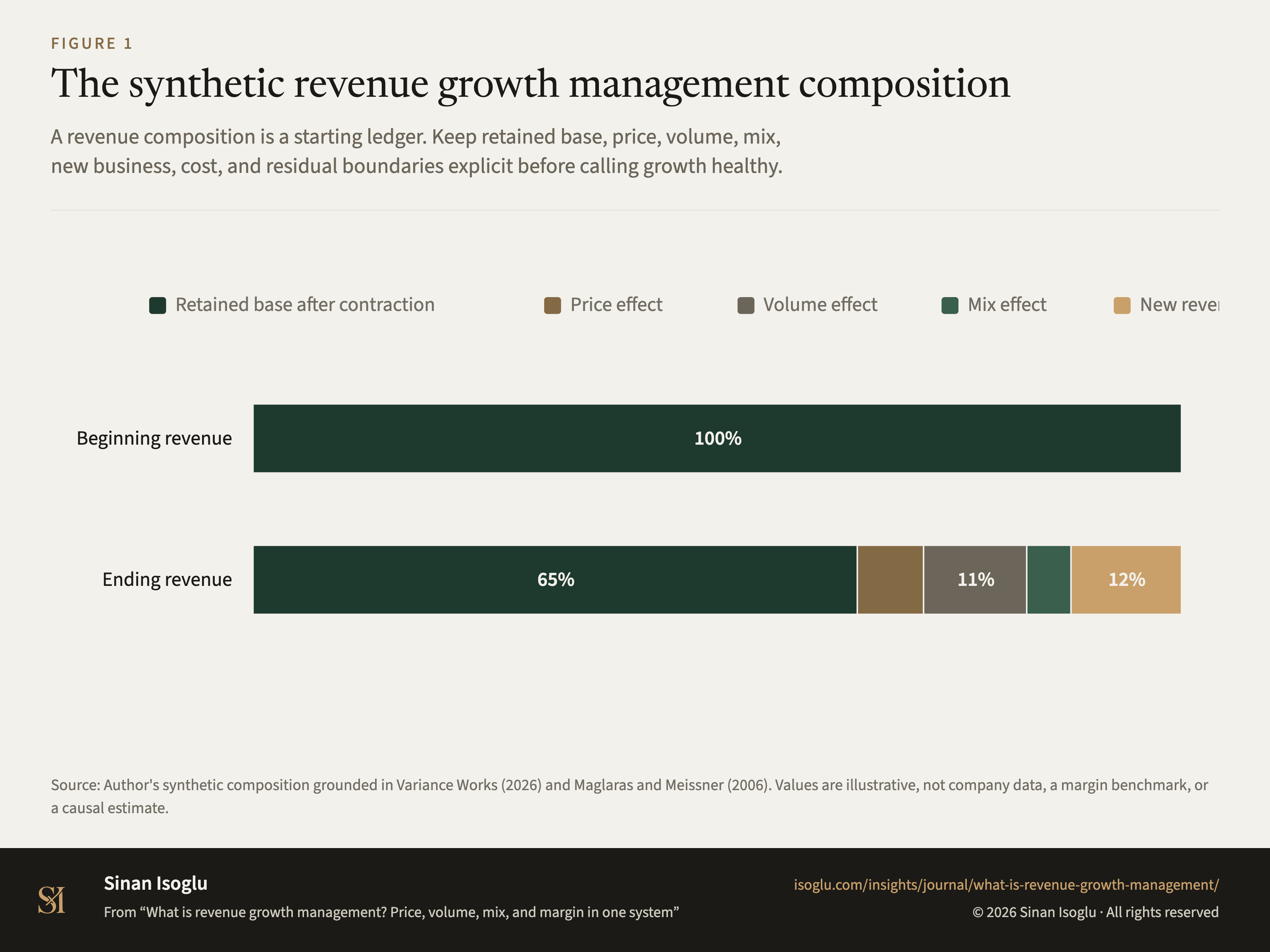
Figure 1Figure
The synthetic revenue growth management composition
What is revenue growth management? Price, volume, mix, and margin in one system
Contact
Bring the question you're working on.
Research, a guest lecture, or a commercial question.