← Every exhibit
Table 1From “Pricing is a positioning decision.”
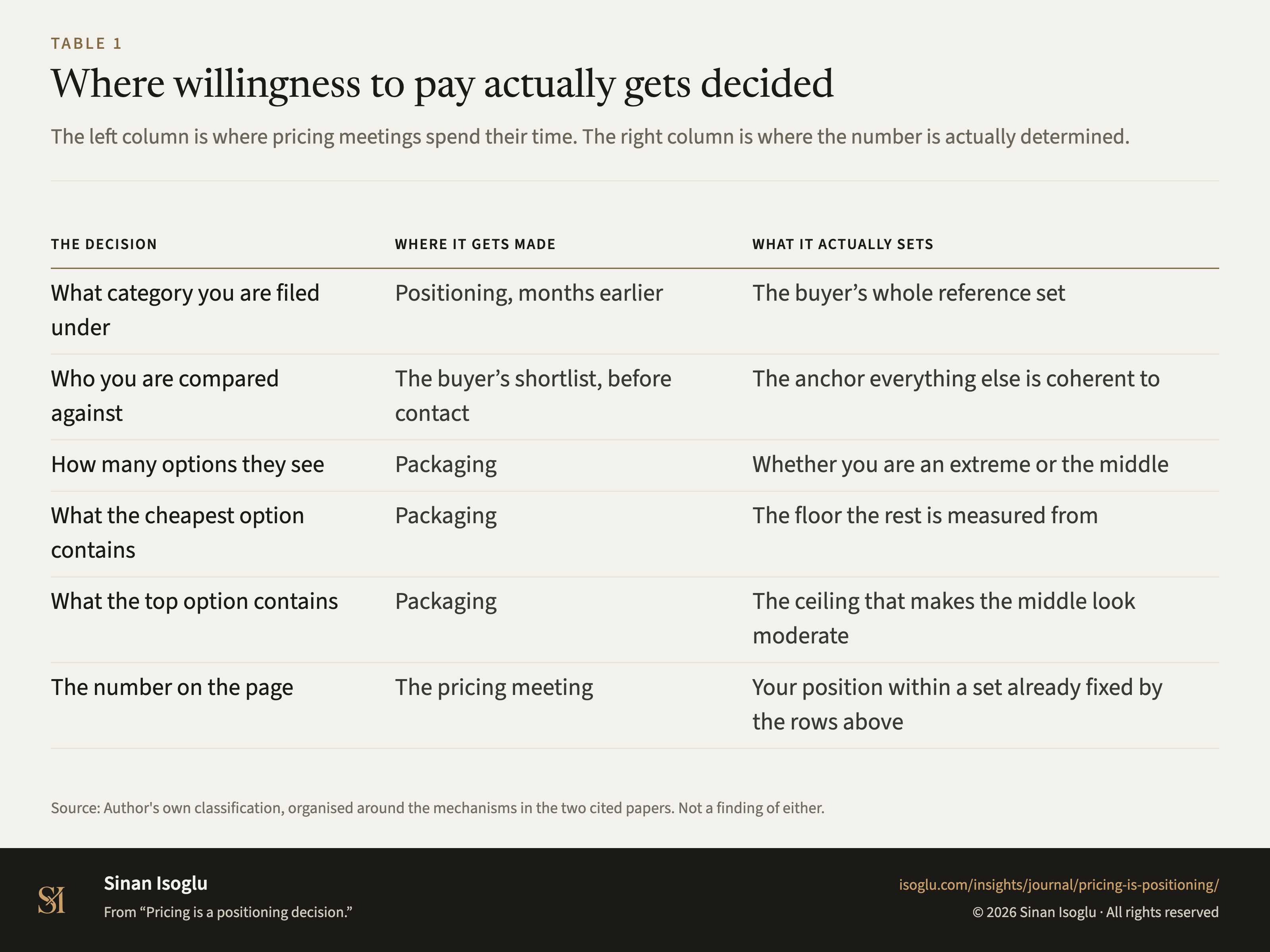
Where willingness to pay actually gets decided
The left column is where pricing meetings spend their time. The right column is where the number is actually determined.
Table 1Where willingness to pay actually gets decided
| The decision | Where it gets made | What it actually sets |
|---|---|---|
| What category you are filed under | Positioning, months earlier | The buyer's whole reference set |
| Who you are compared against | The buyer's shortlist, before contact | The anchor everything else is coherent to |
| How many options they see | Packaging | Whether you are an extreme or the middle |
| What the cheapest option contains | Packaging | The floor the rest is measured from |
| What the top option contains | Packaging | The ceiling that makes the middle look moderate |
| The number on the page | The pricing meeting | Your position within a set already fixed by the rows above |
Swipe or scroll horizontally if the table is wider than your screen.
Source: Author's own classification, organised around the mechanisms in the two cited papers. Not a finding of either.
PNG4:3, 1600 × 1200, with the title, the source line and the attribution set in the image isoglu-2026-pricing-is-positioning-fig03.png
From the essay
Pricing & revenue architecture
Pricing is a positioning decision.
Willingness to pay is not decided at the price page. It is built from what the buyer compares you against: so the set, not the number, is the lever.
Read the essayThis exhibit belongs to an essay: the numbers live here, the argument lives there.
Cite or embed
Contact
Bring the question you're working on.
Research, a guest lecture, or a commercial question.