← Every exhibit

Figure 6From “Porter's five forces: industry explains less than the firm does”

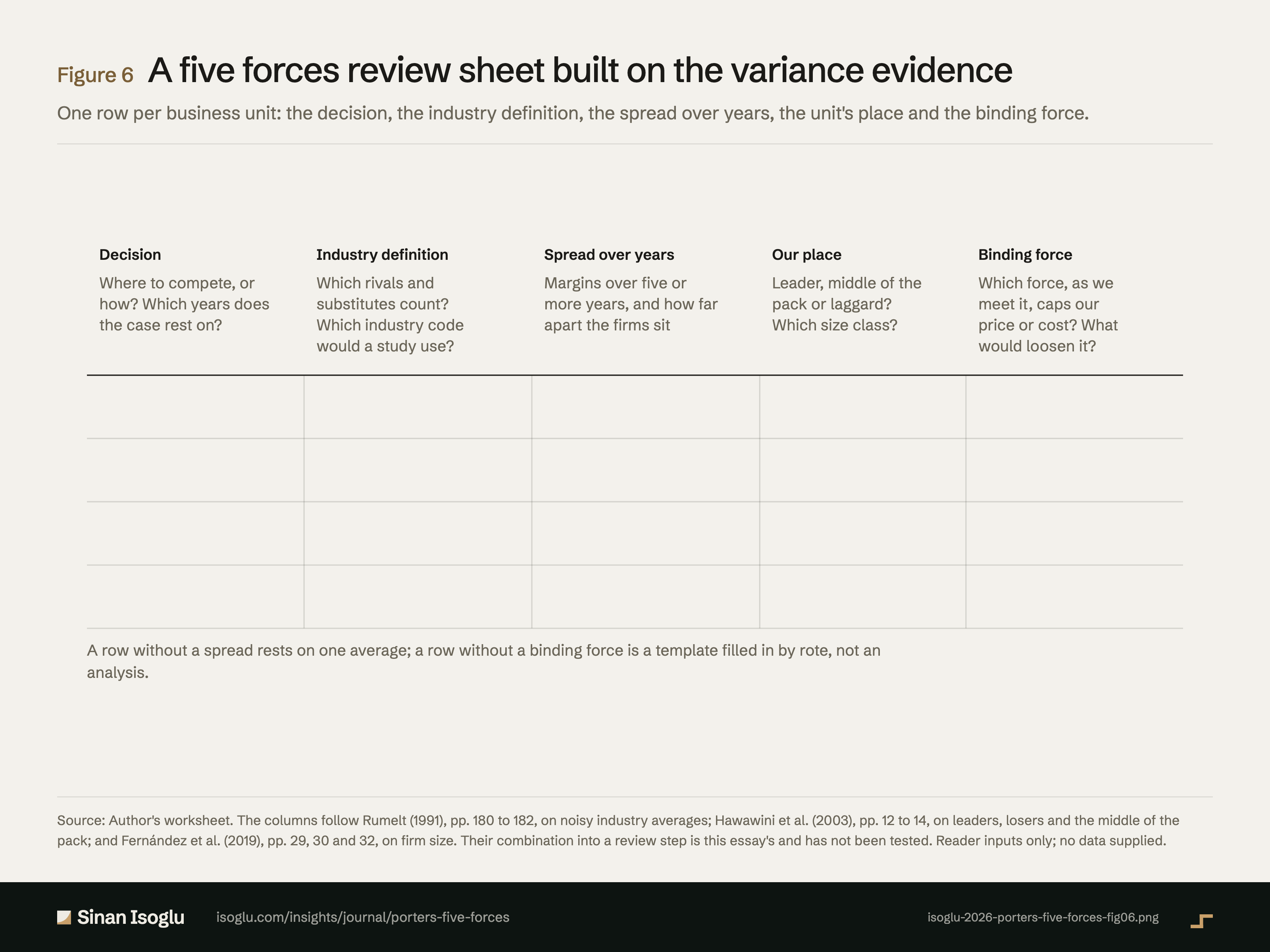
A five forces review sheet built on the variance evidence

One row per business unit: the decision, the industry definition, the spread over years, the unit's place and the binding force.

Cite Embed

Figure 6A five forces review sheet built on the variance evidence

A five forces review worksheet with five columns for each business unit: the decision and the years it rests on, the industry definition with its rivals and substitutes, the spread of margins over several years, the unit’s place as leader, middle or laggard and its size class, and the binding force that caps its price or cost.DecisionWhere to compete, orhow? Which years doesthe case rest on?Industry definitionWhich rivals andsubstitutes count?Which industry codewould a study use?Spread over yearsMargins over five ormore years, and how farapart the firms sitOur placeLeader, middle of thepack or laggard?Which size class?Binding forceWhich force, as wemeet it, caps ourprice or cost? Whatwould loosen it?A row without a spread rests on one average; a row without a binding force is a template filled in by rote, not ananalysis.A five forces review worksheet with five columns for each business unit: the decision and the years it rests on, the industry definition with its rivals and substitutes, the spread of margins over several years, the unit’s place as leader, middle or laggard and its size class, and the binding force that caps its price or cost.DecisionWhere to compete, or how? Which yearsdoes the case rest on?Industry definitionWhich rivals and substitutes count?Which industry code would a study use?Spread over yearsMargins over five or more years, andhow far apart the firms sitOur placeLeader, middle of the pack or laggard?Which size class?Binding forceWhich force, as we meet it, caps ourprice or cost? What would loosen it?A row without a spread rests on oneaverage; a row without a binding forceis a template filled in by rote, not ananalysis.

Source: Author's worksheet. The columns follow Rumelt (1991), pp. 180 to 182, on noisy industry averages; Hawawini et al. (2003), pp. 12 to 14, on leaders, losers and the middle of the pack; and Fernández et al. (2019), pp. 29, 30 and 32, on firm size. Their combination into a review step is this essay's and has not been tested. Reader inputs only; no data supplied.
PNG4:3, 1600 × 1200, with the title, the source line and the attribution set in the image isoglu-2026-porters-five-forces-fig06.png

Source and evidence

Each line names a claim related to this exhibit, its source, and how it was checked.

  • B A verified against the printed page of the primary sourceB primary source, text layer onlyC authoritative secondaryD reported Use guidance (four uses, use 3 hedged to the one study and the yearly-swing comparator, use 4 the binding force as this business meets it), Figure 6 worksheet and the review step: untestedAuthor synthesis

Cite or embed

APA 7

Isoglu, S. (2026). A five forces review sheet built on the variance evidence [Figure]. isoglu.com. https://isoglu.com/insights/exhibits/isoglu-2026-porters-five-forces-fig06/

BibTeX
@misc{isoglu-2026-porters-five-forces-fig06,
  author = {Isoglu, Sinan},
  title = {{A five forces review sheet built on the variance evidence}},
  year = {2026},
  howpublished = {Figure 6, isoglu.com},
  url = {https://isoglu.com/insights/exhibits/isoglu-2026-porters-five-forces-fig06/},
  note = {From the essay {Porter's five forces: industry explains less than the firm does}}
}
Embed this exhibit

Copy this HTML to use the PNG exhibit on your site with its source line and a link back to the exhibit page.

<figure>
  <a href="https://isoglu.com/insights/exhibits/isoglu-2026-porters-five-forces-fig06/">
    <img src="https://isoglu.com/social/isoglu-2026-porters-five-forces-fig06.png" alt="Figure 6: A five forces review sheet built on the variance evidence" width="3200" height="2400">
  </a>
  <figcaption>Figure 6: A five forces review sheet built on the variance evidence. Source: Author&#39;s worksheet. The columns follow Rumelt (1991), pp. 180 to 182, on noisy industry averages; Hawawini et al. (2003), pp. 12 to 14, on leaders, losers and the middle of the pack; and Fernández et al. (2019), pp. 29, 30 and 32, on firm size. Their combination into a review step is this essay&#39;s and has not been tested. Reader inputs only; no data supplied. <a href="https://isoglu.com/insights/exhibits/isoglu-2026-porters-five-forces-fig06/">View exhibit</a>.</figcaption>
</figure>