Table 1From “One customer model cannot predict every outcome”
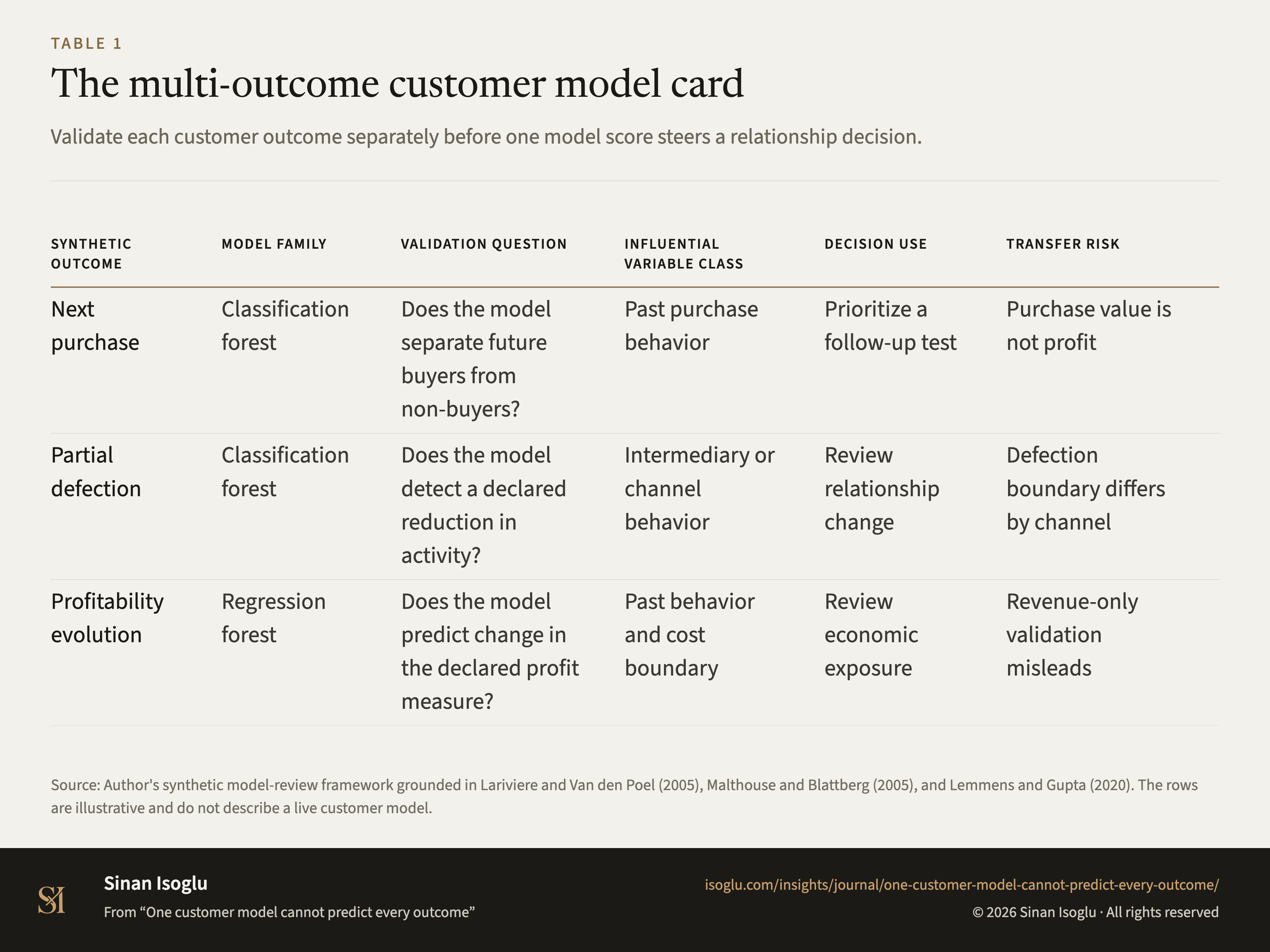
The multi-outcome customer model card
Validate each customer outcome separately before one model score steers a relationship decision.
Table 1The multi-outcome customer model card
| Synthetic outcome | Model family | Validation question | Influential variable class | Decision use | Transfer risk |
|---|---|---|---|---|---|
| Next purchase | Classification forest | Does the model separate future buyers from non-buyers? | Past purchase behavior | Prioritize a follow-up test | Purchase value is not profit |
| Partial defection | Classification forest | Does the model detect a declared reduction in activity? | Intermediary or channel behavior | Review relationship change | Defection boundary differs by channel |
| Profitability evolution | Regression forest | Does the model predict change in the declared profit measure? | Past behavior and cost boundary | Review economic exposure | Revenue-only validation misleads |
Swipe or scroll horizontally if the table is wider than your screen.
Source: Author's synthetic model-review framework grounded in Lariviere and Van den Poel (2005), Malthouse and Blattberg (2005), and Lemmens and Gupta (2020). The rows are illustrative and do not describe a live customer model.
Source and evidence
Each line names a claim related to this exhibit, its source, and how it was checked.
- A LVP05-C1 Three outcomes, one sample: "three important measures of customer outcome next buy partial defection and customers profitability evolution", over "a real life sample of 100 000 customers taken from the data warehouse of a large european financial services company"Lariviere & Van den Poel. (2005)
- A LVP05-C2 "both random forests techniques provide better fit for the estimation and validation sample compared to ordinary linear regression and logistic regression models"Lariviere & Van den Poel. (2005)
- A LVP05-C3 The variables do not transfer between outcomes: "the same set of variables have a different impact on buying versus defection versus profitability behavior", with past customer behaviour "more important to generate repeat purchasing and favorable profitability evolutions"Lariviere & Van den Poel. (2005)
- A MB05-C1 The question is feasibility, not desirability: relationship-marketing strategies "presume that a firm can accurately predict the future profitability of customers", and the paper is "a detailed empirical evaluation of how accurately the future profitability of customers" can be predicted across four industry data setsMalthouse & Blattberg. (2005)
- A MB05-C3 "the feasibility of such strategies depends on the probabilities and costs of misclassifying customers", so it turns on prediction accuracy, forecast horizon, and the costs of misclassification.Malthouse & Blattberg. (2005)
- A LG20-C1 The method, in the authors' words: "defining a profit-based loss function to predict, for each customer, the financial impact of a retention intervention"Lemmens & Gupta. (2020)
- A LG20-C2 The ranking rule is incremental and net of cost: "customers are ranked based on the incremental impact of the intervention on churn and postcampaign cash flows, after accounting for the cost of the intervention", rather than by churn risk or response alone.Lemmens & Gupta. (2020)
Grades: A, verified against the printed page of the primary source · B, primary source, text layer only · C, authoritative secondary · D, reported.
From the essay
Growth that compounds
One customer model cannot predict every outcome
Next purchase, partial defection, and profitability are different outcomes: choose the model and validation question before trusting one customer score.
Read the essayThis exhibit belongs to an essay: the numbers live here, the argument lives there.
Cite or embed
Related exhibits
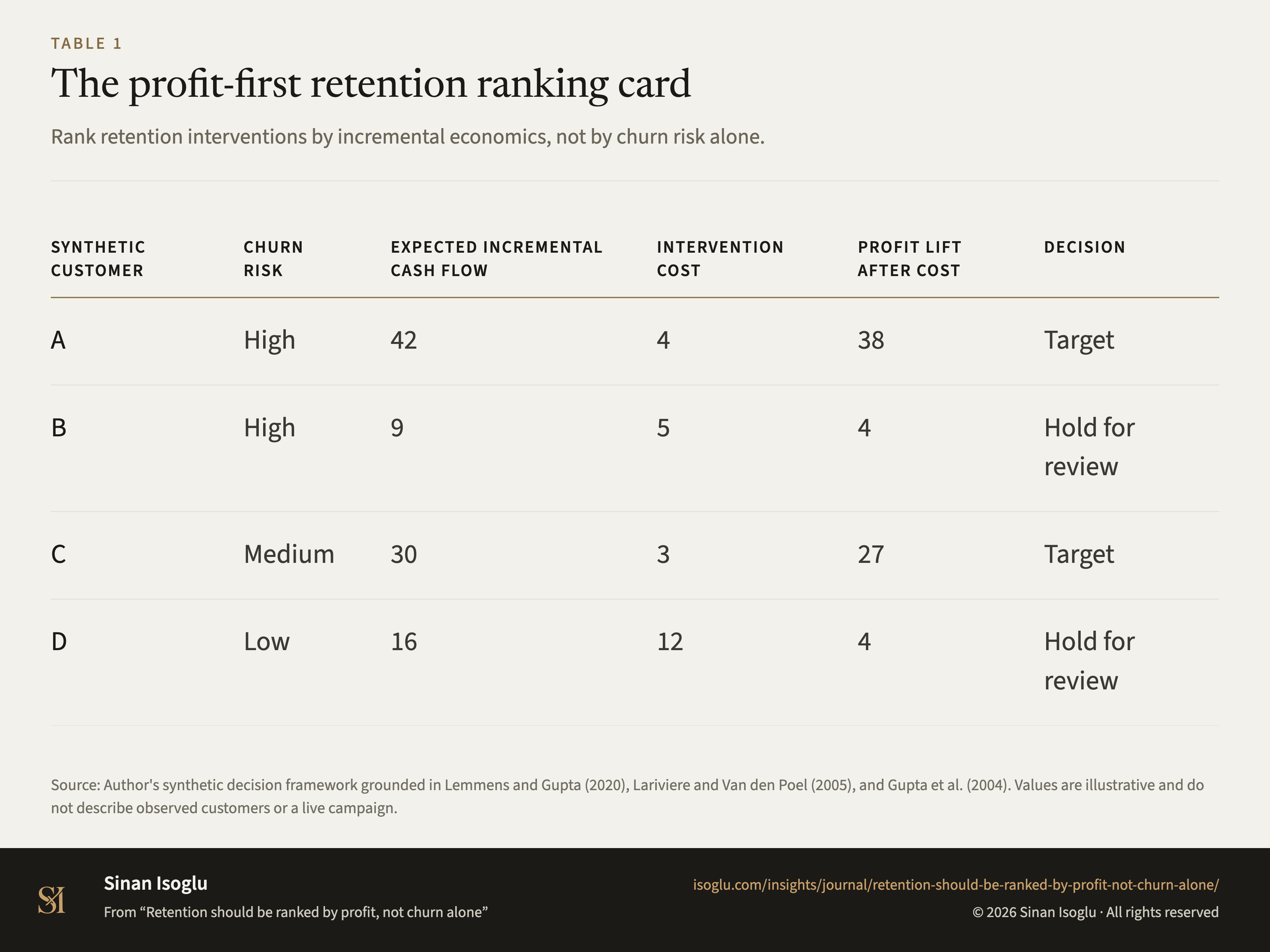
Table 1Table
The profit-first retention ranking card
Retention should be ranked by profit, not churn alone
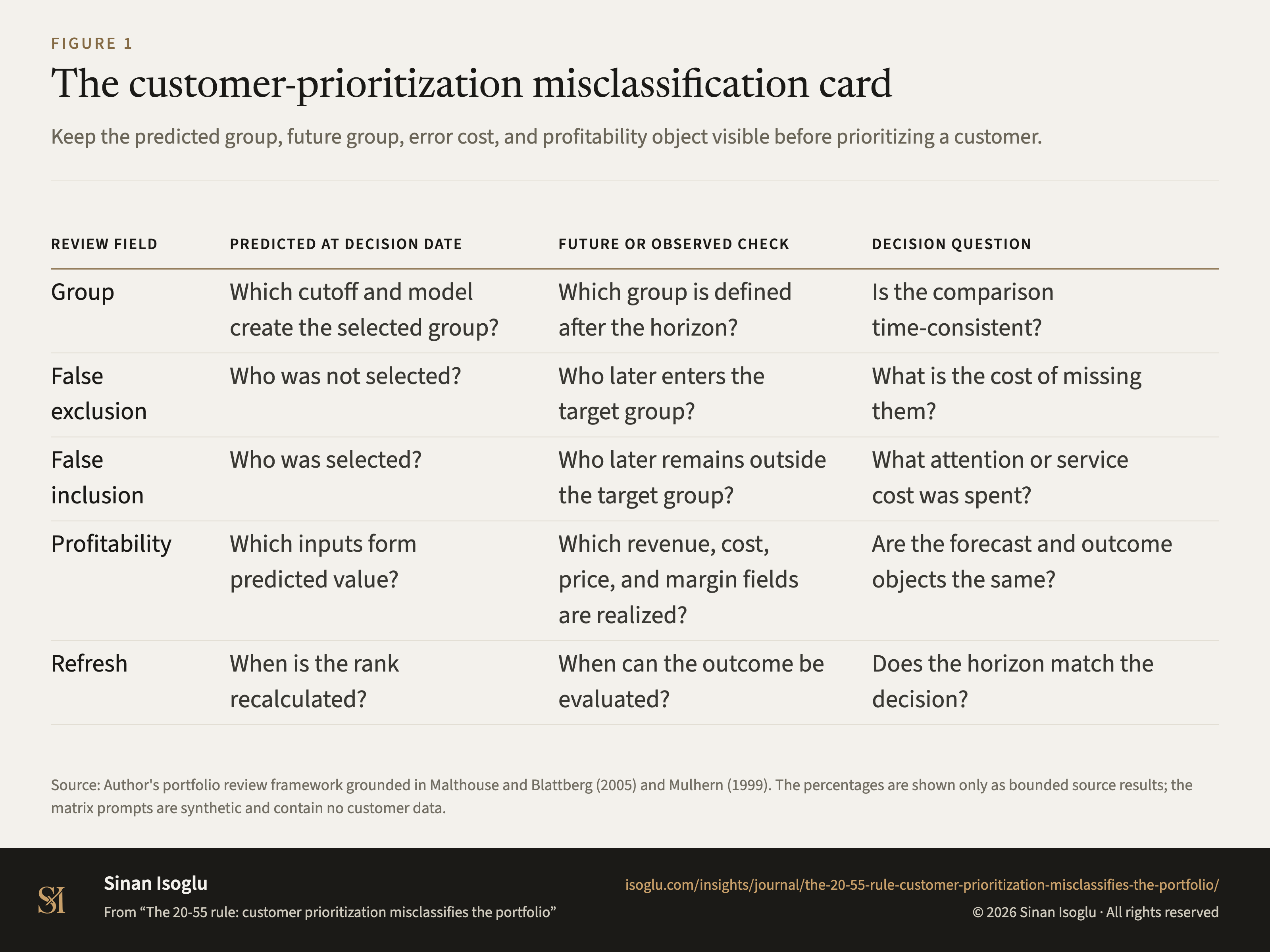
Figure 1Figure
The customer-prioritization misclassification card
The 20-55 rule: customer prioritization misclassifies the portfolio
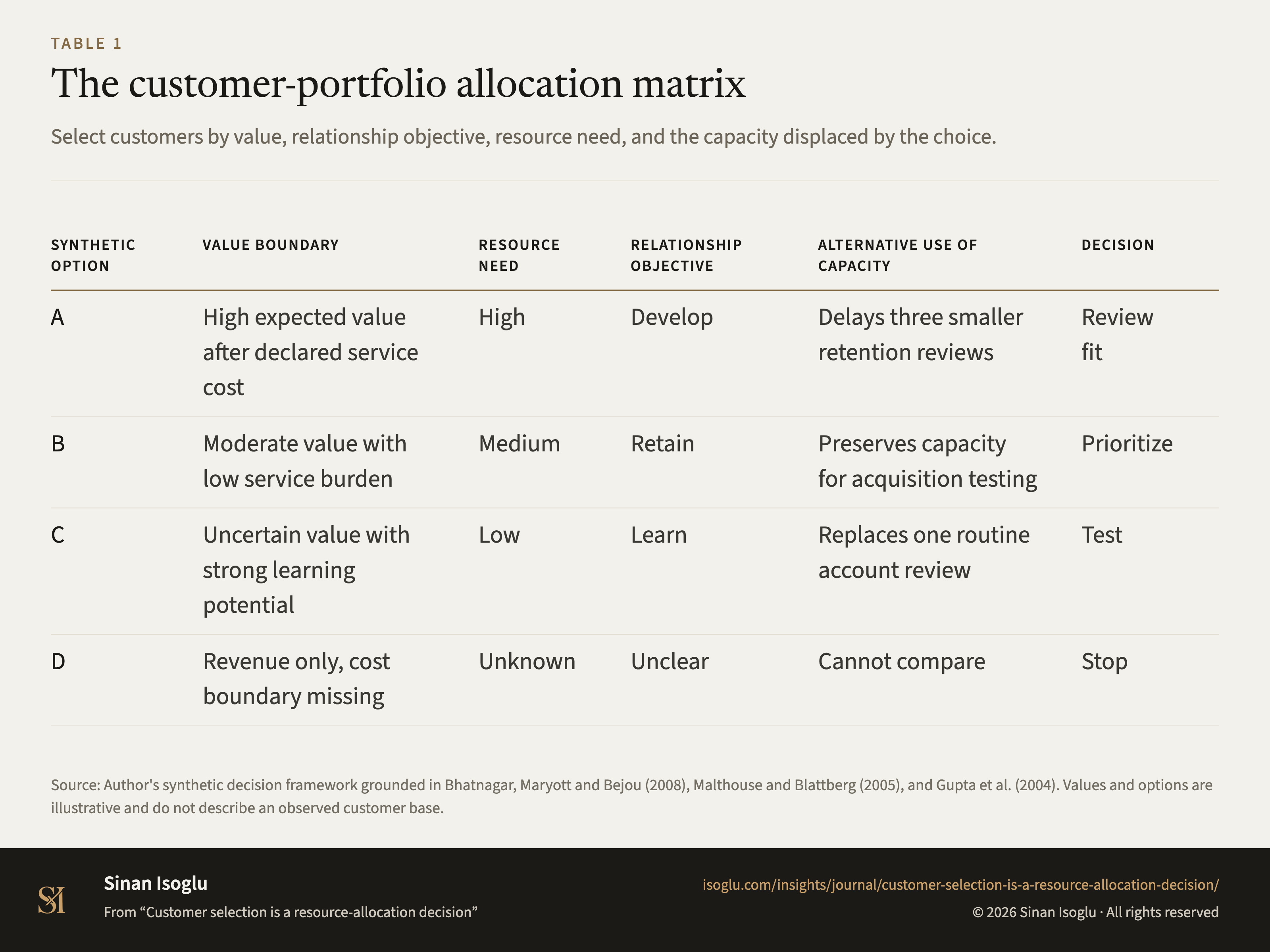
Table 1Table
The customer-portfolio allocation matrix
Customer selection is a resource-allocation decision
Contact
Bring the question you're working on.
Research, a guest lecture, or a commercial question.