Table 1From “One customer model cannot predict every outcome”
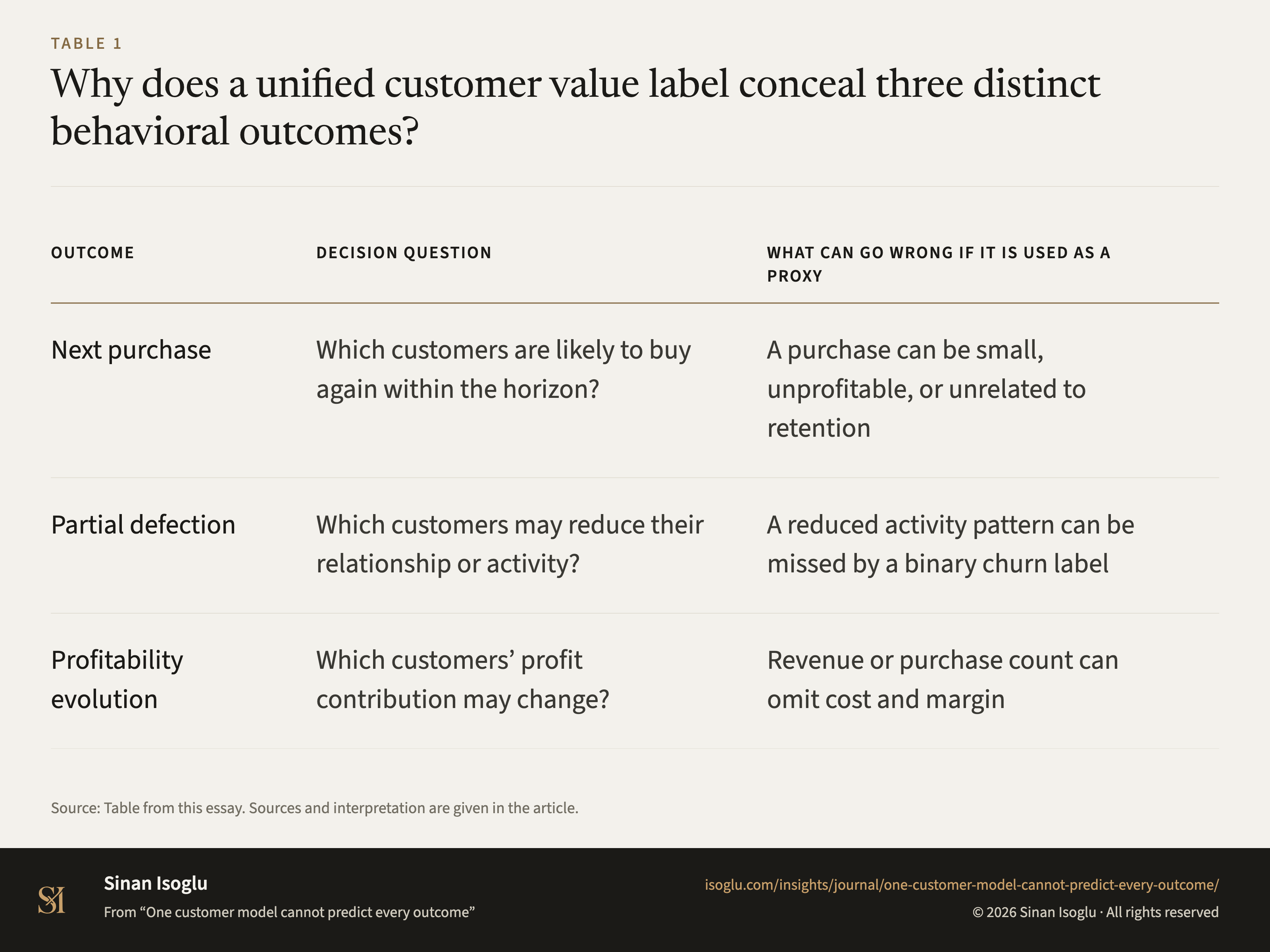
Why does a unified customer value label conceal three distinct behavioral outcomes?
Table 1Why does a unified customer value label conceal three distinct behavioral outcomes?
| Outcome | Decision question | What can go wrong if it is used as a proxy |
|---|---|---|
| Next purchase | Which customers are likely to buy again within the horizon? | A purchase can be small, unprofitable, or unrelated to retention |
| Partial defection | Which customers may reduce their relationship or activity? | A reduced activity pattern can be missed by a binary churn label |
| Profitability evolution | Which customers' profit contribution may change? | Revenue or purchase count can omit cost and margin |
Swipe or scroll horizontally if the table is wider than your screen.
Source: Table from this essay. Sources and interpretation are given in the article.
From the essay
Growth that compounds
One customer model cannot predict every outcome
Next purchase, partial defection, and profitability are different outcomes: choose the model and validation question before trusting one customer score.
Read the essayThis exhibit belongs to an essay: the numbers live here, the argument lives there.
Cite or embed
Related exhibits
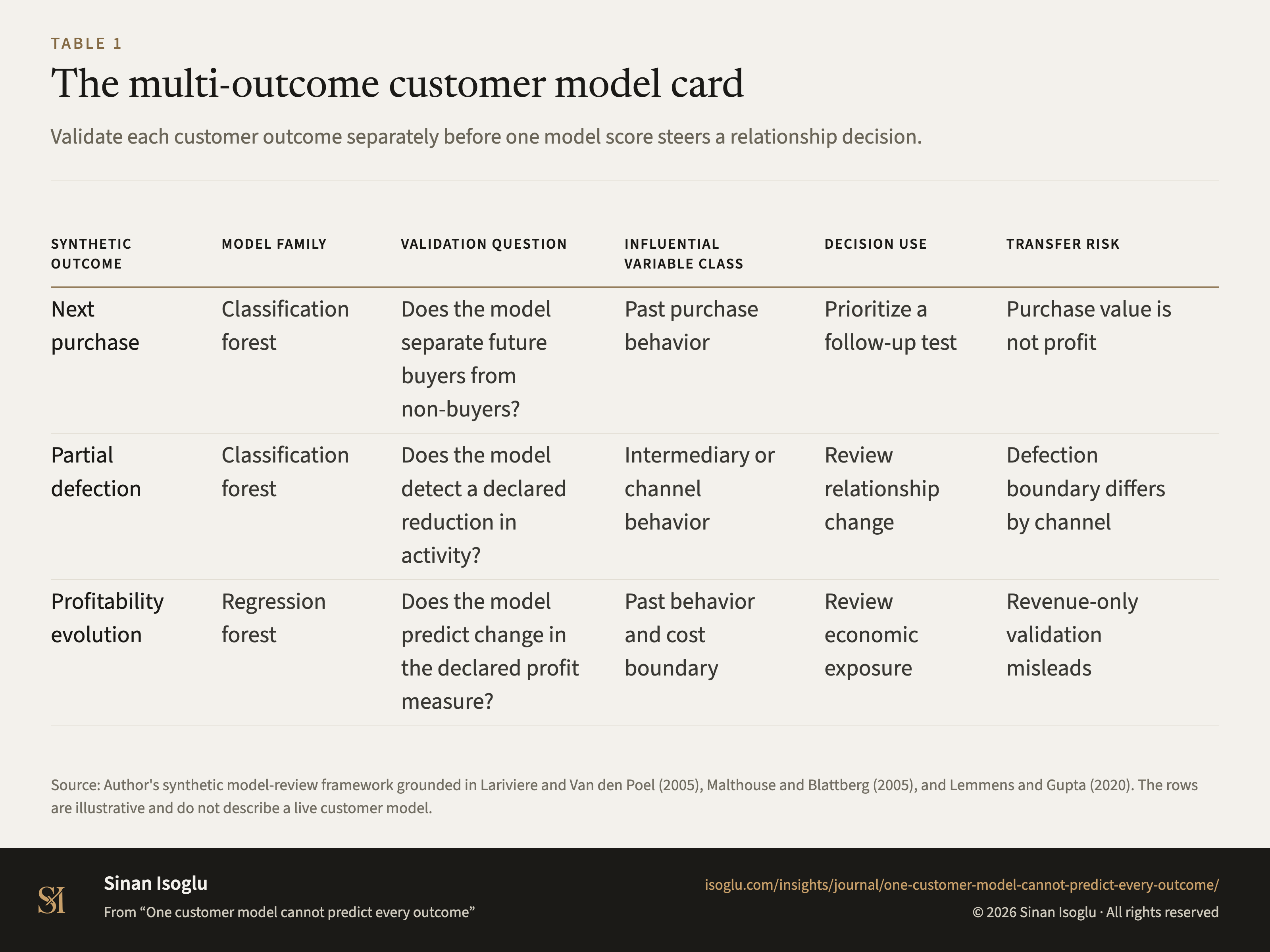
Table 1Table
The multi-outcome customer model card
One customer model cannot predict every outcome
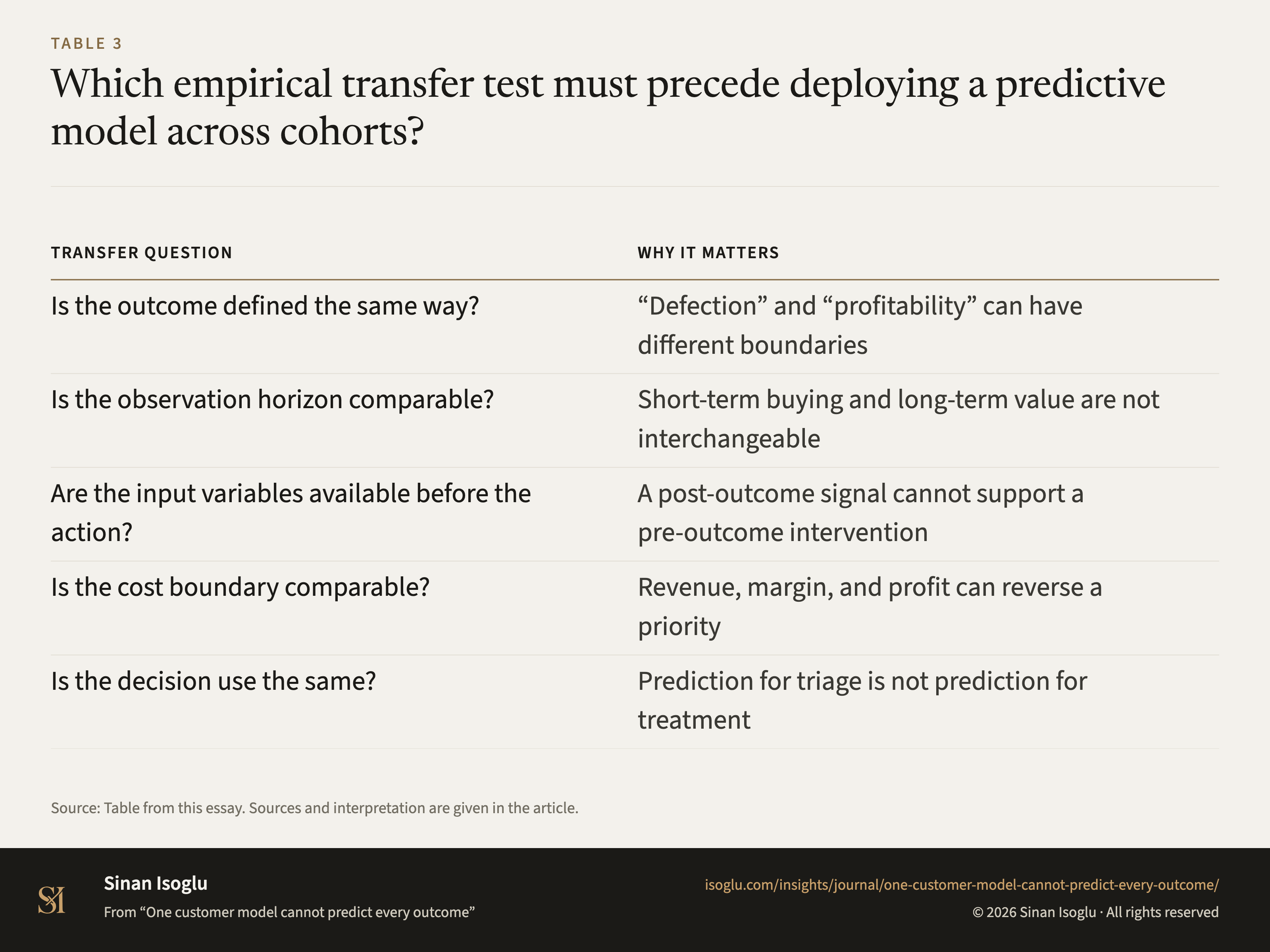
Table 3Table
Which empirical transfer test must precede deploying a predictive model across cohorts?
One customer model cannot predict every outcome
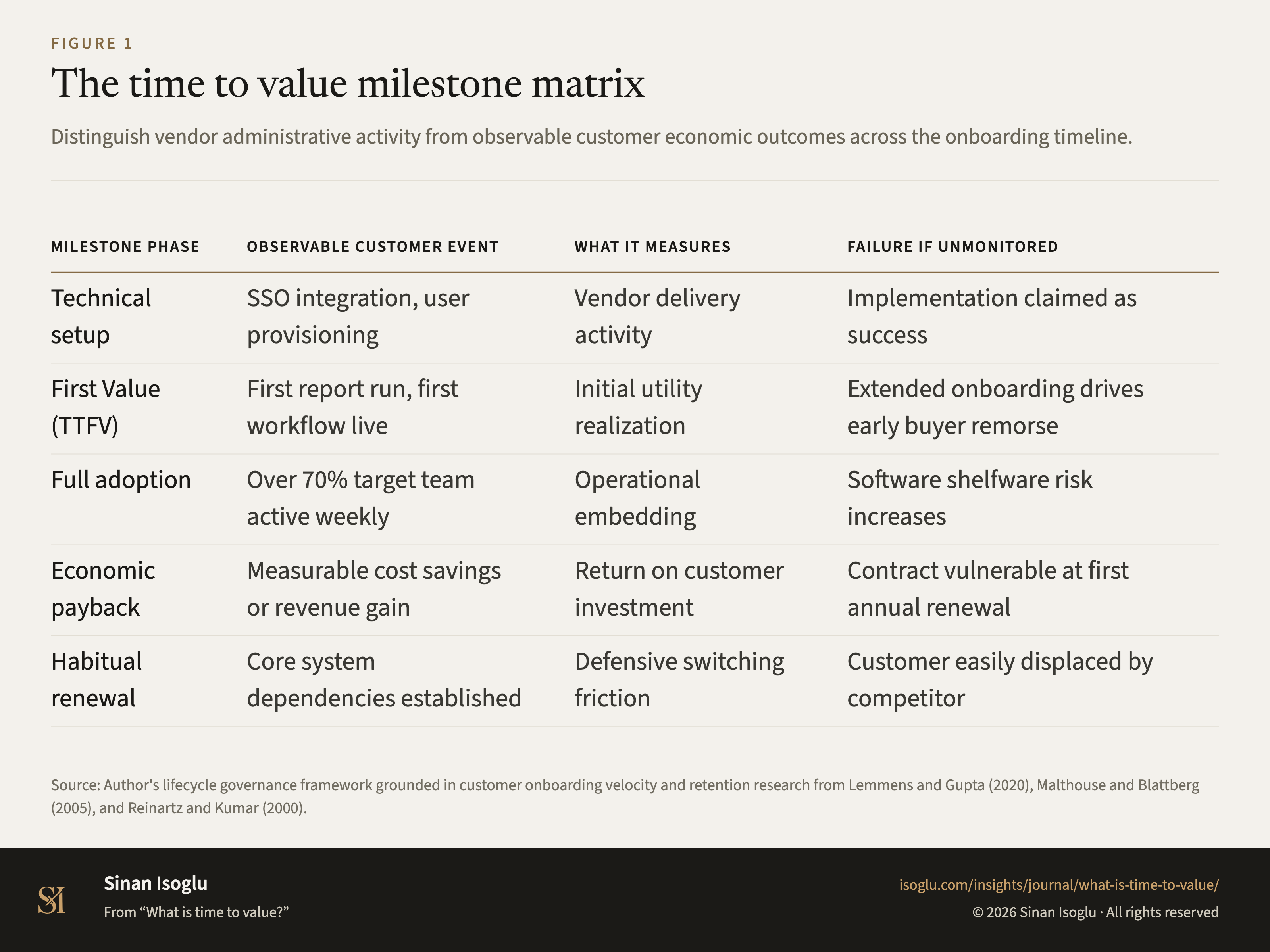
Figure 1Figure
The time to value milestone matrix
What is time to value?
Contact
Bring the question you're working on.
Research, a guest lecture, or a commercial question.