Table 1From “Localization is a market-entry decision”
Localization decision tree
Change a market-entry object only when the evidence for that object is visible.
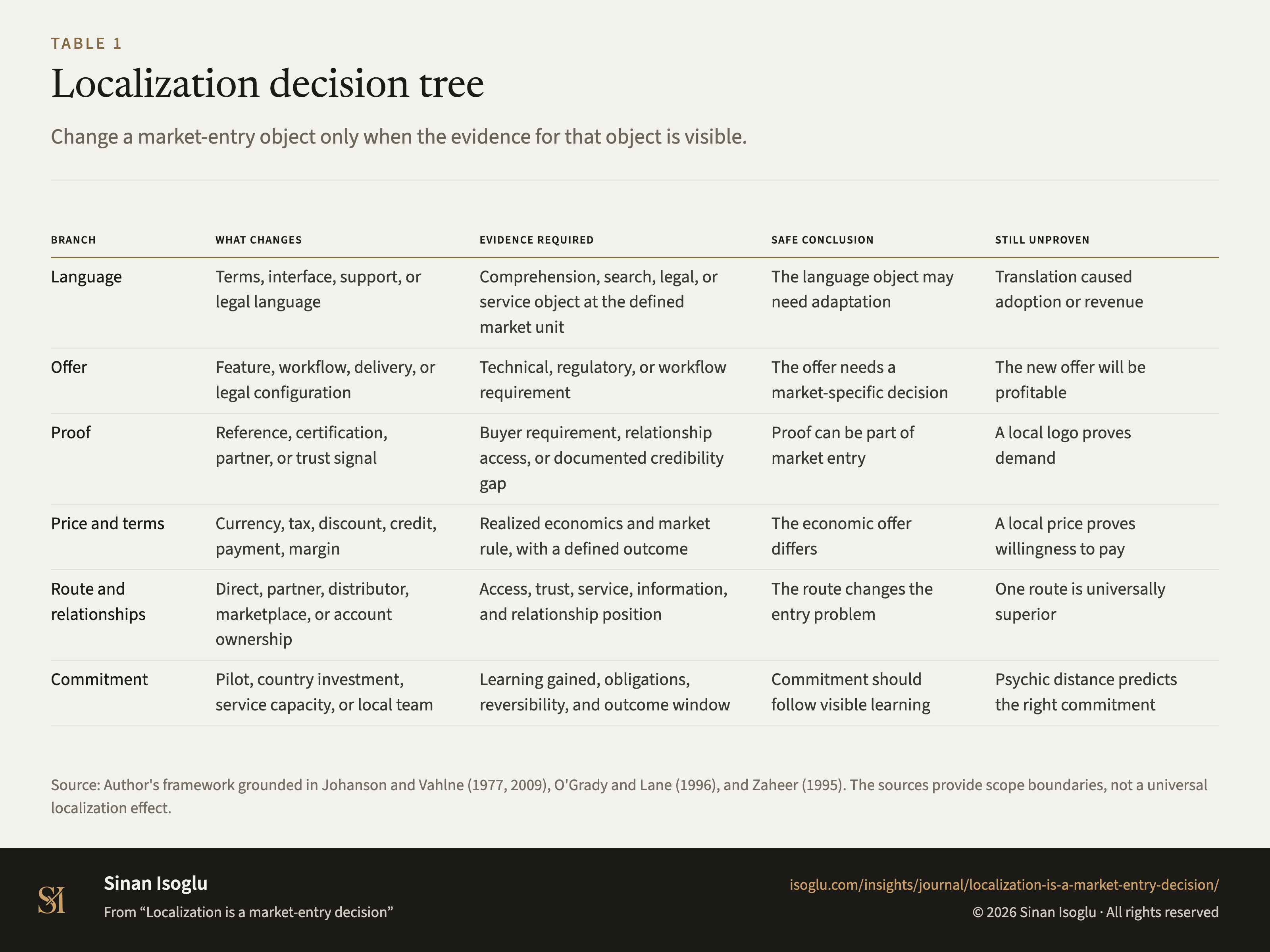
Table 1Localization decision tree
| Branch | What changes | Evidence required | Safe conclusion | Still unproven |
|---|---|---|---|---|
| Language | Terms, interface, support, or legal language | Comprehension, search, legal, or service object at the defined market unit | The language object may need adaptation | Translation caused adoption or revenue |
| Offer | Feature, workflow, delivery, or legal configuration | Technical, regulatory, or workflow requirement | The offer needs a market-specific decision | The new offer will be profitable |
| Proof | Reference, certification, partner, or trust signal | Buyer requirement, relationship access, or documented credibility gap | Proof can be part of market entry | A local logo proves demand |
| Price and terms | Currency, tax, discount, credit, payment, margin | Realized economics and market rule, with a defined outcome | The economic offer differs | A local price proves willingness to pay |
| Route and relationships | Direct, partner, distributor, marketplace, or account ownership | Access, trust, service, information, and relationship position | The route changes the entry problem | One route is universally superior |
| Commitment | Pilot, country investment, service capacity, or local team | Learning gained, obligations, reversibility, and outcome window | Commitment should follow visible learning | Psychic distance predicts the right commitment |
Swipe or scroll horizontally if the table is wider than your screen.
Source: Author's framework grounded in Johanson and Vahlne (1977, 2009), O'Grady and Lane (1996), and Zaheer (1995). The sources provide scope boundaries, not a universal localization effect.
Source and evidence
Each line names a claim related to this exhibit, its source, and how it was checked.
- A JV77-C1 The model focuses on "the gradual acquisition, integration and use of knowledge about foreign markets and operations", and on "the incrementally increasing commitments to foreign markets"johanson-vahlne-1977-internationalization-process
- A JV77-C2 The unit of analysis is one country at a time: "attention is concentrated on the increasing involvement in the individual foreign country"johanson-vahlne-1977-internationalization-process
- A JV09-C1 "Outsidership, in relation to the relevant network, more than psychic distance, is the root of uncertainty"johanson-vahlne-2009-liability-of-outsidership
- A JV09-C2 The market is a web, not a set of independent counterparties: "the business environment is viewed as a web of relationships, a network, rather than as a neoclassical market with many independent suppliers and customers"johanson-vahlne-2009-liability-of-outsidership
- A JV09-C3 Trust-building and knowledge creation are the additions: "The change mechanisms in the revised model are essentially the same as those in the original version, although we add trust-building and knowledge creation"johanson-vahlne-2009-liability-of-outsidership
- B OL96-C1 The paradox is that assumed similarity prevents learning: "The psychic distance paradox is that operations in psychically close countries are not necessarily easy to manage, because assumptions of similarity can prevent executives from learning about critical differences"ogrady-lane-1996-psychic-distance-paradox
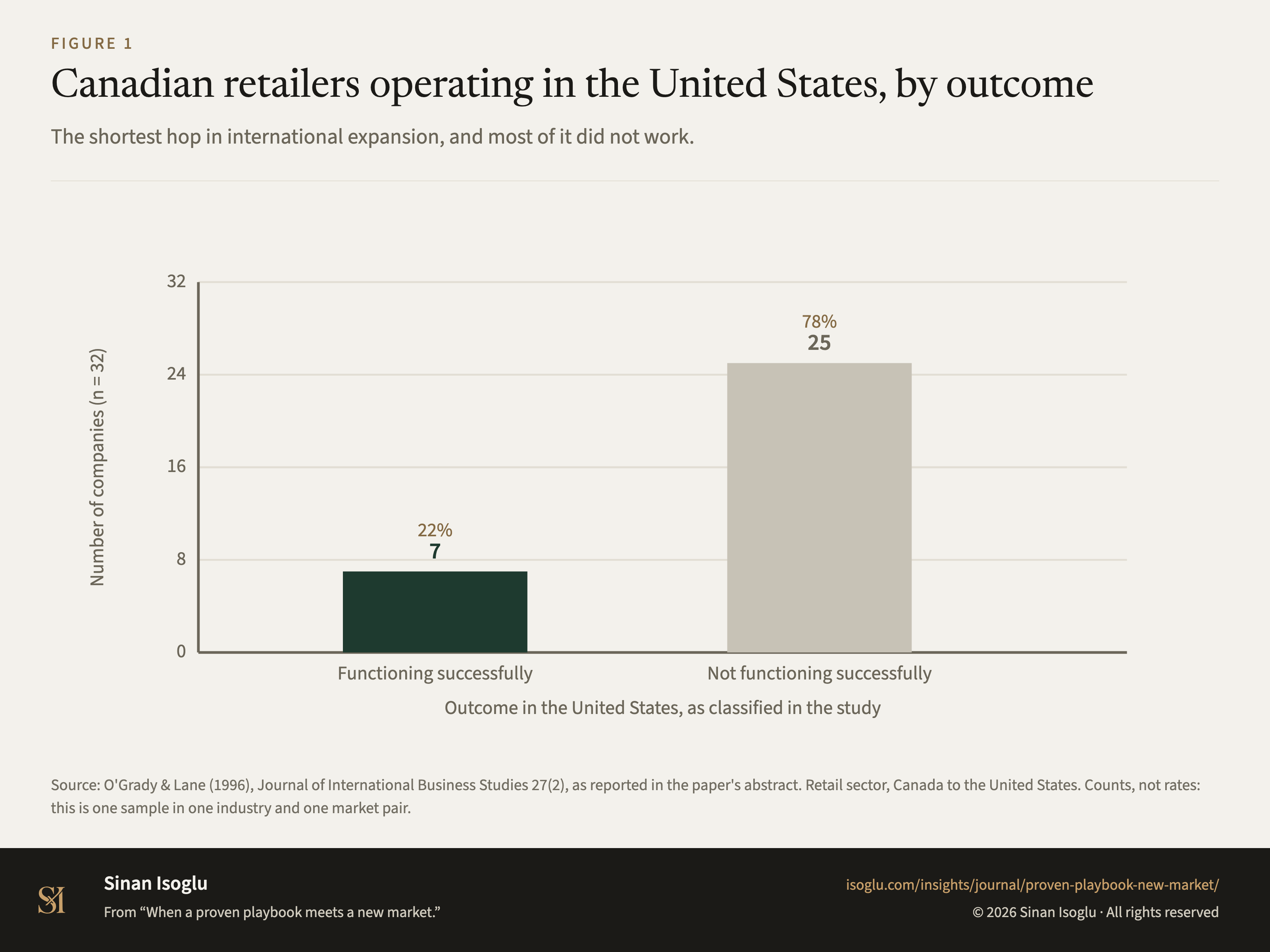
- B OL96-C2 The retail evidence, verbatim: "Evidence from thirty-two Canadian retail com""panies shows that only seven (22%) were functioning successfully in the United States"ogrady-lane-1996-psychic-distance-paradox
- B OL96-C6 The paper refines the concept rather than rejecting it: "Modifications are suggested to improve the psychic distance concept"ogrady-lane-1996-psychic-distance-paradox
- B ZA95-C1 Support for a liability of foreignness AND for administrative heritage as an advantage, in the author's own words: "Results support the existence of a liability of foreignness and the role of a firm's administrative heritage in providing competitive advantage to its multinational subunits", while "they also highlight the difficulty firms face in copying organizational practices from other firms"zaheer-1995-liability-of-foreignness
- B ZA95-C2 The evidence is small and paired, which is the scope limit: "Predictions were tested with a paired sample of 24 foreign exchange trading rooms of major Western and Japanese banks in New York and Tokyo"zaheer-1995-liability-of-foreignness
- B B06-C1 Localization should be tested as a market-entry decision across language, offer, proof, price and route, with each change tied to an observable decision or outcomeAuthor framework grounded in the internationalization sources above
- B B06-C2 A country label does not identify the evidence needed for localization; relationship position, market knowledge, technical or legal requirements, and realized economics must be separatedAuthor framework grounded in Johanson and Vahlne, O'Grady and Lane, and Zaheer
Grades: A, verified against the printed page of the primary source · B, primary source, text layer only · C, authoritative secondary · D, reported.
From the essay
Go-to-market strategy
Localization is a market-entry decision
Localization is a market-entry decision: test language, offer, proof, price, route, and commitment against evidence before scaling translation.
Read the essayThis exhibit belongs to an essay: the numbers live here, the argument lives there.
Cite or embed
Contact
Bring the question you're working on.
Research, a guest lecture, or a commercial question.