Table 1From “A global price is not one price”
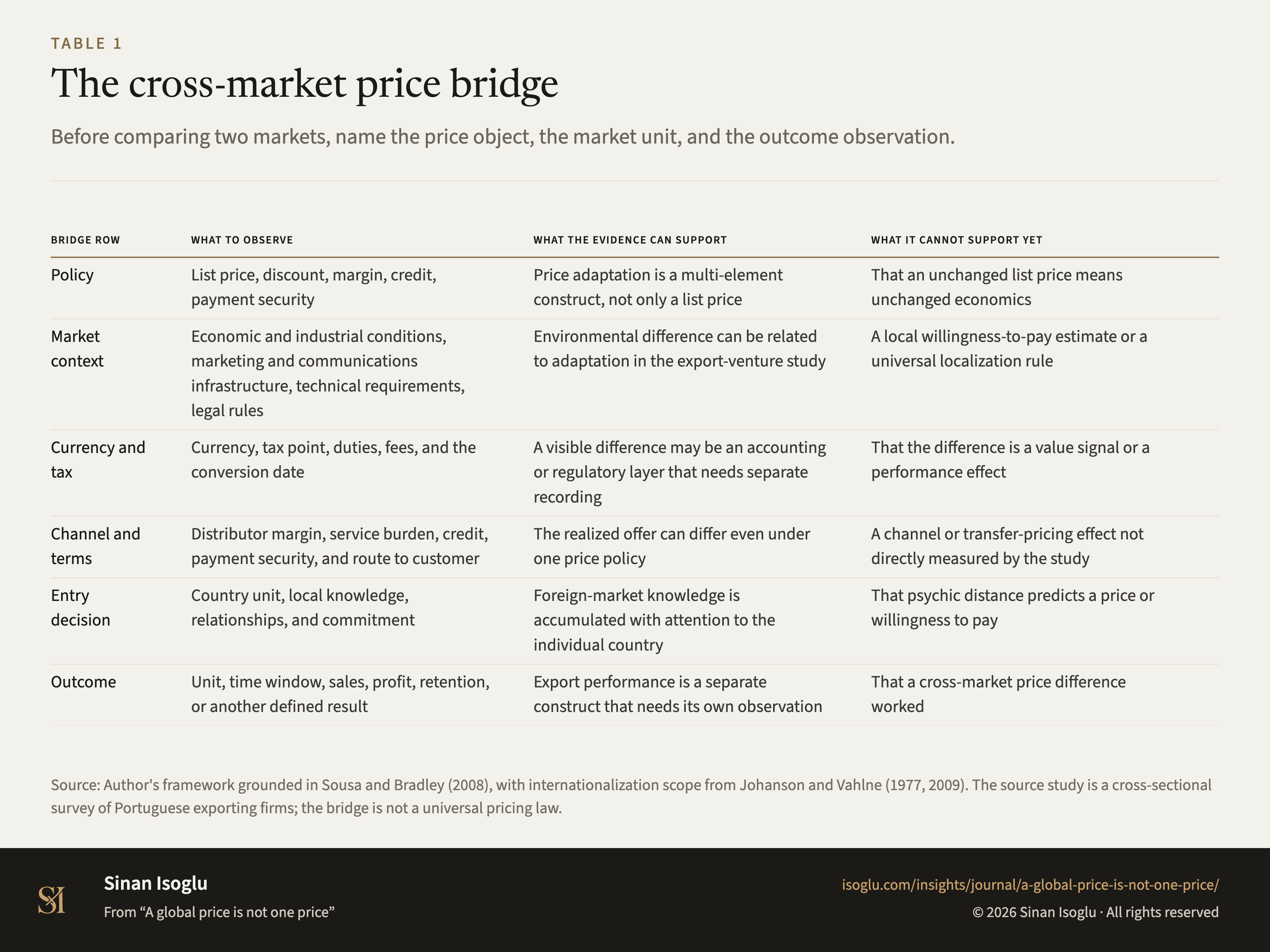
The cross-market price bridge
Before comparing two markets, name the price object, the market unit, and the outcome observation.
Table 1The cross-market price bridge
| Bridge row | What to observe | What the evidence can support | What it cannot support yet |
|---|---|---|---|
| Policy | List price, discount, margin, credit, payment security | Price adaptation is a multi-element construct, not only a list price | That an unchanged list price means unchanged economics |
| Market context | Economic and industrial conditions, marketing and communications infrastructure, technical requirements, legal rules | Environmental difference can be related to adaptation in the export-venture study | A local willingness-to-pay estimate or a universal localization rule |
| Currency and tax | Currency, tax point, duties, fees, and the conversion date | A visible difference may be an accounting or regulatory layer that needs separate recording | That the difference is a value signal or a performance effect |
| Channel and terms | Distributor margin, service burden, credit, payment security, and route to customer | The realized offer can differ even under one price policy | A channel or transfer-pricing effect not directly measured by the study |
| Entry decision | Country unit, local knowledge, relationships, and commitment | Foreign-market knowledge is accumulated with attention to the individual country | That psychic distance predicts a price or willingness to pay |
| Outcome | Unit, time window, sales, profit, retention, or another defined result | Export performance is a separate construct that needs its own observation | That a cross-market price difference worked |
Swipe or scroll horizontally if the table is wider than your screen.
Source: Author's framework grounded in Sousa and Bradley (2008), with internationalization scope from Johanson and Vahlne (1977, 2009). The source study is a cross-sectional survey of Portuguese exporting firms; the bridge is not a universal pricing law.
Source and evidence
Each line names a claim related to this exhibit, its source, and how it was checked.
- B SB08-C1 The sample and the response rate, verbatim: "The sample comprised 874 exporting firms from all parts of the country", and "The effective response rate, after two mail-waves, was 34.4 percent (301 usable questionnaires)"Sousa & Bradley. (2008)
- B SB08-C2 Greater environmental difference is associated with more price adaptation; standardized path coefficient 0.581, p < 0.001Sousa & Bradley. (2008)
- B SB08-C3 A greater number of export markets is associated with less price adaptation; standardized path coefficient -0.181, p < 0.05Sousa & Bradley. (2008)
- B SB08-C4 Manager international experience is negatively associated with price adaptation and positively associated with export performanceSousa & Bradley. (2008)
- B SB08-C5 Price adaptation is negatively associated with export performance in the study's cross-sectional model; H2–H6 supported, H1 not supportedSousa & Bradley. (2008)
- B SB08-C6 The paper reports more standardized pricing for EU destinations and more adaptation for non-EU destinations, with tariffs, taxes, technical requirements, and currency differences in the discussionSousa & Bradley. (2008)
- B SB08-C7 Price adaptation is measured through discount policy, margins, credit concession, and payment security, not a single list priceSousa & Bradley. (2008)
- A JV77-C1 The model focuses on "the gradual acquisition, integration and use of knowledge about foreign markets and operations", and on "the incrementally increasing commitments to foreign markets"johanson-vahlne-1977-internationalization-process
- A JV77-C2 The unit of analysis is one country at a time: "attention is concentrated on the increasing involvement in the individual foreign country"johanson-vahlne-1977-internationalization-process
- B B05-C1 A cross-market price should be decomposed into policy, market context, currency and tax, channel and terms, entry, and outcome before interpretationAuthor framework, stated in Brief - B05 international pricing evidence
- B B05-C2 A same-price policy can coexist with different realized economicsAuthor framework, stated in Brief - B05 international pricing evidence
Grades: A, verified against the printed page of the primary source · B, primary source, text layer only · C, authoritative secondary · D, reported.
From the essay
Pricing & revenue architecture
A global price is not one price
International pricing evidence supports a price bridge, not a universal order to standardize or localize every market in practice.
Read the essayThis exhibit belongs to an essay: the numbers live here, the argument lives there.
Cite or embed
Contact
Bring the question you're working on.
Research, a guest lecture, or a commercial question.