Figure 1From “Knowledge transfer is asset retention with a receiving context”
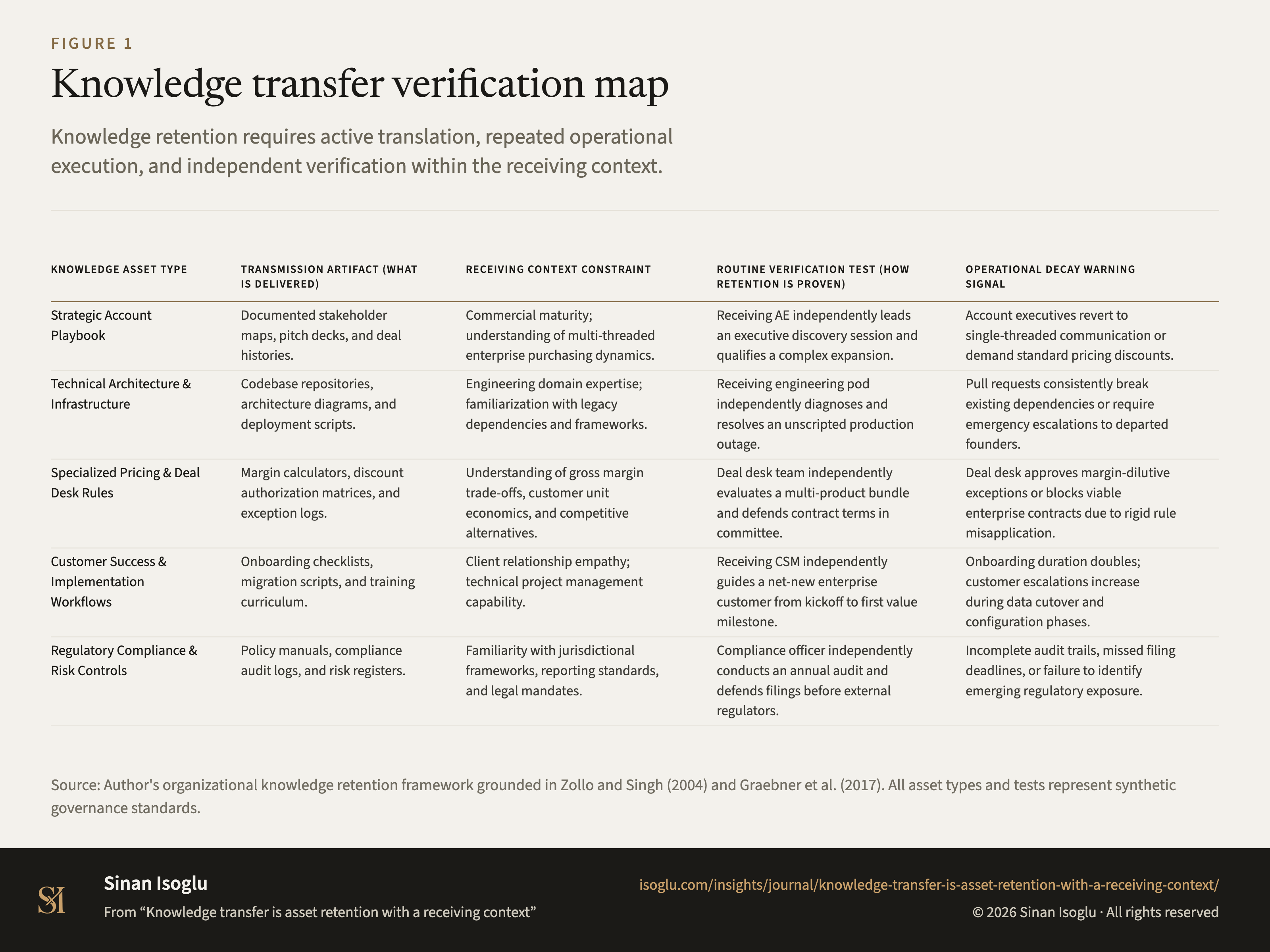
Knowledge transfer verification map
Knowledge retention requires active translation, repeated operational execution, and independent verification within the receiving context.
Figure 1Knowledge transfer verification map
| Knowledge asset type | Transmission artifact (What is delivered) | Receiving context constraint | Routine verification test (How retention is proven) | Operational decay warning signal |
|---|---|---|---|---|
| Strategic Account Playbook | Documented stakeholder maps, pitch decks, and deal histories. | Commercial maturity; understanding of multi-threaded enterprise purchasing dynamics. | Receiving AE independently leads an executive discovery session and qualifies a complex expansion. | Account executives revert to single-threaded communication or demand standard pricing discounts. |
| Technical Architecture & Infrastructure | Codebase repositories, architecture diagrams, and deployment scripts. | Engineering domain expertise; familiarization with legacy dependencies and frameworks. | Receiving engineering pod independently diagnoses and resolves an unscripted production outage. | Pull requests consistently break existing dependencies or require emergency escalations to departed founders. |
| Specialized Pricing & Deal Desk Rules | Margin calculators, discount authorization matrices, and exception logs. | Understanding of gross margin trade-offs, customer unit economics, and competitive alternatives. | Deal desk team independently evaluates a multi-product bundle and defends contract terms in committee. | Deal desk approves margin-dilutive exceptions or blocks viable enterprise contracts due to rigid rule misapplication. |
| Customer Success & Implementation Workflows | Onboarding checklists, migration scripts, and training curriculum. | Client relationship empathy; technical project management capability. | Receiving CSM independently guides a net-new enterprise customer from kickoff to first value milestone. | Onboarding duration doubles; customer escalations increase during data cutover and configuration phases. |
| Regulatory Compliance & Risk Controls | Policy manuals, compliance audit logs, and risk registers. | Familiarity with jurisdictional frameworks, reporting standards, and legal mandates. | Compliance officer independently conducts an annual audit and defends filings before external regulators. | Incomplete audit trails, missed filing deadlines, or failure to identify emerging regulatory exposure. |
Swipe or scroll horizontally if the table is wider than your screen.
Source: Author's organizational knowledge retention framework grounded in Zollo and Singh (2004) and Graebner et al. (2017). All asset types and tests represent synthetic governance standards.
Source and evidence
Each line names a claim related to this exhibit, its source, and how it was checked.
- A ZS04-C1 Codification is treated as a deliberate investment distinct from experience: "a sample of 228 acquisitions in the U.S. banking industry", where the effect of codification is separable from accumulated experienceZollo & Singh. (2004)
- A ZS04-C2 And the moderation runs one way: "increasing levels of post-acquisition integration strengthen the positive effect of codification"Zollo & Singh. (2004)
- A GHHV17-C1 "Postmerger integration plays a critical role in M&A success", and the review organises the field as an unfolding, interactive process in which knowledge sharing depends on human alignment, cultural translation and operational trust.Graebner et al. (2017)
Grades: A, verified against the printed page of the primary source · B, primary source, text layer only · C, authoritative secondary · D, reported.
From the essay
Growth that compounds
Knowledge transfer is asset retention with a receiving context
Handing over docs is transmission, not transfer; true knowledge transfer occurs only when a receiving team embeds and retains the routine in practice.
Read the essayThis exhibit belongs to an essay: the numbers live here, the argument lives there.
Cite or embed
Related exhibits

Table 2Table
Activation rate vs retention rate: which metric answers which question?
What is activation rate? The first value event must be observable
Figure 1Figure
Two synthetic cohort-retention curves
What is cohort analysis? A stable entry event before a retention curve
Figure 1Figure
Synthetic sustainable-growth-rate scenarios
What is sustainable growth rate? Growth has a financing boundary
Contact
Bring the question you're working on.
Research, a guest lecture, or a commercial question.