Figure 1From “Implementation backlog: delivery capacity governs new sales”
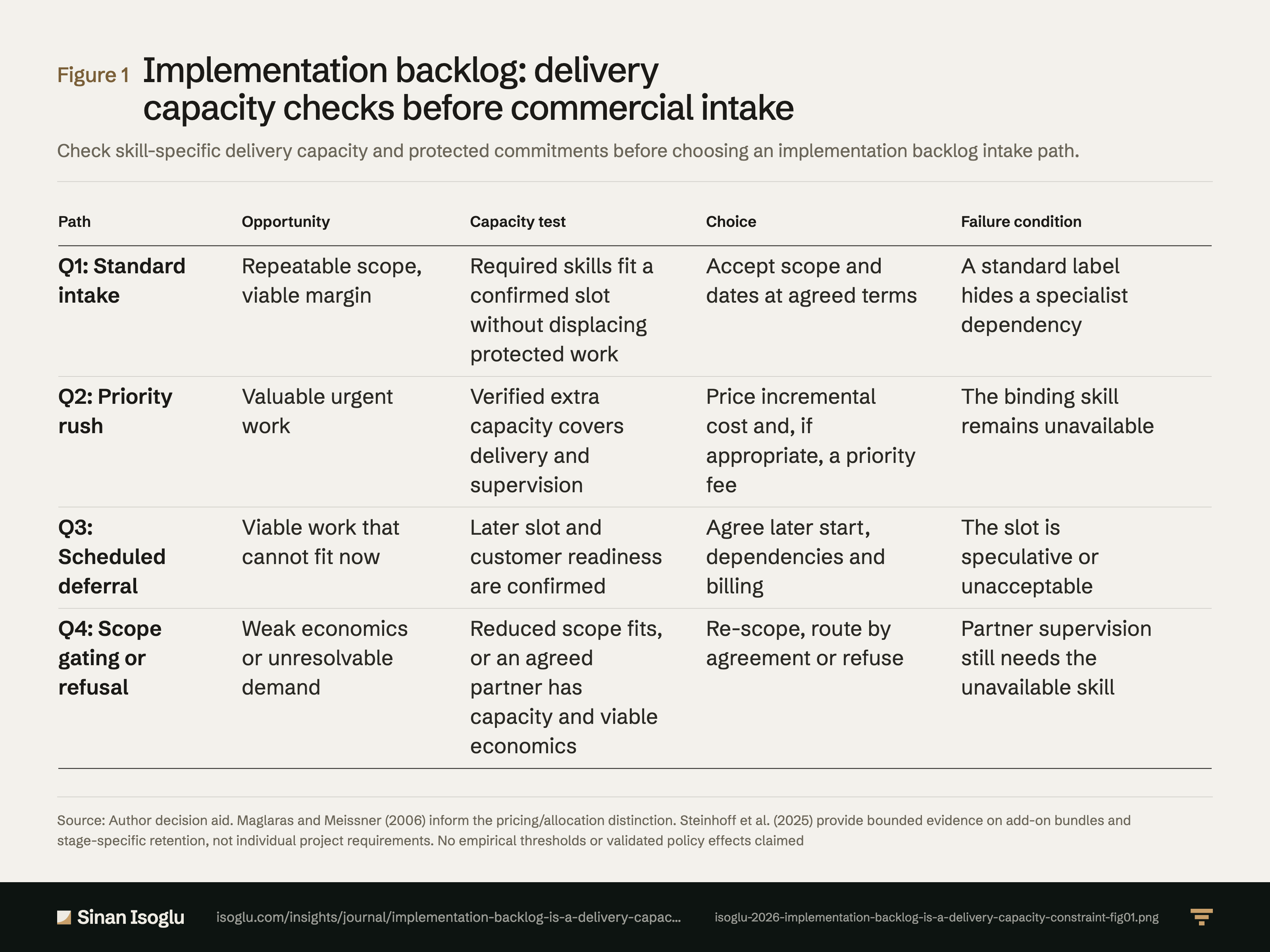
Implementation backlog: delivery capacity checks before commercial intake
Check skill-specific delivery capacity and protected commitments before choosing an implementation backlog intake path.
Figure 1Implementation backlog: delivery capacity checks before commercial intake
| Path | Opportunity | Capacity test | Choice | Failure condition |
|---|---|---|---|---|
| Q1: Standard intake | Repeatable scope, viable margin | Required skills fit a confirmed slot without displacing protected work | Accept scope and dates at agreed terms | A standard label hides a specialist dependency |
| Q2: Priority rush | Valuable urgent work | Verified extra capacity covers delivery and supervision | Price incremental cost and, if appropriate, a priority fee | The binding skill remains unavailable |
| Q3: Scheduled deferral | Viable work that cannot fit now | Later slot and customer readiness are confirmed | Agree later start, dependencies and billing | The slot is speculative or unacceptable |
| Q4: Scope gating or refusal | Weak economics or unresolvable demand | Reduced scope fits, or an agreed partner has capacity and viable economics | Re-scope, route by agreement or refuse | Partner supervision still needs the unavailable skill |
Swipe or scroll horizontally if the table is wider than your screen.
Source: Author decision aid. Maglaras and Meissner (2006) inform the pricing/allocation distinction. Steinhoff et al. (2025) provide bounded evidence on add-on bundles and stage-specific retention, not individual project requirements. No empirical thresholds or validated policy effects claimed
Source and evidence
Each line names a claim related to this exhibit, its source, and how it was checked.
- A MM06-C2 Two variants, not one: "We consider two well-studied variants of this problem." Price-setting under market power and capacity control at fixed prices are distinct variantsmaglaras-meissner-2006-dynamic-pricing-revenue-management
- A SKKP25-C1 The study is stage-specific: "the positive effects of add-on bundling may not manifest in the initial relational stage of customer onboarding". The 74,871-contract single-provider 2015-2018 field study concerns actual deployment, not a waiting queue. Add-on count is negatively associated with retention at deployment completion, richer telesupport moderates the association, and product-supporting versus customer-supporting add-ons differ. Single-provider/endogeneity limits apply; no provider-utilization or pre-kickoff churn curve is estimated.Steinhoff, Kim, Kanuri & Palmatier (2025)
- B V01BACK-OWN-C3 A feasibility check by skill and period precedes four intake paths: standard, verified additional capacity, later slot, scope limitation/refusalAuthor decision aid; local validation is required
- B V01BACK-OWN-C6 All article scenario numbers are constructed by the author, with specified units and assumptions, not observed outcomes or simulationsAuthor-created examples; no client data or empirical estimates
Grades: A, verified against the printed page of the primary source · B, primary source, text layer only · C, authoritative secondary · D, reported.
From the essay
Revenue operations & AI
Implementation backlog: delivery capacity governs new sales
When implementation work exceeds available delivery hours, use a capacity check to accept, defer, re-scope or refuse new contracts.
Read the essayThis exhibit belongs to an essay: the numbers live here, the argument lives there.
Cite or embed
Related exhibits
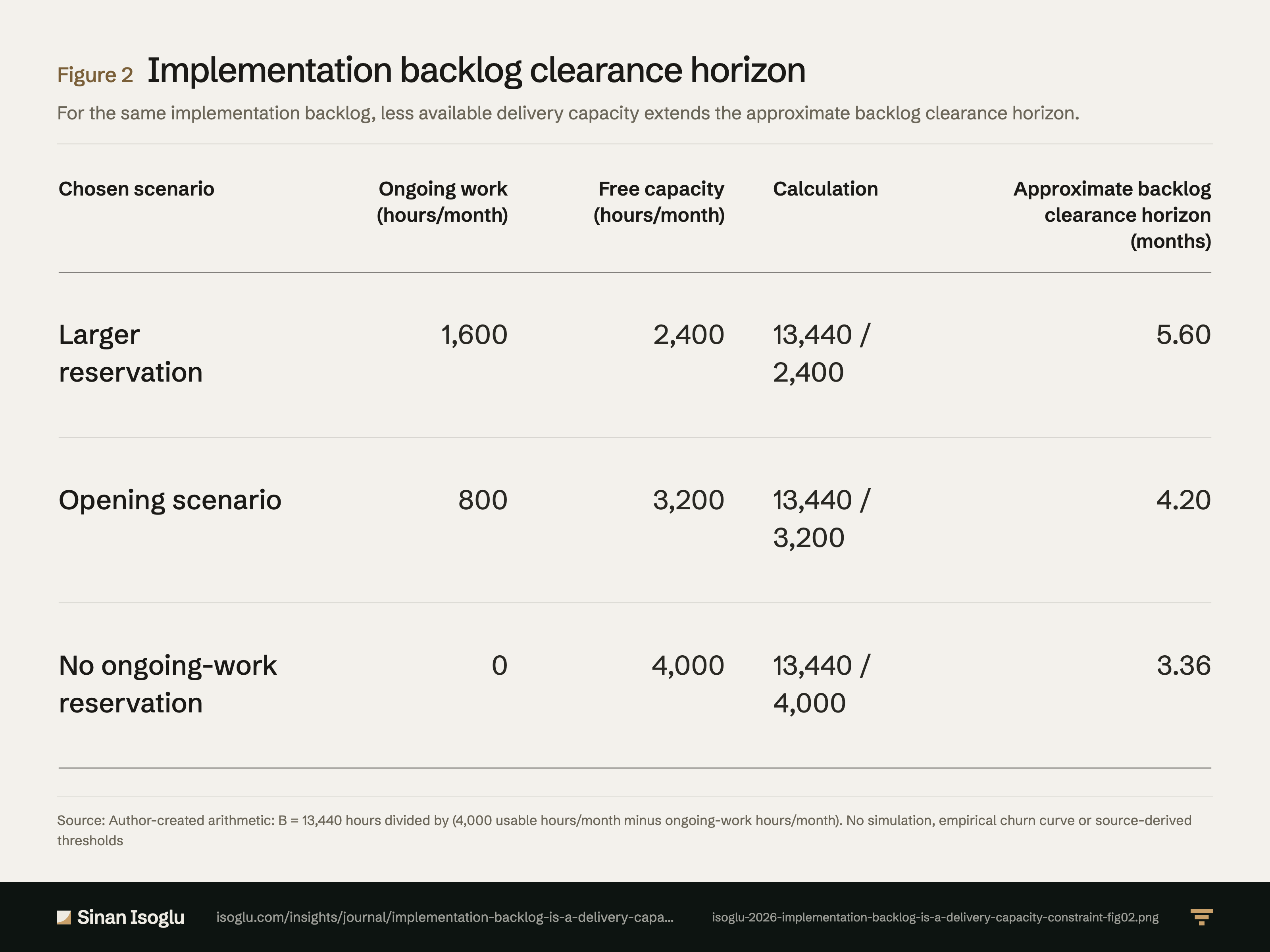
Figure 2Figure
Implementation backlog clearance horizon
Implementation backlog: delivery capacity governs new sales
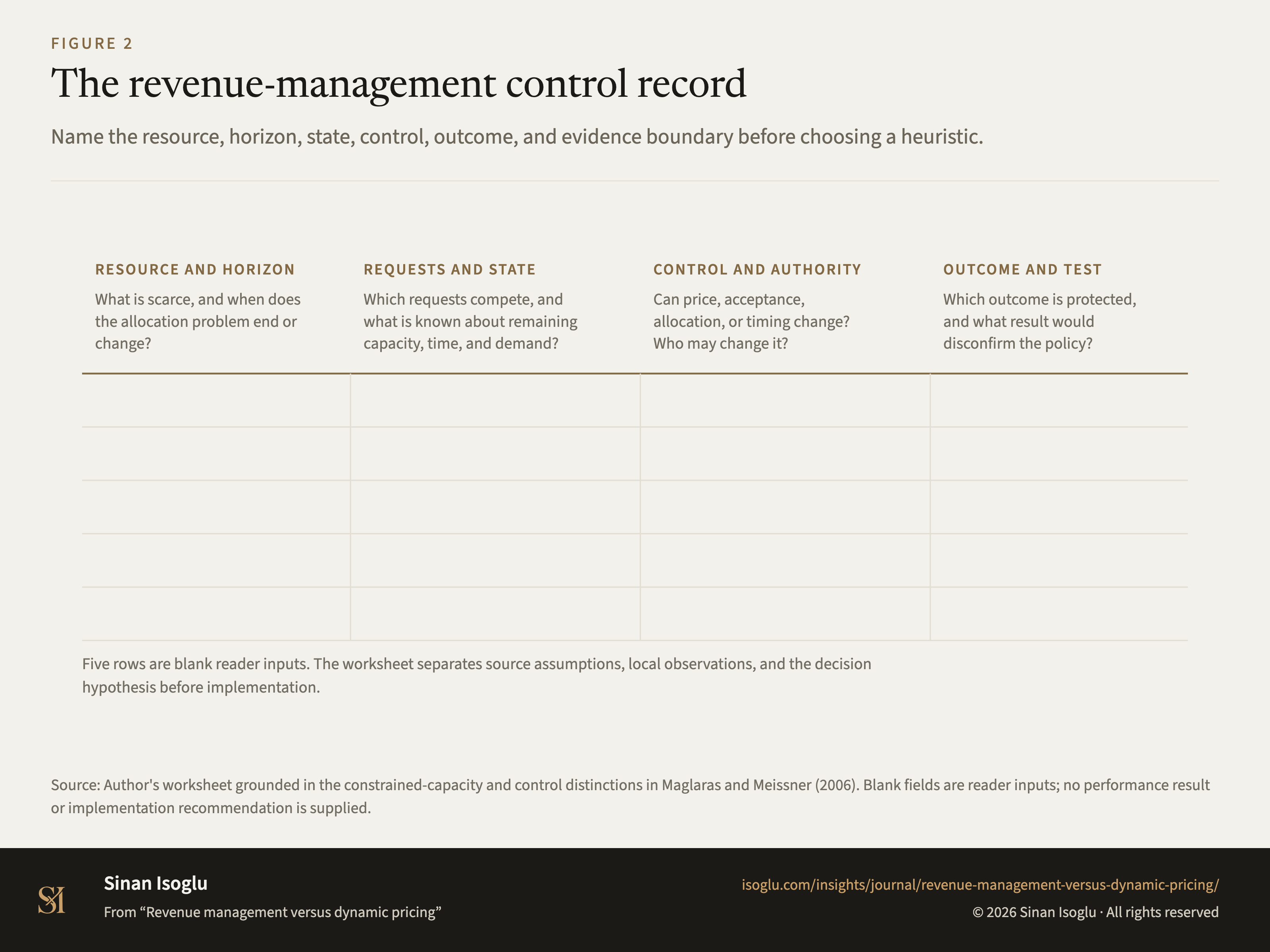
Figure 2Figure
The revenue-management control record
Revenue management versus dynamic pricing
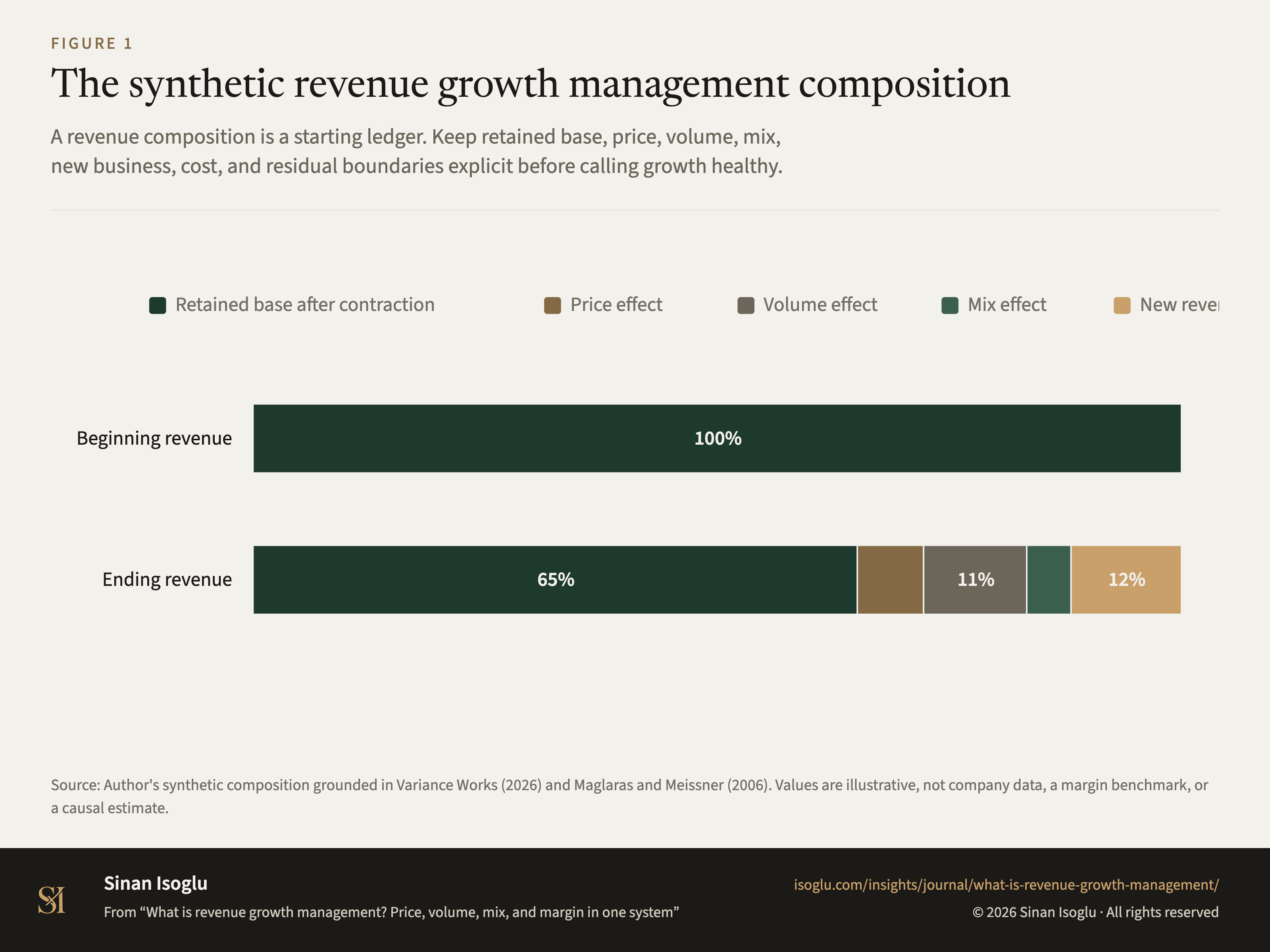
Figure 1Figure
The synthetic revenue growth management composition
What is revenue growth management? Price, volume, mix, and margin in one system
Contact
Bring the question you're working on.
Research, a guest lecture, or a commercial question.