Tabelle 1Aus „Wachstum braucht ein Explorations-Exploitation-Portfolio“
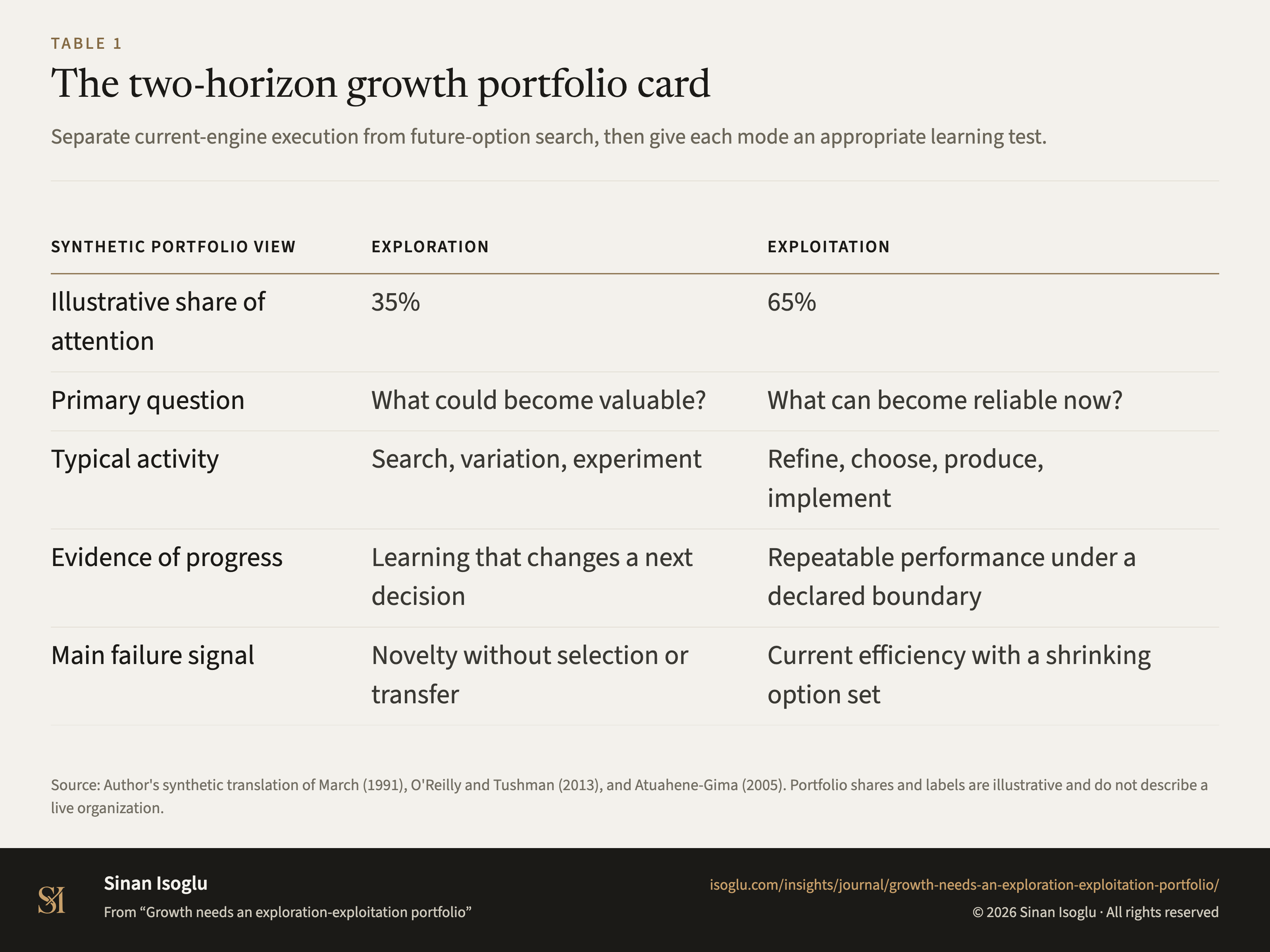
Die Portfoliokarte für zwei Wachstumshorizonte
Die Ausführung des heutigen Geschäfts und die Suche nach künftigen Optionen brauchen passende Lernprüfungen.
Tabelle 1Die Portfoliokarte für zwei Wachstumshorizonte
| Synthetische Portfoliosicht | Exploration | Exploitation |
|---|---|---|
| Illustrativer Aufmerksamkeitsanteil | 35 % | 65 % |
| Primäre Frage | Was könnte wertvoll werden? | Was kann jetzt zuverlässig werden? |
| Typische Aktivität | Suche, Variation, Experiment | Verfeinern, auswählen, produzieren, implementieren |
| Fortschrittsbeleg | Lernen, das die nächste Entscheidung verändert | Wiederholbare Leistung in einer erklärten Grenze |
| Hauptfehlersignal | Neuigkeit ohne Auswahl oder Transfer | Aktuelle Effizienz mit schrumpfender Optionsmenge |
Bei breiten Tabellen horizontal wischen oder scrollen.
Quelle: Synthetische Übertragung von March (1991), O'Reilly und Tushman (2013) sowie Atuahene-Gima (2005) durch den Autor. Anteile und Bezeichnungen sind illustrativ und beschreiben keine reale Organisation.
Quelle und Evidenz
Jede Zeile nennt eine Aussage zu dieser Abbildung, ihre Quelle und die Art ihrer Prüfung.
- A MAR91-C1 Exploration involves search, variation, experimentation, and innovation, while exploitation involves refinement, choice, production, and implementation.March. (1991)
- A MAR91-C2 Organizational learning faces a tension because systems that favor exploitation can improve current returns while reducing long-run adaptability, whereas excessive exploration can undermine competence and returns.March. (1991)
- A MAR91-C3 The balance between exploration and exploitation is shaped by feedback, socialization, competition, and the time horizon over which learning is evaluated.March. (1991)
- A OT13-C1 The definition, verbatim: ambidexterity is "the ability of an organization to both explore and exploit"O'Reilly & Tushman. (2013)
- A OT13-C2 The two regimes are named in the same sentence: mature markets "where efficiency control and incremental improvement are prized" against new ones "where flexibility autonomy and experimentation are needed"O'Reilly & Tushman. (2013)
- A ATU05-C1 The dilemma in the author's words: "how to exploit existing product innovation competencies competence exploitation while avoiding their dysfunctional rigidity effects by renewing and replacing them with entirely new competencies competence exploration"Atuahene-Gima. (2005)
- A ATU05-C2 The proposed resolution: "customer and competitor orientations ensure simultaneous investments in exploiting existing product innovation competencies and exploring new ones"Atuahene-Gima. (2005)
- A ATU05-C3 And the outcome side, including the moderator: "competence exploitation and exploration have opposing relationships with incremental and radical innovation performance", while "the relationship between competence exploration and radical innovation performance is positively moderated by interfunctional coordination"Atuahene-Gima. (2005)
Prüfgrade: A, gegen die gedruckte Seite der Primärquelle geprüft · B, Primärquelle, nur Textebene · C, belastbare Sekundärquelle · D, berichtet.
Aus dem Beitrag
Wachstum, das sich potenziert
Wachstum braucht ein Explorations-Exploitation-Portfolio
Wachstum braucht zwei Zeithorizonte: Exploration sucht und experimentiert; Exploitation verfeinert und implementiert Bewährtes.
Den Beitrag lesenDiese Abbildung gehört zu einem Essay: Die Zahlen stehen hier, das Argument dort.
Zitieren oder einbetten
Verwandte Abbildungen
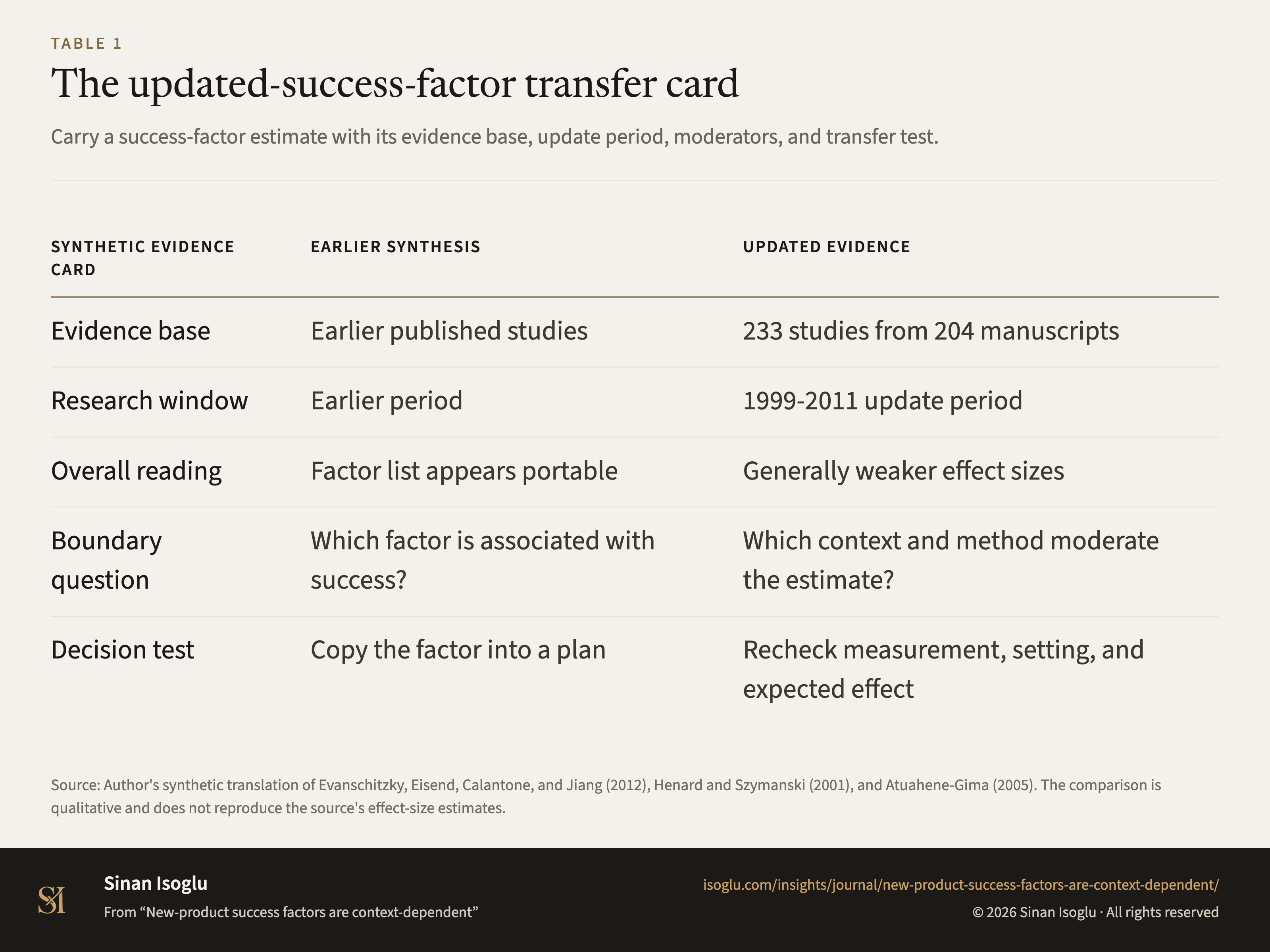
Tabelle 1Tabelle
Die Transferkarte für aktualisierte Erfolgsfaktoren
Erfolgsfaktoren neuer Produkte sind kontextabhängig
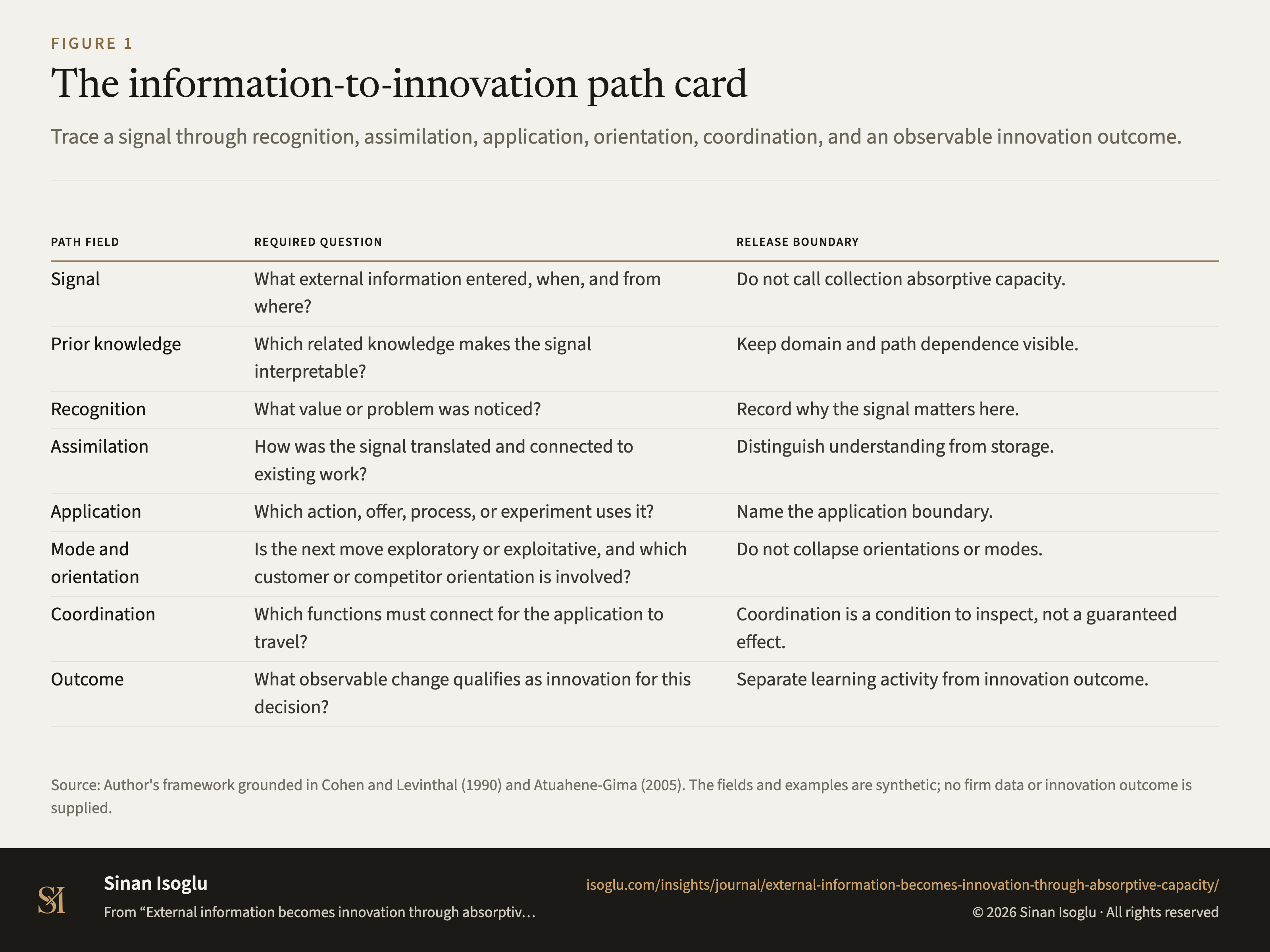
Abbildung 1Grafik
Die Informations-zu-Innovation-Pfadkarte
Externe Information wird durch Absorptionsfähigkeit zu Innovation
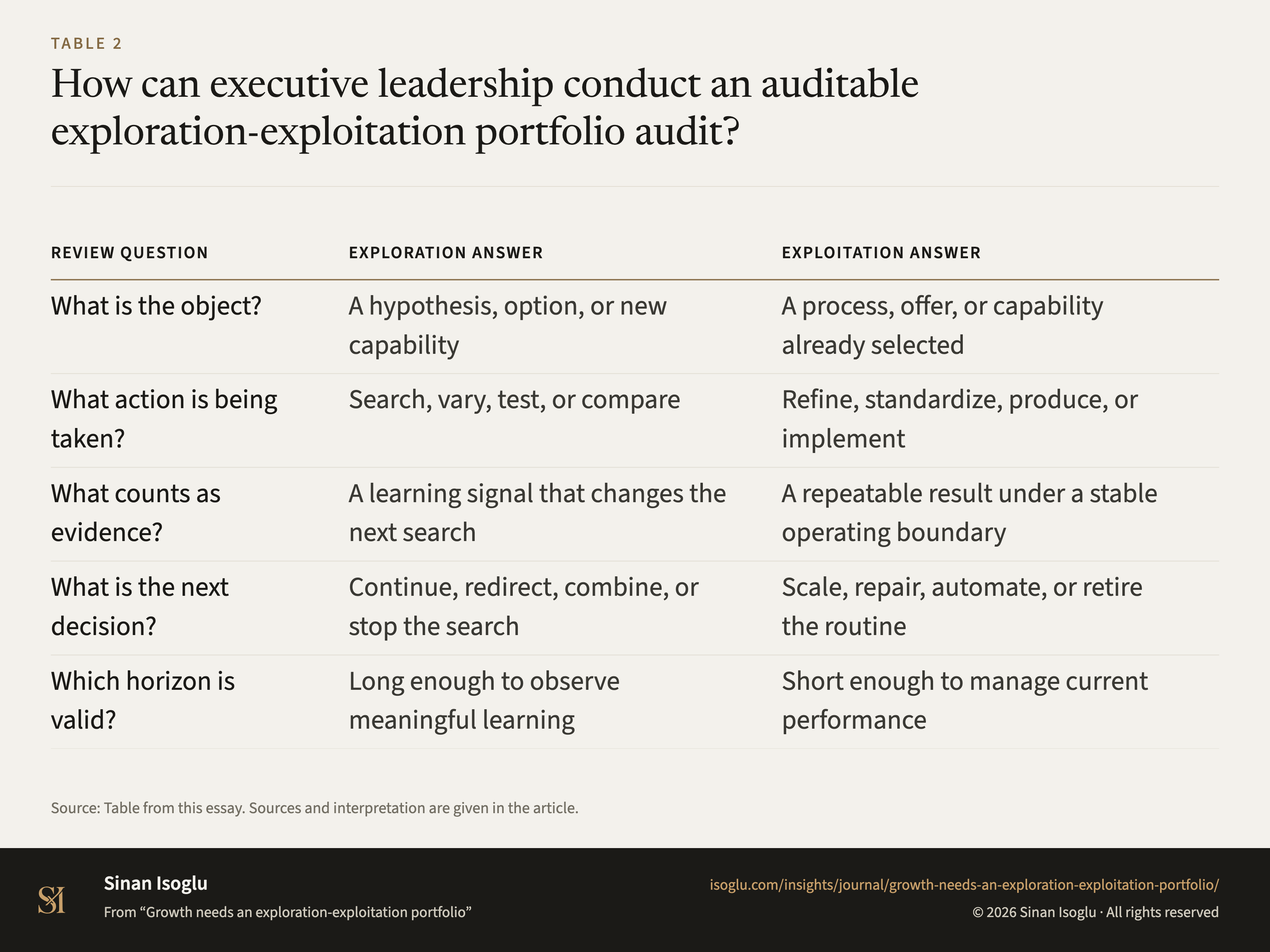
Tabelle 2Tabelle
Wie führt die Unternehmensführung ein prüfbares Ambidextrie-Portfolioaudit durch?
Wachstum braucht ein Explorations-Exploitation-Portfolio
Kontakt
Schicken Sie die Frage, an der Sie arbeiten.
Forschung, ein Gastvortrag oder eine Frage aus der Praxis.