Table 7From “Acquisition growth loops need a declared entry event”
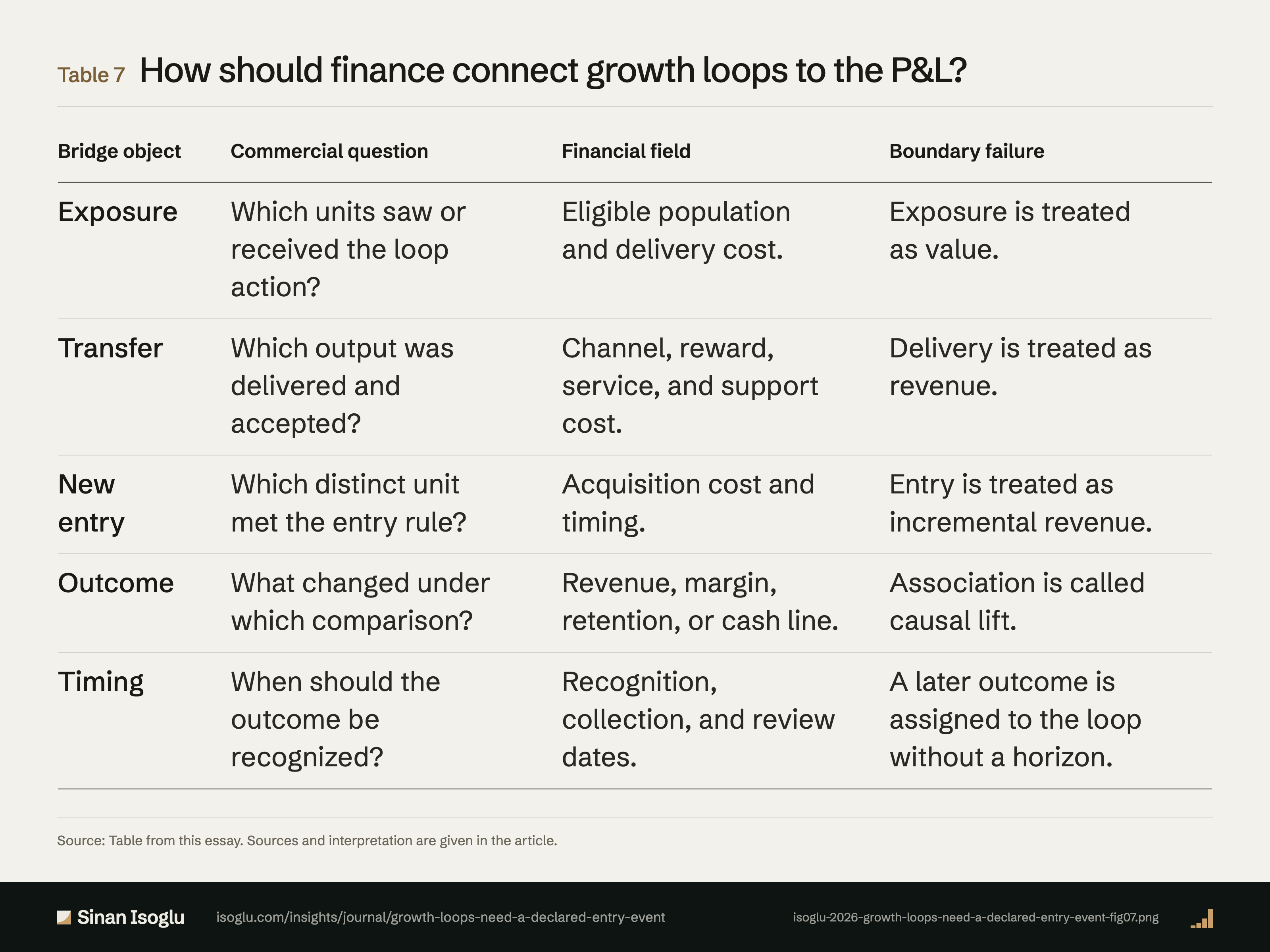
How should finance connect growth loops to the P&L?
Table 7How should finance connect growth loops to the P&L?
| Bridge object | Commercial question | Financial field | Boundary failure |
|---|---|---|---|
| Exposure | Which units saw or received the loop action? | Eligible population and delivery cost. | Exposure is treated as value. |
| Transfer | Which output was delivered and accepted? | Channel, reward, service, and support cost. | Delivery is treated as revenue. |
| New entry | Which distinct unit met the entry rule? | Acquisition cost and timing. | Entry is treated as incremental revenue. |
| Outcome | What changed under which comparison? | Revenue, margin, retention, or cash line. | Association is called causal lift. |
| Timing | When should the outcome be recognized? | Recognition, collection, and review dates. | A later outcome is assigned to the loop without a horizon. |
Swipe or scroll horizontally if the table is wider than your screen.
Source: Table from this essay. Sources and interpretation are given in the article.
From the essay
Growth that compounds
Acquisition growth loops need a declared entry event
An acquisition growth loop is measurable only when action, transfer, eligibility, reward cost, and the next outcome are defined under one boundary.
Read the essayThis exhibit belongs to an essay: the numbers live here, the argument lives there.
Cite or embed
Related exhibits
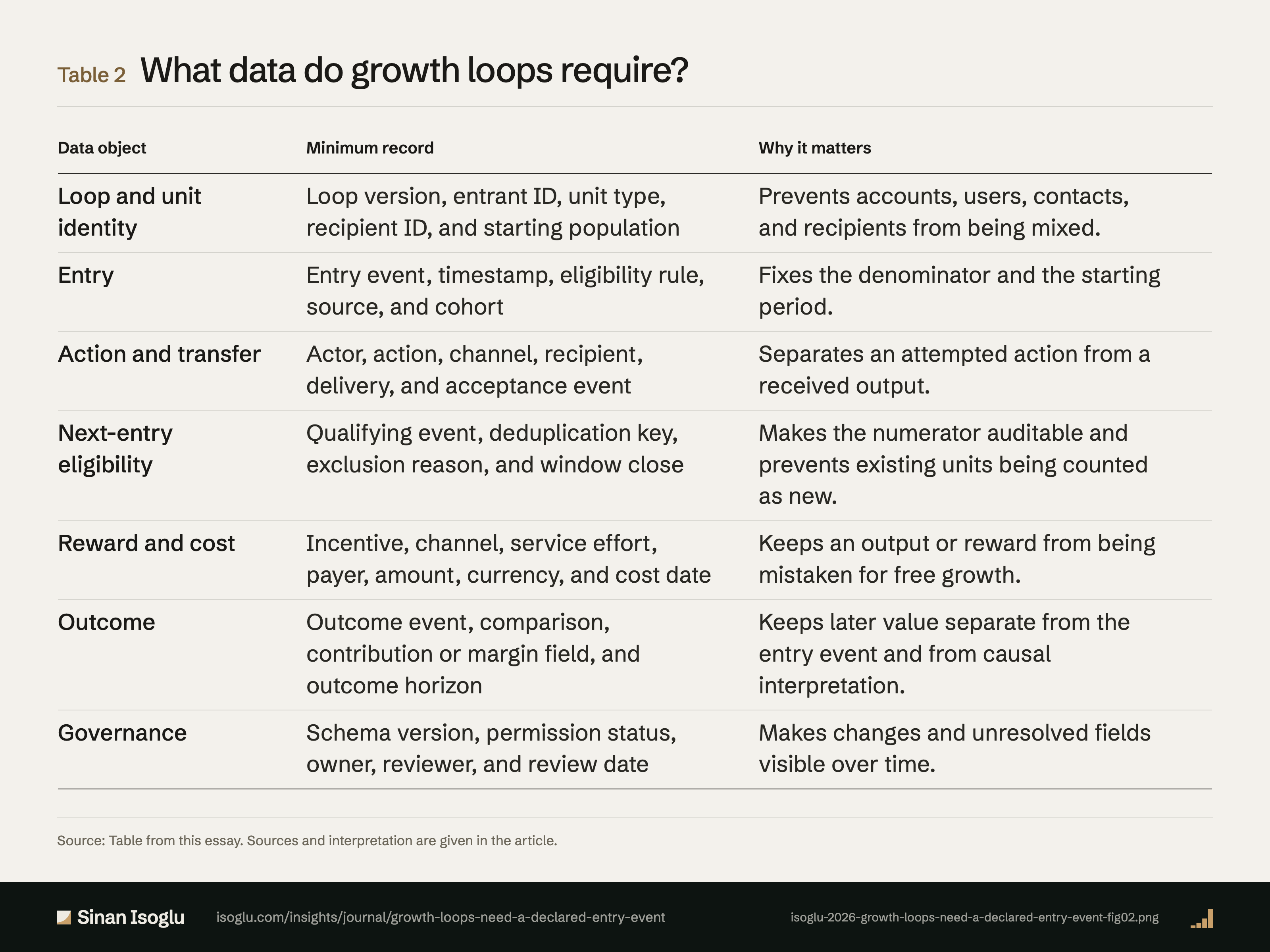
Table 2Table
What data do growth loops require?
Acquisition growth loops need a declared entry event
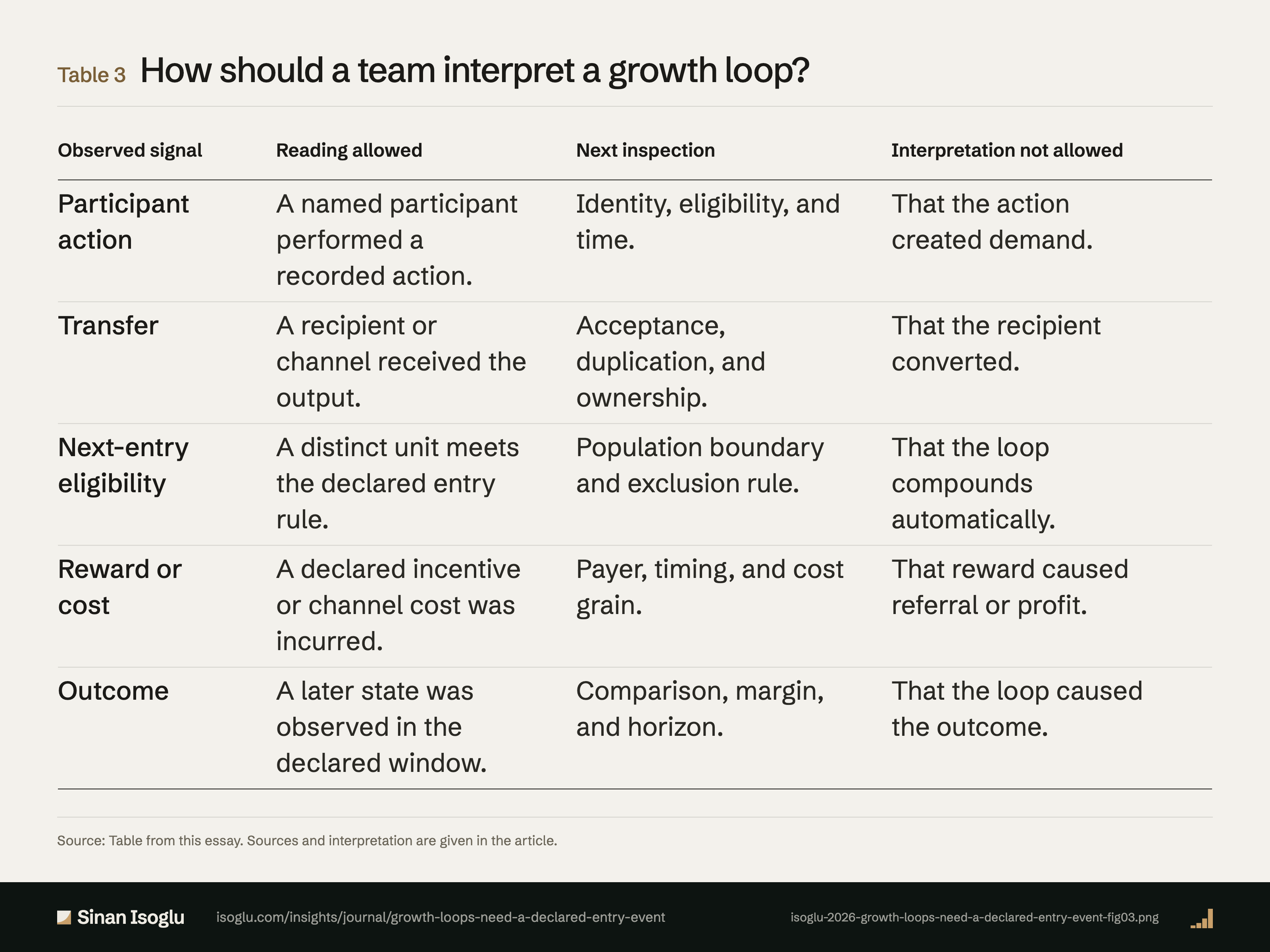
Table 3Table
How should a team interpret a growth loop?
Acquisition growth loops need a declared entry event
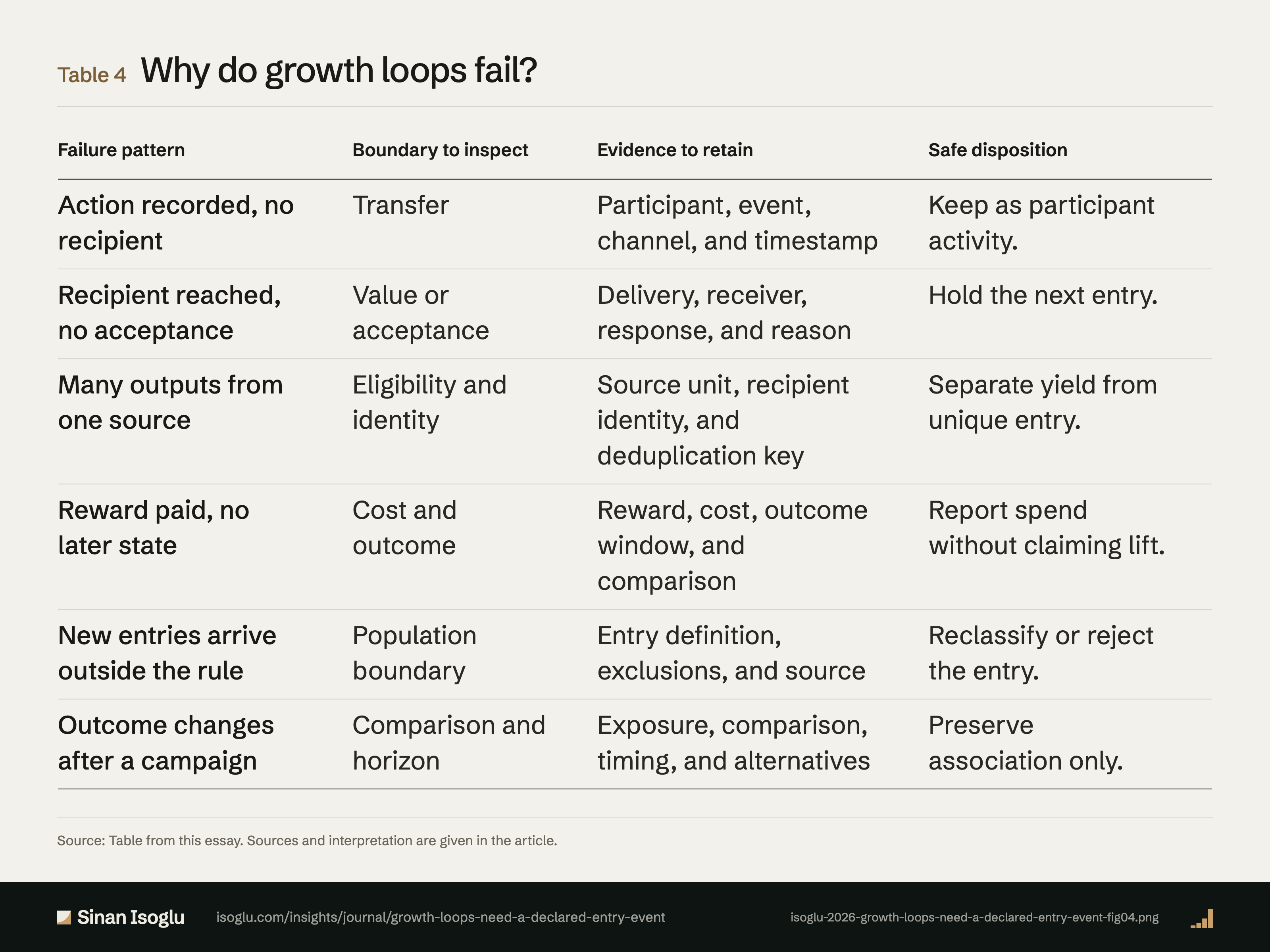
Table 4Table
Why do growth loops fail?
Acquisition growth loops need a declared entry event
Contact
Bring the question you're working on.
Research, a guest lecture, or a commercial question.