Table 1From “Dynamic capabilities are routines, not magic”
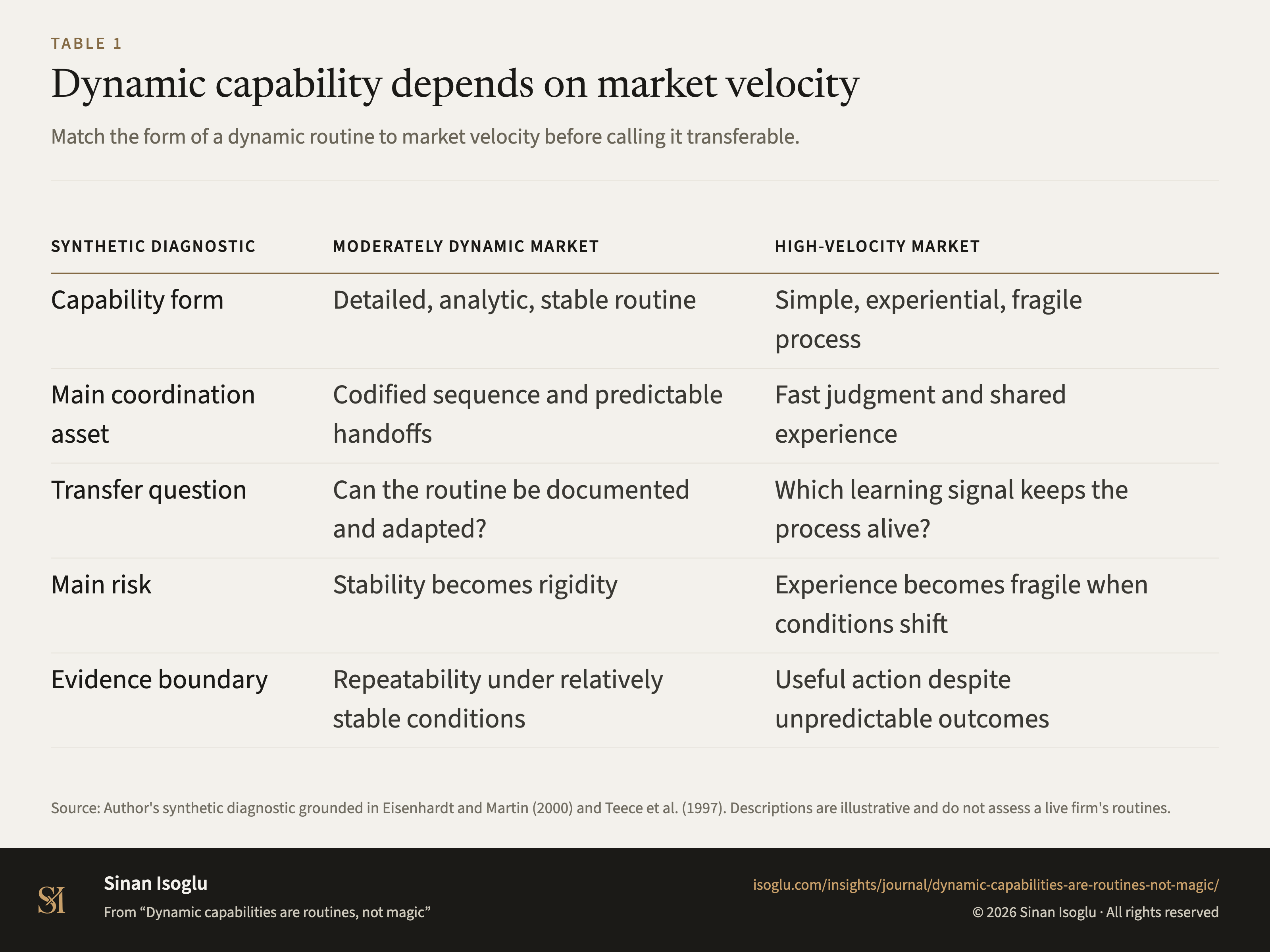
Dynamic capability depends on market velocity
Match the form of a dynamic routine to market velocity before calling it transferable.
Table 1Dynamic capability depends on market velocity
| Synthetic diagnostic | Moderately dynamic market | High-velocity market |
|---|---|---|
| Capability form | Detailed, analytic, stable routine | Simple, experiential, fragile process |
| Main coordination asset | Codified sequence and predictable handoffs | Fast judgment and shared experience |
| Transfer question | Can the routine be documented and adapted? | Which learning signal keeps the process alive? |
| Main risk | Stability becomes rigidity | Experience becomes fragile when conditions shift |
| Evidence boundary | Repeatability under relatively stable conditions | Useful action despite unpredictable outcomes |
Swipe or scroll horizontally if the table is wider than your screen.
Source: Author's synthetic diagnostic grounded in Eisenhardt and Martin (2000) and Teece et al. (1997). Descriptions are illustrative and do not assess a live firm's routines.
Source and evidence
Each line names a claim related to this exhibit, its source, and how it was checked.
- A EM00-C1 Named processes, not an abstraction: "dynamic capabilities are a set of specific and identifiable processes such as product development, strategic decision making, and alliancing": and "they are neither vague nor tautological"Eisenhardt & Martin. (2000)
- A EM00-C2 Both halves in one sentence: "although dynamic capabilities are idiosyncratic in their details and path dependent in their emergence, they have significant commonalities across firms (popularly termed ‘best practice’)"Eisenhardt & Martin. (2000)
- A EM00-C3 The two market regimes: "in moderately dynamic markets, dynamic capabilities resemble the traditional conception of routines", while "in high-velocity markets, they are simple, highly experiential and fragile processes with unpredictable outcomes"Eisenhardt & Martin. (2000)
- A TPS97-C1 The framework’s own scope sentence: it "analyzes the sources and methods of wealth creation and capture by private enterprise firms operating in environments of rapid technological change", resting advantage on "distinctive processes", "asset positions" and "the evolution path(s) it has adopted or inherited"Teece, Pisano & Shuen. (1997)
- A TPS97-C2 Advantage sits in the combining, not the owning: "distinctive processes (ways of coordinating and combining), shaped by the firm’s (specific) asset positions (such as the firm’s portfolio of difficult-to-trade knowledge assets and complementary assets)"Teece, Pisano & Shuen. (1997)
- A TPS97-C3 Path dependence is conditional, and they say when: "the importance of path dependencies is amplified where conditions of increasing returns exist", with erosion depending on "the stability of market demand, and the ease of replicability"Teece, Pisano & Shuen. (1997)
Grades: A, verified against the printed page of the primary source · B, primary source, text layer only · C, authoritative secondary · D, reported.
From the essay
Growth that compounds
Dynamic capabilities are routines, not magic
Dynamic capabilities are identifiable processes, not a synonym for success: test routines, path dependence, and market velocity first.
Read the essayThis exhibit belongs to an essay: the numbers live here, the argument lives there.
Cite or embed
Related exhibits
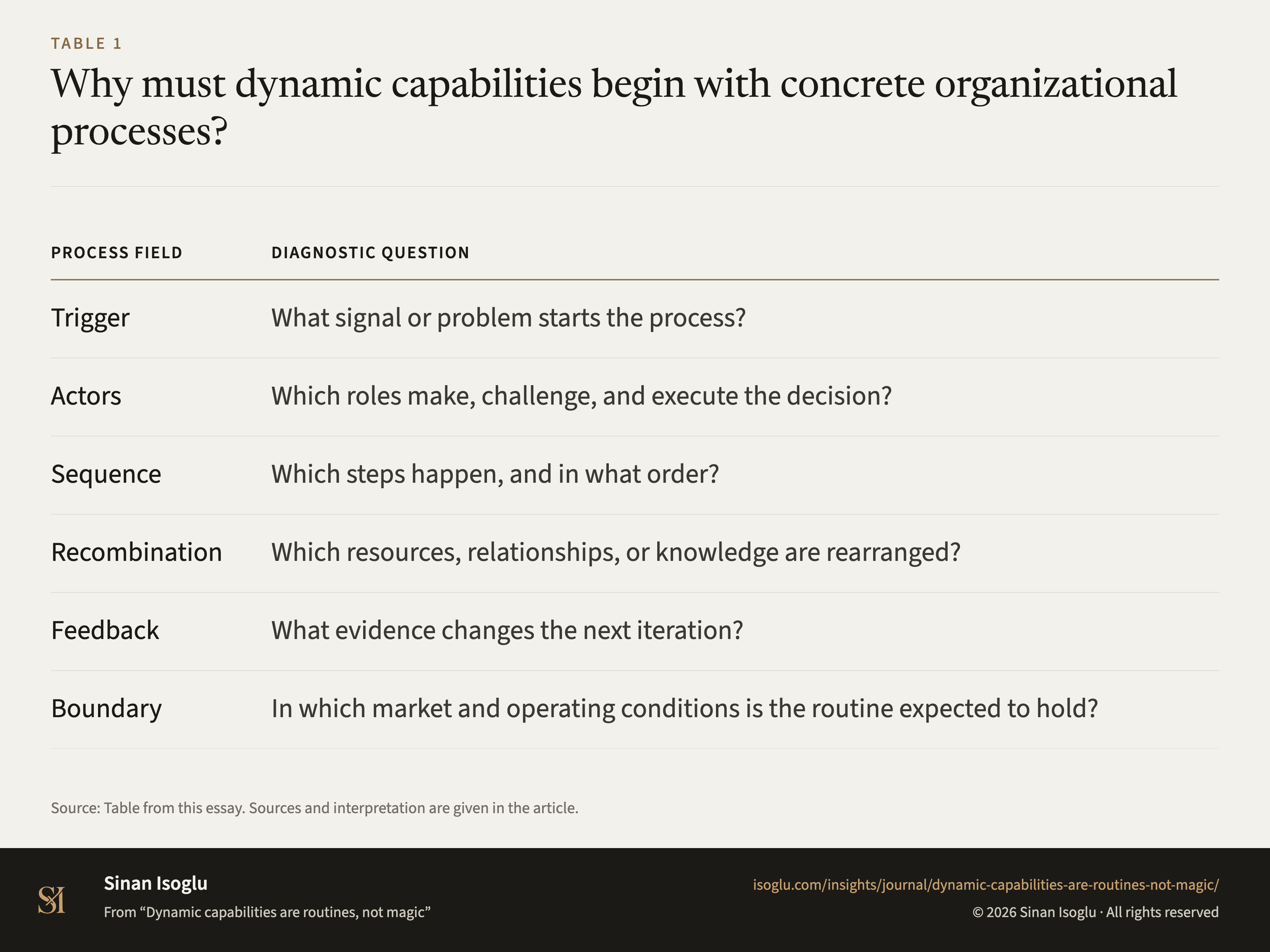
Table 1Table
Why must dynamic capabilities begin with concrete organizational processes?
Dynamic capabilities are routines, not magic
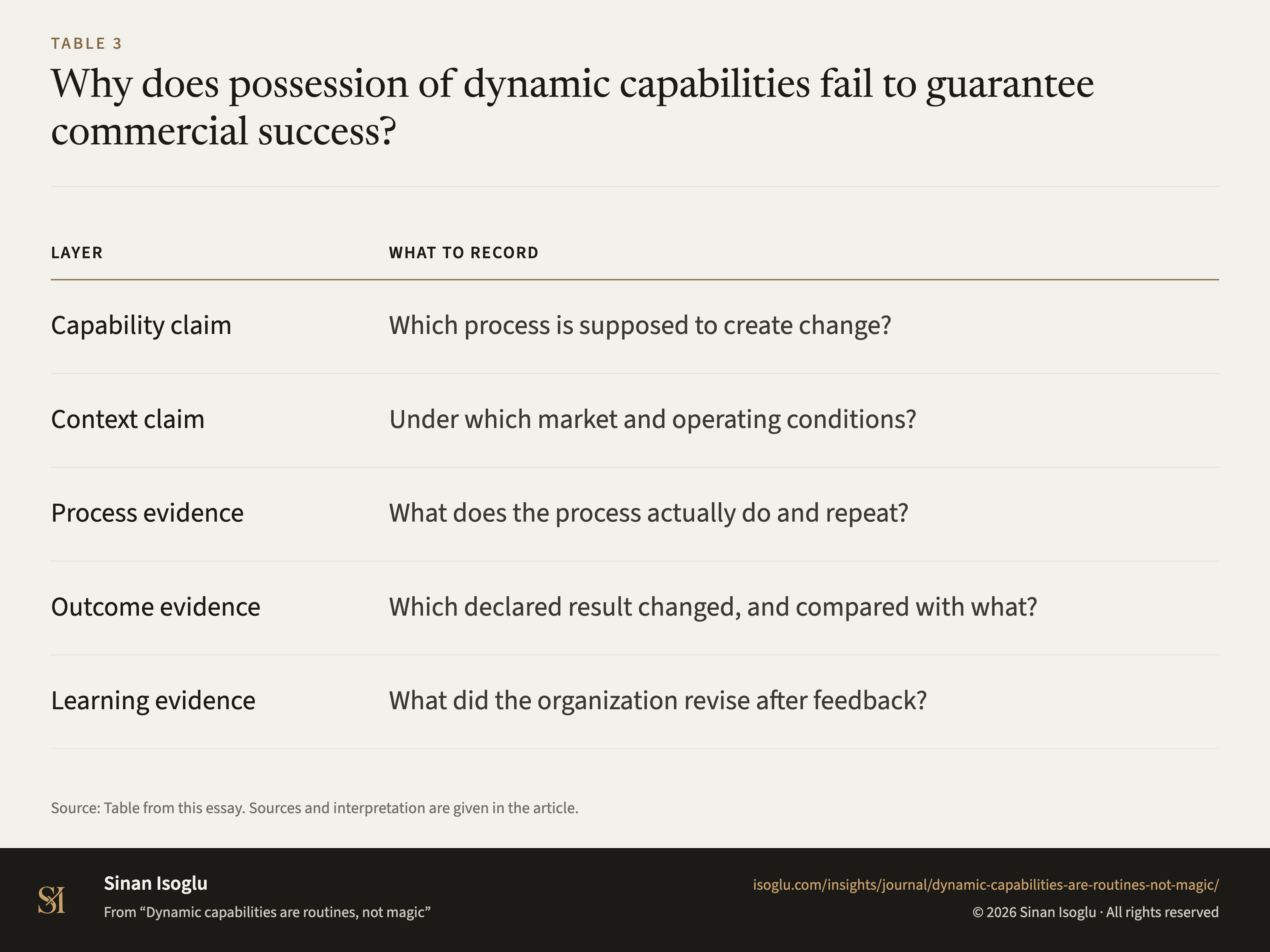
Table 3Table
Why does possession of dynamic capabilities fail to guarantee commercial success?
Dynamic capabilities are routines, not magic
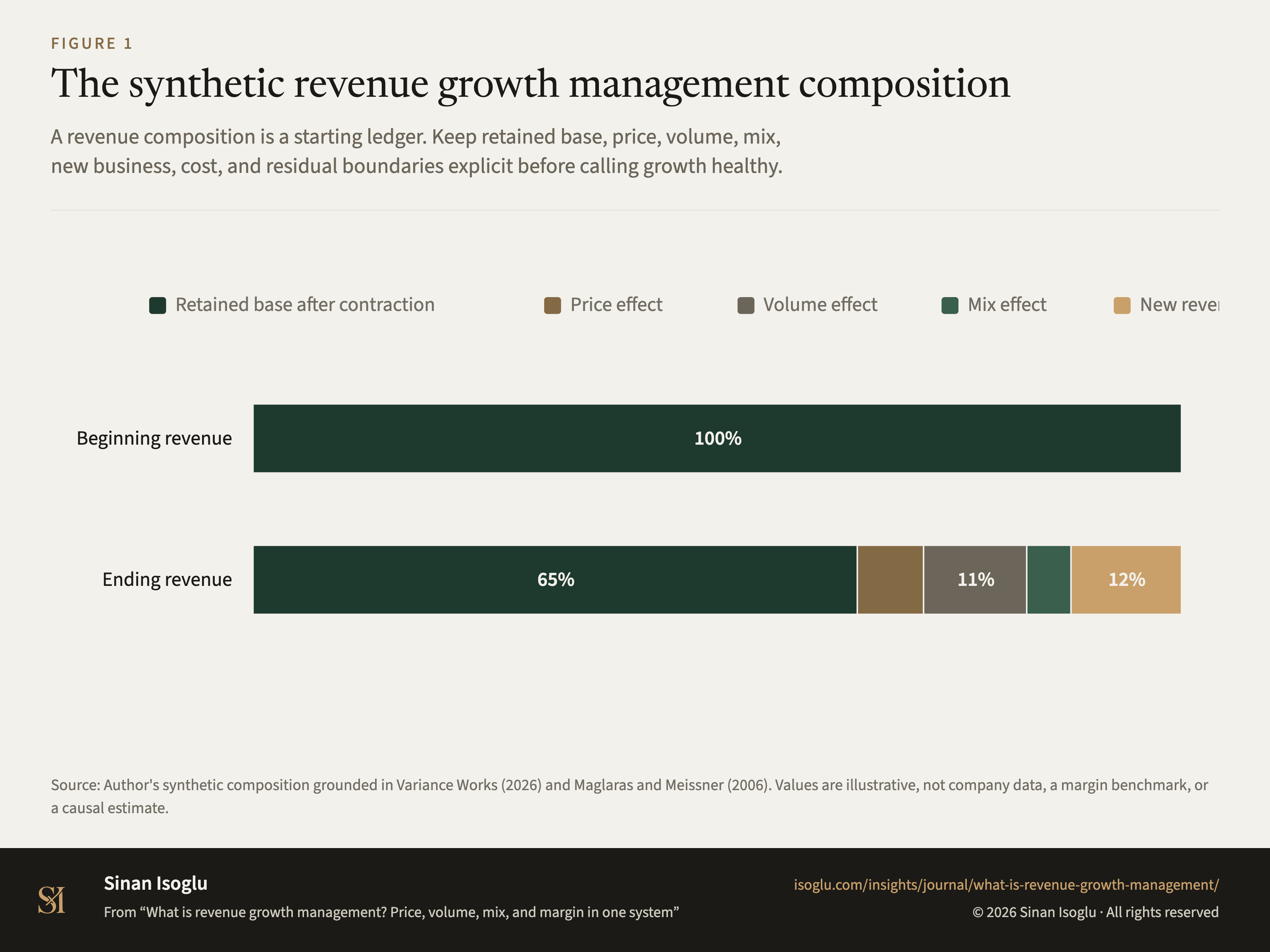
Figure 1Figure
The synthetic revenue growth management composition
What is revenue growth management? Price, volume, mix, and margin in one system
Contact
Bring the question you're working on.
Research, a guest lecture, or a commercial question.