Table 1From “Customer selection is a resource-allocation decision”
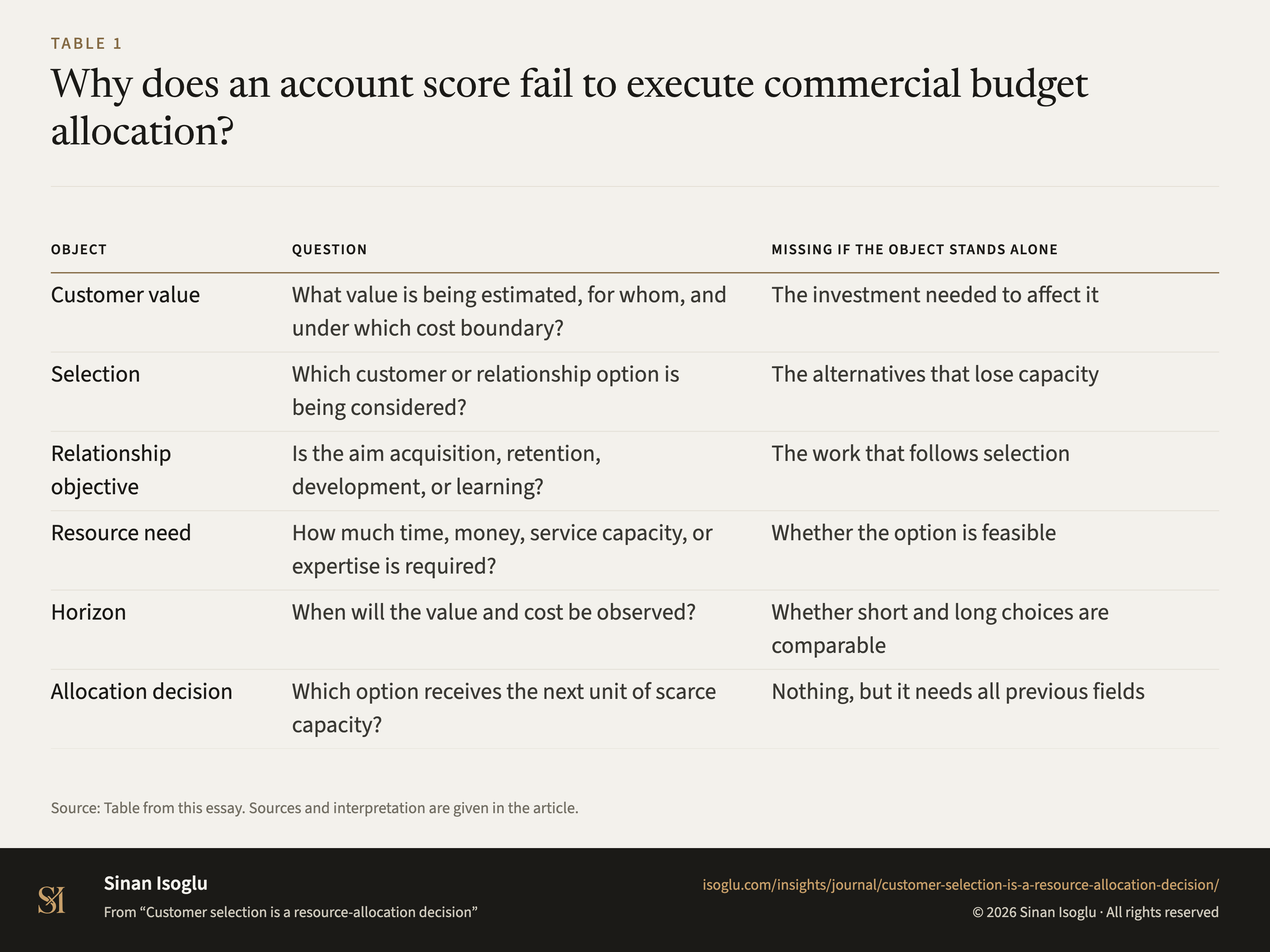
Why does an account score fail to execute commercial budget allocation?
Table 1Why does an account score fail to execute commercial budget allocation?
| Object | Question | Missing if the object stands alone |
|---|---|---|
| Customer value | What value is being estimated, for whom, and under which cost boundary? | The investment needed to affect it |
| Selection | Which customer or relationship option is being considered? | The alternatives that lose capacity |
| Relationship objective | Is the aim acquisition, retention, development, or learning? | The work that follows selection |
| Resource need | How much time, money, service capacity, or expertise is required? | Whether the option is feasible |
| Horizon | When will the value and cost be observed? | Whether short and long choices are comparable |
| Allocation decision | Which option receives the next unit of scarce capacity? | Nothing, but it needs all previous fields |
Swipe or scroll horizontally if the table is wider than your screen.
Source: Table from this essay. Sources and interpretation are given in the article.
From the essay
Growth that compounds
Customer selection is a resource-allocation decision
Customer selection is not a score: compare acquisition, retention, development, customer value, and scarce capacity under one horizon.
Read the essayThis exhibit belongs to an essay: the numbers live here, the argument lives there.
Cite or embed
Related exhibits
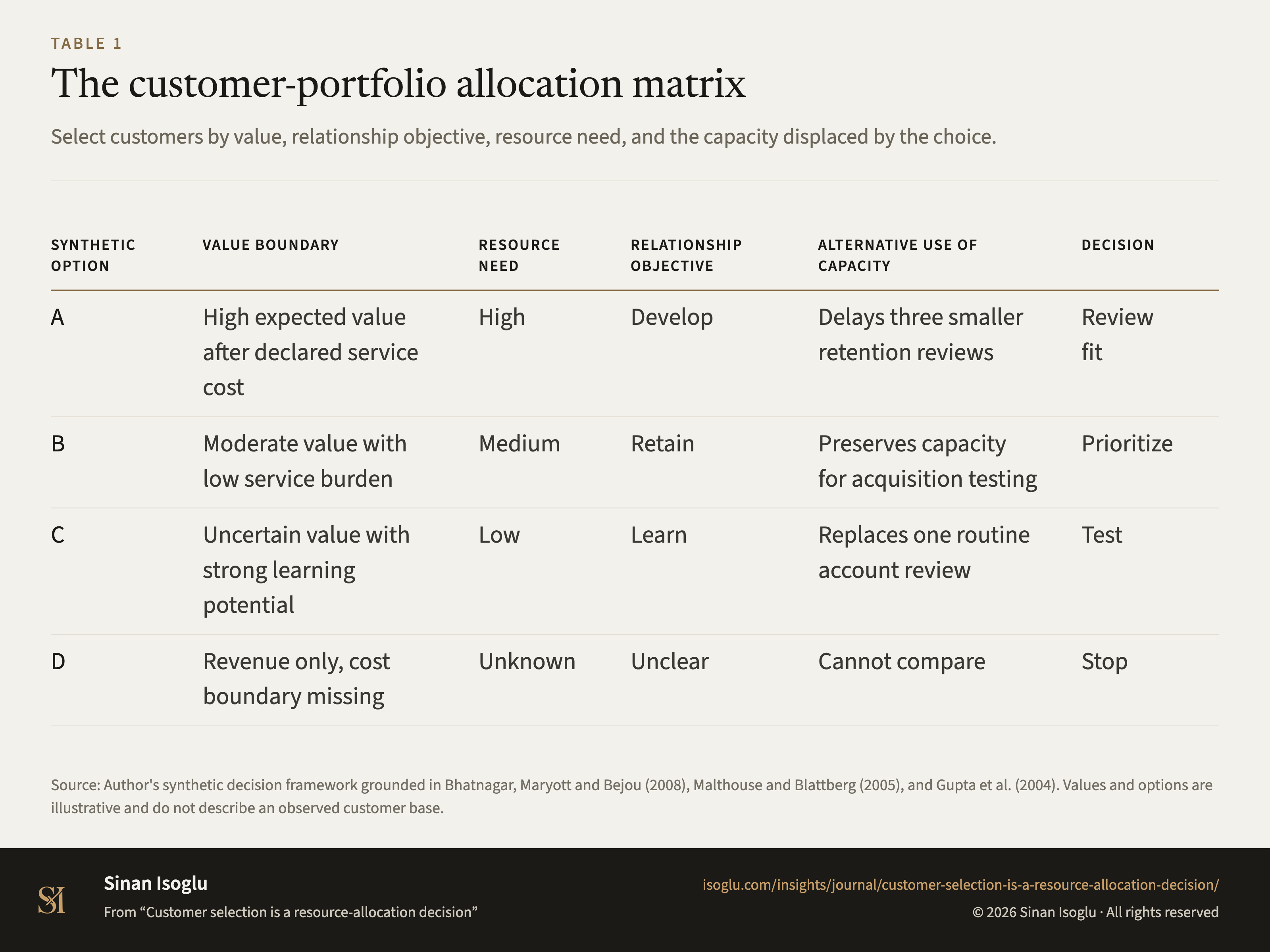
Table 1Table
The customer-portfolio allocation matrix
Customer selection is a resource-allocation decision
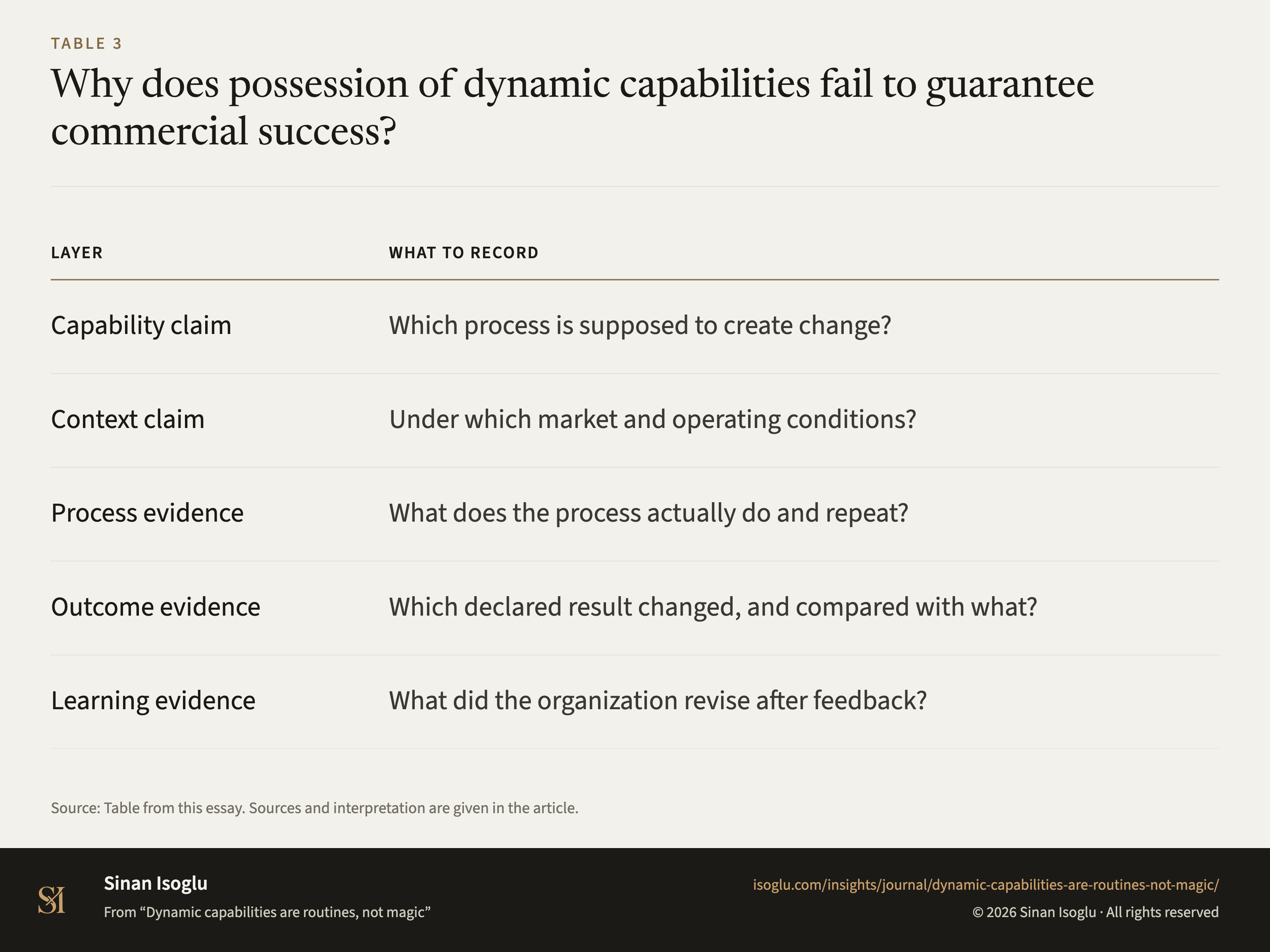
Table 3Table
Why does possession of dynamic capabilities fail to guarantee commercial success?
Dynamic capabilities are routines, not magic
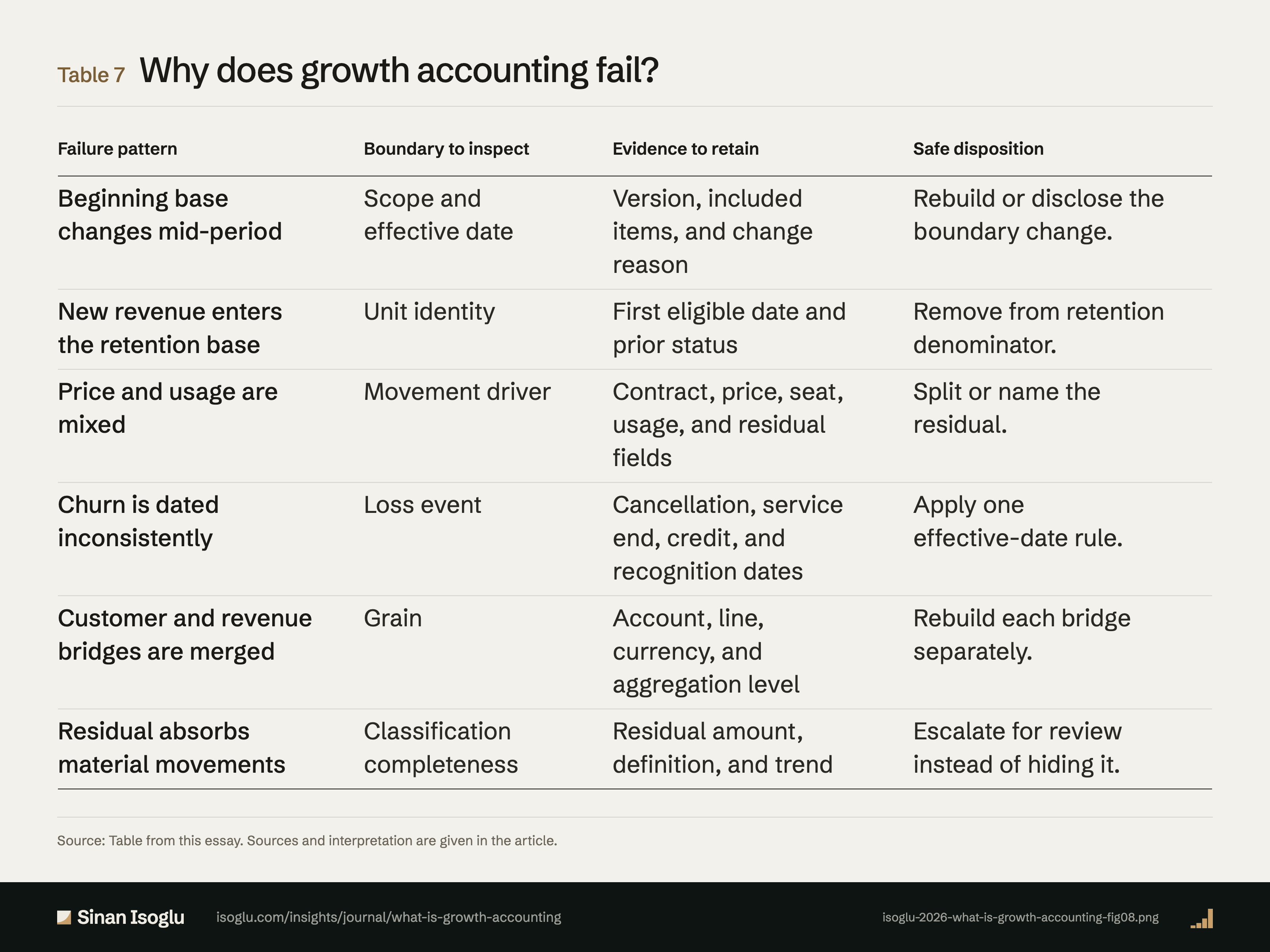
Table 7Table
Why does growth accounting fail?
What is growth accounting? Separate new, retained, expanded, and lost revenue
Contact
Bring the question you're working on.
Research, a guest lecture, or a commercial question.