Abbildung 1Aus „Common Method Bias ist kein Häkchen“
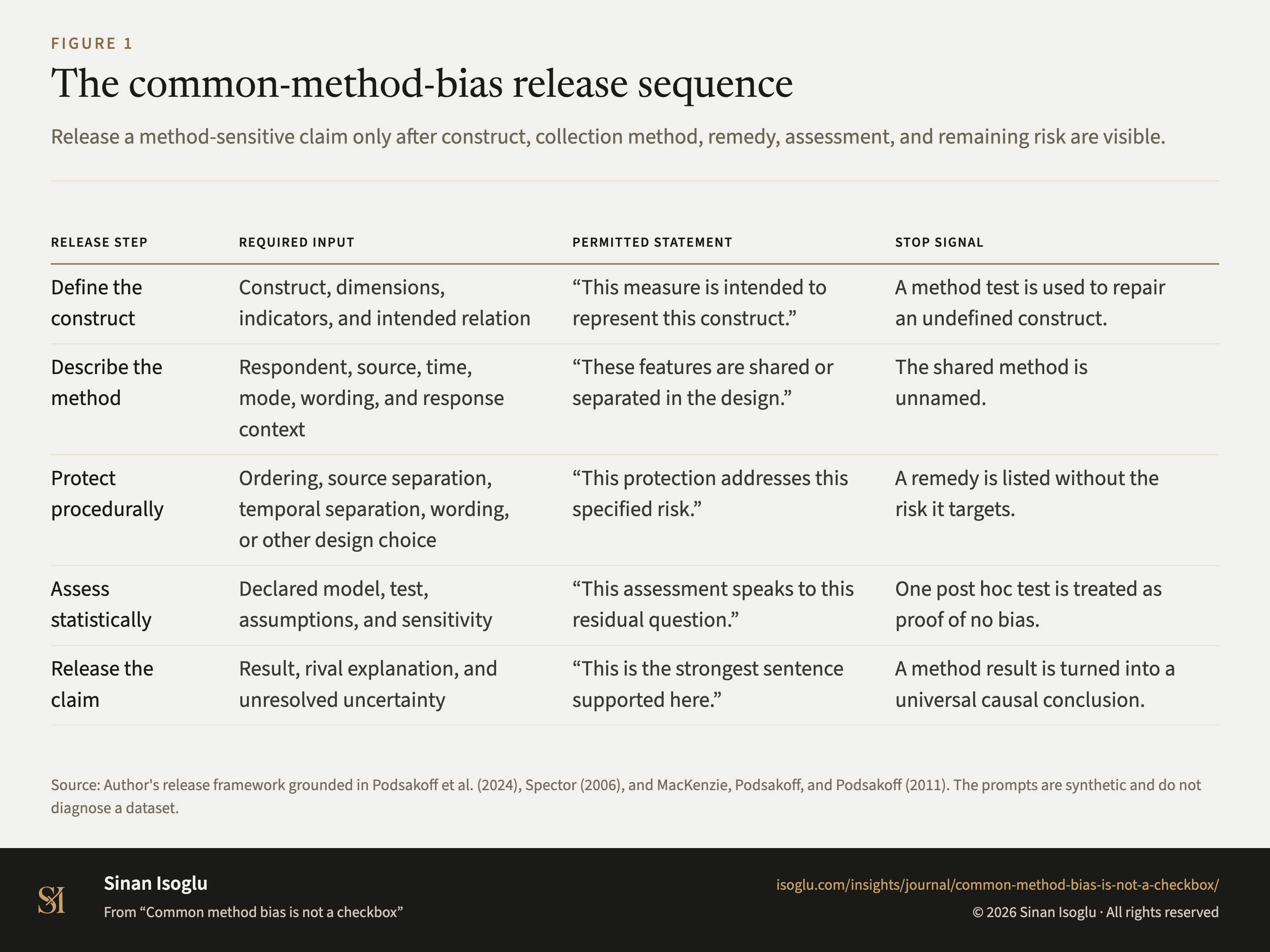
Die Freigabesequenz für Common Method Bias
Geben Sie eine methodensensible Aussage erst frei, wenn Konstrukt, Erhebungsmethode, Schutz, Prüfung und Restunsicherheit sichtbar sind.
Abbildung 1Die Freigabesequenz für Common Method Bias
| Freigabeschritt | Erforderliche Eingabe | Zulässiger Satz | Abbruchsignal |
|---|---|---|---|
| Konstrukt definieren | Konstrukt, Dimensionen, Indikatoren und beabsichtigte Beziehung | „Diese Messung soll dieses Konstrukt abbilden.“ | Ein Methodentest soll ein undefiniertes Konstrukt reparieren. |
| Methode beschreiben | Befragte, Quelle, Zeitpunkt, Modus, Formulierung und Antwortsituation | „Diese Merkmale werden in der Erhebung geteilt oder getrennt.“ | Die gemeinsame Methode bleibt unbenannt. |
| Verfahrensschutz | Reihenfolge, Quellentrennung, zeitliche Trennung, Formulierung oder anderer Designschritt | „Dieser Schutz adressiert dieses benannte Risiko.“ | Ein Schutz wird ohne das Zielrisiko aufgezählt. |
| Statistisch prüfen | Erklärtes Modell, Test, Annahmen und Sensitivität | „Diese Prüfung beantwortet diese Restfrage.“ | Ein Post-hoc-Test gilt als Beweis für die Abwesenheit von Bias. |
| Aussage freigeben | Ergebnis, Gegenhypothese und verbleibende Unsicherheit | „Dies ist der stärkste hier belegte Satz.“ | Ein Methodenergebnis wird zum universellen Kausalsatz. |
Bei breiten Tabellen horizontal wischen oder scrollen.
Quelle: Freigaberahmen des Autors, begründet mit Podsakoff et al. (2024), Spector (2006) sowie MacKenzie, Podsakoff und Podsakoff (2011). Die Fragen sind synthetisch und diagnostizieren keinen Datensatz.
Quelle und Evidenz
Jede Zeile nennt eine Aussage zu dieser Abbildung, ihre Quelle und die Art ihrer Prüfung.
- A POD24-C1 The review's own four-part structure: "we explain the harmful effects of CMB (why it is bad)", then "there are multiple sources of CMB, several of which are likely to be present in any study", then "the conditions under which CMB is likely to occur are relatively widespread, and fourth, we explain why CMB is not easy to fix"Podsakoff et al. (2024)
- A POD24-C2 Multiple sources, and more than one likely at once: "there are multiple sources of CMB, several of which are likely to be present in any study"Podsakoff et al. (2024)
- A POD24-C3 And no single post hoc test is the remedy, because "the conditions under which CMB is likely to occur are relatively widespread, and fourth, we explain why CMB is not easy to fix"Podsakoff et al. (2024)
- A SPE06-C1 The paper's title is its claim: "Method Variance in Organizational Research: Truth or Urban Legend?", and it names the belief it disputes, that "Everything Measured With the Same Method Shares CMV"Spector. (2006)
- A SPE06-C2 The evidential basis for disputing it: "The reason this is legend is because there are few scientific data to unequivocally support this view and there are data to refute it"Spector. (2006)
- A SPE06-C3 So the argument is for design-sensitive reasoning rather than a blanket verdict: "The reason this is legend is because there are few scientific data to unequivocally support this view and there are data to refute it"Spector. (2006)
- A MCK11-C1 The paper's own purpose: "to integrate new and existing techniques into a comprehensive set of recommendations that can be used to give researchers in mis and the behavioral sciences a framework for developing valid measures"MacKenzie, Podsakoff & Podsakoff. (2011)
- A MCK11-C2 The failure it targets: techniques that "provide evidence that the set of items used to represent the focal construct actually measures what it purports to measure" are underusedMacKenzie, Podsakoff & Podsakoff. (2011)
- A MCK11-C3 A sequence, not a checklist: "this process involves a series of steps beginning with construct conceptualization or reconceptualization of an existing construct" and ending in norms for the scaleMacKenzie, Podsakoff & Podsakoff. (2011)
Prüfgrade: A, gegen die gedruckte Seite der Primärquelle geprüft · B, Primärquelle, nur Textebene · C, belastbare Sekundärquelle · D, berichtet.
Aus dem Beitrag
Aus der Forschung
Common Method Bias ist kein Häkchen
Common Method Bias ist ein Designrisiko, kein Einzeltest: Trennen Sie Konstruktvalidität, Methodenvarianz, Verfahrensschutz und Restunsicherheit.
Den Beitrag lesenDiese Abbildung gehört zu einem Essay: Die Zahlen stehen hier, das Argument dort.
Zitieren oder einbetten
Verwandte Abbildungen
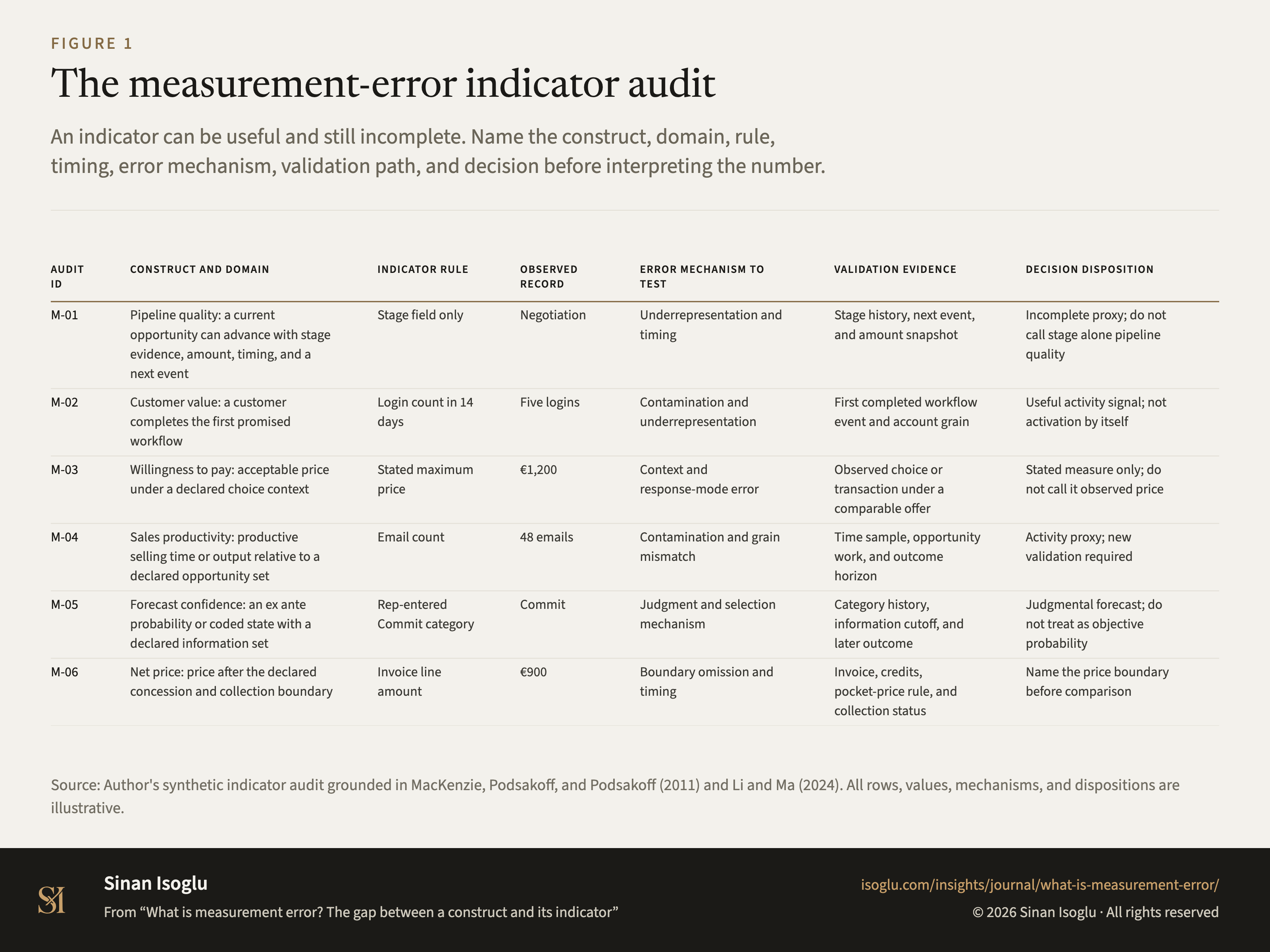
Abbildung 1Grafik
Das Prüfblatt für Messfehler und Indikatoren
Was ist Messfehler? Die Lücke zwischen Konstrukt und Indikator
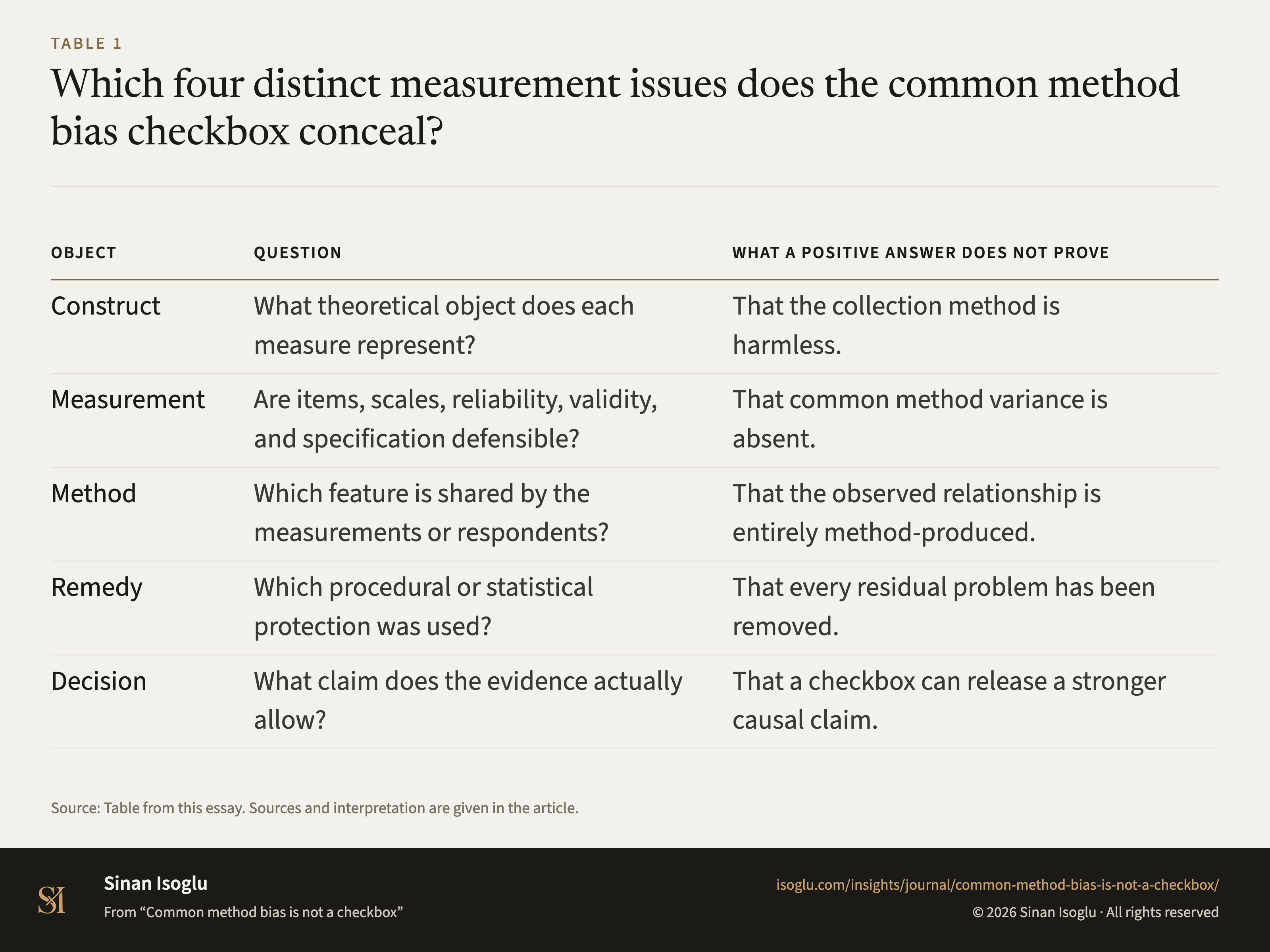
Tabelle 1Tabelle
Welche vier methodischen Probleme verdeckt das Häkchen für Common Method Bias?
Common Method Bias ist kein Häkchen
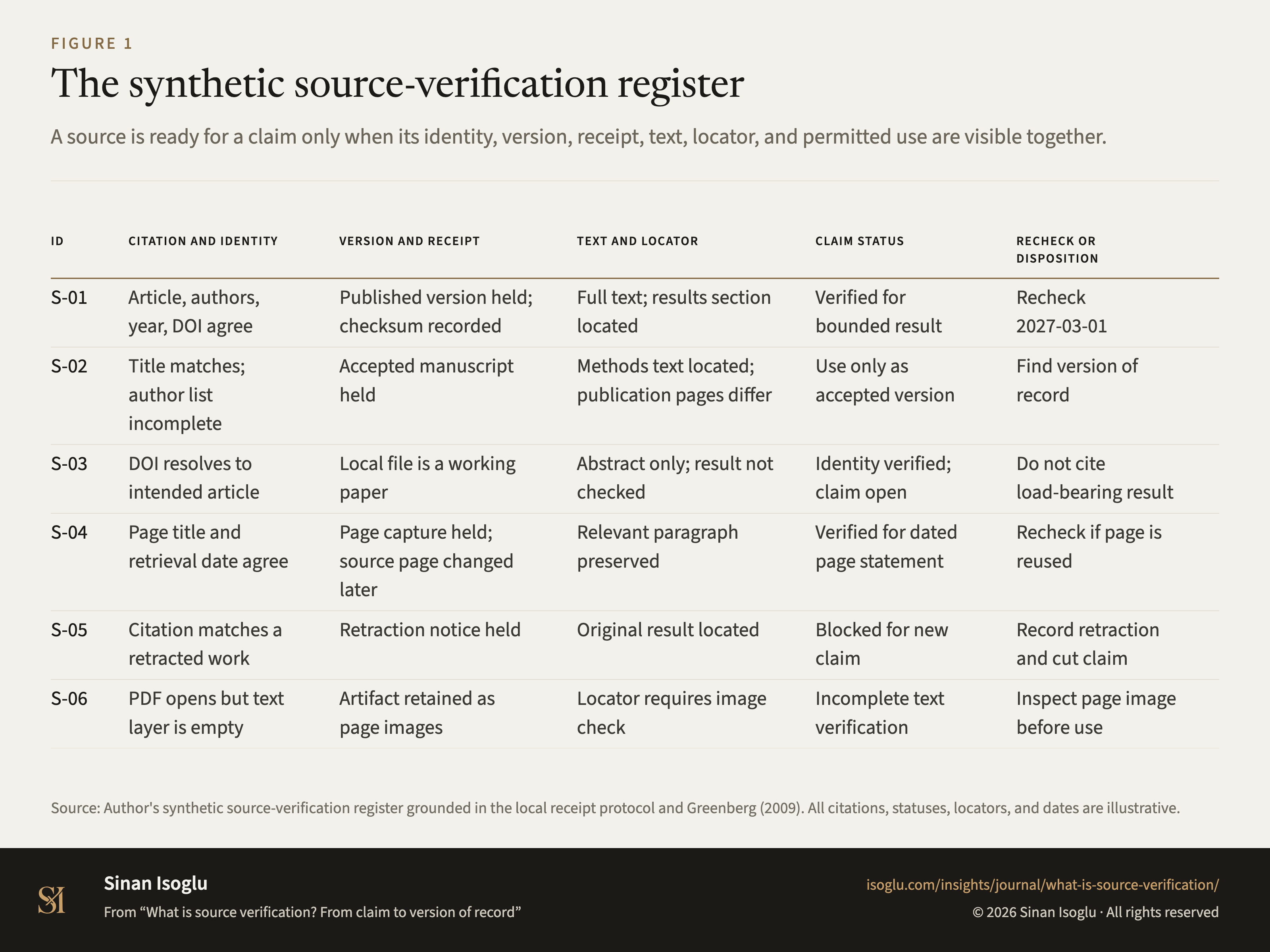
Abbildung 1Grafik
Das synthetische Quellenprüfregister
Was ist Quellenprüfung? Von der Aussage zur Version of Record
Kontakt
Schicken Sie die Frage, an der Sie arbeiten.
Forschung, ein Gastvortrag oder eine Frage aus der Praxis.