Figure 1From “What is source verification? From claim to version of record”
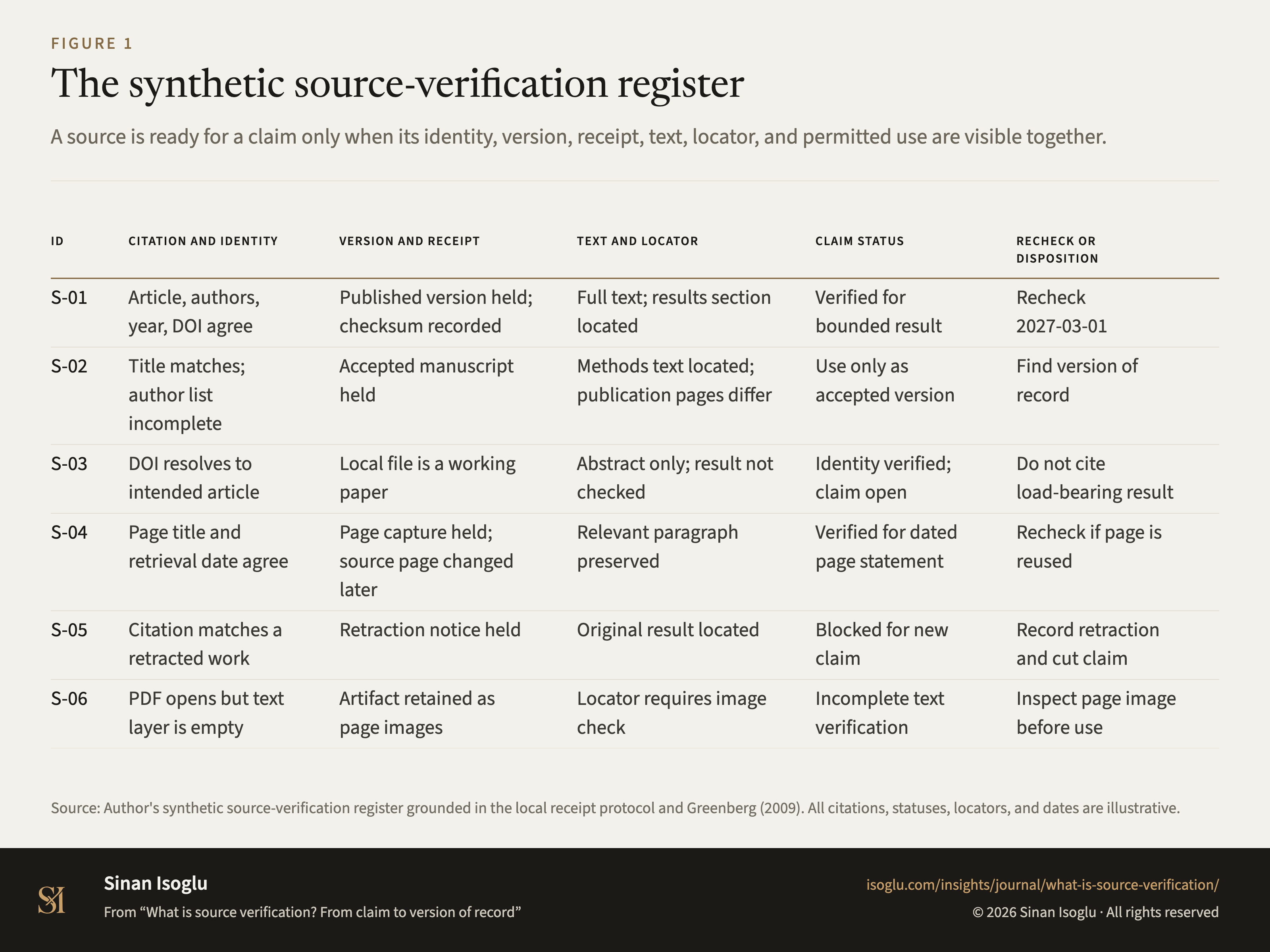
The synthetic source-verification register
A source is ready for a claim only when its identity, version, receipt, text, locator, and permitted use are visible together.
Figure 1The synthetic source-verification register
| ID | Citation and identity | Version and receipt | Text and locator | Claim status | Recheck or disposition |
|---|---|---|---|---|---|
| S-01 | Article, authors, year, DOI agree | Published version held; checksum recorded | Full text; results section located | Verified for bounded result | Recheck 2027-03-01 |
| S-02 | Title matches; author list incomplete | Accepted manuscript held | Methods text located; publication pages differ | Use only as accepted version | Find version of record |
| S-03 | DOI resolves to intended article | Local file is a working paper | Abstract only; result not checked | Identity verified; claim open | Do not cite load-bearing result |
| S-04 | Page title and retrieval date agree | Page capture held; source page changed later | Relevant paragraph preserved | Verified for dated page statement | Recheck if page is reused |
| S-05 | Citation matches a retracted work | Retraction notice held | Original result located | Blocked for new claim | Record retraction and cut claim |
| S-06 | PDF opens but text layer is empty | Artifact retained as page images | Locator requires image check | Incomplete text verification | Inspect page image before use |
Swipe or scroll horizontally if the table is wider than your screen.
Source: Author's synthetic source-verification register grounded in the local receipt protocol and Greenberg (2009). All citations, statuses, locators, and dates are illustrative.
Source and evidence
Each line names a claim related to this exhibit, its source, and how it was checked.
- A GRN09-C1 The stated outcome measures are "Citation bias, amplification, and invention, and their effects on determining authority", in a complete citation network about one biomedical belief. These are mechanisms that can create unfounded authorityGreenberg (2009), abstract and discussion
- A GRN09-C3 The evidence base is one network: "The network contained 242 papers and 675 citations addressing the belief". Within it, citation alone can convert a hypothesis into a statement presented as factGreenberg (2009), abstract and discussion
- B R05-OWN-C1 Source verification is a chain from source identity and version through retrieval, held artifact, text integrity, claim location, and permitted useAuthor framework grounded in GRN09-C1 to GRN09-C3
- B R05-OWN-C2 Discovery, retrieval, identity, version, full-text receipt, extraction, quotation checking, and recheck are separate source-control eventsAuthor framework
- B R05-OWN-C5 A full-text receipt supports a claim only within the version, scope, and text actually heldAuthor boundary
- B R05-OWN-C6 A source ledger should preserve citation, identifier, version, receipt, full-text status, locator, claim status, and next recheck dateAuthor operating framework
- B R05-OWN-C9 The six-row verification register is synthetic and contains no private correspondence, account, participant, or customer sourceAuthor synthetic object
Grades: A, verified against the printed page of the primary source · B, primary source, text layer only · C, authoritative secondary · D, reported.
From the essay
From the research bench
What is source verification? From claim to version of record
Source verification connects a citation to its identity, version, held text, locator, and permitted use. A DOI alone is not a claim check.
Read the essayThis exhibit belongs to an essay: the numbers live here, the argument lives there.
Cite or embed
Related exhibits
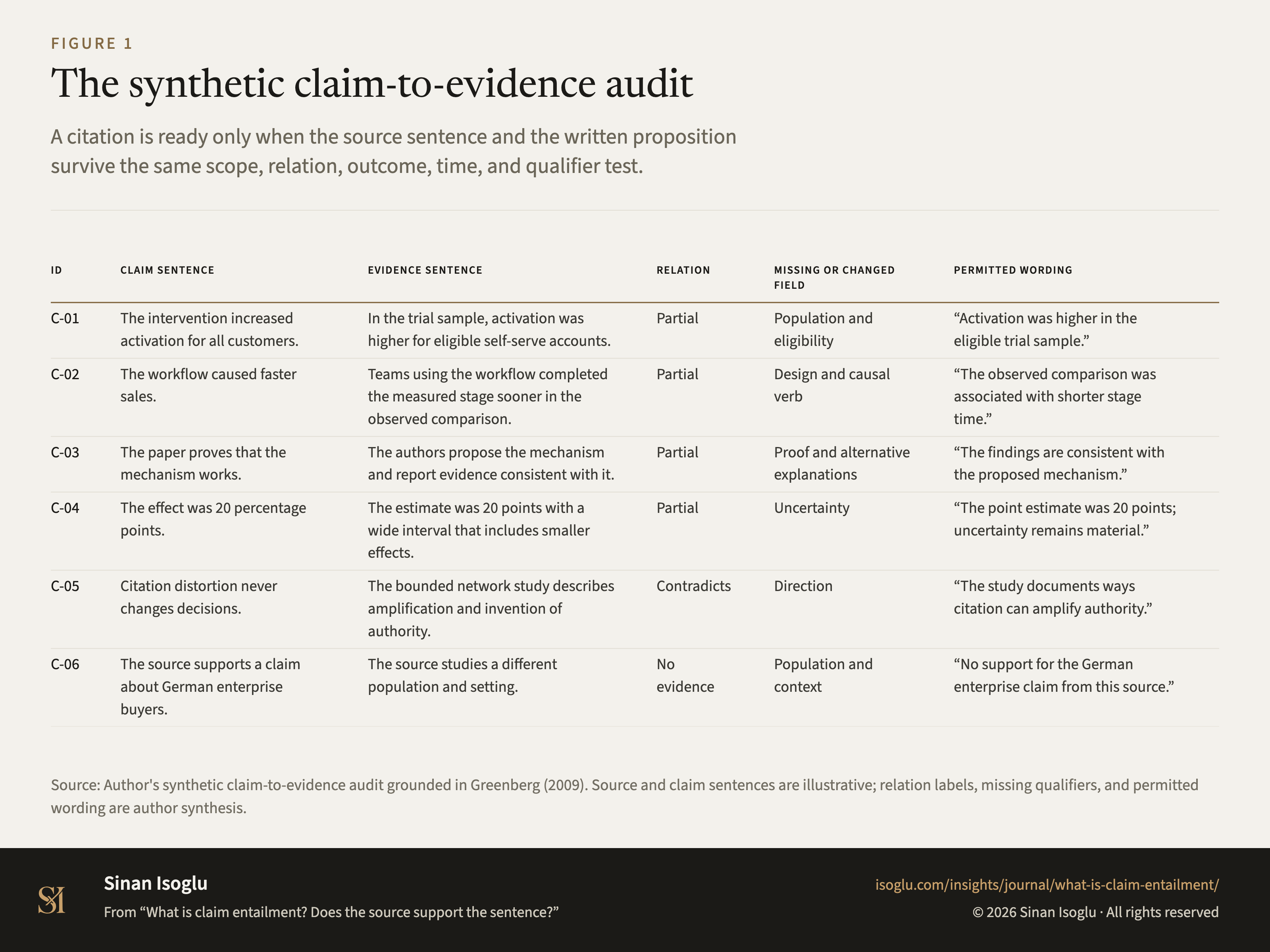
Figure 1Figure
The synthetic claim-to-evidence audit
What is claim entailment? Does the source support the sentence?
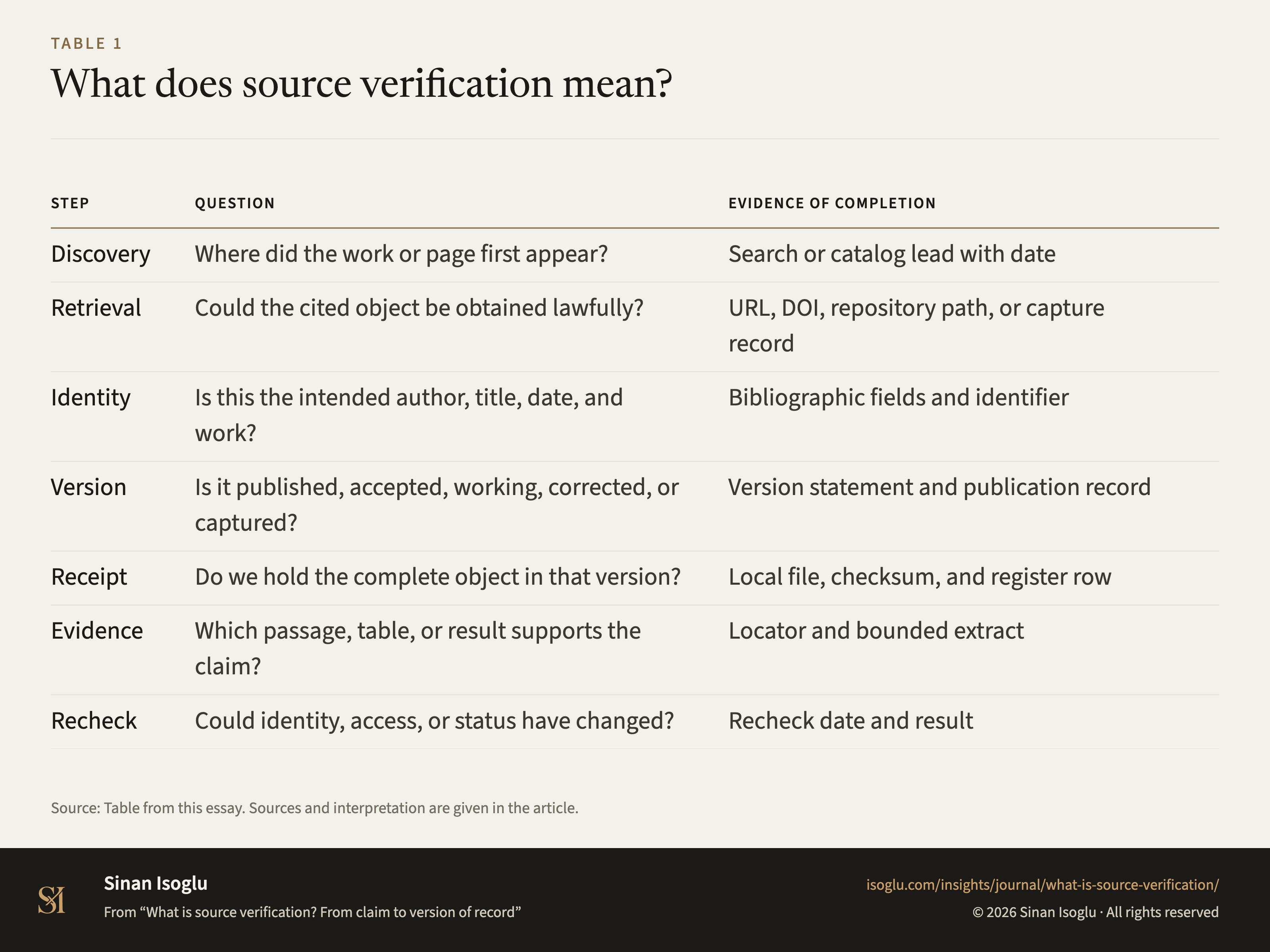
Table 1Table
What does source verification mean?
What is source verification? From claim to version of record
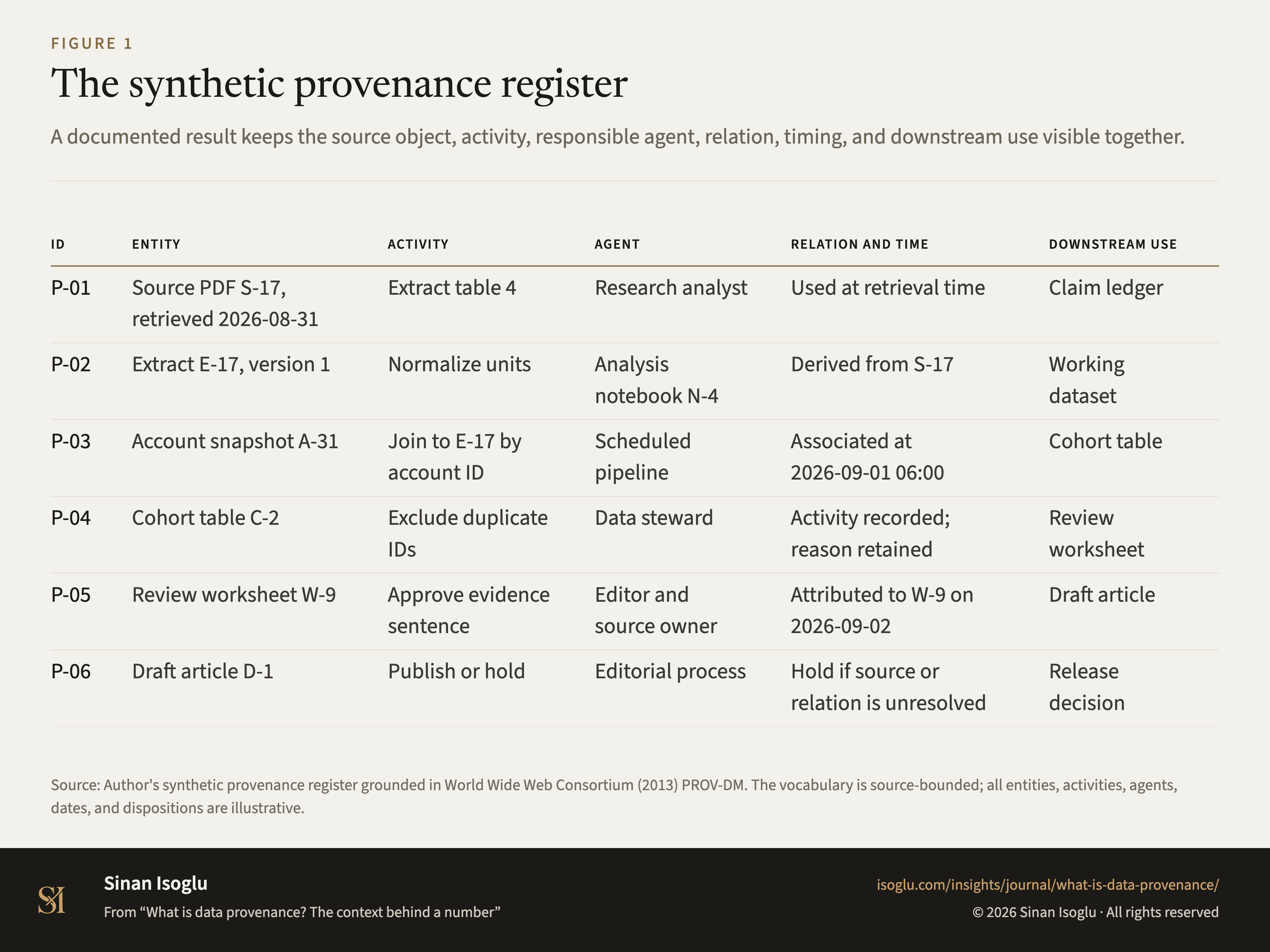
Figure 1Figure
The synthetic provenance register
What is data provenance? The context behind a number
Contact
Bring the question you're working on.
Research, a guest lecture, or a commercial question.