Table 2From “A case study is an evidence design, not a story.”
Saturation anchors carry their conditions
Sample adequacy depends on the target: codebook stability, meaning, cross-site themes, or information power.
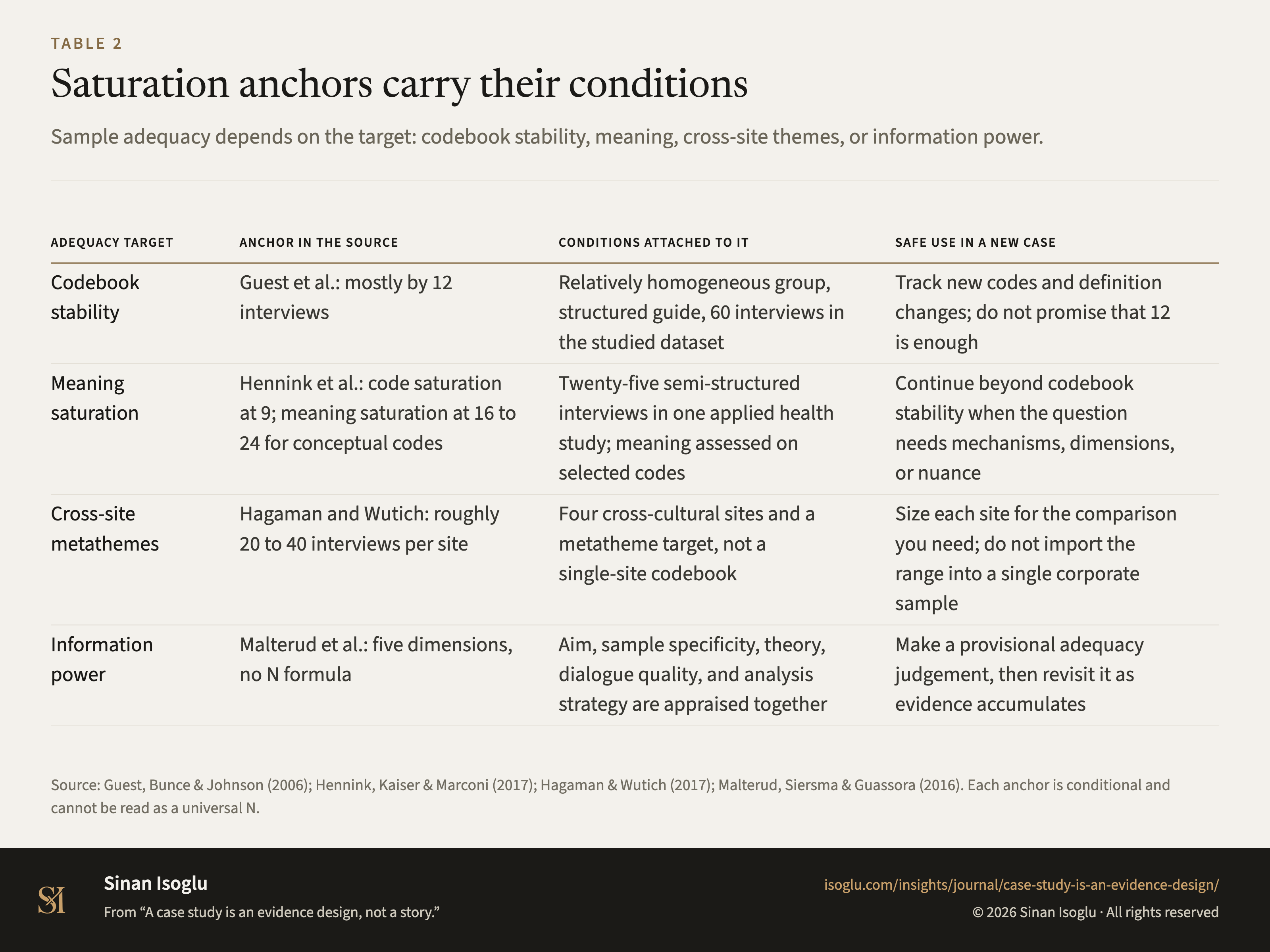
Table 2Saturation anchors carry their conditions
| Adequacy target | Anchor in the source | Conditions attached to it | Safe use in a new case |
|---|---|---|---|
| Codebook stability | Guest et al.: mostly by 12 interviews | Relatively homogeneous group, structured guide, 60 interviews in the studied dataset | Track new codes and definition changes; do not promise that 12 is enough |
| Meaning saturation | Hennink et al.: code saturation at 9; meaning saturation at 16 to 24 for conceptual codes | Twenty-five semi-structured interviews in one applied health study; meaning assessed on selected codes | Continue beyond codebook stability when the question needs mechanisms, dimensions, or nuance |
| Cross-site metathemes | Hagaman and Wutich: roughly 20 to 40 interviews per site | Four cross-cultural sites and a metatheme target, not a single-site codebook | Size each site for the comparison you need; do not import the range into a single corporate sample |
| Information power | Malterud et al.: five dimensions, no N formula | Aim, sample specificity, theory, dialogue quality, and analysis strategy are appraised together | Make a provisional adequacy judgement, then revisit it as evidence accumulates |
Swipe or scroll horizontally if the table is wider than your screen.
Source: Guest, Bunce & Johnson (2006); Hennink, Kaiser & Marconi (2017); Hagaman & Wutich (2017); Malterud, Siersma & Guassora (2016). Each anchor is conditional and cannot be read as a universal N.
Source and evidence
Each line names a claim related to this exhibit, its source, and how it was checked.
- B GUEST06-C1 The number is conditional on that study's design: "they found that saturation occurred within the first twelve interviews, although basic elements for metathemes were present as early as six interviews"Guest, Bunce & Johnson. (2006)
- B GUEST06-C2 The 12-interview result is conditional and not a universal rule, and the authors bound it themselves: saturation occurred within the first twelve interviews, "at least based on the codebook we devel"oped, in a study of relatively homogeneous respondentsGuest, Bunce & Johnson. (2006)
- B HENN17-C1 Two different closure questions, named: "Our study compared two approaches to assessing saturation: code saturation and meaning saturation", and "we found that code saturation was reached at nine interviews" while meaning saturation took longerHennink, Kaiser & Marconi. (2017)
- B HENN17-C2 Code saturation and meaning saturation answer different questions, and the paper reports different sample sizes for each: more interviews "were needed to reach meaning saturation where we developed a richly textured understanding of issues", and the authors present the finding as conditions rather than a number, since "We used our results to develop parameters that influence saturation"Hennink, Kaiser & Marconi. (2017)
- B HAG17-C1 In a four-site cross-cultural study, larger samples were needed for metathemes: the purpose was "to reach data saturation for metathemes in multisited and cross-cultural research", the analysis "Analysis of the data yielded 240 site-specific themes and nine cross-cultural metathemes", and the authors report larger sample sizes "ranging from 20 to 40 interviews"Hagaman & Wutich. (2017)
- B HAG17-C2 Homogeneity is what moves the number: "We found that 16 or fewer interviews were enough to identify common themes from sites with relatively homogeneous groups"Hagaman & Wutich. (2017)
- B MAL16-C1 Information power is defined by five items, verbatim: "information power depends on (a) the aim of the study, (b) sample specificity, (c) use of established theory, (d) quality" of dialogue, and (e) analysis strategyMalterud, Siersma & Guassora. (2016)
- B MAL16-C2 Higher information power can support a smaller sample, but the concept is an appraisal and not a formula: "Information power indicates that the more information the sample holds, relevant" for the study, the lower the number of participants neededMalterud, Siersma & Guassora. (2016)
Grades: A, verified against the printed page of the primary source · B, primary source, text layer only · C, authoritative secondary · D, reported.
From the essay
From the research bench
A case study is an evidence design, not a story.
A practical case study research design: set the boundary, test rivals, plan saturation, and state exactly what the evidence can transfer.
Read the essayThis exhibit belongs to an essay: the numbers live here, the argument lives there.
Cite or embed
Related exhibits
Contact
Bring the question you're working on.
Research, a guest lecture, or a commercial question.