Table 2Aus „Eine Fallstudie ist ein Evidenzdesign, keine Geschichte.“
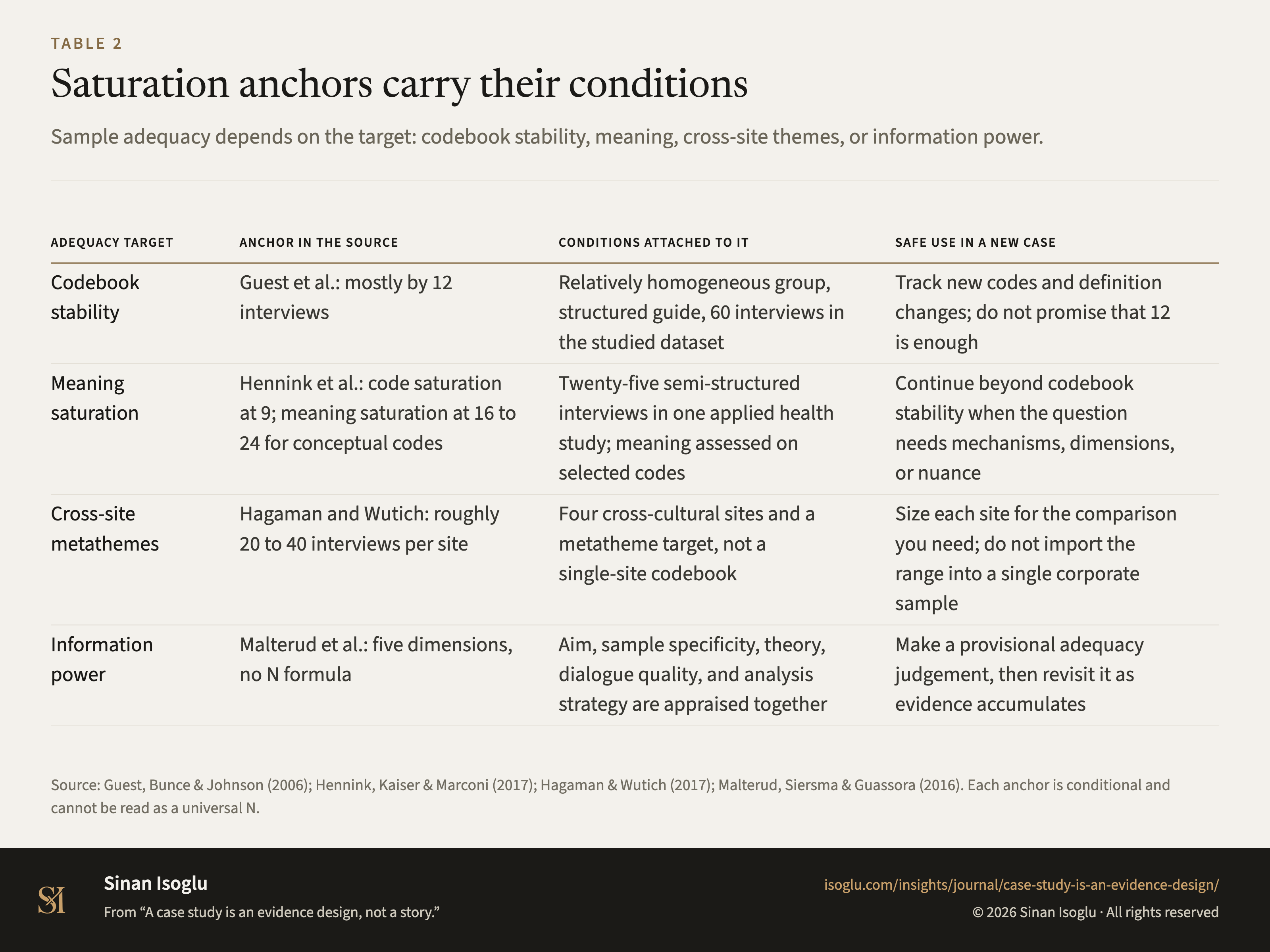
Sättigungsanker tragen ihre Bedingungen
Die angemessene Stichprobe hängt davon ab, ob Codebuch, Bedeutung, standortübergreifende Themen oder Informationsstärke das Ziel ist.
Table 2Sättigungsanker tragen ihre Bedingungen
| Ziel der Angemessenheit | Anker in der Quelle | Bedingungen | Sichere Nutzung im neuen Fall |
|---|---|---|---|
| Codebuchstabilität | Guest et al.: überwiegend bis Interview 12 | Relativ homogene Gruppe, strukturierter Leitfaden, 60 Interviews im Datensatz | Neue Codes und Definitionsänderungen verfolgen; 12 nicht versprechen |
| Bedeutungssättigung | Hennink et al.: Codes bei 9, Bedeutung konzeptioneller Codes bei 16 bis 24 | 25 semistrukturierte Gespräche in einer anwendungsbezogenen Gesundheitsstudie | Nach stabilen Codes weiterarbeiten, wenn Mechanismen, Dimensionen oder Nuancen wichtig sind |
| Standortübergreifende Metathemen | Hagaman und Wutich: ungefähr 20 bis 40 Interviews je Standort | Vier kulturübergreifende Standorte und ein Metathemenziel, kein einzelnes Codebuch | Jeden Standort für den geplanten Vergleich bemessen; den Bereich nicht in eine Unternehmensstichprobe übertragen |
| Informationsstärke | Malterud et al.: fünf Dimensionen, keine Formel | Ziel, Spezifität, Theorie, Gesprächsqualität und Analysemethode gemeinsam beurteilen | Eine vorläufige Einschätzung treffen und während der Erhebung neu prüfen |
Bei breiten Tabellen horizontal wischen oder scrollen.
Quelle: Guest, Bunce & Johnson (2006); Hennink, Kaiser & Marconi (2017); Hagaman & Wutich (2017); Malterud, Siersma & Guassora (2016). Jeder Anker ist bedingt und keine allgemeingültige Fallzahl.
Quelle und Evidenz
Jede Zeile nennt eine Aussage zu dieser Abbildung, ihre Quelle und die Art ihrer Prüfung.
- B GUEST06-C1 The number is conditional on that study's design: "they found that saturation occurred within the first twelve interviews, although basic elements for metathemes were present as early as six interviews"Guest, Bunce & Johnson. (2006)
- B GUEST06-C2 The 12-interview result is conditional and not a universal rule, and the authors bound it themselves: saturation occurred within the first twelve interviews, "at least based on the codebook we devel"oped, in a study of relatively homogeneous respondentsGuest, Bunce & Johnson. (2006)
- B HENN17-C1 Two different closure questions, named: "Our study compared two approaches to assessing saturation: code saturation and meaning saturation", and "we found that code saturation was reached at nine interviews" while meaning saturation took longerHennink, Kaiser & Marconi. (2017)
- B HENN17-C2 Code saturation and meaning saturation answer different questions, and the paper reports different sample sizes for each: more interviews "were needed to reach meaning saturation where we developed a richly textured understanding of issues", and the authors present the finding as conditions rather than a number, since "We used our results to develop parameters that influence saturation"Hennink, Kaiser & Marconi. (2017)
- B HAG17-C1 In a four-site cross-cultural study, larger samples were needed for metathemes: the purpose was "to reach data saturation for metathemes in multisited and cross-cultural research", the analysis "Analysis of the data yielded 240 site-specific themes and nine cross-cultural metathemes", and the authors report larger sample sizes "ranging from 20 to 40 interviews"Hagaman & Wutich. (2017)
- B HAG17-C2 Homogeneity is what moves the number: "We found that 16 or fewer interviews were enough to identify common themes from sites with relatively homogeneous groups"Hagaman & Wutich. (2017)
- B MAL16-C1 Information power is defined by five items, verbatim: "information power depends on (a) the aim of the study, (b) sample specificity, (c) use of established theory, (d) quality" of dialogue, and (e) analysis strategyMalterud, Siersma & Guassora. (2016)
- B MAL16-C2 Higher information power can support a smaller sample, but the concept is an appraisal and not a formula: "Information power indicates that the more information the sample holds, relevant" for the study, the lower the number of participants neededMalterud, Siersma & Guassora. (2016)
Prüfgrade: A, gegen die gedruckte Seite der Primärquelle geprüft · B, Primärquelle, nur Textebene · C, belastbare Sekundärquelle · D, berichtet.
Aus dem Beitrag
Aus der Forschung
Eine Fallstudie ist ein Evidenzdesign, keine Geschichte.
Ein belastbares Fallstudiendesign setzt Fallgrenzen, prüft Gegen-Erklärungen, plant Sättigung und zeigt, wohin die Evidenz übertragbar ist.
Den Beitrag lesenDiese Abbildung gehört zu einem Essay: Die Zahlen stehen hier, das Argument dort.
Zitieren oder einbetten
Verwandte Abbildungen
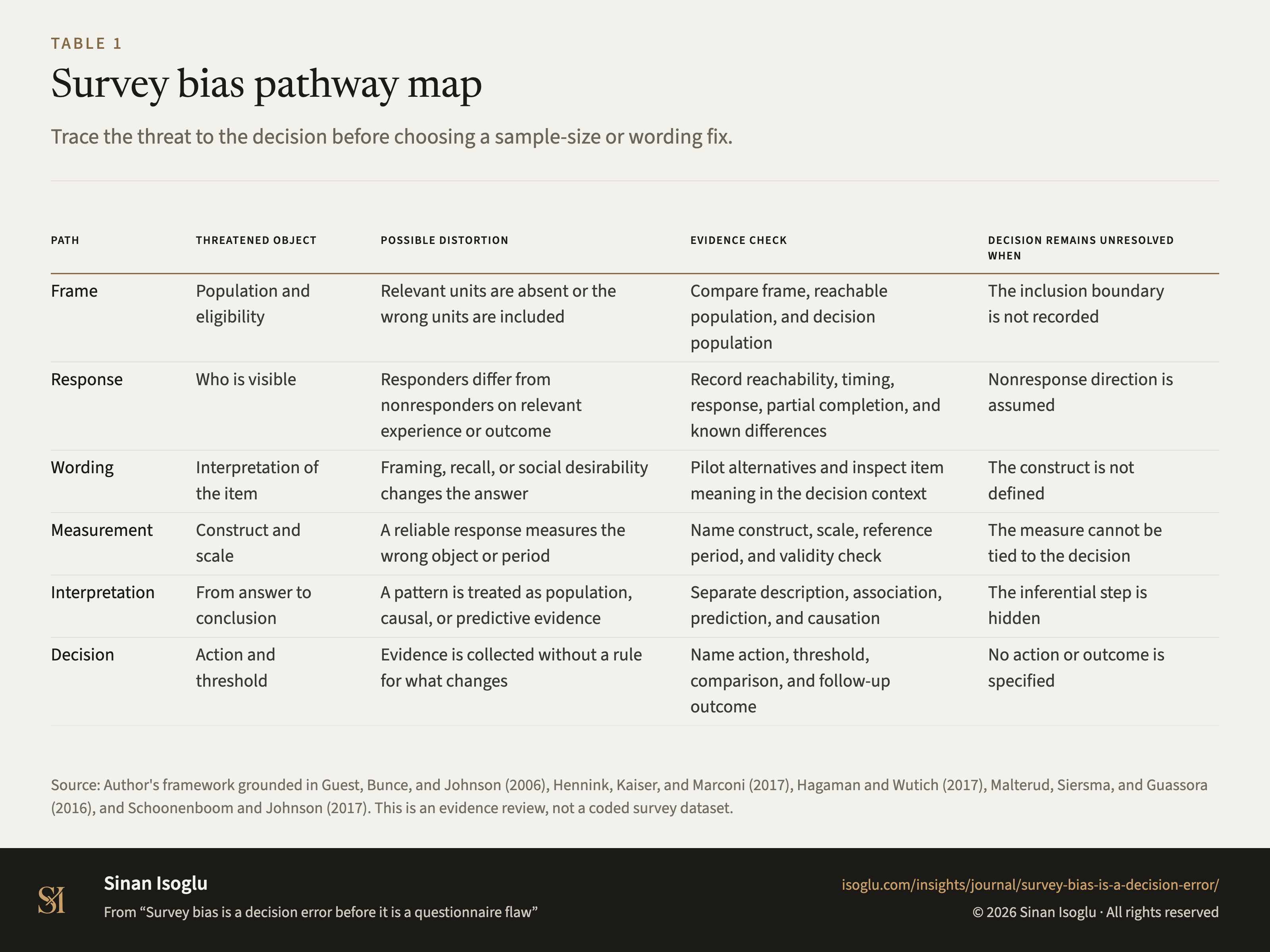
Tabelle 1Tabelle
Bias-Pfadkarte für Umfragen
Survey-Bias ist zuerst ein Entscheidungsfehler
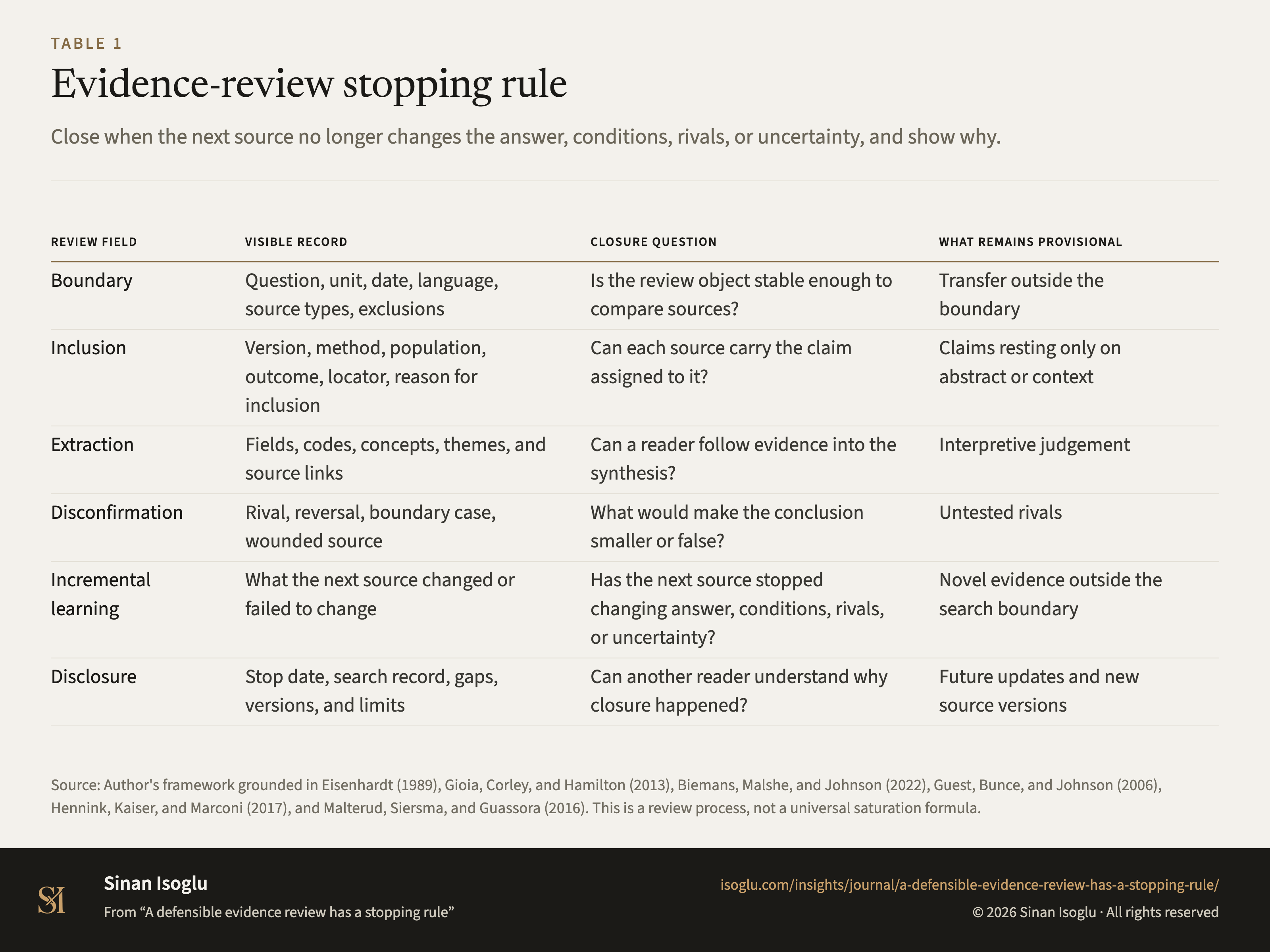
Tabelle 1Tabelle
Abbruchregel für Evidenzreviews
Ein belastbares Evidenzreview braucht eine Abbruchregel
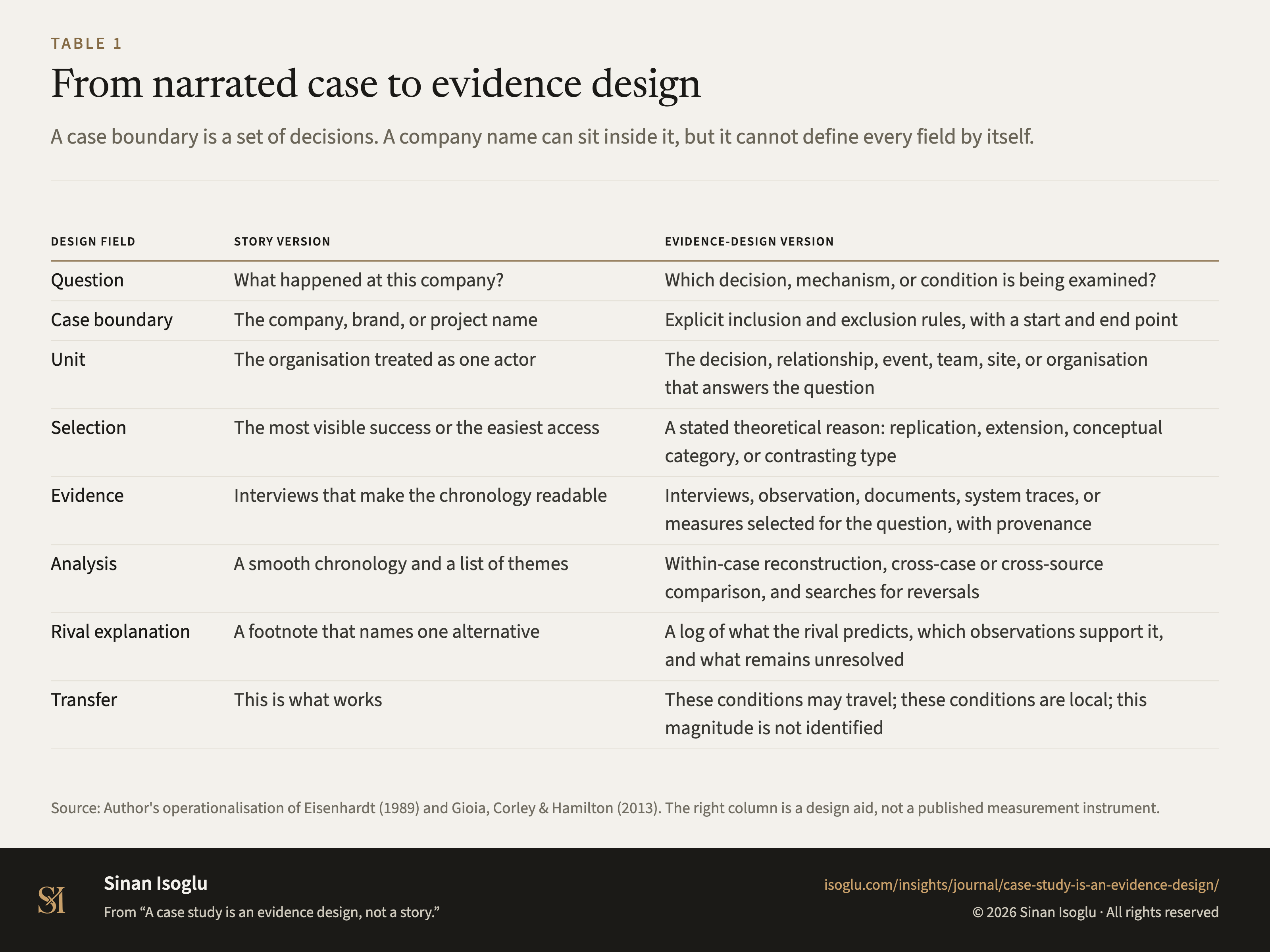
Table 1Tabelle
Vom Erzählfall zum Evidenzdesign
Eine Fallstudie ist ein Evidenzdesign, keine Geschichte.
Kontakt
Schicken Sie die Frage, an der Sie arbeiten.
Forschung, ein Gastvortrag oder eine Frage aus der Praxis.