Table 1From “A case study is an evidence design, not a story.”
From narrated case to evidence design
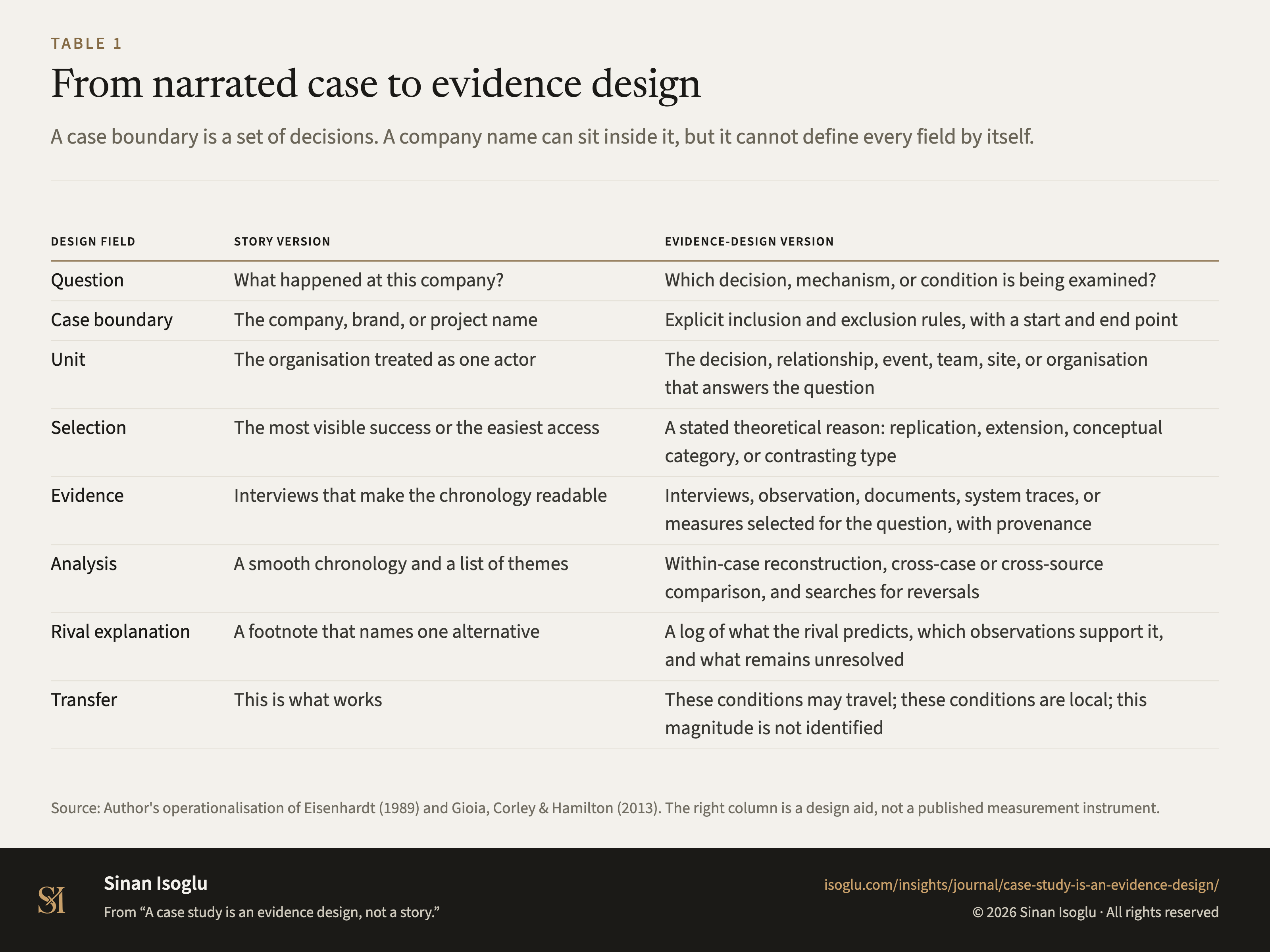
A case boundary is a set of decisions. A company name can sit inside it, but it cannot define every field by itself.
Table 1From narrated case to evidence design
| Design field | Story version | Evidence-design version |
|---|---|---|
| Question | What happened at this company? | Which decision, mechanism, or condition is being examined? |
| Case boundary | The company, brand, or project name | Explicit inclusion and exclusion rules, with a start and end point |
| Unit | The organisation treated as one actor | The decision, relationship, event, team, site, or organisation that answers the question |
| Selection | The most visible success or the easiest access | A stated theoretical reason: replication, extension, conceptual category, or contrasting type |
| Evidence | Interviews that make the chronology readable | Interviews, observation, documents, system traces, or measures selected for the question, with provenance |
| Analysis | A smooth chronology and a list of themes | Within-case reconstruction, cross-case or cross-source comparison, and searches for reversals |
| Rival explanation | A footnote that names one alternative | A log of what the rival predicts, which observations support it, and what remains unresolved |
| Transfer | This is what works | These conditions may travel; these conditions are local; this magnitude is not identified |
Swipe or scroll horizontally if the table is wider than your screen.
Source: Author's operationalisation of Eisenhardt (1989) and Gioia, Corley & Hamilton (2013). The right column is a design aid, not a published measurement instrument.
Source and evidence
Each line names a claim related to this exhibit, its source, and how it was checked.
- B EISEN89-C1 The paper describes a process, not a result: "This paper describes the process of inducting theory using case stud"ies, from specifying the research questions to reaching closureEisenhardt. (1989). Building theories from case study research
- B EISEN89-C2 Sampling is theoretical rather than statistical: "Such research relies on theo""retical sampling (i.e., cases are chosen for theo"retical reasons, including polar typesEisenhardt. (1989). Building theories from case study research
- B EISEN89-C3 The triangulation is named in the paper's own contribution list: "triangulation of multiple investigators, within"-"case and cross-case analyses, and the role of" existing literatureEisenhardt. (1989). Building theories from case study research
- B EISEN89-C4 Within-case first, then across: the framework names "case and cross-case analyses, and the role of" existing literature as separate stepsEisenhardt. (1989). Building theories from case study research
- B EISEN89-C5 Closure is a judgement, and the table says so: "Theoretical saturation when possible Ends process when marginal improvement becomes small"Eisenhardt. (1989). Building theories from case study research
- B EISEN89-C6 Case-based theory should be evaluated for evidence fit, testability, logical coherence, rival explanations, and bounded noveltyEisenhardt. (1989). Building theories from case study research
- B GIOIA13-C1 The two orders are the paper's own device: "a systematic presentation of both a" first-"order analysis (i.e., an analysis using informant-centric terms and codes)" and a second-order one, distilled into "aggregate dimensions"Gioia, Corley & Hamilton. (2013)
- B GIOIA13-C2 And the authors refuse the template reading: "we see it as a flexible orientation toward qualitative, inductive research that is open to innovation", rather than a cookbookGioia, Corley & Hamilton. (2013)
Grades: A, verified against the printed page of the primary source · B, primary source, text layer only · C, authoritative secondary · D, reported.
From the essay
From the research bench
A case study is an evidence design, not a story.
A practical case study research design: set the boundary, test rivals, plan saturation, and state exactly what the evidence can transfer.
Read the essayThis exhibit belongs to an essay: the numbers live here, the argument lives there.
Cite or embed
Related exhibits
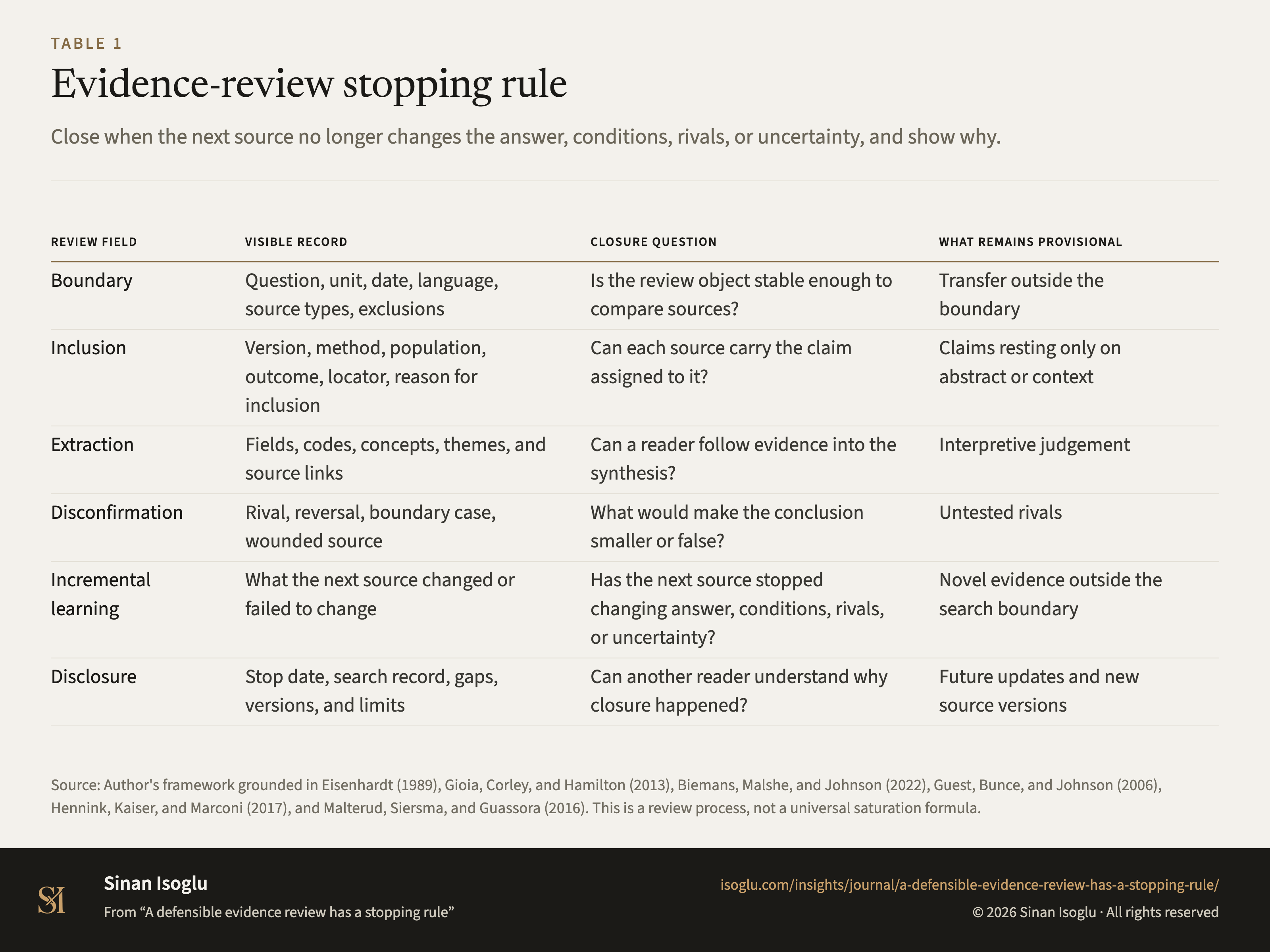
Table 1Table
Evidence-review stopping rule
A defensible evidence review has a stopping rule
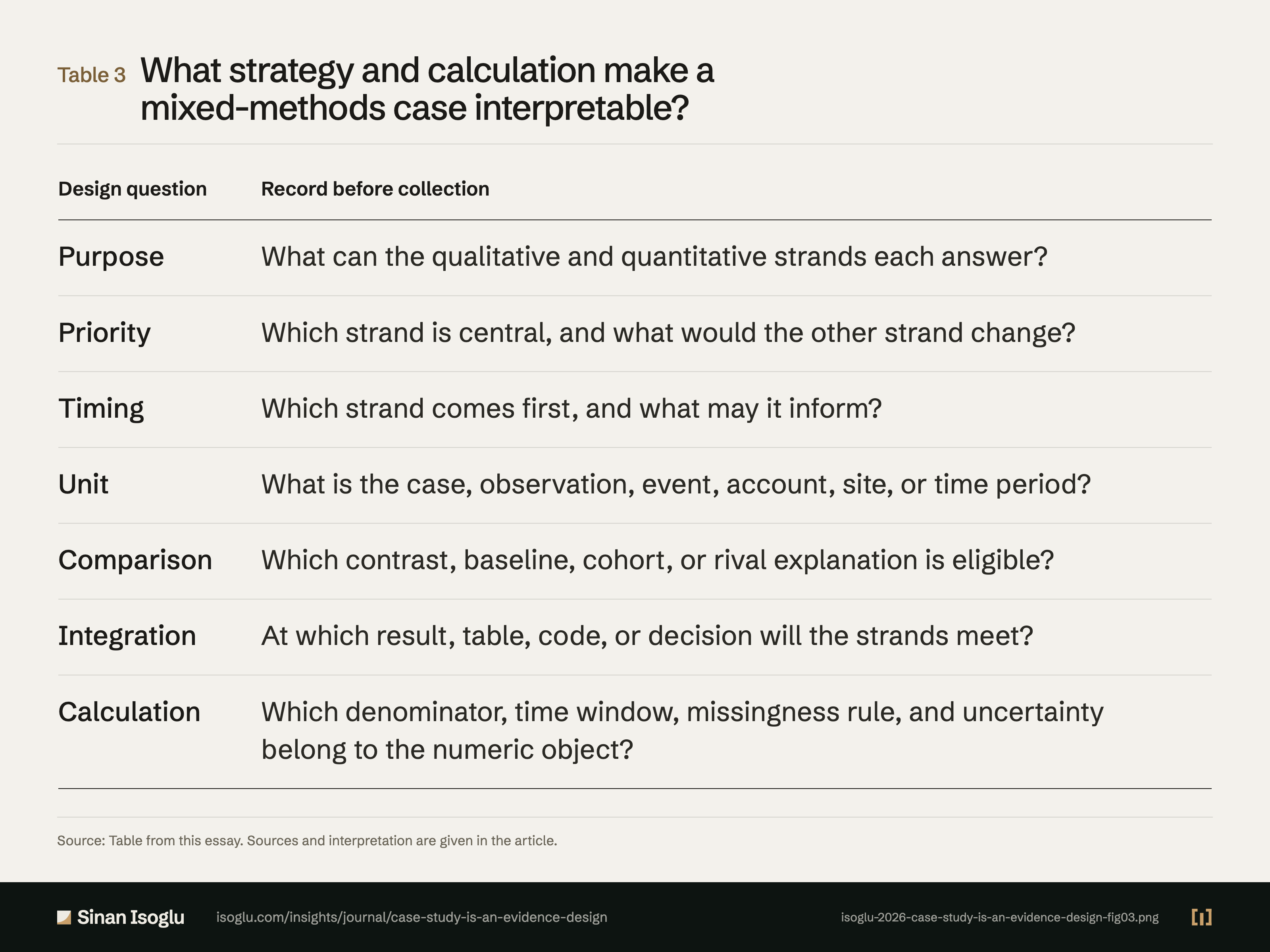
Table 3Table
What strategy and calculation make a mixed-methods case interpretable?
A case study is an evidence design, not a story.
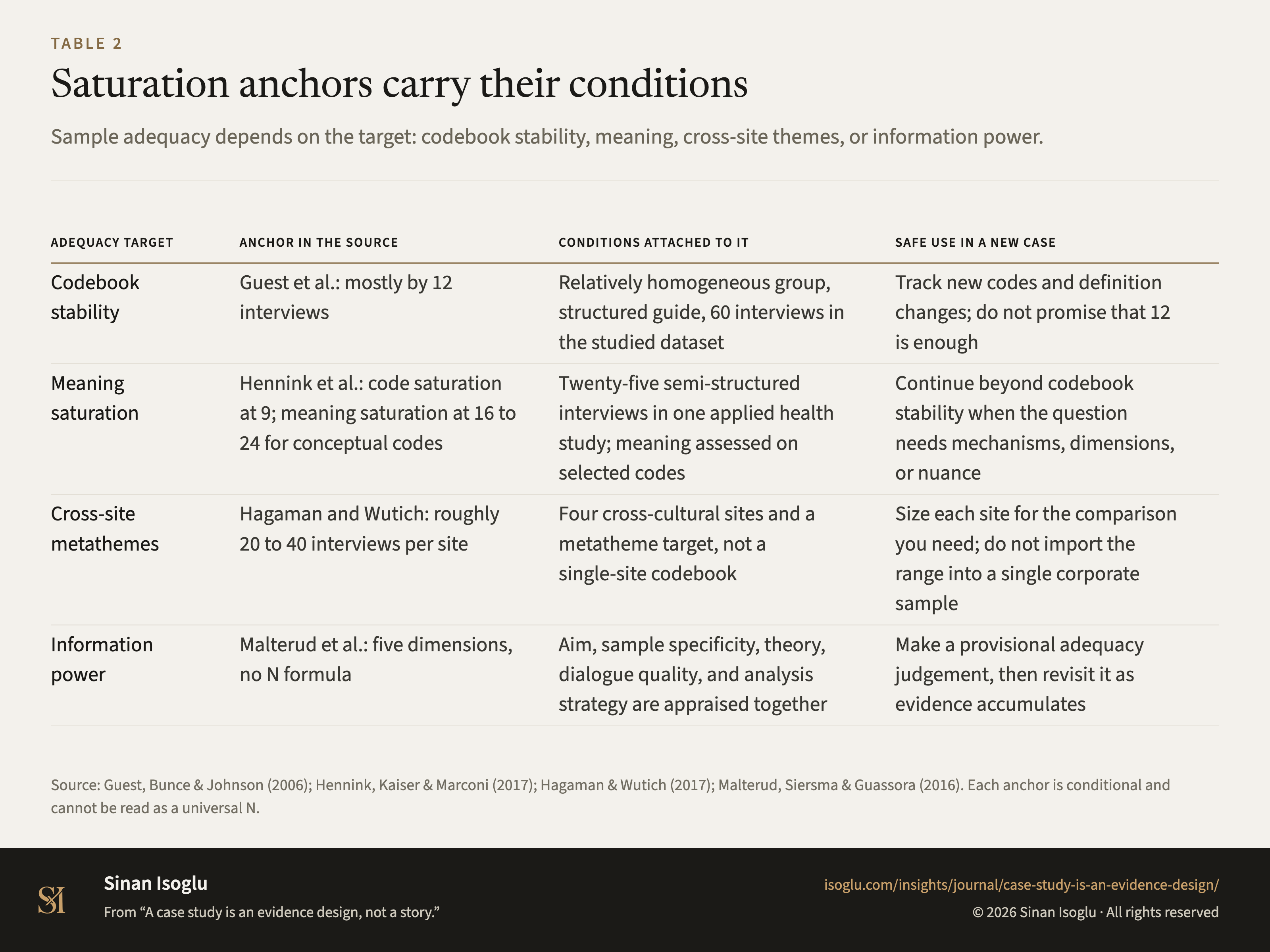
Table 2Table
Saturation anchors carry their conditions
A case study is an evidence design, not a story.
Contact
Bring the question you're working on.
Research, a guest lecture, or a commercial question.