Table 1From “The buyer is not the user in a B2B journey”
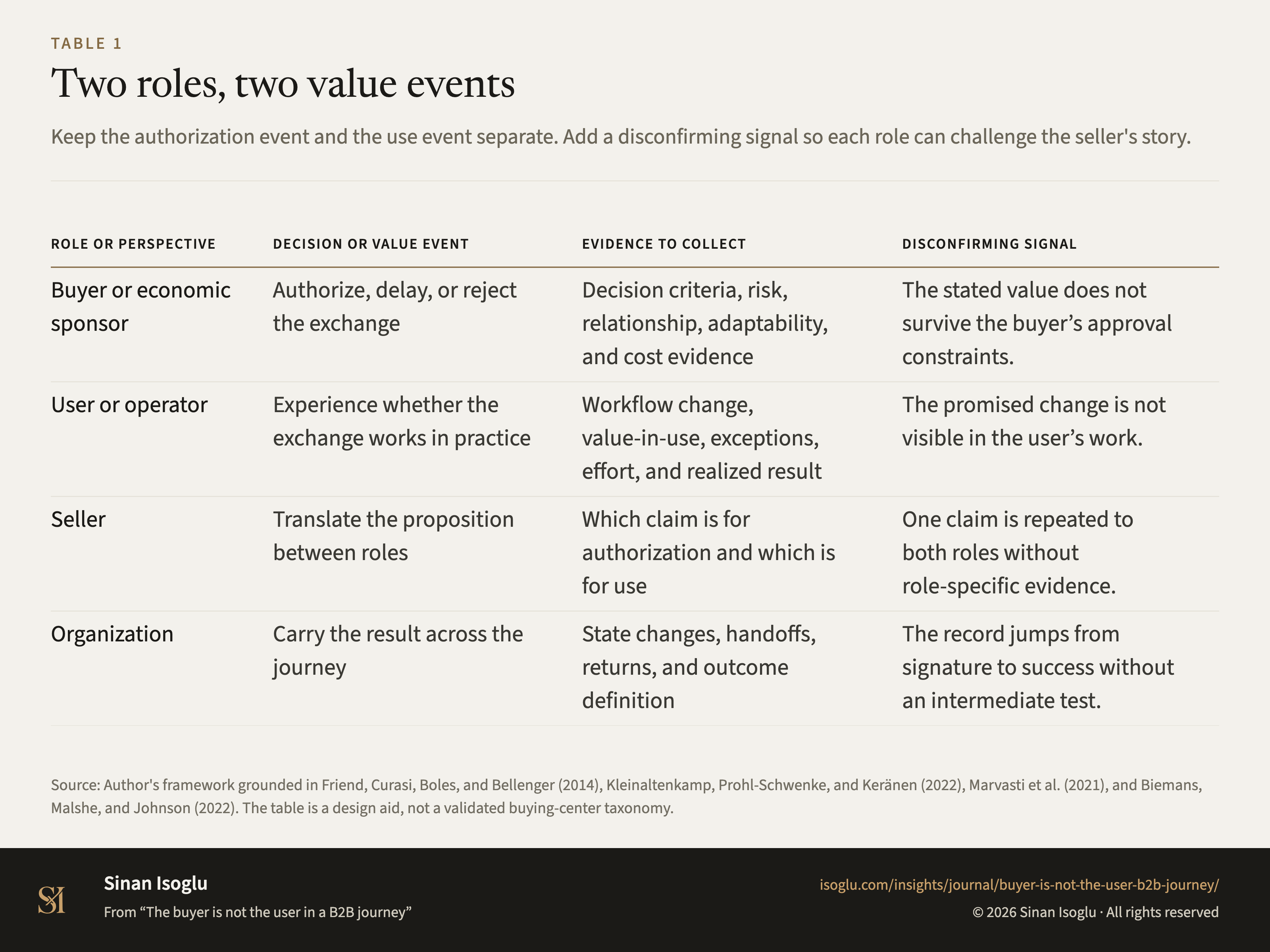
Two roles, two value events
Keep the authorization event and the use event separate. Add a disconfirming signal so each role can challenge the seller's story.
Table 1Two roles, two value events
| Role or perspective | Decision or value event | Evidence to collect | Disconfirming signal |
|---|---|---|---|
| Buyer or economic sponsor | Authorize, delay, or reject the exchange | Decision criteria, risk, relationship, adaptability, and cost evidence | The stated value does not survive the buyer's approval constraints. |
| User or operator | Experience whether the exchange works in practice | Workflow change, value-in-use, exceptions, effort, and realized result | The promised change is not visible in the user's work. |
| Seller | Translate the proposition between roles | Which claim is for authorization and which is for use | One claim is repeated to both roles without role-specific evidence. |
| Organization | Carry the result across the journey | State changes, handoffs, returns, and outcome definition | The record jumps from signature to success without an intermediate test. |
Swipe or scroll horizontally if the table is wider than your screen.
Source: Author's framework grounded in Friend, Curasi, Boles, and Bellenger (2014), Kleinaltenkamp, Prohl-Schwenke, and Keränen (2022), Marvasti et al. (2021), and Biemans, Malshe, and Johnson (2022). The table is a design aid, not a validated buying-center taxonomy.
From the essay
Go-to-market strategy
The buyer is not the user in a B2B journey
The person authorizing a purchase and the person living with its outcome need different evidence. Map both value events before calling a journey complete.
Read the essayThis exhibit belongs to an essay: the numbers live here, the argument lives there.
Cite or embed
Contact
Bring the question you're working on.
Research, a guest lecture, or a commercial question.